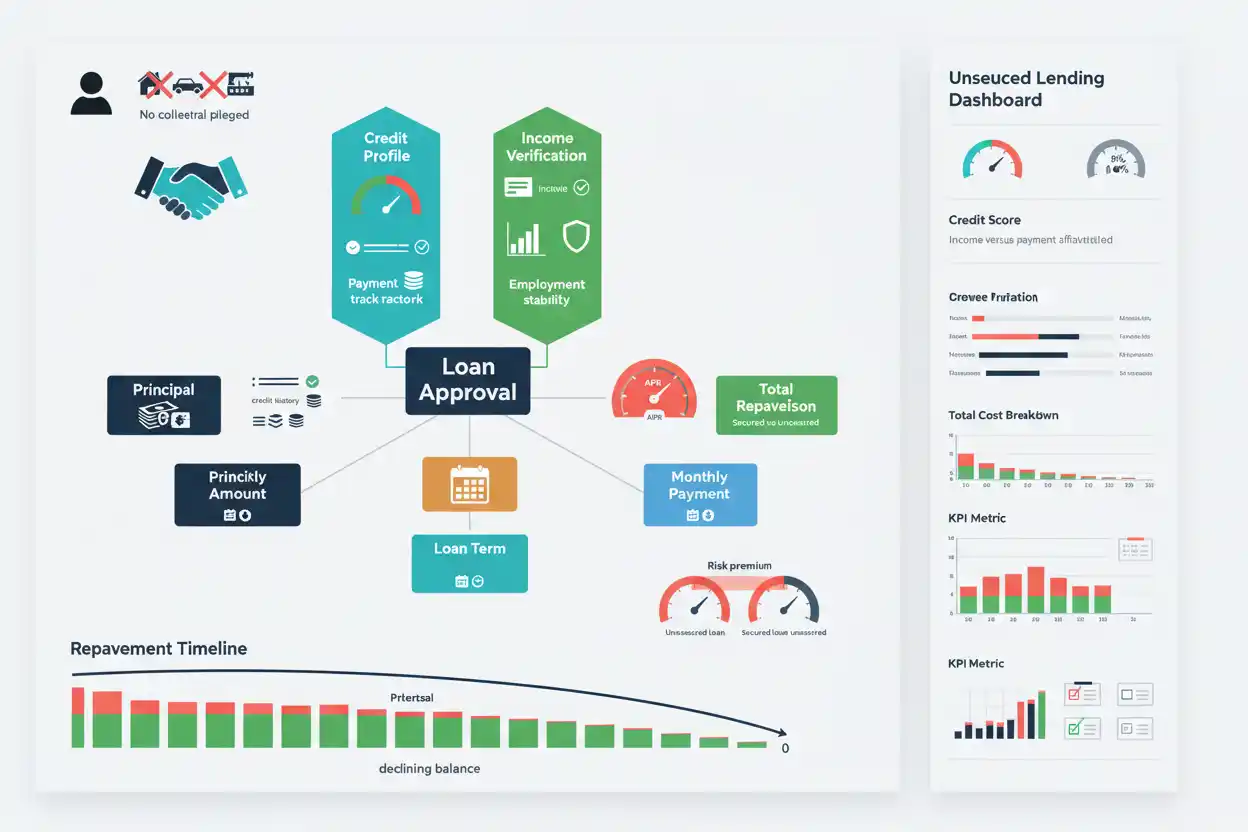

An unsecured loan is credit that is not backed by a specific asset pledged as collateral in the same way as a mortgage, vehicle loan, or other secured financing.
Instead, the lender relies primarily on the borrower’s contractual promise to repay and its assessment of credit risk.
Unsecured borrowing can include certain:
personal loans, credit cards, student loans, and other credit products.
The absence of pledged collateral does not mean the debt is consequence-free.
The borrower still owes the money and can face collection, credit, or legal consequences if the obligation is not repaid according to its terms.
There is no special mathematical formula that makes debt unsecured. When the loan is a conventional fixed-rate installment loan, the standard payment formula is:
Payment = P × [r(1 + r)^n] ÷ [(1 + r)^n − 1]
The difference between secured and unsecured borrowing is primarily the collateral structure, not the basic amortization formula.
What Is an Unsecured Loan?
An unsecured loan does not rely on a specifically pledged asset as the lender’s primary contractual security.
By contrast, a secured loan is backed by collateral such as:
a vehicle, property, equipment, or another qualifying asset.
The broader Loans & Credit framework separates collateral structure from interest, payments, terms, APR, and repayment risk.
Unsecured Loan Payment Formula
Suppose an unsecured personal installment loan has:
Principal = $18,000
Annual fixed rate = 13%
Term = 48 months
Monthly rate:
Monthly Rate = 13% ÷ 12
Monthly Rate ≈ 1.08333%
Number of payments:
n = 48
Payment:
Payment = $18,000 × [r(1 + r)^48] ÷ [(1 + r)^48 − 1]
The result is approximately:
Monthly Payment ≈ $482.89
This uses conventional amortizing-loan assumptions.
Total Interest Example
Total scheduled payments:
Total Payments ≈ $482.89 × 48
Using full precision:
Total Payments ≈ $23,178.96
Total interest:
Total Interest ≈ $23,178.96 − $18,000
Total Interest ≈ $5,178.96
The unsecured loan therefore costs approximately $5,179 of interest under the example before any additional fees.
Secured vs Unsecured Cost Example
Suppose the same borrower could instead obtain a hypothetical secured loan:
Principal = $18,000
Rate = 9%
Term = 48 months
Payment:
Secured Payment ≈ $447.93
Total interest:
Total Interest ≈ $3,500.68
Compared with the 13% unsecured example:
Additional Unsecured Interest ≈ $5,178.96 − $3,500.68
Additional Interest ≈ $1,678.28
This does not prove secured borrowing is always cheaper.
It simply illustrates why collateral can affect lender pricing.
A secured loan also exposes the pledged asset to risk.
Why Unsecured Loan Rates Can Be Higher
Collateral provides a lender with another potential recovery source.
Without that collateral, lender loss exposure can be greater.
Therefore, lenders can price unsecured borrowing differently.
However, the rate offered also depends on factors such as:
credit history, income, existing debt, loan size, term, lender policies, and market conditions.
The credit score factors page explains part of the credit-risk side of this decision.
Unsecured Loan vs Secured Loan
The essential contrast is:
Secured Loan = Debt + Specific Collateral
Unsecured Loan = Debt Without the Same Specific Collateral Pledge
This difference affects risk.
With secured debt, default can expose the pledged asset.
With unsecured debt, there is no equivalent asset-specific repossession mechanism built around a pledged house or vehicle, though lenders can still pursue remedies available under the contract and law.
Unsecured Loan and APR
APR measures annualized borrowing cost.
An unsecured loan can have:
a contractual interest rate, origination fees, and APR.
Suppose:
Interest rate = 13%
APR = 15%
The difference can reflect applicable financing charges.
The borrower should compare APR among similar loan products instead of focusing only on the nominal rate.
Unsecured Loan Origination Fees
A loan origination fee can materially affect an unsecured personal loan.
Suppose:
Loan amount = $18,000
Fee = 4%
Origination Fee = $18,000 × 4%
Origination Fee = $720
If the fee is withheld:
Net Proceeds = $18,000 − $720
Net Proceeds = $17,280
The borrower receives less usable cash while still assuming the contractual loan obligation.
Unsecured Personal Loans
Many personal loan payments are associated with unsecured installment financing.
The lender advances a defined principal and requires scheduled installments.
This differs from revolving credit because the borrower does not ordinarily keep reborrowing the repaid principal from the same fixed installment loan.
Personal Loan APR
The personal loan APR is especially useful when comparing unsecured lenders with different origination-fee structures.
A lender advertising 10% interest plus a large fee may have a higher annualized cost than another lender quoting 11% with no fee.
The smallest stated percentage is not automatically the cheapest loan.
Unsecured Loan and Simple Interest
An unsecured loan can also be a simple interest loan.
“Unsecured” describes collateral.
“Simple interest” describes how interest is calculated.
These are different dimensions of the financing.
For example, an unsecured personal installment loan can calculate interest from outstanding principal.
Unsecured Loan and Student Debt
Student loan payments provide another useful contrast with collateralized financing.
Education debt generally does not rely on a purchased house or vehicle as pledged collateral.
However, student loans can have specialized repayment programs and legal rules that make them different from a standard unsecured personal loan.
Student Loan Interest
Student loan interest can accrue daily even though the loan is not backed by conventional collateral.
Again, collateral structure does not determine the interest method.
An unsecured loan can use simple interest, daily interest, or another permitted structure.
Unsecured Loan and Principal Balance
The principal balance is the remaining amount borrowed.
On a conventional amortizing unsecured loan:
Ending Principal = Beginning Principal − Principal Repaid
Collateral does not change this calculation.
Unsecured Loan and Repayment Schedule
A repayment schedule can track:
payment, interest, principal, and ending balance.
A fixed-rate unsecured installment loan can have the same schedule mathematics as a secured installment loan with identical principal, rate, and term.
The security structure is a separate contractual characteristic.
Unsecured Loan and Loan Term
The loan term affects payment and total interest.
Longer term:
lower monthly payment, generally more total interest.
Shorter term:
higher monthly payment, generally less total interest.
This tradeoff exists regardless of collateral.
Unsecured Loan and Total Debt Service Ratio
An unsecured loan payment can affect the total debt service ratio when included under the applicable underwriting method.
Suppose:
Gross income = $8,000
Existing qualifying obligations = $2,800
New unsecured loan payment = $500
Ratio after the new loan:
($2,800 + $500) ÷ $8,000 × 100
≈ 41.25%
The lack of collateral does not eliminate the monthly payment burden.
Unsecured Loan and DTI
Similarly, the debt-to-income ratio increases when a qualifying unsecured loan payment is added.
Suppose:
Gross monthly income = $6,000
Existing debt = $1,200
New payment = $482.89
DTI = $1,682.89 ÷ $6,000 × 100
DTI ≈ 28.0%
Unsecured Loan and Loan-to-Income Ratio
The loan-to-income ratio compares the loan principal with annual income.
Suppose:
Loan = $18,000
Annual income = $72,000
LTI = $18,000 ÷ $72,000 × 100
LTI = 25%
This measures borrowing size rather than monthly payment burden.
Unsecured Loan Payoff
A loan payoff quote can differ from the displayed principal because accrued interest or other amounts can remain due.
For a final settlement:
Payoff ≈ Principal + Accrued Interest + Applicable Charges − Credits
The absence of collateral does not change that basic principle.
Prepayment
Some unsecured loans permit early principal payments without charge; others can have specific terms.
A borrower planning aggressive early repayment should review any prepayment penalty before accepting the loan.
A low monthly payment is less valuable if exiting the financing early becomes unnecessarily expensive.
Unsecured Loan vs Credit Card
Both can be unsecured, but their structures differ.
A personal installment loan normally has:
defined principal, scheduled installments, and a defined term.
A credit card is revolving.
The borrower can repay and borrow again up to the available credit limit.
That difference can materially change repayment behavior.
Debt Consolidation With an Unsecured Loan
An unsecured personal loan can be used for debt consolidation.
Suppose high-rate credit-card balances are replaced by a lower-rate installment loan.
The borrower can gain:
one payment and a defined payoff schedule.
However, the strategy fails if the paid-off cards are immediately used to rebuild debt.
When an Unsecured Loan Can Make Sense
Unsecured borrowing can be attractive when:
the borrower does not want to pledge an important asset, the APR is competitive, the payment fits the budget, and the loan serves a defined purpose.
The absence of collateral can be valuable.
It should not justify accepting an excessively high borrowing cost.
When an Unsecured Loan Is Risky
Risk increases when:
the APR is high, term is long, fees are substantial, income is unstable, or the loan is being used to cover a persistent spending deficit.
Unsecured does not mean low-risk.
The lender may lack specific collateral, but the borrower still has a legally enforceable financial obligation.
Common Unsecured Loan Mistakes
One mistake is assuming unsecured debt has no serious consequences.
Another is assuming it is automatically more expensive than every secured alternative.
Borrowers also compare only monthly payments.
A fourth mistake is ignoring origination fees.
Finally, using unsecured borrowing to pay off credit cards without controlling future card spending can increase total debt rather than reduce it.
Frequently Asked Questions
What is an unsecured loan?
It is a loan that is not backed by a specific pledged asset in the same way as ordinary secured financing.
Does an unsecured loan require collateral?
Generally no specific collateral such as a vehicle or home is pledged for the loan.
How are unsecured loan payments calculated?
A conventional fixed-rate installment loan can use:
Payment = P × [r(1 + r)^n] ÷ [(1 + r)^n − 1]
What is the payment on $18,000 at 13% for four years?
Approximately $482.89 per month.
Are unsecured rates always higher?
No. Pricing depends on the complete borrower, lender, product, and market context.
Is a personal loan unsecured?
Many personal loans are unsecured, but secured personal-purpose products also exist.
Is a credit card unsecured?
Many ordinary credit cards are unsecured revolving credit, although secured credit cards also exist.
Are student loans unsecured?
They generally do not use conventional pledged collateral, although their repayment and legal structures differ from ordinary personal loans.
Can an unsecured loan have an origination fee?
Yes.
Can I pay an unsecured loan off early?
Often, but check the contract for applicable prepayment terms.
Does an unsecured loan affect DTI?
Qualifying monthly payments can affect debt-to-income calculations.
What should I compare before borrowing?
Compare APR, interest rate, fees, term, payment, total repayment, prepayment terms, and the reason for borrowing.
Final Takeaway
An unsecured loan is defined primarily by what it does not have:
No Specific Pledged Collateral Under the Ordinary Loan Structure
The payment mathematics can still look exactly like other amortizing debt.
An $18,000 unsecured loan at 13% for 48 months produces an estimated payment of:
$482.89 per Month
and total interest of approximately:
$5,178.96
The absence of collateral protects the borrower from placing a specific asset directly behind the loan, but it does not eliminate repayment risk.
Evaluate unsecured borrowing based on APR, fees, payment affordability, term, total interest, credit consequences, and whether the loan actually improves the borrower’s financial position.