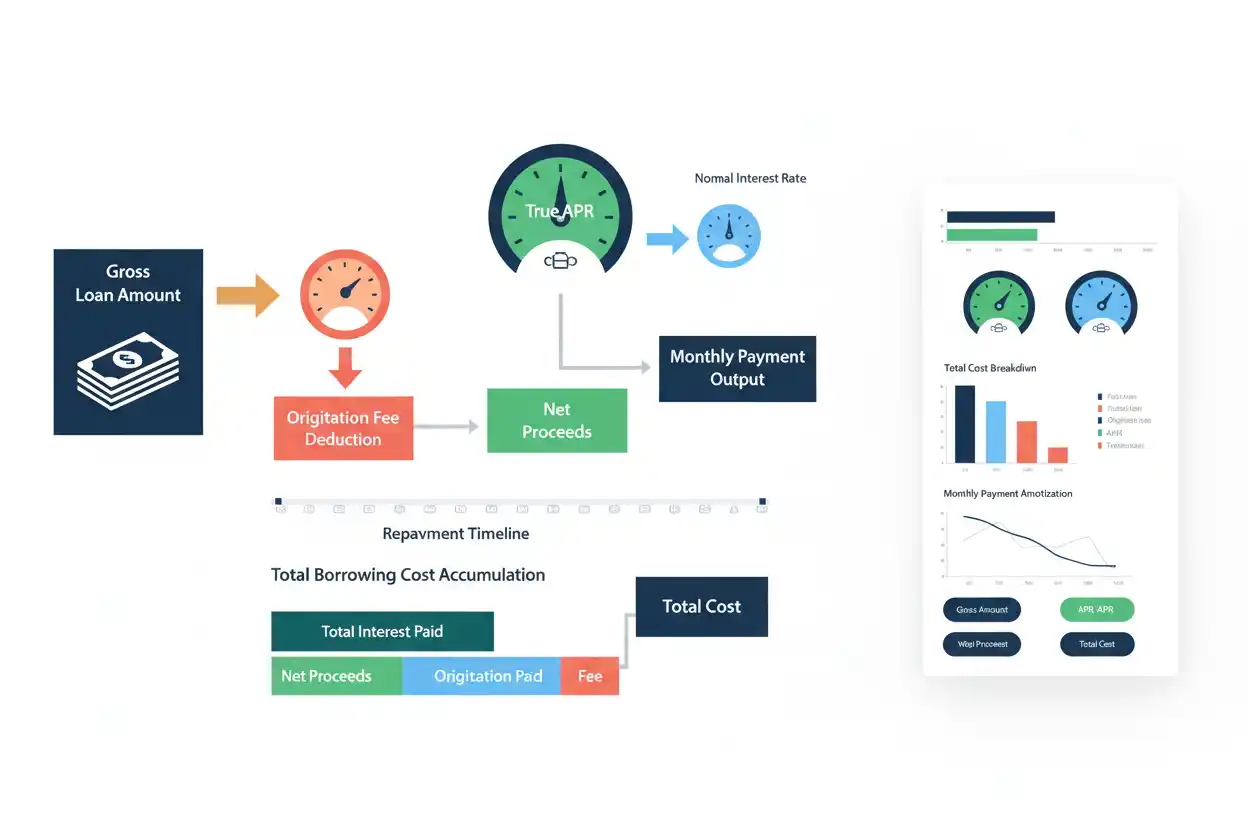

A loan origination fee is a charge associated with making or originating a loan.
Depending on the product and lender, the fee can compensate for activities such as application processing, underwriting, funding, administration, or other origination-related services.
The basic percentage formula is:
Loan Origination Fee = Loan Amount × Origination Fee Rate
If a $25,000 loan carries a 3% origination fee:
Origination Fee = $25,000 × 3%
Origination Fee = $750
The important question is what happens to that $750.
The lender might deduct it from the loan proceeds, require it to be paid separately, or finance it into the debt.
Each treatment changes the economics differently.
What Is a Loan Origination Fee?
A loan origination fee is an upfront financing charge associated with creating the loan.
The exact name can vary.
A lender may separately list:
origination, processing, application, underwriting, administrative, or similar charges.
For a borrower, the economically important questions are:
How much is the total fee?
When is it paid?
Does it reduce the cash received?
Is it financed?
Does it affect APR?
The broader Loans & Credit cluster connects the fee with payments, annualized borrowing cost, terms, and payoff mechanics within Finance.
Loan Origination Fee Formula
When charged as a percentage:
Origination Fee = Gross Loan Amount × Fee Percentage
Suppose:
Loan amount = $50,000
Origination fee rate = 2.5%
Then:
Origination Fee = $50,000 × 2.5%
Origination Fee = $1,250
A flat-dollar origination fee does not require a percentage calculation.
If the lender charges $500 regardless of loan size:
Origination Fee = $500
Net Loan Proceeds
If the lender deducts the origination fee before releasing funds:
Net Proceeds = Gross Loan Amount − Origination Fee
Using the $25,000 loan and $750 fee:
Net Proceeds = $25,000 − $750
Net Proceeds = $24,250
The borrower signs for a $25,000 contractual loan but receives only $24,250 of usable proceeds under this example.
That difference can materially increase the effective borrowing cost.
Origination Fee Example
Assume:
Gross loan amount = $25,000
Contractual annual interest rate = 9%
Term = 60 months
Origination fee = 3%
Fee deducted from proceeds
The fee is:
Fee = $25,000 × 3%
Fee = $750
Net proceeds:
Net Proceeds = $25,000 − $750
Net Proceeds = $24,250
The scheduled payment is still calculated from the $25,000 contractual principal under this example.
Using the standard loan payments formula:
Monthly Payment ≈ $518.96
Total scheduled payments are approximately:
Total Payments ≈ $31,137.53
Contractual interest is approximately:
Interest = $31,137.53 − $25,000
Interest ≈ $6,137.53
Yet the borrower received only $24,250.
That is why the true borrowing cost is higher than the 9% contractual rate suggests.
Approximate Annualized Cost After the Fee
Solving for the monthly rate that equates:
$24,250 of net proceeds
with:
60 payments of approximately $518.96
produces an implied monthly economic rate of about:
0.859% per Month
A nominal annualization is approximately:
0.859% × 12 ≈ 10.31%
The effective annual rate from that periodic cost is approximately:
Effective Annual Cost = (1 + 0.00859)^12 − 1
Effective Annual Cost ≈ 10.81%
This is an analytical cash-flow illustration rather than a substitute for a lender’s required APR disclosure.
Loan Origination Fee and APR
The broader APR calculation is important because qualifying origination charges can increase annualized borrowing cost.
Two loans can have identical interest rates but different APRs.
Suppose:
Loan A interest rate = 9%
Origination fee = $0
Loan B interest rate = 9%
Origination fee = 3%
Loan B provides less usable economic value or creates an additional cost.
Therefore, it should not automatically be considered equivalent to Loan A.
Origination Fee vs Interest Rate
Interest is generated over time according to the loan’s rate and outstanding balance.
An origination fee is generally associated with obtaining the financing.
These are different cost categories.
Total Financing Cost ≈ Interest + Loan Fees + Other Applicable Financing Charges
The exact amount depends on the contract and repayment behavior.
If the Fee Is Financed
Suppose the $750 fee is added to the $25,000 principal instead of withheld.
Financed Principal = $25,000 + $750
Financed Principal = $25,750
Now the borrower receives the intended $25,000 of cash but owes a larger principal.
Interest can also be generated on the financed fee.
This increases both the payment and total interest.
If the Fee Is Paid in Cash
Suppose:
Loan principal = $25,000
Fee = $750
Fee paid separately at closing
The loan principal stays at $25,000.
The borrower receives the full loan proceeds but must contribute another $750 from existing cash.
That fee still belongs in the economic cost comparison even though it does not increase the principal.
Origination Fee Percentage of Net Proceeds
A 3% fee on the gross loan is actually a slightly larger percentage of the cash received when the fee is withheld.
Fee as % of Net Proceeds = Fee ÷ Net Proceeds × 100
Using:
Fee = $750
Net proceeds = $24,250
Fee as % of Net Proceeds = $750 ÷ $24,250 × 100
Fee as % of Net Proceeds ≈ 3.09%
This is another reason the headline fee percentage does not reveal the complete financing impact.
Loan Origination Fee vs Leasing Costs
Leasing costs can include acquisition or administrative fees.
Those charges are economically similar in the sense that they increase the transaction cost, but a lease fee should not automatically be called a loan origination fee.
The products and disclosure rules differ.
Origination Fees and Loan Payoff
A loan payoff quote usually reflects the amount required to satisfy the outstanding debt at a specific date.
An origination fee already paid at the beginning is generally a sunk financing cost.
Paying the loan off early may reduce future interest but does not automatically refund the original fee unless the contract or applicable rules provide otherwise.
Origination Fees and Loan Term
The loan term strongly affects the economic weight of an upfront fee.
A $1,000 fee spread economically across a 10-year loan may have a smaller annualized effect than the same $1,000 fee on a six-month loan.
That is because the borrower pays the fee for access to financing over a much shorter period in the second case.
Fee Impact on Short-Term Loans
Suppose:
Loan = $10,000
Origination fee = $500
The fee equals:
Fee Rate = $500 ÷ $10,000 × 100
Fee Rate = 5%
If the loan lasts only six months, a 5% upfront charge is economically substantial even before interest.
Short-term borrowers should therefore pay particular attention to fees.
Origination Fee and Interest Rate Basics
Interest rate basics helps distinguish the contractual rate from the effective cost of obtaining credit.
A lender can advertise an appealing nominal rate while charging fees that materially raise annualized cost.
The useful comparison is therefore:
rate plus fees plus term plus total repayment.
Business Loan Origination Fees
Commercial borrowing can involve significant origination charges.
The business loan APR page explains why fees can create a large difference between the rate stated in the contract and the annualized economic cost to the business.
The fee matters especially when it is deducted from proceeds because the business receives less working capital than the gross loan amount suggests.
Personal Loan Origination Fees
A personal loan APR can help compare lenders whose origination fees differ.
Suppose:
Lender A: 10% rate, no fee
Lender B: 9% rate, 5% origination fee
Lender B does not automatically cost less.
Payment timing and term determine which offer produces the lower overall borrowing cost.
Auto Loan Origination Costs
An auto loan APR should likewise be compared with the underlying interest rate and financed charges.
Vehicle transactions can contain multiple fees and optional products, so borrowers should verify which costs belong to the vehicle purchase and which belong to financing.
Origination Fee and Principal Balance
If the fee is financed, it becomes part of the starting principal balance under that structure.
If the fee is withheld, principal can remain unchanged while net cash received falls.
Those two methods can produce different payment and cash-flow results.
Origination Fee and Repayment Schedule
A repayment schedule shows how contractual principal and interest decline.
An upfront fee that has already been paid separately does not normally appear as recurring interest in that schedule.
Therefore, total financing analysis should combine the schedule with upfront fees rather than relying on the amortization table alone.
Origination Fee and Personal Loan Payments
Personal loan payments are usually determined by principal, rate, and term.
If an origination fee is withheld, the payment may still be based on the full contractual principal even though the borrower receives less cash.
If the fee is financed, the larger principal can directly raise the monthly payment.
Origination Fee and Business Loan Payments
The same principle applies to business loan payments.
A business should distinguish:
cash received, debt recorded, periodic payment, total interest, and upfront fees.
Combining all five provides a more realistic picture of financing cost.
Origination Fee and Interest Coverage
The interest coverage ratio focuses on earnings relative to interest expense.
A separately expensed financing fee may affect accounting results differently from contractual interest.
For financial-statement or covenant analysis, the applicable accounting and lender definitions should be followed rather than automatically placing every loan fee into the interest coverage denominator.
Origination Fees and Prepayment
If a borrower expects to repay quickly, check both the upfront fee and any prepayment penalty.
A loan with:
a large nonrefundable origination fee and early repayment
can have a very high effective cost because the fee is spread over a short actual borrowing period.
How to Compare Two Origination Fees
Suppose:
Loan A = $20,000, 1% fee
Loan B = $20,000, 4% fee
Loan A:
Fee = $200
Loan B:
Fee = $800
Difference:
Additional Fee = $800 − $200
Additional Fee = $600
However, Loan B could still be cheaper if its interest rate is sufficiently lower.
That is why the fee should never be considered independently from APR, term, and total payments.
Common Loan Origination Fee Mistakes
One mistake is assuming the fee is always deducted from the loan.
Another is treating the fee percentage as if it were an annual interest rate.
Borrowers also overlook fees when a lender finances them into principal.
A fourth mistake is comparing rates without comparing APR or total cash flows.
Finally, a short-term borrower can underestimate how expensive an upfront fee becomes when the loan is repaid quickly.
Frequently Asked Questions
What is a loan origination fee?
It is a charge associated with creating, processing, underwriting, funding, or administering a loan.
What is the loan origination fee formula?
Origination Fee = Loan Amount × Origination Fee Percentage
How much is a 3% fee on $25,000?
$25,000 × 3% = $750
Is an origination fee deducted from the loan?
It can be deducted, paid separately, or financed depending on the lender and loan agreement.
What are net loan proceeds?
They are the amount of usable cash received after deducted upfront fees.
Net Proceeds = Gross Loan Amount − Withheld Fees
Does an origination fee increase APR?
Applicable financing charges can increase APR or another annualized measure of borrowing cost.
Is an origination fee the same as interest?
No. Interest accumulates over time, while an origination fee is generally an upfront financing charge.
Can I finance an origination fee?
Some lenders allow or require it to be added to principal, depending on the product.
Do I get the fee back if I repay early?
Not automatically. Refundability depends on the contract and applicable rules.
Is a lower origination fee always better?
Not necessarily. A loan with a slightly higher fee can still have a lower total cost if its rate and other terms are materially better.
Why are origination fees especially important on short loans?
Because the upfront cost is incurred over a shorter borrowing period, increasing its annualized economic impact.
What should I compare besides the fee?
Compare net proceeds, interest rate, APR, payment, term, total repayment, and prepayment terms.
Final Takeaway
A loan origination fee is commonly calculated as:
Loan Origination Fee = Loan Amount × Fee Rate
A $25,000 loan with a 3% fee creates a $750 origination charge.
If that fee is withheld:
Net Proceeds = $25,000 − $750 = $24,250
The borrower can therefore receive less cash than the contractual principal while still making payments based on the larger amount.
That is why origination fees should always be evaluated together with the interest rate, APR, net proceeds, loan term, monthly payment, and total repayment rather than treated as a small administrative detail.