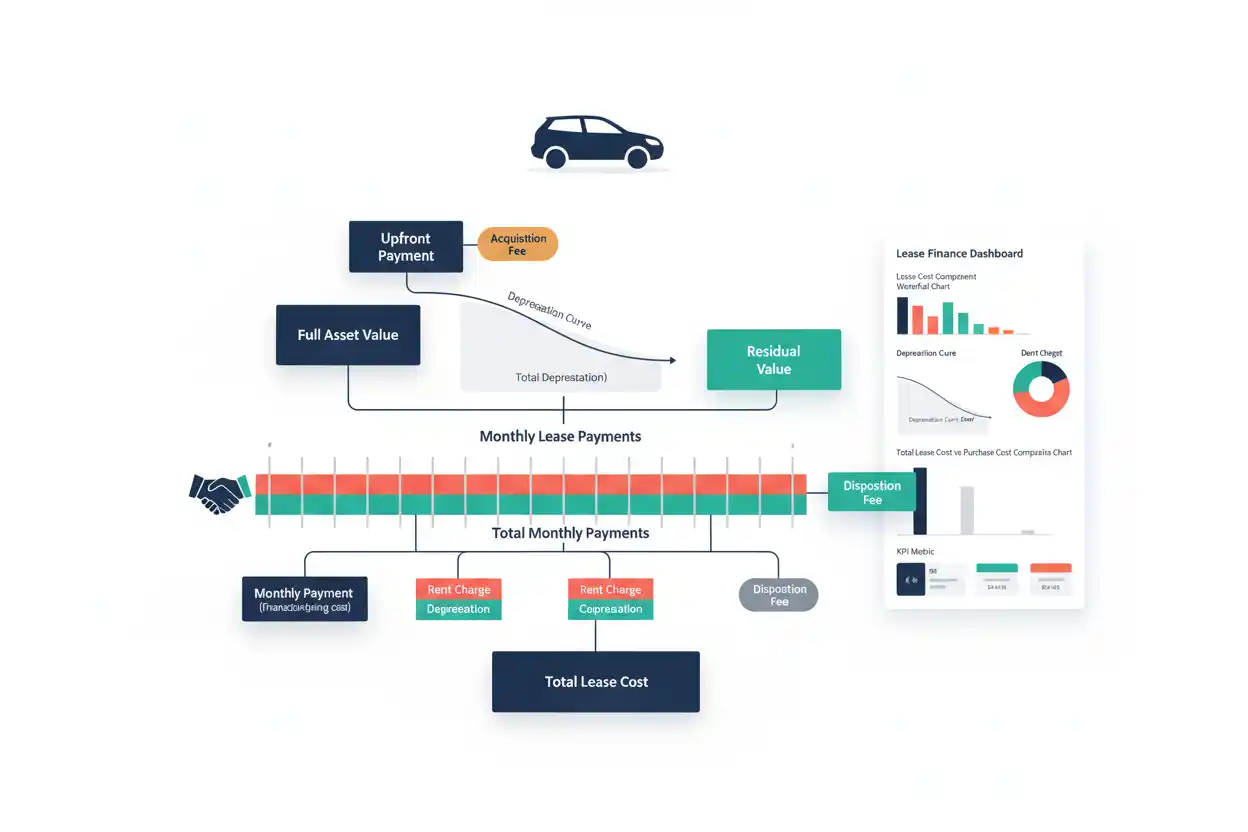

Leasing costs include more than the monthly payment shown in an advertisement or quotation.
A lease can involve cash due at signing, periodic payments, a financing or rent charge, acquisition fees, taxes, maintenance obligations, excess-use charges, disposition fees, and potentially an end-of-term purchase price.
The useful question is therefore not simply:
What is the monthly lease payment?
It is:
What will the right to use the asset actually cost over the period you expect to keep it?
A practical starting point is:
Total Lease Cost = Upfront Nonrefundable Costs + Periodic Payments + Expected End-of-Lease Costs + Other Required Charges
Refundable deposits should generally be treated separately because they are not necessarily a permanent cost.
Within the broader Loans & Credit framework, leasing differs from ordinary borrowing because the lessee generally pays for the right to use an asset rather than simply amortizing borrowed principal. That distinction also matters across the wider Finance category.
What Are Leasing Costs?
Leasing costs are the economic payments and charges associated with obtaining and using an asset under a lease.
Depending on the transaction, they can include:
- cash paid at signing,
- periodic lease payments,
- rent or financing charges,
- acquisition or administrative fees,
- taxes and registration charges,
- maintenance or insurance obligations,
- excess mileage or use charges,
- disposition fees,
- early termination charges,
- and an optional purchase price.
The exact structure depends on the leased asset and the contract.
A consumer vehicle lease, an equipment lease, and a commercial property lease should not be assumed to work identically.
Total Leasing Cost Formula
For planning purposes:
Total Leasing Cost = Upfront Costs + Sum of Lease Payments + Expected End Costs + Other Required Nonrefundable Charges
Suppose a three-year lease requires:
Upfront nonrefundable costs = $2,500
Monthly payments = $1,650
Lease term = 36 months
Expected disposition fee = $500
Periodic payments total:
Periodic Payments = $1,650 × 36
Periodic Payments = $59,400
Total estimated nominal leasing cost is:
Total Leasing Cost = $2,500 + $59,400 + $500
Total Leasing Cost = $62,400
That calculation does not include a purchase option because the example assumes the asset will be returned.
Effective Monthly Lease Cost
A useful budgeting metric spreads nonrefundable costs across the period of use.
Effective Monthly Lease Cost = Total Expected Lease Cost ÷ Months of Use
Using the $62,400 example:
Effective Monthly Lease Cost = $62,400 ÷ 36
Effective Monthly Lease Cost ≈ $1,733.33
The advertised monthly payment is $1,650, but the effective monthly cash cost rises to approximately $1,733.33 after the upfront amount and expected disposition charge are included.
This is often more useful for budgeting than the headline monthly payment.
Upfront Leasing Costs
A lease can require several amounts at signing.
Depending on the contract, these may include:
the first periodic payment, security deposit, acquisition fee, capitalized cost reduction, registration costs, taxes, and other charges.
Not every dollar due at signing has the same economic meaning.
A refundable security deposit, for example, differs from a nonrefundable acquisition fee.
When comparing offers, separate:
Refundable Amounts
from:
Permanent Lease Costs
Otherwise, the comparison can overstate or understate the true cost.
Rent Charge
For many leases, part of the periodic payment compensates the lessor for financing the asset.
In consumer motor-vehicle leasing this is commonly called a rent charge.
It serves an interest-like economic role, although it is not automatically the same thing as loan interest or APR.
A simplified lease payment concept is:
Base Lease Payment = Depreciation and Amortized Amounts + Rent Charge
The specialist auto lease payments page owns the detailed vehicle-lease payment calculation involving adjusted capitalized cost, residual value, and money factor.
This page instead focuses on the broader cost of leasing.
Money Factor and Rate-Like Comparisons
Vehicle lessors sometimes use a money factor to calculate the rent portion of a lease payment.
A common industry shortcut is:
Approximate Annualized Rate-Like Figure = Money Factor × 2,400
Suppose:
Money factor = 0.0025
Then:
Approximate Rate-Like Figure = 0.0025 × 2,400
Approximate Rate-Like Figure = 6.0%
This is useful only as a rough comparison convention.
A money factor is not a standardized consumer-loan APR, and the result should not be treated as an exact effective annual borrowing rate.
The broader interest rate basics framework explains why percentages must be compared only after identifying what each rate actually measures.
Effective Rate From Lease Cash Flows
For more advanced financial analysis, an implied periodic rate can be derived from lease cash flows when the asset value, lease payments, residual value, and timing are known.
Conceptually, the rate r solves:
Asset Value = Present Value of Lease Payments + Present Value of Residual Value
For level end-of-period payments:
Asset Value = Σ [Lease Payment ÷ (1 + r)^t] + Residual Value ÷ (1 + r)^n
Suppose:
Asset fair value = $50,000
Monthly lease payment = $1,100
Term = 36 months
Residual value = $18,000
Solving the cash flows produces an implied monthly rate of approximately:
Monthly Implied Rate ≈ 0.603%
A nominal annualized version is approximately:
0.603% × 12 ≈ 7.23%
An effective annual rate is approximately:
Effective Annual Rate = (1 + 0.00603)^12 − 1
Effective Annual Rate ≈ 7.48%
This is an analytical implied-rate calculation. It should not be presented as a regulated consumer lease APR unless the applicable rules define it that way.
Lease Fees
Fees can materially change leasing costs even when the periodic payment appears competitive.
Common examples include:
acquisition fees, administrative charges, disposition fees, excess-use charges, late fees, early termination charges, and fees associated with an optional purchase.
The economic impact depends on whether the fee is:
paid upfront, added to the amount being amortized, included in periodic payments, or charged at the end.
A loan origination fee performs a different role in borrowing, but the comparison is useful: both illustrate why headline rates and monthly payments can omit important transaction costs.
Acquisition Fee
An acquisition fee is generally associated with setting up or originating the lease.
Suppose:
Acquisition fee = $900
Term = 36 months
If the fee is paid upfront, its simple monthly-equivalent impact is:
Monthly Equivalent = $900 ÷ 36
Monthly Equivalent = $25
If the fee is instead rolled into the lease calculation, it can also affect the rent charge.
Therefore, “no acquisition fee due today” does not necessarily mean there is no acquisition cost.
Disposition Fee
A disposition fee can apply when the asset is returned at lease end.
Suppose:
Disposition fee = $500
If you expect to return the asset, the fee belongs in the economic comparison.
A lease advertised at $450 per month but carrying a $500 end charge is not economically identical to another $450 lease with no comparable fee.
Residual Value
Residual value represents the expected value of the leased asset at the end of the lease period.
For vehicle leases, it directly affects how much depreciation is allocated to the lessee.
Conceptually:
Lease Depreciation = Adjusted Capitalized Cost − Residual Value
A higher residual generally reduces the depreciation portion of the periodic payment, all else equal.
However, a higher residual can also make an end-of-lease purchase option less attractive if the purchase price is tied to that amount.
Leasing Cost vs Loan Payment
A loan payment generally repays principal and interest.
A lease payment generally compensates for use of the asset and associated financing economics.
This distinction matters because at the end of a fully repaid loan, the borrower generally owns the financed asset free of that loan.
At the end of many leases, the lessee returns the asset unless a purchase option is exercised.
A lower lease payment therefore does not automatically mean a lower lifetime economic cost.
Lease vs Flat and Reducing-Balance Interest
The flat vs reducing balance interest comparison belongs to lending rather than ordinary lease accounting.
Still, it provides an important analytical lesson: a quoted percentage means little until you know the cash flows behind it.
Lease quotations should likewise be evaluated from:
upfront cash, periodic payments, rent charge, residual value, fees, and end-of-term obligations.
Lease Term and Total Cost
The loan term page focuses on borrowing, but duration also matters in leasing.
A longer lease can spread fixed upfront costs across more months.
However, the asset will also be older at lease end, which can affect residual value, maintenance exposure, and end-of-term economics.
Do not assume extending a lease always reduces total cost.
Fixed vs Variable Lease Economics
Some lease arrangements can expose the lessee to changing rates, index-linked payments, or other variable charges.
The fixed vs variable interest rate page explains the general borrowing distinction.
For any variable lease structure, evaluate the payment not only at today’s rate but under reasonable adverse scenarios.
Lease Costs and Repayment Schedules
A conventional repayment schedule tracks principal and interest on debt.
A lease schedule instead tracks contractual periodic payments and potentially rent or amortized components.
The schedules can look similar while representing different ownership economics.
Business Leasing and Interest Coverage
Businesses often lease vehicles, equipment, or facilities to preserve cash or match payments with asset use.
However, lease obligations still consume operating cash.
The interest coverage ratio measures earnings relative to interest expense, but a business with substantial lease obligations may also need broader fixed-charge or cash-flow analysis.
A low apparent interest burden does not automatically mean contractual lease commitments are insignificant.
Leasing vs Business Borrowing
A business deciding between leasing equipment and financing its purchase should compare the lease with the actual business loan APR, not merely the lender’s nominal rate.
The loan side may involve:
interest, origination fees, ownership value, depreciation, and eventual resale value.
The lease side may involve:
rent charge, fees, residual assumptions, use restrictions, and return obligations.
The decision should compare complete after-tax and cash-flow economics when the amounts are material.
Leasing and Principal Balance
A lease generally does not have a conventional borrower principal balance in the same way as a term loan.
That is another reason lease cost should not be forced into ordinary amortization language.
The lessee may instead have an adjusted lease balance or other contractually defined amount used for early termination.
Leasing vs Simple Interest Loans
A simple interest loan charges interest according to outstanding principal.
Lease rent charges follow lease-specific economics.
When deciding whether to lease or finance, compare the actual cash flows rather than assuming a money factor and simple-interest percentage are directly interchangeable.
Total Cost With a Purchase Option
Suppose a lease has:
Upfront nonrefundable costs = $2,500
Payments = $1,650 × 36 = $59,400
Purchase option = $20,000
Purchase-option fee = $300
If the lessee intends to buy the asset:
Total Cash Paid = $2,500 + $59,400 + $20,000 + $300
Total Cash Paid = $82,200
That amount can then be compared with the total cost of financing a purchase from the beginning.
Whether purchasing is better depends on asset value, financing cost, taxes, maintenance, and opportunity cost—not simply total nominal cash paid.
Common Leasing Cost Mistakes
One mistake is comparing only monthly payments.
Another is treating all cash due at signing as a refundable deposit.
Lessee comparisons can also omit disposition fees, excess-use charges, or early termination exposure.
A fourth mistake is converting a money factor into a rate and calling the result APR.
Finally, comparing a lease with a loan without considering ownership value at the end can produce a misleading conclusion.
Frequently Asked Questions
What are leasing costs?
They are the upfront, recurring, financing-related, and end-of-term costs associated with using an asset under a lease.
What is the basic total leasing cost formula?
Total Lease Cost = Upfront Nonrefundable Costs + Periodic Payments + Expected End Costs + Other Required Charges
Is the monthly lease payment the total cost?
No. Upfront fees, taxes, end charges, excess use, and other amounts can materially increase total cost.
What is a lease rent charge?
It is the amount charged in addition to depreciation and other amortized amounts in many lease structures.
Is a lease money factor the same as APR?
No. A money factor is a lease calculation input, not a standardized consumer-loan APR.
How can I compare two leases with different upfront payments?
Calculate each lease’s total expected cost and divide by the expected months of use to obtain an effective monthly cash-cost comparison.
Does residual value affect lease cost?
Yes. A higher residual generally lowers the depreciation allocated to the lease, all else equal.
What is a disposition fee?
It is an end-of-lease charge that may apply when the leased asset is returned.
Should I include a purchase option in total lease cost?
Include it only when comparing a scenario in which you actually expect to exercise the option.
Is leasing always cheaper than financing?
No. Leasing can have a lower monthly payment while producing different long-term economics because ownership, residual value, fees, and asset disposition differ.
Can an effective lease rate be calculated?
An implied rate can be calculated from consistent cash flows, but it is an analytical measure and should not automatically be labeled APR.
What should I compare before signing a lease?
Compare upfront cash, periodic payments, rent charge, fees, term, residual value, use restrictions, termination terms, end costs, and alternative financing.
Final Takeaway
Leasing costs extend well beyond the advertised monthly payment.
A practical comparison begins with:
Total Leasing Cost = Upfront Nonrefundable Costs + Periodic Payments + Expected End Costs + Other Required Charges
In the example, a lease requiring $2,500 upfront, $1,650 per month for 36 months, and a $500 disposition fee costs approximately $62,400 before any optional purchase.
That equals an effective monthly cash cost of about:
$62,400 ÷ 36 = $1,733.33
The strongest lease comparison therefore evaluates the entire cash-flow structure—including rent charges, residual value, fees, term, return obligations, and purchase options—rather than choosing whichever offer displays the smallest monthly number.