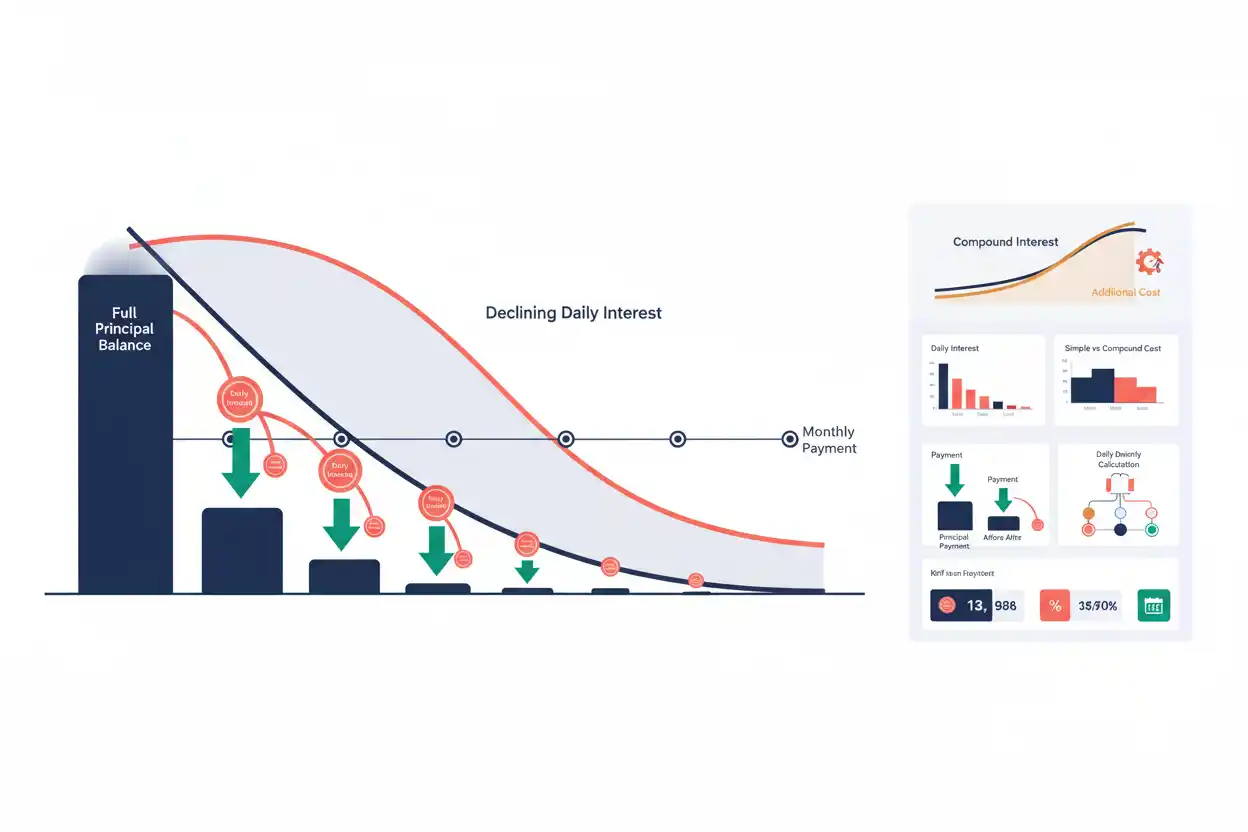

A simple interest loan calculates interest from principal rather than charging interest on previously accumulated interest under the normal calculation method.
The classic simple-interest formula is:
Simple Interest = Principal × Interest Rate × Time
If $12,000 remains outstanding for three years at 8% without interim principal changes:
Interest = $12,000 × 8% × 3
Interest = $2,880
Total principal plus simple interest would be:
Total = $12,000 + $2,880
Total = $14,880
Real installment loans require a more detailed approach because principal usually changes whenever payments are made.
For those loans, interest is calculated from the current outstanding principal, often daily or monthly.
That is the defining practical feature.
What Is a Simple Interest Loan?
A simple interest loan calculates periodic interest from principal.
For a declining-balance loan:
Interestₜ = Outstanding Principalₜ × Periodic Interest Rate
When principal is reduced, future interest is also reduced.
That makes payment timing and additional principal especially important.
The wider Loans & Credit framework connects simple interest with daily accrual, repayment schedules, student loans, vehicle financing, and payoff calculations throughout Finance.
Simple Interest Formula
For a principal that remains unchanged:
I = P × r × t
Where:
I = interest
P = principal
r = annual interest rate
t = time in years
Suppose:
P = $10,000
r = 7%
t = 2 years
Then:
I = $10,000 × 0.07 × 2
I = $1,400
This formula is ideal for illustrating the concept, but installment loans need to account for principal changes over time.
Daily Simple Interest Formula
A daily simple interest loan can use:
Interest = Principal × Annual Rate × Days ÷ Day-Count Basis
Suppose:
Principal = $15,000
Annual rate = 8%
Elapsed days = 30
Basis = 365
Then:
Interest = $15,000 × 8% × 30 ÷ 365
Interest ≈ $98.63
If the borrower pays $500:
Principal Reduction = $500 − $98.63
Principal Reduction ≈ $401.37
New principal:
$15,000 − $401.37 = $14,598.63
Future interest is now calculated from the lower balance.
Daily Interest After the Payment
Before the payment:
Daily Interest = $15,000 × 8% ÷ 365
Daily Interest ≈ $3.29
After principal falls to $14,598.63:
Daily Interest ≈ $14,598.63 × 8% ÷ 365
Daily Interest ≈ $3.20
The reduction is small each day, but it compounds into meaningful savings across a long remaining term.
Simple Interest and Outstanding Principal
The principal balance is the key input.
If the balance is cut in half while the interest rate remains unchanged:
Dollar Interest Per Period Is Also Cut Approximately in Half
For example:
$20,000 at 6%:
Annual Simple Interest Illustration = $1,200
$10,000 at 6%:
Annual Simple Interest Illustration = $600
This makes principal reduction especially valuable.
Simple Interest Loan vs Compound Interest Loan
A compound interest loan can calculate future interest on a balance that includes previous interest.
Simple interest does not inherently do that.
Suppose:
Principal = $10,000
Interest accrued = $500
Under a simple-interest structure where the $500 remains separate:
future interest can continue to be calculated from $10,000.
If the $500 is capitalized into principal:
future interest can be calculated from $10,500.
That is no longer the same simple outstanding-principal situation.
Simple Interest vs Precomputed Interest
A simple-interest loan should also be distinguished from precomputed interest.
With simple interest, interest depends on the actual outstanding principal over time.
With a precomputed structure, a total interest amount can be calculated in advance and incorporated into the repayment obligation according to the contract.
This difference matters when making extra payments.
Reducing principal early can provide stronger savings on a conventional simple-interest loan.
Simple Interest and Repayment Schedules
A repayment schedule shows the interaction directly.
Each period:
Interest = Beginning Principal × Periodic Rate
Principal = Payment − Interest
Ending Principal = Beginning Principal − Principal
The next period then calculates interest from that lower ending balance.
Simple Interest and Amortizing Loans
An amortizing loan can use simple interest.
The payment may be constant even though:
interest decreases and principal repayment increases.
That does not make the loan a compound-interest loan.
Amortization describes repayment.
Simple interest describes the interest base.
Simple Interest and Accrued Interest
Accrued interest is interest generated but not yet paid.
If:
Principal = $15,000
Daily interest ≈ $3.29
Days since last payment = 20
Then:
Accrued Interest ≈ $3.29 × 20
Accrued Interest ≈ $65.75
A later payment can be applied first to applicable accrued interest before the remainder reduces principal, depending on the loan terms.
Simple Interest and Student Loans
Student loan interest commonly provides a real-world example of daily simple-interest mechanics.
Federal Direct Loans use daily interest calculations based on outstanding principal and the applicable interest rate factor.
The details of when the borrower is responsible for interest depend on the loan type and status.
Student Loan Payments
Student loan payments can therefore contain different interest amounts from one month to another because calendar months contain different numbers of days and payment timing can vary.
A fixed payment does not necessarily imply exactly the same dollar interest charge every month.
Simple Interest and Secured Loans
A secured loan can use simple interest.
Many auto loans combine:
collateral plus outstanding-balance interest.
These are independent characteristics.
A loan can be secured or unsecured while still using simple interest.
Simple Interest and Fixed vs Variable Rates
The fixed vs variable interest rate distinction also operates independently.
A simple-interest loan can use a fixed rate.
It can also use a variable rate.
If the rate changes, future simple-interest calculations use the new applicable rate.
Simple Interest and APR
APR is not the same thing as a simple interest rate.
APR can incorporate applicable financing charges and provide an annualized borrowing-cost measure.
A loan can therefore have:
simple contractual interest rate = 8%
while:
APR = 8.8%
because fees increase the annualized cost.
Simple Interest and Flat Interest
The flat vs reducing balance interest comparison is important.
A normal reducing-balance simple-interest loan calculates interest from the outstanding principal.
A flat-rate calculation may keep using the original principal as its stated interest base.
The two should not be treated as equivalent simply because both are described with an annual percentage.
Simple Interest and Loan Payments
The general loan payments formula can produce a fixed installment for a simple-interest amortizing loan when the periodic assumptions are appropriate.
However, actual daily-interest loans can differ slightly from a simplified monthly amortization model because the number of elapsed days varies.
Extra Payments on Simple Interest Loans
Suppose:
Balance = $15,000
Rate = 8%
Extra principal payment = $2,000
New principal:
$15,000 − $2,000 = $13,000
Daily interest before:
$15,000 × 8% ÷ 365 ≈ $3.29
Daily interest after:
$13,000 × 8% ÷ 365 ≈ $2.85
Daily reduction:
Approximately $0.44
Over 180 days, the simple approximate interest difference is:
$0.44 × 180 ≈ $78.90
Actual savings depend on later payments and timing.
Payment Timing
On a daily simple-interest loan, paying 10 days later means 10 additional days of interest accrue before principal is reduced.
Suppose:
Daily interest = $3.29
Ten additional days create approximately:
$3.29 × 10 = $32.90
of additional interest.
More of the next payment must then satisfy interest, leaving less for principal.
Simple Interest and Loan Term
A longer loan term keeps principal outstanding for more time.
Even though simple interest does not compound previous interest in the ordinary calculation, additional time still creates additional interest.
Simple does not mean inexpensive.
Simple Interest and Payoff Quotes
A loan payoff quote for a daily simple-interest loan can change every day.
Suppose:
Principal = $10,000
Daily interest = $2.19
A quote valid seven days later can include approximately:
$2.19 × 7 = $15.33
of additional interest before other charges.
Simple Interest and Prepayment
A prepayment penalty can reduce the benefit of paying principal early.
If:
Interest avoided = $1,000
Penalty = $300
Then:
Net Simplified Saving = $1,000 − $300
Net Saving = $700
Always compare both sides of the transaction.
Auto Loans and Simple Interest
Auto loan payments commonly involve outstanding-balance interest.
A borrower who pays extra principal can often reduce future interest, subject to the financing agreement.
The exact calculation depends on how and when payments are applied.
Personal Loans and Simple Interest
Personal loan payments can also use conventional outstanding-balance amortization.
Origination fees can raise APR even when the interest calculation itself remains simple.
Common Simple Interest Loan Mistakes
One mistake is believing simple interest means interest is calculated once and never changes.
Another is using the original principal after scheduled principal has been repaid.
Borrowers also confuse simple interest with flat interest.
A fourth mistake is ignoring the number of days between payments on daily-interest loans.
Finally, simple interest should not be confused with APR, which can incorporate fees and other finance charges.
Frequently Asked Questions
What is a simple interest loan?
It is a loan where interest is calculated from principal rather than normally charging interest on previous interest.
What is the basic simple-interest formula?
Interest = Principal × Rate × Time
How is daily simple interest calculated?
Interest = Principal × Annual Rate × Days ÷ Day-Count Basis
Does interest fall when principal falls?
Yes, when the same rate is applied to a smaller outstanding principal.
Is simple interest the same as flat interest?
No. Flat interest can be calculated from original principal, while reducing-balance simple interest uses outstanding principal.
Is simple interest the same as compound interest?
No. Compound interest can charge interest on previous interest after it becomes part of the interest-bearing balance.
Can a secured loan use simple interest?
Yes.
Do student loans use simple interest?
Many student loans, including federal Direct Loans, use daily simple-interest mechanics, although specific terms vary.
Does paying early save interest?
It generally can when the payment reduces principal sooner, subject to the loan’s terms.
Does payment timing matter?
Yes on daily simple-interest loans because interest accrues for each day principal remains outstanding.
Can a simple-interest loan have APR higher than its rate?
Yes. Applicable financing charges can cause APR to exceed the contractual interest rate.
Does simple interest mean the loan is cheap?
No. A high rate, large principal, or long term can still create substantial interest cost.
Final Takeaway
The simple interest concept starts with:
Interest = Principal × Rate × Time
For loans whose principal changes through payments, interest is recalculated from the outstanding balance.
A $15,000 balance at 8% for 30 days produces approximately:
$98.63 of Interest
using a 365-day basis.
If a $500 payment is made, approximately:
$401.37
reduces principal, leaving roughly:
$14,598.63
Future interest is then calculated from that smaller balance.
That is the practical advantage of understanding simple interest: reducing principal earlier can directly reduce the interest generated later.