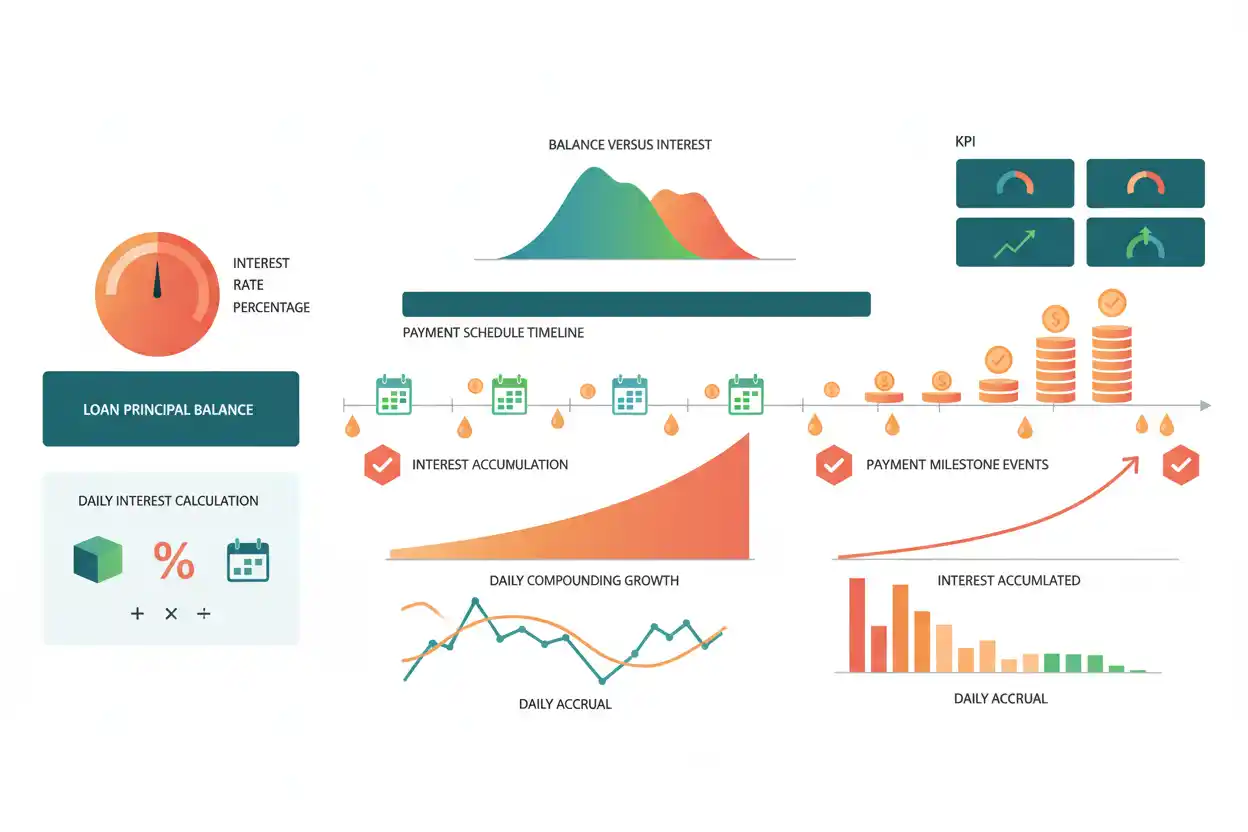

Accrued interest is interest that has been earned or incurred over time but has not yet been paid or received.
For a borrower, accrued interest represents the financing cost that has accumulated since the relevant starting date or previous payment.
For a lender or investor, it can represent interest earned but not yet collected.
The concept matters because interest does not necessarily wait for a monthly statement date to exist. On many loans, it builds with time. That means the amount required to pay off a debt today can differ from the principal balance shown after the previous payment.
What Is Accrued Interest?
Accrued interest is the amount of interest attributable to an elapsed period before the interest is actually settled.
A simplified formula is:
Accrued Interest = Principal × Annual Interest Rate × Time
If time is expressed as days:
Accrued Interest = Principal × Annual Rate × Days ÷ Day-Count Basis
A 365-day basis is common in many daily-interest examples, although actual contracts can use different conventions.
The loan agreement controls the contractual calculation.
Accrued Interest Example
Suppose a loan has:
Outstanding principal = $10,000
Annual rate = 8%
Days since the relevant payment date = 31
Day-count basis = 365
First calculate the daily rate:
Daily Rate = 8% ÷ 365
Daily Rate ≈ 0.021918%
Now calculate the accrued interest:
Accrued Interest = $10,000 × 8% × 31 ÷ 365
Accrued Interest ≈ $67.95
Approximately $67.95 of interest has accrued during the 31-day period under these assumptions.
The actual amount can differ if the balance changes during the period, the agreement uses another day-count method, fees are involved, or payments are credited according to different timing rules.
Daily Accrued Interest
For a balance that remains unchanged:
Daily Interest = Principal × Annual Rate ÷ 365
Using the same $10,000 balance and 8% rate:
Daily Interest = $10,000 × 8% ÷ 365
Daily Interest ≈ $2.19
Each additional day would add approximately $2.19 while the assumptions remain unchanged.
The daily simple interest page owns the detailed mechanics of loans that calculate interest using daily balances.
CFPB consumer guidance notes that simple-interest auto loans can calculate interest on the outstanding balance on a daily or monthly basis, and paying principal down faster can reduce future interest.
Why Accrued Interest Changes With Principal
Interest is generally connected to the balance on which the contractual rate applies.
If principal declines, the interest generated by the same rate and time interval generally declines as well.
Suppose the outstanding balance falls from $10,000 to $7,000.
At 8% for 31 days:
Accrued Interest = $7,000 × 8% × 31 ÷ 365
Accrued Interest ≈ $47.56
The smaller principal produces less accrued interest over the same period.
That relationship explains why a declining principal balance generally changes the interest portion of later payments on an amortizing loan.
Accrued Interest and Amortizing Loans
An amortizing loan uses scheduled payments that normally cover accrued interest and reduce principal.
A simplified payment allocation is:
Principal Paid = Payment − Interest Due
Suppose a monthly payment is $400 and $75 of interest has accrued.
Principal Paid = $400 − $75 = $325
After the interest obligation is satisfied under the assumed structure, $325 reduces principal.
Future interest is then calculated using the new balance according to the loan’s terms.
Accrued Interest and Payment Timing
Payment timing can matter when a loan accrues interest daily.
Consider a simple-interest loan where approximately $5 per day is accruing.
If a payment is applied 10 days later than another otherwise identical payment:
Additional Accrued Interest ≈ $5 × 10
Additional Accrued Interest ≈ $50
That does not mean every loan treats early or late payments identically. Contracts differ, and some products use scheduled-period calculations rather than straightforward daily accrual.
Still, the example demonstrates why elapsed time matters.
Accrued Interest and Loan Payoff Quotes
Suppose your principal balance is $12,000, but interest continues accruing at $2.50 per day.
If the lender calculates a payoff five days after the latest balance date:
Additional Accrued Interest = $2.50 × 5
Additional Accrued Interest = $12.50
Ignoring other adjustments:
Estimated Payoff = $12,000 + $12.50 = $12,012.50
A formal loan payoff quote may therefore differ from the balance displayed on a previous statement.
It can also include other contractual amounts, so a borrower should not assume principal alone is sufficient to close the account.
Accrued Interest vs Interest Paid
Accrued interest and paid interest are different.
Accrued interest has accumulated because time has passed.
Interest paid has actually been settled through a payment or other transaction.
A loan can therefore have interest accrued today even when the next scheduled payment is not yet due.
Accrued Interest vs APR
Accrued interest is a dollar amount for a specific elapsed period.
APR is an annualized measure of credit cost.
For example:
Accrued interest might equal $67.95 for one month.
APR might equal 8.6% annually after the applicable credit-cost calculation.
The two numbers answer entirely different questions.
One tells you how much interest has accumulated.
The other helps describe annualized borrowing cost.
Accrued Interest vs APY
APR vs APY is also separate from accrued-interest calculation.
APY is primarily a yield measure that incorporates compounding over a one-year period for deposit accounts under Regulation DD.
Accrued interest, by contrast, can be calculated for virtually any relevant elapsed period.
Accrued Interest and Simple Interest Loans
A simple interest loan normally calculates interest from principal rather than charging interest on previously accumulated interest in the same way as a compound-interest structure.
A simplified daily version is:
Interest = Outstanding Principal × Daily Rate × Number of Days
This structure is common enough that borrowers should understand how payment timing and principal reduction interact.
Accrued Interest and Compound Interest
Accrued interest does not automatically mean compound interest.
Interest can accrue without being added to principal.
Compounding occurs when interest becomes part of the balance used to calculate later interest.
That distinction is why the compound interest loan topic should remain separate.
What Is Capitalized Interest?
Capitalization occurs when unpaid accrued interest is added to principal under applicable terms or rules.
Suppose:
Principal = $20,000
Unpaid accrued interest = $1,200
If the $1,200 is capitalized:
New Principal = $20,000 + $1,200
New Principal = $21,200
Future interest can then be calculated from the larger principal.
CFPB guidance describes negative amortization as a situation in which payments do not cover the interest owed and unpaid interest can be added to the amount borrowed, causing the balance to increase.
Accrued Interest on Student Loans
Student loan interest can involve daily accrual and, in some situations, capitalization according to the applicable loan rules.
That makes it important to separate three amounts:
principal, accrued unpaid interest, and the amount of interest that may become part of principal.
The exact treatment depends on the loan program and current terms.
Accrued Interest on Auto Loans
Many vehicle loans use declining-balance simple-interest structures.
The auto loan APR measures annualized borrowing cost, while auto loan payments determine scheduled payment mechanics.
Accrued interest sits underneath those calculations by determining how much interest has accumulated on the applicable balance over time.
Accrued Interest and Early Payments
When interest accrues on the outstanding principal, reducing principal earlier can reduce later interest.
Consider a $15,000 balance at 7%.
If a $2,000 extra payment reduces principal to $13,000, future interest is calculated from a lower base under a conventional declining-balance structure.
This is one reason early principal reduction can accelerate a credit card payoff or loan payoff, although revolving-credit calculations and account rules differ from installment loans.
Accrued Interest and Late Payments
Late payments can create two separate effects:
- more time for interest to accrue, depending on the loan structure; and
- contractual or regulatory consequences associated with missed or late payments.
These should not be conflated.
Additional interest is mathematically connected to time and balance. A late fee is a separate contractual charge.
Accrued Interest Accounting
Accrued interest also appears in accrual accounting.
A borrower may recognize interest expense before paying the related cash.
A lender may recognize interest income before collecting it.
The simplified borrower-side entry conceptually reflects:
interest expense incurred during the period and a liability for interest not yet paid.
This is different from the consumer-loan question of how much interest must be paid on a specific date, even though both use the same underlying accrual concept.
How to Calculate Accrued Interest Between Two Dates
A practical method is:
First, identify the principal balance applicable during the period.
Second, determine the contractual annual or periodic rate.
Third, count the days or other applicable time units.
Fourth, confirm the contractual day-count convention.
Finally, calculate:
Accrued Interest = Principal × Rate × Time
If the balance changes during the period, divide the calculation into separate segments.
For example, if the balance is $10,000 for 10 days and $8,000 for the next 20 days:
Interest = ($10,000 × Rate × 10 ÷ 365) + ($8,000 × Rate × 20 ÷ 365)
That is more accurate than applying one balance to the entire period.
Common Accrued Interest Mistakes
One mistake is using the original loan amount even after principal has been reduced.
Another is dividing an annual rate by 12 when the loan actually accrues daily.
Borrowers can also confuse APR with the actual contractual interest rate used to accrue periodic interest.
Finally, using 365 days automatically can be wrong when the agreement specifies another basis.
The contract’s calculation terms should therefore be verified before relying on an accrued-interest estimate.
Frequently Asked Questions
What is accrued interest?
Accrued interest is interest that has accumulated over time but has not yet been paid or received.
What is the accrued interest formula?
A simplified formula is:
Accrued Interest = Principal × Annual Rate × Time
For daily calculations, time can be expressed as days divided by the applicable annual day-count basis.
Does interest accrue every day?
Some loans accrue interest daily, while others use different calculation periods. The loan agreement determines the method.
Is accrued interest included in principal?
Not automatically. Accrued interest can remain separate until paid. It becomes part of principal only when capitalization or another applicable mechanism adds it to the principal balance.
Does accrued interest affect a payoff amount?
Yes. A payoff amount can include interest that accumulated after the date of the last statement balance.
Can accrued interest increase after I make a payment?
Yes. After a payment is applied, new interest can begin accruing on the remaining balance according to the loan’s terms.
Does paying early reduce accrued interest?
On many daily simple-interest loans, paying principal earlier can reduce the balance on which future interest accrues.
Is accrued interest the same as APR?
No. Accrued interest is a dollar amount associated with an elapsed period. APR is an annualized borrowing-cost measure.
Is accrued interest compound interest?
Not necessarily. Interest can accrue without compounding. Compounding requires interest to become part of the balance on which later interest is calculated.
Why does my payoff amount exceed my principal balance?
The payoff can include accrued interest through the payoff date and potentially other contractual amounts.
How do I calculate daily accrued interest?
A common simplified calculation is:
Daily Interest = Principal × Annual Rate ÷ 365
Use the actual day-count basis required by the agreement.
Can accrued interest be negative?
Ordinary loan interest owed by a borrower is not normally described as negative accrued interest. Accounting adjustments, reversals, or special instruments can produce unusual presentation, but those situations require separate analysis.
Final Takeaway
Accrued interest measures how much interest has accumulated during an elapsed period.
The basic relationship is:
Accrued Interest = Principal × Rate × Time
For a $10,000 balance at 8% over 31 days on a 365-day basis, accrued interest is approximately $67.95.
The calculation becomes especially important when estimating payoff amounts, understanding daily-interest loans, reviewing amortization, or separating unpaid interest from principal.
The key is to use the correct balance, rate, number of days, and contractual calculation method rather than assuming interest only changes when a monthly statement arrives.