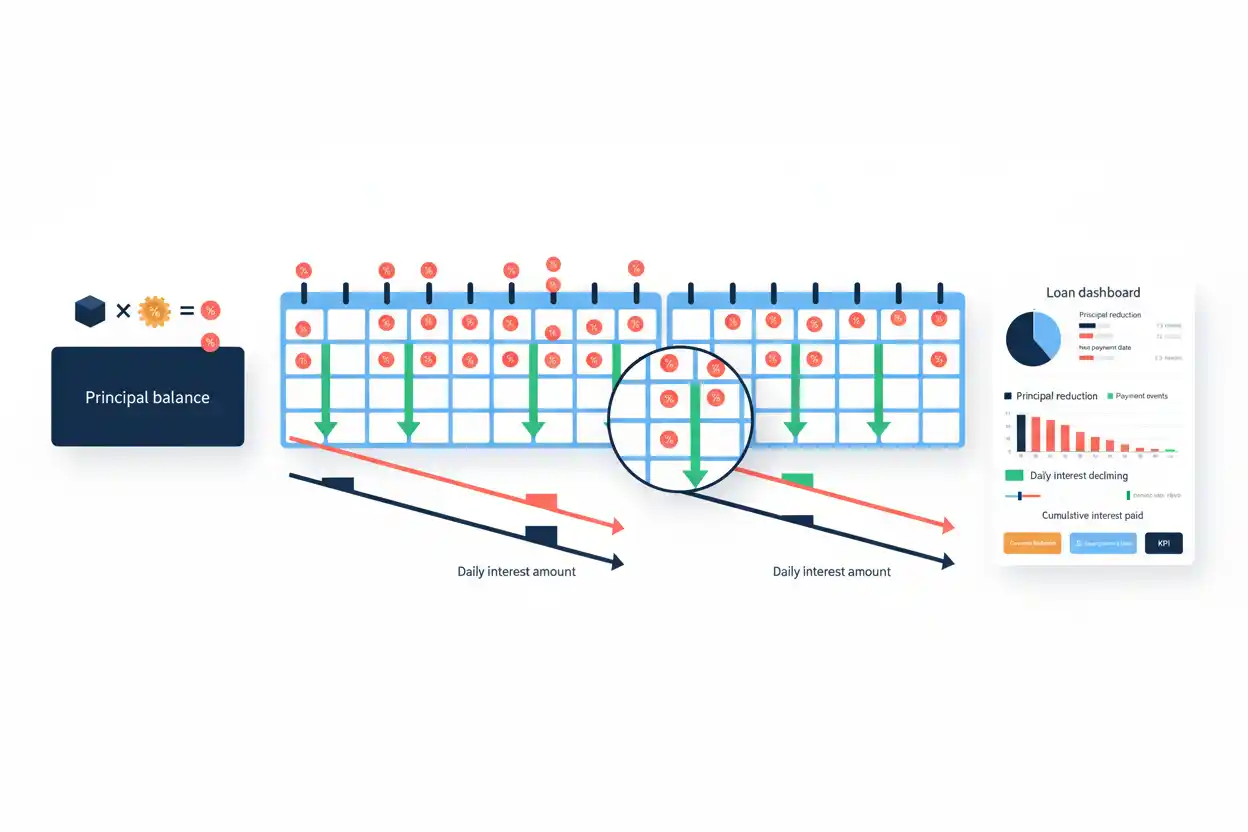

Daily simple interest calculates interest from an outstanding principal balance based on the number of days that balance remains unpaid.
The basic formula is:
Daily Interest = Outstanding Principal × Annual Interest Rate ÷ Day-Count Basis
Then:
Interest for Period = Daily Interest × Number of Days
Suppose you owe $10,000 at an 8% annual rate using a 365-day basis.
Daily interest is:
Daily Interest = $10,000 × 8% ÷ 365
Daily Interest ≈ $2.19
If 30 days pass with the balance unchanged:
Interest = $2.19 × 30
Using the full-precision calculation:
Interest ≈ $65.75
The key feature is that interest depends on both principal and time.
What Is Daily Simple Interest?
Daily simple interest is an interest-calculation method in which interest is determined from the outstanding principal and the number of elapsed days.
The general equation is:
Interest = Principal × Annual Rate × Days ÷ Day-Count Basis
For a 365-day basis:
Interest = Principal × Annual Rate × Days ÷ 365
Some contracts use different conventions, so the loan agreement controls.
The broader Loans & Credit framework connects daily simple interest with amortization, payments, principal balances, APR, and debt strategies.
Daily Simple Interest Formula
Assume:
Principal = P
Annual rate = R
Number of days = D
Day-count basis = B
Then:
Daily Simple Interest = P × R × D ÷ B
If you want the per-day amount:
Interest Per Day = P × R ÷ B
Using:
P = $20,000
R = 6%
B = 365
Daily Interest = $20,000 × 0.06 ÷ 365
Daily Interest ≈ $3.29
Every additional day with the same principal adds approximately $3.29.
30-Day Daily Simple Interest Example
Suppose:
Loan principal = $20,000
Annual interest rate = 6%
Elapsed time = 30 days
Day-count basis = 365
Calculate:
Interest = $20,000 × 6% × 30 ÷ 365
Interest ≈ $98.63
If a $600 payment is then applied after the interest due is satisfied under the simplified example:
Principal Reduction = $600 − $98.63
Principal Reduction = $501.37
New principal:
New Principal = $20,000 − $501.37
New Principal = $19,498.63
Future daily interest is now lower because the outstanding principal has fallen.
New Daily Interest After Payment
Using the new principal:
Daily Interest = $19,498.63 × 6% ÷ 365
Daily Interest ≈ $3.21
Before the payment, daily interest was about $3.29.
After principal reduction, it falls to about $3.21.
This is the defining advantage of reducing principal earlier on a daily simple-interest loan.
Payment Timing Matters
Suppose a loan balance is $20,000 at 6%.
Daily interest is approximately:
$3.29 per day
Compare making a payment after 25 days versus after 35 days.
25-day interest:
Interest = $20,000 × 6% × 25 ÷ 365
Interest ≈ $82.19
35-day interest:
Interest = $20,000 × 6% × 35 ÷ 365
Interest ≈ $115.07
Difference:
Additional Interest ≈ $115.07 − $82.19
Additional Interest ≈ $32.88
Ten additional days produce roughly $32.88 of additional interest while principal remains unchanged.
Why Early Payments Can Reduce Interest
If a payment reaches the lender earlier and reduces principal earlier, future daily interest can be calculated from a smaller balance.
Suppose $5,000 is applied to principal 10 days earlier than originally expected.
At an 8% annual rate:
Daily Interest Saved on $5,000 = $5,000 × 8% ÷ 365
Daily Savings ≈ $1.10
Across 10 days:
Approximate Interest Saved = $1.10 × 10
Approximate Savings ≈ $10.96
This assumes the payment is actually applied to principal on the earlier date and no contractual feature changes the calculation.
Daily Simple Interest vs Accrued Interest
Accrued interest is interest that has accumulated but has not yet been paid.
Daily simple interest is one method by which that accrued interest can be generated.
For example:
Principal = $10,000
Daily interest = $2.19
Days elapsed = 20
Accrued Interest ≈ $2.19 × 20
Accrued Interest ≈ $43.84
Thus, accrued interest describes the amount accumulated, while daily simple interest describes the method used to calculate it.
Daily Simple Interest vs Simple Interest Loan
A simple interest loan calculates interest based on principal rather than charging interest on prior interest in the same manner as a compounding loan.
Daily simple interest is simply a version in which time is measured daily.
The formula is:
Interest = Principal × Rate × Time
with:
Time = Days ÷ Day-Count Basis
Daily Simple Interest vs Compound Interest
A compound interest loan allows interest to become part of the balance on which future interest is calculated.
Daily simple interest does not inherently do that.
Suppose $100 of interest accrues on a daily simple-interest loan.
If future interest continues to be calculated only from the outstanding principal and the $100 remains separate, the $100 does not itself generate additional interest.
That is the conceptual distinction.
Daily Simple Interest and Amortization
A daily simple-interest loan can still be an amortizing loan.
Amortization describes balance repayment.
Daily simple interest describes interest calculation.
For example, an auto loan can require monthly payments while calculating interest daily from the outstanding principal.
The two concepts therefore coexist.
Daily Simple Interest and Principal Balance
The principal balance is central to daily simple interest because principal is the base used in the calculation.
If principal falls 20%, the daily interest expense also falls 20% when the annual rate remains unchanged.
For example:
Old principal = $10,000
New principal = $8,000
Rate = 8%
Old daily interest:
$10,000 × 8% ÷ 365 ≈ $2.19
New daily interest:
$8,000 × 8% ÷ 365 ≈ $1.75
Principal reduction immediately affects future daily interest.
Daily Simple Interest and Auto Loans
Many auto loans calculate simple interest on the outstanding balance either daily or monthly.
This means the actual amount of interest between payments can depend on how many days pass.
The auto loan payments page focuses on scheduled payment size, while auto loan APR focuses on annualized borrowing cost.
Daily simple interest owns the day-by-day interest calculation.
Daily Simple Interest and Credit Score Factors
The credit score factors page addresses credit-report information and scoring.
Daily simple interest does not directly calculate a credit score.
However, payment behavior on a reported loan can affect the borrower’s credit history.
Interest mathematics and credit scoring therefore remain separate.
Daily Simple Interest and Credit Utilization
The credit utilization ratio applies primarily to revolving-credit balances relative to revolving limits.
Daily simple interest often appears on installment debt.
Therefore, do not calculate credit-card utilization by adding a daily simple-interest auto or personal loan to revolving balances.
They answer different questions.
Daily Simple Interest and Debt Avalanche
The debt avalanche prioritizes higher-interest debt.
When one of the debts uses daily simple interest, paying principal earlier can reduce interest immediately.
However, debt prioritization should still compare rates, balances, minimum payments, penalties, and other contractual costs across all obligations.
Daily Simple Interest and Debt Consolidation
Debt consolidation can replace several obligations with a new loan.
If the new consolidation loan uses daily simple interest, payment timing and principal reduction will influence its cost.
A lower advertised rate does not automatically guarantee savings if the new term is substantially longer or fees are high.
Daily Interest and Payoff Quotes
Suppose:
Principal = $15,000
Annual rate = 7.5%
Daily interest basis = 365
Daily interest:
Daily Interest = $15,000 × 7.5% ÷ 365
Daily Interest ≈ $3.08
If a payoff amount is quoted for five days later:
Additional Interest ≈ $3.08 × 5
Additional Interest ≈ $15.41
A loan payoff quote can therefore exceed the displayed principal balance.
Late Payments and Daily Simple Interest
When payment is delayed on a daily simple-interest loan, additional days allow additional interest to accrue.
This can cause more of the eventual payment to be used for interest and less for principal.
That does not mean every late payment consequence is simply interest.
Late fees, reporting consequences, default terms, and other contractual effects can also exist separately.
Extra Principal Payments
An extra principal payment can produce ongoing savings.
Suppose:
Extra principal = $2,000
Annual rate = 9%
Daily interest no longer generated by that $2,000 is:
Daily Savings = $2,000 × 9% ÷ 365
Daily Savings ≈ $0.49
Over 180 days:
Approximate Interest Reduction = $0.49 × 180
Using full precision:
Approximate Savings ≈ $88.77
Actual savings depend on the timing of future payments and the remaining term.
365 vs 366 Days
A daily-interest calculation requires a day-count basis.
Many examples use 365 days.
Some financial products or periods can use another basis, including leap-year conventions.
Therefore, do not automatically assume:
Daily Rate = Annual Rate ÷ 365
without confirming the contract.
The formula itself remains:
Daily Rate = Annual Rate ÷ Contractual Day-Count Basis
Daily Simple Interest vs Precomputed Interest
Under daily simple interest, interest depends on the outstanding balance and elapsed time.
Under a precomputed-interest structure, financing cost can be determined differently at origination and allocated according to the contract.
That difference can affect the value of making payments early or paying additional principal.
Borrowers should identify the loan’s actual calculation method rather than assuming every installment loan behaves the same way.
Common Daily Simple Interest Mistakes
One common mistake is multiplying the annual rate by the number of days without dividing by the day-count basis.
Another is calculating interest from the original loan amount after principal has declined.
Borrowers also sometimes assume every month contains exactly 30 interest days.
Another mistake is confusing the APR with the contractual interest rate used in the daily calculation.
Finally, an early payment only reduces future interest if it is applied in a way that actually reduces outstanding principal earlier.
Frequently Asked Questions
What is daily simple interest?
It is interest calculated from an outstanding principal balance based on the number of days the balance remains unpaid.
What is the daily simple interest formula?
Interest = Principal × Annual Rate × Days ÷ Day-Count Basis
How do I calculate interest per day?
Daily Interest = Principal × Annual Rate ÷ Day-Count Basis
What is the daily interest on $10,000 at 8%?
Using 365 days:
$10,000 × 8% ÷ 365 ≈ $2.19 per day
Does paying early save interest?
It can when the payment reduces principal earlier under the loan’s terms.
Does paying late increase interest?
On a daily simple-interest loan, additional elapsed days generally allow more interest to accrue.
Is daily simple interest compound interest?
No. Simple interest does not inherently charge interest on previously accrued interest.
Can an amortizing loan use daily simple interest?
Yes. Amortization and the interest-calculation method are separate features.
Is APR used in the daily simple-interest formula?
Use the contractual annual interest rate required by the loan terms, which may differ from APR.
Does the daily rate change when principal changes?
The percentage rate can remain unchanged, but the dollar amount of daily interest falls when principal falls.
Why is my payoff amount higher than my principal?
Interest can continue accruing between the last payment and the payoff date.
Should I always use 365 days?
No. Use the day-count convention stated in the loan agreement.
Final Takeaway
Daily simple interest calculates financing cost from three main inputs:
Principal × Annual Rate × Time
When time is measured in days:
Interest = Principal × Annual Rate × Days ÷ Day-Count Basis
A $20,000 balance at 6% for 30 days produces approximately $98.63 of interest on a 365-day basis.
If a $600 payment then reduces principal by approximately $501.37, the balance falls to about $19,498.63 and future daily interest falls with it.
The central principle is simple: every day and every dollar of outstanding principal can affect the interest calculation.