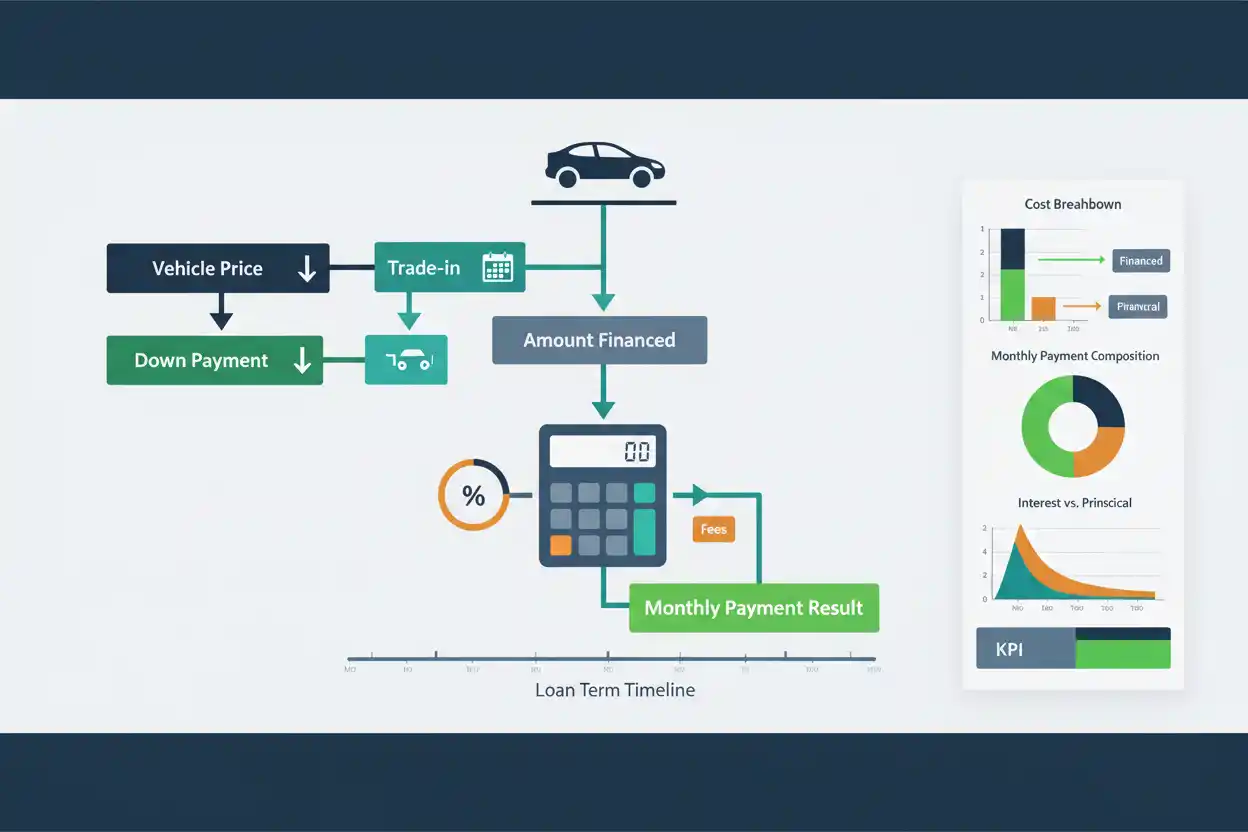

Auto loan payments depend primarily on how much you finance, the contractual interest rate, and the number of payments in the loan term.
The vehicle’s advertised price is only the starting point.
Taxes, registration charges, dealer fees, optional financed products, down payment, rebates, trade-in equity, and negative equity can all change the actual amount financed.
Once that financed amount is known, a standard fixed-rate amortization formula can calculate the scheduled principal-and-interest payment.
Auto Loan Payment = P × [r(1 + r)^n] ÷ [(1 + r)^n − 1]
where:
P = amount financed
r = periodic interest rate
n = number of scheduled payments
Understanding each input is more useful than focusing only on the monthly figure shown by a dealer or online calculator.
What Are Auto Loan Payments?
Auto loan payments are scheduled amounts used to repay vehicle financing.
For a standard amortizing loan, each payment normally contains:
interest generated by the remaining balance and principal repayment that reduces the debt.
The payment can remain constant while the allocation changes.
Early in the term, more of the payment typically goes toward interest because the balance is higher.
Later, more goes toward principal.
The broader Loans & Credit cluster places auto financing alongside APR, loan terms, interest calculations, fees, and payoff concepts.
Auto Loan Payment Formula
For a fixed-rate loan with equal periodic payments:
Payment = P × [r(1 + r)^n] ÷ [(1 + r)^n − 1]
For monthly payments:
Monthly Rate = Annual Interest Rate ÷ 12
And:
Number of Payments = Loan Term in Years × 12
Suppose:
Annual rate = 6.5%
Term = 5 years
Then:
Monthly Rate = 6.5% ÷ 12
Monthly Rate ≈ 0.541667%
and:
Number of Payments = 5 × 12 = 60
Calculate the Amount Financed First
Before calculating the payment, determine how much is actually being financed.
A useful framework is:
Amount Financed = Vehicle Price + Financed Taxes and Fees + Financed Add-Ons + Negative Equity − Down Payment − Trade-In Credit − Applicable Rebates
Not every transaction contains all of these items.
For a simplified example:
Vehicle price = $32,000
Financed taxes and fees = $1,200
Down payment = $4,000
Positive trade-in equity = $3,000
Then:
Amount Financed = $32,000 + $1,200 − $4,000 − $3,000
Amount Financed = $26,200
That is the amount used in the payment example.
Auto Loan Payment Example
Assume:
Amount financed = $26,200
Annual interest rate = 6.5%
Term = 60 months
Step 1: Calculate Monthly Rate
Monthly Rate = 6.5% ÷ 12
Monthly Rate = 0.00541667
Step 2: Set the Number of Payments
n = 60
Step 3: Apply the Formula
Payment = $26,200 × [0.00541667(1.00541667)^60] ÷ [(1.00541667)^60 − 1]
The approximate payment is:
Monthly Auto Loan Payment ≈ $512.63
The borrower would therefore pay about $512.63 per month under these assumptions.
Total Payments and Total Interest
Monthly affordability is only part of the analysis.
Total scheduled payments are:
Total Payments = Monthly Payment × Number of Payments
Total Payments ≈ $512.63 × 60
Using full precision:
Total Payments ≈ $30,757.98
Total interest is approximately:
Total Interest = $30,757.98 − $26,200
Total Interest ≈ $4,557.98
Therefore, the $26,200 financed balance produces approximately $4,558 of interest over the five-year term under the example assumptions.
How Loan Term Changes Auto Loan Payments
The loan term has a major effect on monthly payment.
Using the same $26,200 principal and 6.5% rate:
| Term | Approx. Payment | Approx. Total Interest |
|---|---|---|
| 48 months | $621.33 | $3,623.92 |
| 60 months | $512.63 | $4,557.98 |
| 72 months | $440.42 | $5,510.25 |
The 72-month loan reduces the payment by about $181 compared with the 48-month loan.
However, it generates roughly $1,886 more total interest.
This illustrates one of the most important vehicle-financing principles:
Longer Term → Lower Payment, But Usually Higher Total Interest
when principal and rate remain constant.
How Interest Rate Changes the Payment
A higher rate increases the amount of interest generated by the outstanding balance.
For the same principal and term, that normally increases the payment.
The exact relationship is nonlinear because each payment also changes the remaining principal.
This is why auto loan APR and the contractual interest rate should be examined before accepting a monthly quote.
Auto Loan Rate vs APR
The contractual rate drives the standard principal-and-interest payment.
APR expresses annualized borrowing cost and can reflect qualifying finance charges.
A loan could therefore have:
Interest rate = 6.5%
APR = 7.0%
while its scheduled payment is still calculated from the contractual 6.5% rate and financed amount.
The difference matters when comparing offers with different fees.
Auto Loan Payments vs APR vs APY
APR vs APY explains why these annual percentages should not be mixed.
APR is relevant to borrowing.
APY is generally used to describe annual yield after compounding.
Neither replaces the payment calculation.
Auto Loan Payment Amortization
Each payment on a typical fixed-rate amortizing vehicle loan can be divided into interest and principal.
Suppose the starting balance is $26,200 and the monthly rate is 0.541667%.
First-month interest is approximately:
Interest = $26,200 × 0.00541667
Interest ≈ $141.92
Principal reduction is:
Principal Paid = $512.63 − $141.92
Principal Paid ≈ $370.71
The approximate ending balance becomes:
New Principal Balance = $26,200 − $370.71
New Principal Balance ≈ $25,829.29
The next month’s interest is calculated from the lower balance under a standard monthly simple-interest illustration.
A complete repayment schedule repeats this process throughout the loan.
Principal Balance
The principal balance is the remaining amount of borrowed principal.
It should not be confused with the sum of all remaining scheduled payments.
For example, a $20,000 principal balance may correspond to more than $20,000 of future payments because those payments also contain future interest.
Simple Interest Auto Loans
Many vehicle loans use simple interest loan mechanics.
Interest is based on the outstanding balance.
If the loan accrues interest daily, the daily simple interest amount depends on the balance, annual rate, and number of elapsed days.
Payment timing can therefore affect the interest allocation on some loans.
Fees and Auto Loan Payments
A financing fee can affect an auto loan in two different ways.
If it is added to the principal, the amount financed rises, which can increase the payment.
If it is treated as a prepaid finance charge, it can affect APR even if it does not increase the financed balance in the same manner.
The loan origination fee page explains fee mechanics separately.
Down Payment Impact
A larger down payment reduces the principal financed when all other transaction terms remain unchanged.
Suppose the buyer increases the down payment by $3,000.
The financed amount falls from $26,200 to:
New Amount Financed = $26,200 − $3,000
New Amount Financed = $23,200
At the same 6.5% rate and 60-month term, the payment would fall accordingly.
The benefit comes from borrowing less, not from a special change in the amortization formula.
Trade-In Equity
Positive trade-in equity can reduce the amount financed.
For example:
Trade value = $12,000
Loan payoff on trade = $8,000
Then:
Trade Equity = $12,000 − $8,000
Trade Equity = $4,000
That $4,000 can reduce the new transaction balance when applied as credit.
Negative Equity
Negative equity occurs when the amount owed on the trade exceeds its value.
Suppose:
Trade value = $12,000
Existing payoff = $16,000
Then:
Negative Equity = $16,000 − $12,000
Negative Equity = $4,000
If that $4,000 is rolled into the new financing, it increases the amount borrowed.
That can create a higher payment and leave the borrower owing substantially more than the replacement vehicle’s purchase price.
Auto Loan Payments vs Car Payments
Car payments is a broader concept that can include affordability and principal-versus-interest analysis.
This page specifically owns the auto loan payment calculation using rate, term, fees, down payment, and amount financed.
Auto Loan Payments vs Leasing
Auto lease payments use residual value, depreciation, rent charge, and a lease term rather than a traditional principal payoff schedule.
A lease payment can therefore be lower without being mathematically comparable to an auto loan payment.
At the end of a fully repaid vehicle loan, the borrower normally owns the vehicle free of that loan.
At the end of a typical lease, the vehicle is generally returned unless a purchase option is exercised.
Auto Loan Payments vs Boat Loan Payments
Boat loan payments can use the same amortization mathematics.
However, boat financing can involve different principal amounts, collateral characteristics, terms, fees, and rates.
The formula is reusable; the underwriting assumptions are not.
Credit and Loan Payment Size
A borrower’s credit profile can affect the offered interest rate.
The credit score factors page explains the broader credit-scoring context.
If a weaker credit profile results in a higher rate, the payment rises even if the vehicle price and term remain unchanged.
Debt-to-Income Ratio
The debt-to-income ratio compares recurring debt payments with gross income.
A payment that a lender approves can still be uncomfortable within an individual’s actual household budget.
Therefore, auto affordability should consider housing, insurance, fuel, maintenance, taxes, savings, and other obligations in addition to the car payment.
Fixed vs Variable Rates
Most familiar vehicle-loan examples assume a fixed rate.
A fixed vs variable interest rate structure changes the analysis because a variable rate may alter future payment calculations or interest cost.
Always match the formula to the contract.
Prepayment
If extra money reduces principal, future interest can fall on many declining-balance loans.
However, review the contract for any prepayment penalty and verify how extra amounts are applied.
Do not assume an additional payment automatically reduces principal immediately.
Loan Payoff Amount
The scheduled balance is not always identical to the amount required to close the loan today.
A loan payoff quote can include interest accrued since the latest payment and other contractual amounts.
This distinction becomes important when selling or refinancing a vehicle.
Balance Transfer Fees Are Different
A balance transfer fee relates to moving revolving card debt.
It does not belong inside an ordinary auto loan payment formula.
The comparison is useful because both illustrate a broader financing principle: fees and rates must be analyzed separately from the headline payment.
Common Auto Loan Payment Mistakes
A common mistake is calculating the loan from the vehicle price while ignoring financed taxes, fees, add-ons, or negative equity.
Another is entering the annual rate directly into a formula that expects a monthly rate.
A third is using the number of years instead of the number of monthly payments.
Borrowers also frequently choose a long term simply because the monthly payment appears affordable.
Finally, a payment quote should not be accepted without confirming the amount financed and contractual rate behind it.
Frequently Asked Questions
How do I calculate an auto loan payment?
For a standard fixed-rate loan:
Payment = P × [r(1 + r)^n] ÷ [(1 + r)^n − 1]
What determines my auto loan payment?
The main inputs are amount financed, contractual interest rate, and number of payments.
Do fees increase the monthly payment?
They can if they are financed and therefore increase the principal.
Does a larger down payment lower the payment?
Yes, when it reduces the amount financed and other terms stay the same.
Does a trade-in reduce the payment?
Positive trade equity can reduce the amount financed. Negative equity can increase it.
Is APR used to calculate the payment?
The contractual rate generally drives the scheduled interest calculation, while APR measures annualized borrowing cost.
Why does a longer loan have a lower payment?
The principal is spread over more payment periods, although the borrower generally pays interest for longer.
Does a longer term cost more?
Usually, when the principal and interest rate are otherwise identical, because interest accrues over a longer period.
Can I lower my payment by refinancing?
Potentially. A lower rate, longer term, reduced balance, or combination of those factors can lower the payment, although extending the term may increase total cost.
What should I compare besides the payment?
Compare amount financed, APR, interest rate, term, total interest, fees, optional products, and prepayment terms.
Final Takeaway
Auto loan payments are driven by the amount financed, periodic interest rate, and repayment term.
For a standard fixed-rate loan:
Payment = P × [r(1 + r)^n] ÷ [(1 + r)^n − 1]
Financing $26,200 at 6.5% for 60 months produces a payment of approximately $512.63 and total interest of roughly $4,557.98.
Extending the same example to 72 months reduces the payment to about $440.42, but total interest rises to approximately $5,510.25.
The most useful auto-loan comparison therefore begins with the complete amount financed—not the advertised vehicle price—and evaluates rate, APR, term, fees, monthly payment, and total cost together.