
A loan term is the length of time scheduled for repaying a loan.
It can be expressed in:
months, years, weeks, or another contractual payment period.
For a conventional monthly-payment loan:
Number of Payments = Loan Term in Years × 12
A five-year loan therefore contains:
5 × 12 = 60 Monthly Payments
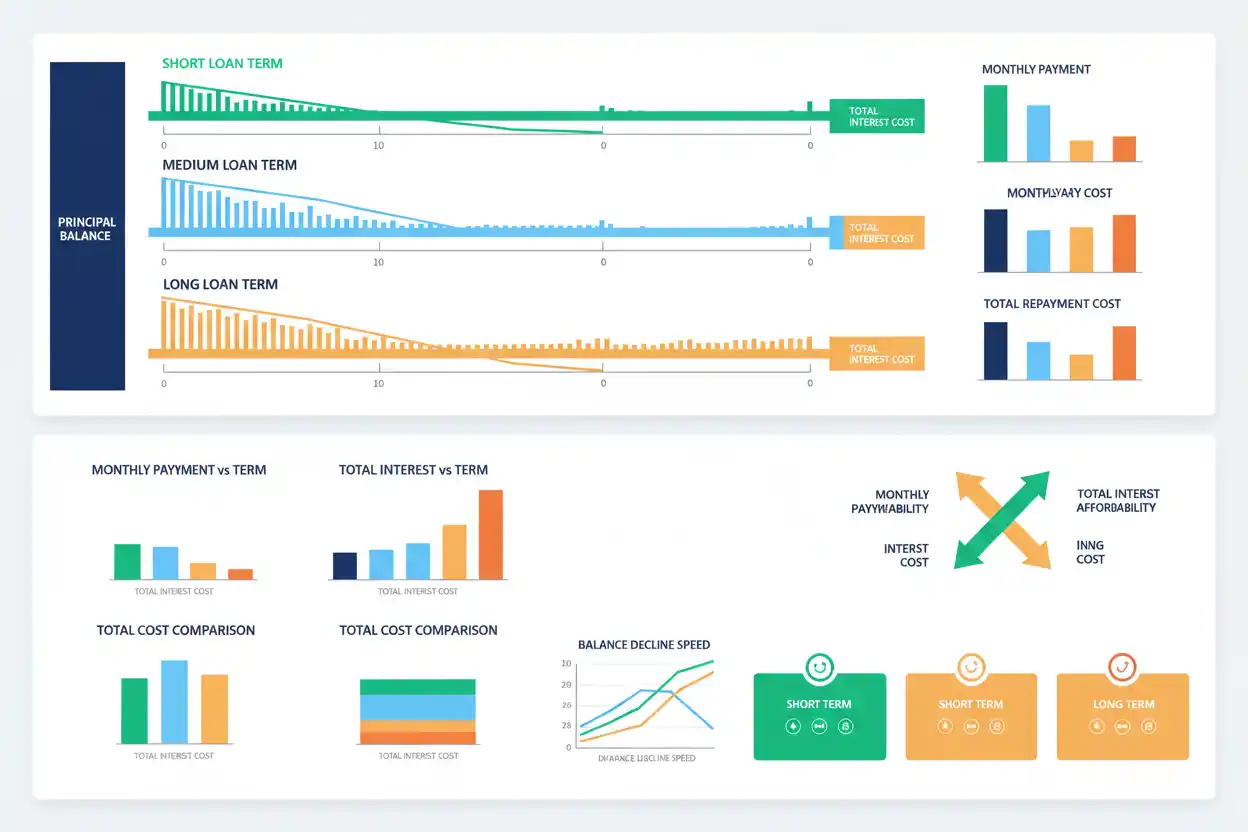
Loan term matters because it directly affects the relationship between monthly payment and total interest.
A shorter term generally requires larger payments but repays principal faster.
A longer term generally reduces the monthly payment but keeps the borrower in debt for longer and usually increases total interest when principal and rate remain unchanged.
That tradeoff makes loan term one of the most important variables in Loans & Credit and the broader Finance framework.
What Is a Loan Term?
Loan term is the contractual repayment period.
Suppose a borrower receives a loan on January 1, 2027, with a five-year scheduled term.
The debt is designed to remain outstanding until approximately the corresponding maturity date in 2032 unless:
the borrower prepays, refinances, defaults, modifies the agreement, or another contractual event changes the schedule.
Loan term should not be confused with:
interest rate, amortization period, remaining term, or payment frequency.
Those variables can interact without being identical.
Loan Term Formula
If the loan term is known:
Number of Payments = Term × Payments Per Year
For monthly payments:
n = Years × 12
For biweekly payments:
n = Years × 26
For quarterly payments:
n = Years × 4
The payment formula then uses n as the number of periods.
Loan Payment Formula With Term
For a standard fixed-rate amortizing loan:
Payment = P × [r(1 + r)^n] ÷ [(1 + r)^n − 1]
Where:
P = principal
r = periodic interest rate
n = total number of payments
The loan payments page owns the complete payment calculation.
Here, the focus is what happens when n, the term, changes.
Loan Term Example
Suppose:
Principal = $30,000
Annual interest rate = 8%
Payments = monthly
Compare three terms:
36 months
60 months
84 months
36-Month Term
Monthly Payment ≈ $940.09
Total payments:
$940.09 × 36 ≈ $33,843.27
Total interest:
Interest ≈ $3,843.27
60-Month Term
Monthly Payment ≈ $608.29
Total payments:
≈ $36,497.51
Total interest:
≈ $6,497.51
84-Month Term
Monthly Payment ≈ $467.59
Total payments:
≈ $39,277.26
Total interest:
≈ $9,277.26
Loan Term Comparison
| Loan Term | Approx. Monthly Payment | Approx. Total Interest |
|---|---|---|
| 36 months | $940.09 | $3,843.27 |
| 60 months | $608.29 | $6,497.51 |
| 84 months | $467.59 | $9,277.26 |
Extending the loan from 36 to 84 months reduces the monthly payment by approximately:
$940.09 − $467.59 = $472.50
But total interest increases by approximately:
$9,277.26 − $3,843.27 = $5,433.99
The borrower gains almost $473 of monthly cash-flow relief but pays more than $5,400 of additional interest.
Why Longer Terms Lower Payments
A longer term spreads principal across more payments.
Consider only the principal portion conceptually.
Without interest:
$30,000 over 36 months:
$30,000 ÷ 36 ≈ $833.33
$30,000 over 84 months:
$30,000 ÷ 84 ≈ $357.14
Interest makes the actual payments higher, but the same basic effect remains.
More repayment periods reduce the amount of principal that must be recovered each month.
Why Longer Terms Increase Interest
Interest is charged while principal remains outstanding.
A longer term keeps principal unpaid for more time.
Therefore:
Longer Time in Debt → More Opportunities for Interest to Accrue
This is true even when the monthly rate remains unchanged.
The lower payment is achieved partly by slowing principal reduction.
Short-Term Loan Advantages
A shorter loan term can provide:
faster debt elimination, lower total interest, quicker equity accumulation in a financed asset, and less exposure to long-term interest-rate or collateral risk.
The tradeoff is higher required payments.
That can strain cash flow if the loan is too aggressively structured.
Long-Term Loan Advantages
A longer term can provide:
lower monthly payments and more short-term liquidity.
This can be useful when preserving monthly cash flow is essential.
However, the borrower should not confuse affordability today with low total cost.
Loan Term vs Maturity
Loan term and maturity are often closely related, but some contracts distinguish between an amortization period and a maturity date.
For example, a business loan might calculate payments as if the debt were being repaid over 20 years but require the remaining balance after five years.
In that case:
Amortization period = 20 years
Contractual maturity = 5 years
A balloon balance remains due at maturity.
Therefore, always verify whether “term” means:
payment-calculation period, legal maturity, or both.
Remaining Loan Term
After payments begin, the remaining term is shorter than the original term.
Suppose:
Original term = 60 months
Payments already made = 18
Ignoring modifications:
Remaining Term = 60 − 18
Remaining Term = 42 Months
The remaining term matters when refinancing because a new 60-month loan would extend the debt beyond the original scheduled payoff date.
Calculating Term From Payment
If principal, periodic rate, and payment are known, the number of payments can be solved algebraically:
n = −ln(1 − rP ÷ Payment) ÷ ln(1 + r)
Suppose:
Principal = $25,000
Annual rate = 8%
Monthly payment = $600
Monthly rate:
r = 8% ÷ 12
r ≈ 0.0066667
Then:
n ≈ −ln(1 − (0.0066667 × $25,000 ÷ $600)) ÷ ln(1.0066667)
n ≈ 48.98 Months
The loan would require approximately 49 monthly payments, with the final payment adjusted for the exact remaining amount.
Payment Must Exceed Interest
The term formula only works when the payment is large enough to reduce principal.
Suppose:
Principal = $25,000
Monthly rate = 1%
Monthly interest:
Interest = $25,000 × 1%
Interest = $250
If the payment is only $200, it does not cover the simplified monthly interest.
A conventional positive amortization term cannot be calculated from that $200 payment because the balance would not decline under those assumptions.
Loan Term and EMI
An EMI calculation uses the number of monthly installments as one of its core inputs.
Longer tenure reduces EMI when principal and rate stay constant.
However, a long EMI schedule also increases the cumulative interest burden.
The correct term is therefore a balance between:
monthly affordability and total financing cost.
Loan Term and Interest Rate Basics
The interest rate basics page explains why the rate and term must be considered together.
A 5% loan over 20 years can cost more total interest than a 7% loan over three years.
The lower percentage is only one dimension of borrowing cost.
Loan Term and Nominal vs Effective Rates
The nominal vs effective interest rate distinction matters because periodic compounding can change the annual economic rate.
Term determines how long those periodic costs continue.
A small difference in effective rate can become material across a very long borrowing period.
Loan Term and APR
APR provides an annualized borrowing-cost measure.
Two loans with identical APRs can still generate different total dollar interest when their terms differ.
APR standardizes rate comparison.
Term determines how long the debt and its financing costs remain outstanding.
Loan Term and Origination Fees
A loan origination fee can affect short and long loans differently.
Suppose both loans charge a $500 upfront fee.
Loan A lasts six months.
Loan B lasts five years.
The same $500 cost represents a much heavier annualized burden on Loan A because the borrower pays the fee for a much shorter period of financing.
Loan Term and Loan Payoff Quotes
A loan payoff quote shows the amount required to end the loan before its remaining scheduled term expires.
Early payoff can reduce the time during which interest is generated.
For a long-term loan, the amount of future interest avoided can be substantial.
Loan Term and Amortization
An amortizing loan is structured so scheduled payments reduce principal across the chosen term.
A longer term changes the entire amortization path.
Principal falls more slowly.
As a result, the borrower can remain exposed to a relatively large balance for longer.
Loan Term and Repayment Schedules
A repayment schedule makes term differences visible.
Compare the balance after 24 months on:
a 36-month loan and an 84-month loan.
The shorter loan will generally have reduced principal much more aggressively.
That can matter when the financed asset is depreciating.
Auto Loan Term
Auto loan payments can be reduced dramatically by stretching vehicle financing across more years.
However, a longer auto-loan term can increase the risk that the borrower owes more than the vehicle is worth during part of the loan.
The payment is smaller because principal is being repaid more slowly.
Personal Loan Term
Personal loan payments similarly decline as term expands.
For debt consolidation, extending the term too far can undermine the benefit of receiving a lower interest rate.
A consolidation loan should produce both:
a manageable payment and a credible debt-free date.
Business Loan Term
Business loan payments should ideally align with the useful economic life and cash-generation profile of whatever the financing supports.
Financing a short-lived asset over a very long term can leave the business paying for an asset after its economic benefit has largely disappeared.
Boat Loan Term
Boat loan payments can use particularly long terms.
That can make high-priced assets appear affordable on a monthly basis while generating significant total interest.
Long terms can also increase the period during which outstanding debt exceeds resale value.
Loan Term and Fixed vs Variable Rates
The fixed vs variable interest rate choice becomes more important as term length increases.
A one-year variable loan has limited time for rate changes.
A 15-year variable loan gives market rates many opportunities to move.
Longer terms therefore increase exposure to rate-reset uncertainty.
Loan Term and Flat vs Reducing Balance Interest
The flat vs reducing balance interest calculation method can magnify term differences.
A flat-rate loan continues using the original principal as its stated interest base.
Over a long term, that can create a much larger effective borrowing cost than a similar reducing-balance rate.
Loan Term and Principal Balance
The principal balance declines according to the amortization schedule.
A long term usually means slower principal reduction.
That matters for:
refinancing, asset sales, equity, and early payoff.
Loan Term and DTI
The debt-to-income ratio can improve when a longer term reduces the required monthly payment.
Suppose:
Gross monthly income = $5,000
36-month payment = $940.09
DTI contribution:
$940.09 ÷ $5,000 × 100 ≈ 18.8%
84-month payment = $467.59
$467.59 ÷ $5,000 × 100 ≈ 9.4%
The longer term cuts the immediate DTI contribution roughly in half, but total interest rises sharply.
Loan-to-Income Ratio
The loan-to-income ratio compares the loan amount with income rather than monthly payment.
Changing the term does not change the original principal borrowed.
Therefore, a term extension can reduce DTI without reducing loan-to-income.
The borrower still owes the same initial principal.
Loan Term and Prepayment
A prepayment penalty can affect borrowers who choose a long contractual term but intend to pay early.
If no meaningful penalty applies, the longer term may provide payment flexibility while extra principal is paid voluntarily.
However, that strategy requires discipline.
If extra payments stop, the borrower remains on the longer and more expensive schedule.
How to Choose a Loan Term
A useful decision process is to compare at least three terms.
For each one, calculate:
monthly payment, total interest, total repayment, time to debt freedom, cash-flow margin, and relevant collateral risk.
Then choose the shortest term whose required payment remains comfortably sustainable—not merely technically possible.
Common Loan Term Mistakes
One mistake is choosing the longest available term solely to obtain the lowest payment.
Another is comparing loan payments without holding principal and rate constant.
Borrowers also confuse remaining term with original term.
A fourth mistake is assuming a lower DTI automatically means a cheaper loan.
Finally, a long term can conceal significant total interest because the additional cost is spread across many small monthly payments.
Frequently Asked Questions
What is a loan term?
It is the length of time scheduled for repaying a loan.
How do I convert years to monthly payments?
Number of Payments = Years × 12
How many payments are in a five-year monthly loan?
5 × 12 = 60 Payments
Does a longer term lower monthly payments?
Generally yes, when principal and rate stay unchanged.
Does a longer term increase interest?
Generally yes because principal remains outstanding longer.
Is loan term the same as amortization period?
Not always. Some loans amortize over one period but mature earlier with a balloon balance.
Can I calculate loan term from payment?
Yes, for a conventional fixed-rate loan:
n = −ln(1 − rP ÷ Payment) ÷ ln(1 + r)
Can I shorten my loan term by paying extra?
Often yes when extra money reduces principal, subject to the loan agreement.
Does refinancing restart the loan term?
A refinance creates a new loan with its own term. Choosing a long new term can extend repayment beyond the original payoff date.
Is a shorter loan always better?
No. A payment that is too high can create cash-flow stress. The term must remain affordable.
Does term affect APR?
Term can influence APR calculations and lender pricing, but APR and term remain distinct measurements.
What should I compare when choosing a term?
Compare monthly payment, total interest, total repayment, rate, APR, fees, cash-flow capacity, and expected time you will keep the debt or financed asset.
Final Takeaway
Loan term determines how long repayment is scheduled to continue.
For monthly loans:
Number of Payments = Loan Term in Years × 12
On a $30,000 loan at 8%, extending the term from 36 to 84 months changes the payment from approximately:
$940.09 → $467.59 per Month
but increases total interest from approximately:
$3,843.27 → $9,277.26
The longer term creates substantial monthly relief, but it adds roughly $5,434 of additional interest.
That is the central loan-term tradeoff: short terms demand more cash now; long terms make the debt easier to carry each month but usually more expensive to carry overall.