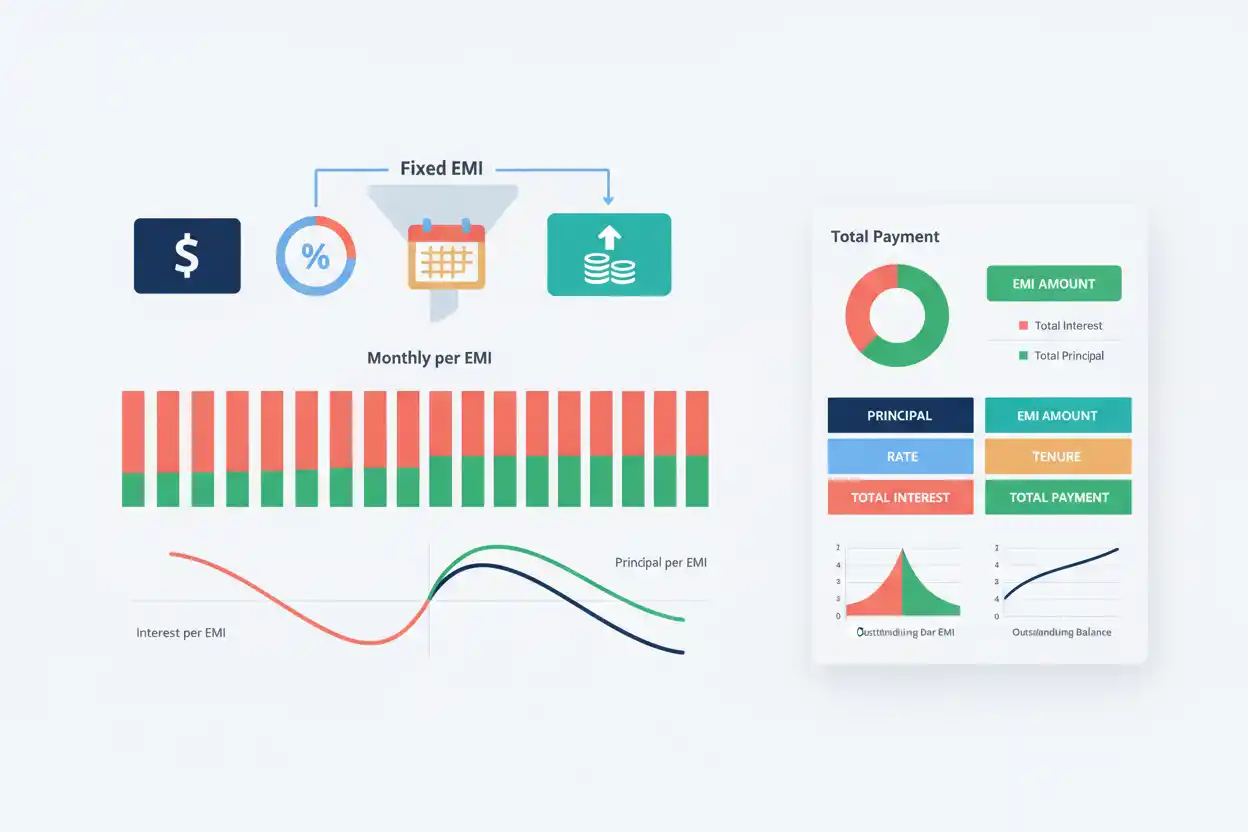

EMI, or equated monthly installment, is a fixed monthly payment commonly used to repay an amortizing loan over a defined term.
Each EMI generally contains two components:
interest, which represents the cost of borrowing, and principal, which reduces the outstanding loan balance.
Although the EMI can remain constant on a fixed-rate loan, the amount allocated to principal and interest changes over time. Early payments normally contain more interest because the outstanding balance is larger. Later payments contain more principal because the balance has declined.
The standard EMI formula is:
EMI = P × [r(1 + r)ⁿ] ÷ [(1 + r)ⁿ − 1]
Where:
P = loan principal
r = periodic interest rate
n = total number of installments
The concept sits at the center of many calculations in the Loans & Credit cluster and is one of the core borrowing calculations within Finance.
What Is EMI?
EMI means equated monthly installment.
It is the scheduled monthly payment required to repay a loan over an agreed period when the loan follows a conventional amortization structure.
Suppose a lender advances $100,000 for five years at a fixed annual rate.
The lender calculates a monthly payment large enough to:
pay the interest generated by the remaining principal and reduce principal sufficiently so that the scheduled balance reaches approximately zero after the final installment.
This is closely related to the broader loan payments calculation, but EMI specifically describes an equal monthly installment structure.
EMI Formula
The formula is:
EMI = P × [r(1 + r)ⁿ] ÷ [(1 + r)ⁿ − 1]
The most common mistake is inserting an annual percentage directly into r.
For monthly installments:
Monthly Interest Rate = Annual Nominal Interest Rate ÷ 12
If the annual rate is 12%:
Monthly Rate = 12% ÷ 12
Monthly Rate = 1%
As a decimal:
r = 0.01
If the term is five years:
Number of Installments = 5 × 12
n = 60
EMI Example
Suppose:
Loan principal = $100,000
Annual interest rate = 12%
Loan term = 5 years
Payment frequency = monthly
Step 1: Convert the Annual Rate
Monthly Rate = 12% ÷ 12 = 1%
Therefore:
r = 0.01
Step 2: Calculate Number of Payments
n = 5 × 12
n = 60
Step 3: Apply the EMI Formula
EMI = $100,000 × [0.01(1.01)⁶⁰] ÷ [(1.01)⁶⁰ − 1]
The result is approximately:
EMI = $2,224.44 per Month
The borrower therefore makes approximately 60 monthly payments of $2,224.44, subject to lender rounding and actual contractual terms.
Total Repayment
The monthly payment alone does not reveal the total cost.
Using full-precision calculations:
Total Payments ≈ $2,224.44 × 60
Total Payments ≈ $133,466.69
Total interest is approximately:
Total Interest = $133,466.69 − $100,000
Total Interest ≈ $33,466.69
Therefore, the borrower receives $100,000 of principal and repays roughly $133,467 over the five-year term under the example assumptions.
How the First EMI Is Split
The first month’s interest is:
First-Month Interest = Outstanding Principal × Monthly Rate
First-Month Interest = $100,000 × 1%
First-Month Interest = $1,000
The remainder reduces principal:
Principal Repaid = EMI − Interest
Principal Repaid = $2,224.44 − $1,000
Principal Repaid = $1,224.44
The approximate new principal balance becomes:
New Balance = $100,000 − $1,224.44
New Balance = $98,775.56
Second EMI
Second-month interest is calculated from the lower balance:
Interest ≈ $98,775.56 × 1%
Interest ≈ $987.76
Principal repayment becomes:
Principal Repaid ≈ $2,224.44 − $987.76
Principal Repaid ≈ $1,236.68
The EMI remains approximately $2,224.44, but more of it now reduces principal.
A detailed repayment schedule tracks this transition across every installment.
Why EMI Usually Stays Constant
A conventional fixed-rate EMI is mathematically designed so that:
- the payment remains constant;
- interest falls as principal falls;
- principal repayment increases;
- the remaining balance approaches zero at the end of the term.
This is the core logic of an amortizing loan.
The payment itself does not need to decrease because the mix inside the payment changes.
EMI and Loan Principal
The amount borrowed has a direct effect on EMI.
Keeping the rate and term unchanged:
Higher Principal → Higher EMI
Suppose the loan principal doubles from $100,000 to $200,000.
Because the EMI formula is linear with respect to principal, the monthly payment also approximately doubles under identical rate and term assumptions.
EMI and Interest Rate
A higher interest rate increases EMI when principal and term remain unchanged.
This occurs because more of each payment must compensate the lender for interest while the same principal still needs to be repaid by maturity.
Understanding interest rate basics is therefore essential when comparing EMI quotations.
EMI and Loan Term
A longer loan term generally lowers EMI because repayment is spread over more months.
However, lower EMI does not automatically mean lower cost.
Suppose the same principal is repaid over:
5 years versus 10 years.
The longer term may produce a significantly smaller monthly obligation but usually keeps principal outstanding for much longer, increasing total interest.
Therefore:
Longer Term → Lower EMI, Usually Higher Total Interest
when other assumptions remain unchanged.
EMI and Fixed Interest Rates
With a genuinely fixed contractual rate, the EMI can remain predictable throughout the scheduled term.
The fixed vs variable interest rate comparison becomes important because variable-rate loans can behave differently.
When the rate changes, the lender may:
increase EMI, extend the remaining term, or use a combination of both depending on the loan agreement and applicable rules.
EMI on a Variable-Rate Loan
Suppose a loan begins with:
EMI = $2,000
Rate = 7%
Later, the rate increases.
If the lender recalculates the EMI while maintaining the same maturity date, the monthly payment generally increases.
Alternatively, some structures keep EMI relatively stable while extending the repayment period.
A borrower should therefore ask whether a rate reset changes:
the payment, the term, or both.
EMI vs Flat-Rate Interest
The flat vs reducing balance interest distinction can materially change the real cost behind an EMI.
Under a reducing-balance loan, interest is calculated from the outstanding principal.
Under a flat-rate structure, interest may be calculated using the original principal for the stated term even as installments reduce the economic amount owed.
Two loans can therefore advertise similar percentages while producing very different effective costs.
EMI and Effective Interest Rate
The nominal vs effective interest rate distinction also matters.
A quoted nominal annual rate divided by 12 gives the periodic rate used in a conventional monthly EMI formula.
However, the effective annual rate reflects the mathematical effect of periodic compounding.
Do not assume the nominal percentage and effective annual borrowing rate are identical.
EMI vs APR
APR measures annualized borrowing cost and can account for applicable financing charges.
EMI measures the monthly payment.
A loan can therefore have:
low EMI but relatively high total cost because the term is long or substantial fees apply.
Payment affordability and borrowing cost must be analyzed separately.
EMI and Debt-to-Income Ratio
The debt-to-income ratio compares recurring debt payments with gross monthly income.
Suppose:
Gross monthly income = $8,000
Existing debt payments = $1,500
New EMI = $2,224
Total monthly debt becomes:
Debt Payments = $1,500 + $2,224
Debt Payments = $3,724
DTI becomes approximately:
DTI = $3,724 ÷ $8,000 × 100
DTI ≈ 46.6%
The EMI can therefore materially affect borrowing capacity.
EMI and Debt Service Coverage Ratio
For a business, the debt service coverage ratio evaluates cash flow relative to debt service.
An EMI represents part of that required debt service.
A mathematically affordable EMI can still be risky if operating cash flow is volatile or seasonal.
Businesses should therefore analyze payment timing as well as annual profitability.
EMI and Debt Snowball
A fixed EMI can participate in a debt snowball repayment strategy.
When the installment loan becomes the targeted smallest balance, extra payments may be directed toward principal if the agreement permits them.
The contractual EMI remains the required payment floor until the loan is eliminated or formally restructured.
EMI for Auto Loans
Many auto loan payments can be calculated using the same amortization formula.
However, vehicle financing can involve:
down payments, trade-in equity, taxes, financed add-ons, and origination costs.
The amount inserted into P must therefore be the actual amount financed rather than simply the vehicle’s sticker price.
EMI for Personal Loans
Personal loan payments often use equal monthly installments.
If an origination fee is withheld rather than financed, the borrower can receive less usable cash even though EMI is still calculated from the contractual loan amount.
That can increase the effective borrowing cost.
EMI for Business Loans
Business loan payments can also use fixed installments, although commercial lending can include more varied structures.
Some business loans use:
interest-only periods, seasonal repayment, variable rates, balloon payments, or nonmonthly schedules.
The EMI formula should be used only when the financing actually requires equal monthly installments.
EMI for Boat Loans
Boat loan payments can follow the same mathematical structure.
A long boat-loan term may produce a manageable EMI while generating substantial lifetime interest.
For high-value assets, total repayment deserves as much attention as the monthly payment.
EMI and Simple Interest
A simple interest loan can still use equal monthly payments.
The interest method and repayment structure are different characteristics.
That means:
EMI Does Not Automatically Mean Compound Interest
The payment can be equated while interest is calculated from a declining principal balance.
EMI and Prepayment
Additional principal payments can reduce future interest on many loans.
However, a prepayment penalty can affect the economics.
Paying extra principal does not always reduce the normal EMI immediately. Depending on the lender, it may instead shorten the remaining term unless the loan is recast.
EMI and Accrued Interest
Accrued interest can affect how payments are allocated.
On loans where interest accumulates between payment dates, the amount of interest due at payment time depends on the balance and elapsed period.
The remainder of the EMI then reduces principal.
Common EMI Mistakes
A frequent mistake is using the annual rate directly as r instead of converting it to a monthly rate.
Another is entering years instead of the total number of monthly installments.
Borrowers also focus on EMI without calculating total repayment.
A fourth mistake is assuming lower EMI automatically means a cheaper loan.
Finally, the standard formula should not be applied mechanically to loans with irregular payments, variable rates, balloon balances, or unusual interest methods.
Frequently Asked Questions
What does EMI stand for?
EMI stands for equated monthly installment.
What is the EMI formula?
EMI = P × [r(1 + r)ⁿ] ÷ [(1 + r)ⁿ − 1]
What does P mean in the EMI formula?
P is the principal amount financed.
What does r mean?
It is the periodic interest rate. For conventional monthly payments, it is commonly the annual nominal rate divided by 12.
What does n mean?
It is the total number of monthly installments.
Does EMI include principal and interest?
Yes. A conventional EMI includes both components.
Why does the interest portion decline?
Because interest is calculated from a progressively smaller outstanding principal under a reducing-balance amortizing structure.
Does a longer term lower EMI?
Generally yes, but it usually increases total interest when other terms remain unchanged.
Can EMI change on a variable-rate loan?
Yes. Depending on the agreement, a rate change can affect EMI, loan term, or both.
Does paying extra reduce EMI?
Not automatically. It can reduce principal and shorten the term, while some lenders may allow recasting or recalculation.
Is EMI the same as APR?
No. EMI is a payment amount. APR is an annualized borrowing-cost measure.
Is EMI the same as interest?
No. Interest is only one component of the installment.
Final Takeaway
EMI converts principal, periodic interest rate, and repayment term into a fixed monthly loan payment.
The formula is:
EMI = P × [r(1 + r)ⁿ] ÷ [(1 + r)ⁿ − 1]
For a $100,000 loan at 12% for five years, the EMI is approximately:
$2,224.44 per month
The first payment contains about $1,000 of interest and $1,224.44 of principal. As the balance declines, interest falls and more of the same EMI goes toward principal.
The monthly payment is useful for budgeting, but a sound loan comparison should also examine total interest, APR, fees, term, repayment method, and whether the rate can change.