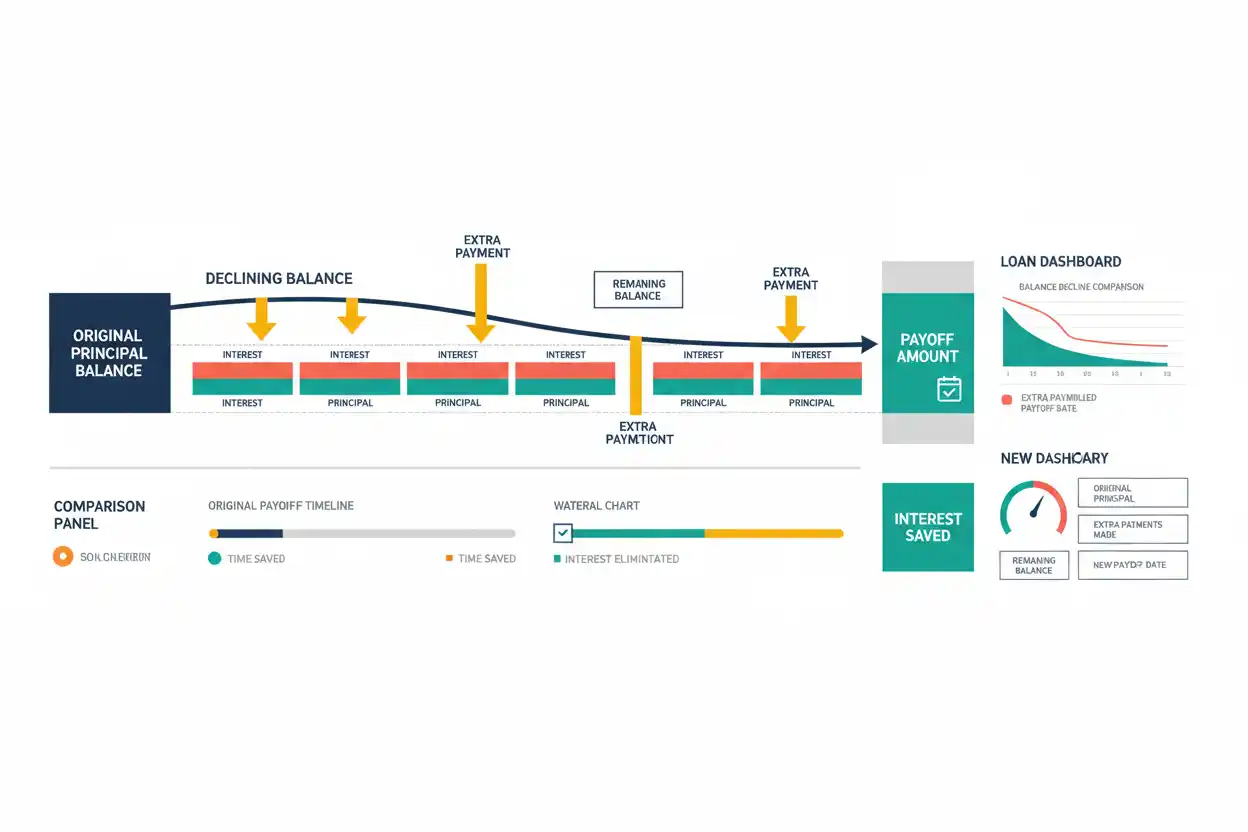

Principal balance is the amount of borrowed principal that remains unpaid on a loan.
If you originally borrow $20,000, your starting principal balance is generally $20,000. As scheduled payments reduce principal, the balance falls. Interest charges normally do not reduce principal; they represent the cost of borrowing.
A basic balance relationship is:
Ending Principal Balance = Beginning Principal Balance − Principal Repaid
If a $20,000 loan receives a payment containing $508.44 of principal:
Ending Principal Balance = $20,000 − $508.44
Ending Principal Balance = $19,491.56
That distinction between payment amount and principal reduction is central to understanding loans.
The wider Loans & Credit framework connects principal balance with payments, interest, amortization, repayment schedules, and payoff calculations throughout the Finance category.
What Is Principal Balance?
Principal balance is the remaining amount of loan principal that has not yet been repaid.
It does not automatically equal:
the original loan amount, total remaining payments, payoff amount, or total debt cost.
For example, suppose:
Original loan = $20,000
Current principal balance = $14,000
The borrower has already reduced principal by:
Principal Repaid = $20,000 − $14,000
Principal Repaid = $6,000
However, the borrower can still owe more than $14,000 in total future payments because future interest may also be due.
Principal Balance Formula
For a single payment:
Ending Principal = Beginning Principal − Principal Portion of Payment
The principal portion is:
Principal Portion = Payment − Interest − Other Amounts Applied Before Principal
In a simplified loan with no fees:
Principal Portion = Payment − Interest
Suppose:
Beginning principal = $20,000
Monthly payment = $608.44
Interest = $100
Then:
Principal Portion = $608.44 − $100
Principal Portion = $508.44
New principal:
Principal Balance = $20,000 − $508.44
Principal Balance = $19,491.56
Principal Balance Example
Assume:
Original principal = $20,000
Annual interest rate = 6%
Term = 36 months
Payments = monthly
The standard fixed payment is approximately:
Monthly Payment ≈ $608.44
Monthly interest rate:
Monthly Rate = 6% ÷ 12
Monthly Rate = 0.5%
First Payment
Interest:
Interest = $20,000 × 0.5%
Interest = $100
Principal:
Principal Repaid = $608.44 − $100
Principal Repaid = $508.44
Ending balance:
Ending Principal = $20,000 − $508.44
Ending Principal ≈ $19,491.56
Second Payment
Interest:
Interest = $19,491.56 × 0.5%
Interest ≈ $97.46
Principal:
Principal Repaid = $608.44 − $97.46
Principal Repaid ≈ $510.98
Ending principal:
Ending Principal ≈ $19,491.56 − $510.98
Ending Principal ≈ $18,980.58
More of the second payment reduces principal because interest is being calculated from a lower balance.
Principal Balance After Several Payments
For a standard fixed-rate amortizing loan, remaining principal after k payments can also be calculated directly.
Balance After k Payments = P(1 + r)^k − A × [((1 + r)^k − 1) ÷ r]
Where:
P = original principal
r = periodic interest rate
A = periodic payment
k = number of payments already made
Using the $20,000 loan at 6% with a $608.44 monthly payment:
After 12 payments:
Principal Balance ≈ $13,728.12
After 24 payments:
Principal Balance ≈ $7,069.41
After 35 payments:
Principal Balance ≈ $605.41
After the final scheduled payment, the balance approaches zero, subject to rounding and contract-specific calculations.
Principal Balance vs Loan Payment
A loan payment is the amount paid during a period.
Principal balance is the amount of borrowed principal still outstanding.
A $600 payment does not necessarily reduce principal by $600.
If $100 covers interest:
Principal Reduction = $600 − $100
Principal Reduction = $500
That is why payment history alone does not reveal the remaining principal.
Principal Balance and Repayment Schedules
A repayment schedule shows how principal changes after every payment.
A typical schedule contains:
beginning balance, payment, interest, principal, and ending balance.
The next period’s beginning balance is generally the previous period’s ending principal.
This creates a continuous mathematical chain from origination to payoff.
Principal Balance and Amortization
An amortizing loan is structured so principal declines through scheduled payments.
Early in the term, a larger portion of each payment generally goes toward interest.
Later, progressively more goes toward principal.
The principal balance therefore commonly declines slowly at first and more quickly later in the schedule.
Principal Balance and Accrued Interest
Accrued interest is separate from principal unless the contract or applicable rules cause it to be capitalized.
Suppose:
Principal = $10,000
Accrued interest = $75
The loan can have:
Principal Balance = $10,000
while:
Total Amount Currently Owed ≈ $10,075
before considering fees or other charges.
Do not automatically add accrued interest to principal unless capitalization has actually occurred.
Principal Balance and Simple Interest
On a simple interest loan, interest generally depends on the outstanding principal.
That means reducing principal earlier can reduce future interest.
For example:
Principal falls from $10,000 to $8,000.
At the same interest rate, the future dollar interest generated per period also falls because the calculation uses a smaller balance.
Principal Balance and Daily Simple Interest
Daily simple interest makes this relationship particularly clear.
A simplified formula is:
Daily Interest = Principal Balance × Annual Rate ÷ Day-Count Basis
At 8% on $10,000 using 365 days:
Daily Interest ≈ $2.19
If principal falls to $8,000:
Daily Interest ≈ $1.75
Principal balance therefore directly controls daily interest cost.
Principal Balance and Compound Interest
A compound interest loan can behave differently if unpaid interest becomes part of the balance used for future interest calculations.
For example:
Original principal = $10,000
Capitalized interest = $500
If capitalization increases principal:
New Principal Balance = $10,000 + $500
New Principal Balance = $10,500
Future interest can then be calculated from the larger amount.
Principal Balance vs Payoff Quote
A loan payoff quote can exceed principal balance.
A simplified payoff relationship is:
Payoff = Principal + Accrued Interest + Applicable Charges − Credits
Suppose:
Principal balance = $15,000
Accrued interest = $75
Applicable fee = $25
Then:
Payoff = $15,000 + $75 + $25
Payoff = $15,100
Principal and payoff are therefore related but not interchangeable.
Principal Balance and Prepayment Penalties
A prepayment penalty can sometimes be calculated from outstanding principal.
For example:
Principal balance = $40,000
Penalty rate = 2%
Penalty = $40,000 × 2%
Penalty = $800
The principal balance can therefore affect not only future interest but also the cost of early settlement when such a provision applies.
Principal Balance on Personal Loans
Personal loan payments generally reduce principal through scheduled installments.
If a loan has a fixed interest rate and conventional amortization, the balance can be projected from the payment schedule.
However, fees, delayed payments, variable rates, or additional charges can cause the actual balance to differ from a simple model.
Principal Balance and Personal Loan APR
Personal loan APR measures annualized borrowing cost rather than remaining principal.
Two borrowers can have the same $10,000 principal balance but very different APRs.
The balance tells you how much principal remains.
APR helps describe how expensive the financing is.
Principal Balance and Secured Loans
A secured loan uses collateral under the loan agreement.
The remaining principal can be compared with the current value of that collateral.
Suppose:
Principal balance = $15,000
Collateral value = $20,000
The simple balance-to-value relationship is:
Loan-to-Value = $15,000 ÷ $20,000 × 100
LTV = 75%
As principal falls, the lender’s collateral coverage can improve if the collateral value remains stable.
Principal Balance and Loan Term
A longer loan term generally causes principal to decline more slowly because the payment is spread across more periods.
That can leave a larger balance outstanding for longer.
This matters especially for assets that lose value rapidly.
Principal Balance and EMI
An EMI is designed to reduce principal progressively while paying interest.
The EMI can remain equal from month to month even though the principal balance changes continuously.
That is why the word equated refers to the payment, not the balance.
Fixed vs Variable Rates
With a fixed vs variable interest rate loan, the principal path can change if a variable rate causes payment or term adjustments.
A higher rate can reduce how quickly a fixed payment attacks principal.
If the payment is recalculated upward instead, principal can remain on the original amortization timeline.
The agreement determines the actual result.
Extra Principal Payments
Suppose:
Current principal = $20,000
Extra principal payment = $3,000
Then:
New Principal Balance = $20,000 − $3,000
New Principal Balance = $17,000
If interest is calculated from outstanding principal, future interest is now based on $17,000 instead of $20,000.
This is why properly applied additional principal payments can shorten repayment and reduce interest.
Principal Balance After Refinancing
Refinancing generally creates a new loan.
Suppose:
Old payoff = $18,000
New closing costs financed = $1,000
The new principal can become:
New Principal = $18,000 + $1,000
New Principal = $19,000
Even though the borrower refinanced an $18,000 remaining debt, the new principal is larger because fees were financed.
Negative Amortization
Principal balance can increase rather than decrease when payments are insufficient to cover the required interest and unpaid amounts are added to the balance.
Suppose:
Interest generated = $500
Payment = $350
Unpaid interest capitalized = $150
Then:
Principal Increase = $150
A borrower can therefore make payments while the amount owed grows under a negative-amortization structure.
Common Principal Balance Mistakes
One mistake is assuming every payment reduces principal by the full payment amount.
Another is confusing principal with payoff amount.
Borrowers also sometimes add all remaining payments and call that figure principal.
A fourth mistake is ignoring capitalized interest.
Finally, a displayed account balance can include accrued interest or fees, so borrowers should verify exactly which balance a lender’s interface is showing.
Frequently Asked Questions
What is principal balance?
Principal balance is the amount of borrowed principal that remains unpaid.
What is the basic principal balance formula?
Ending Principal = Beginning Principal − Principal Repaid
Is principal balance the same as loan balance?
Sometimes interfaces use the terms loosely, but total loan balance can include accrued interest or other amounts. Check the lender’s definition.
Does interest reduce principal?
No. Interest is a borrowing cost. Only the portion of a payment applied to principal reduces principal balance.
Why does principal fall slowly at first?
On a standard amortizing loan, early payments contain more interest because the outstanding principal is larger.
Does paying extra reduce principal?
Yes, when the lender applies the extra amount directly to principal.
Is principal balance the same as payoff amount?
No. Payoff can include accrued interest, fees, penalties, or credits.
Can principal balance increase?
Yes, for example when unpaid interest is capitalized or negative amortization occurs.
Does a lower principal balance reduce interest?
Usually on an outstanding-balance interest structure, because future interest is calculated from a smaller principal.
Can I calculate principal after several payments?
Yes. Use an amortization schedule or the remaining-balance formula for a standard fixed-rate loan.
Does refinancing reduce principal?
Not necessarily. New fees can be added to the refinanced balance.
Why should I track principal separately?
Because it shows how much actual debt has been repaid and helps evaluate interest, equity, refinancing, and payoff decisions.
Final Takeaway
Principal balance is the remaining borrowed amount—not the payment, not accumulated interest, and not necessarily the payoff amount.
The basic relationship is:
Ending Principal Balance = Beginning Principal − Principal Repaid
On a $20,000 loan at 6% for 36 months, the approximately $608.44 first payment contains:
$100 of Interest
and:
$508.44 of Principal
leaving a principal balance of approximately:
$19,491.56
Understanding principal balance makes it much easier to read repayment schedules, measure real debt reduction, estimate payoff, calculate future interest, and evaluate whether extra payments are producing meaningful progress.