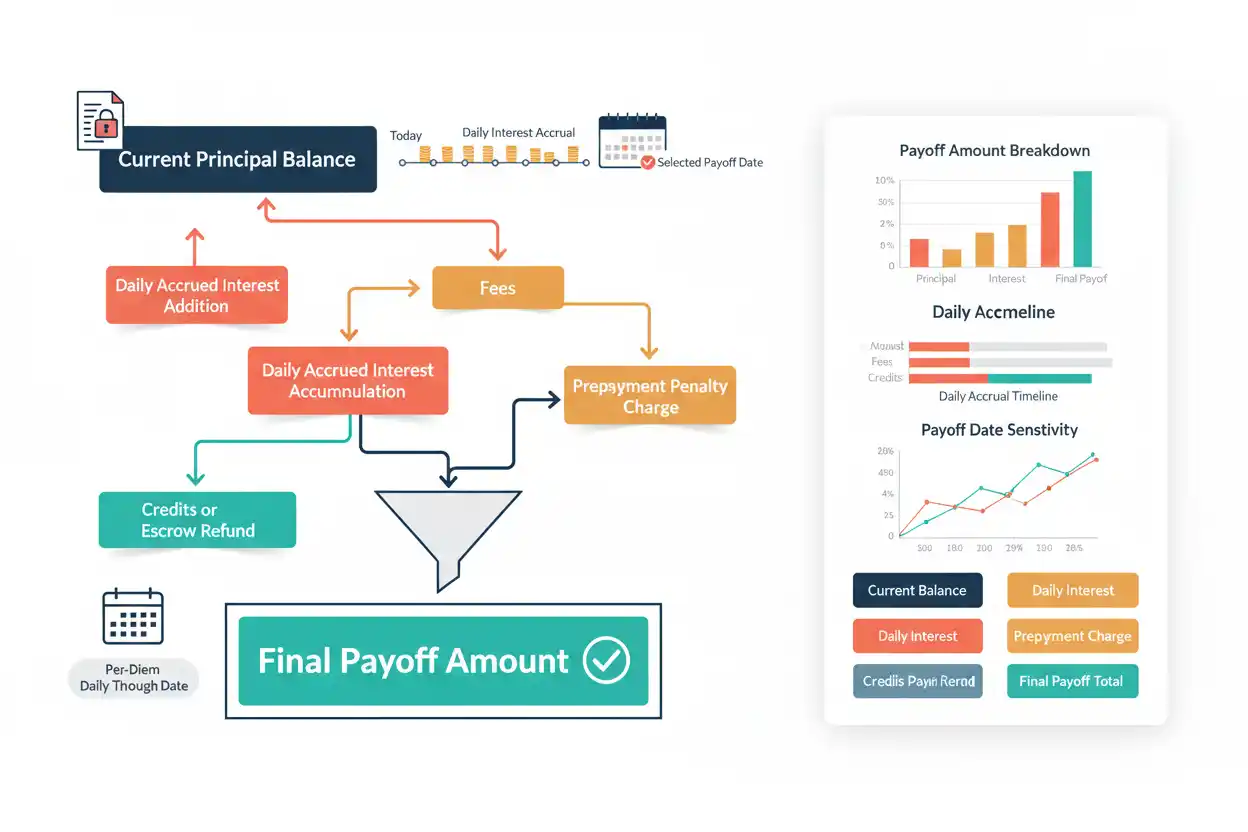

A loan payoff quote is the amount required to satisfy a loan completely on a specified date.
It can differ from the principal balance shown on a statement because interest may continue accruing after the statement date. Unpaid fees, prepayment charges, or other contractual amounts can also affect the final figure.
A practical payoff formula is:
Loan Payoff Amount = Principal Balance + Accrued Interest + Unpaid Fees + Applicable Payoff Charges − Applicable Credits
For a daily-interest loan:
Accrued Interest = Principal Balance × Annual Interest Rate × Days ÷ Day-Count Basis
That makes the requested payoff date important.
A quote for Friday can differ from a quote for the following Monday because three additional days of interest may accrue.
What Is a Loan Payoff Quote?
A loan payoff quote is a lender or servicer’s calculation of the amount necessary to extinguish the debt as of a particular date.
The phrase as of a particular date matters.
A payoff quote is not simply a permanent number attached to the loan.
If interest continues to accrue:
Payoff Amount Changes With Time
until the debt is actually satisfied.
Within Loans & Credit, payoff calculation connects the remaining balance with accrued interest, repayment timing, fees, and early repayment. It is part of the wider Finance framework.
Loan Payoff Quote Formula
A general formula is:
Payoff Quote = Outstanding Principal + Accrued Interest + Unpaid Charges + Applicable Prepayment Amounts − Credits
Not every loan contains every component.
For a straightforward simple-interest loan with no additional charges:
Payoff Quote ≈ Principal + Accrued Interest
Loan Payoff Quote Example
Suppose:
Principal balance = $18,500
Annual interest rate = 7.2%
Payoff date = 10 days after the latest interest-paid-through date
Day-count basis = 365
No unpaid fees initially
First calculate daily interest:
Daily Interest = $18,500 × 7.2% ÷ 365
Daily Interest ≈ $3.65
Then calculate 10 days of interest:
Accrued Interest = $3.6493 × 10
Accrued Interest ≈ $36.49
Estimated payoff:
Payoff Amount = $18,500 + $36.49
Payoff Amount ≈ $18,536.49
The principal balance is $18,500, but the loan requires approximately $18,536.49 to satisfy it on the assumed payoff date.
Add Fees and Credits
Now suppose:
Unpaid fee = $25
Account credit = $10
Then:
Payoff = $18,500 + $36.49 + $25 − $10
Payoff ≈ $18,551.49
That is why borrowers should request the lender’s actual quote rather than calculating from principal alone.
Payoff Quote vs Principal Balance
The principal balance represents remaining borrowed principal.
A payoff quote can include principal plus other amounts.
Therefore:
Principal Balance ≠ Automatically Payoff Amount
Suppose:
Principal = $20,000
Accrued interest = $100
Unpaid fee = $30
Payoff:
$20,000 + $100 + $30 = $20,130
A statement showing $20,000 of principal would understate the amount required to settle the loan.
Payoff Quote vs Remaining Loan Payments
The loan payments schedule includes future installments.
If you multiply the normal payment by every remaining month, you include future interest that may never accrue after the loan is paid early.
Suppose:
Remaining payments = 24
Normal payment = $500
Remaining Scheduled Payments = $500 × 24
Remaining Scheduled Payments = $12,000
The payoff quote might be only $10,700 because much of the $1,300 difference represents future interest avoided by paying immediately.
Accrued Interest
Accrued interest is one of the most important payoff components.
Interest can continue building after:
the last statement, last scheduled payment, or latest balance update.
The relevant start date depends on the contract and servicing calculation.
Per-Diem Interest
Per diem means per day.
For a daily simple-interest loan:
Per-Diem Interest = Principal × Annual Rate ÷ Day-Count Basis
Using the example:
Per Diem = $18,500 × 7.2% ÷ 365
Per Diem ≈ $3.65
If settlement is delayed five additional days:
Additional Interest ≈ $3.65 × 5
Additional Interest ≈ $18.25
A payoff sent after the quote’s good-through date can therefore be insufficient.
Daily Simple Interest and Payoff
The daily simple interest page explains this timing relationship in detail.
If principal changes, daily interest also changes.
Suppose the balance falls from $18,500 to $15,000.
At 7.2%:
New Daily Interest = $15,000 × 7.2% ÷ 365
New Daily Interest ≈ $2.96
Paying principal down lowers the amount of interest that can accrue each day.
Payoff Quote and Loan Term
The loan term determines how long the loan would remain outstanding if it continued according to schedule.
A payoff quote ignores most of that future period because the debt is being settled now.
That is one reason early payoff can save substantial interest.
Payoff Quote and Origination Fees
A loan origination fee is generally incurred when financing begins.
If it was already paid or deducted, it normally does not disappear simply because the borrower pays the loan off early.
That fee represents a historical financing cost.
The payoff quote focuses on what remains due today.
Payoff Quote and Prepayment Penalty
A prepayment penalty can increase the amount required for early settlement.
Suppose:
Principal = $20,000
Accrued interest = $100
Prepayment charge = $400
Then:
Payoff = $20,000 + $100 + $400
Payoff = $20,500
The borrower saves future interest but must account for the penalty.
Whether early payoff still saves money depends on the future interest avoided.
Break-Even Early Payoff Analysis
A simple framework is:
Net Early-Payoff Savings = Future Interest Avoided − Prepayment Costs − Other Incremental Payoff Costs
Suppose:
Future interest avoided = $2,000
Prepayment penalty = $400
Other incremental cost = $50
Then:
Net Savings = $2,000 − $400 − $50
Net Savings = $1,550
Early payoff still saves approximately $1,550 in this simplified example.
Amortizing Loans and Payoff
On an amortizing loan, principal declines with scheduled payments.
The payoff amount therefore tends to become smaller over time, although interest accrued since the latest payment can create small short-term increases between payment dates.
This creates a pattern:
payment reduces the balance sharply, then daily interest gradually accumulates until the next payment.
Simple Interest Loans and Payoff
A simple interest loan often provides significant early-payoff savings because future interest has not yet been earned.
However, exact savings depend on the contract.
Borrowers should not assume every installment loan handles unearned interest identically.
Repayment Schedule vs Payoff Quote
A repayment schedule is a forecast assuming scheduled payments continue.
A payoff quote is a settlement calculation for a specific date.
The schedule can help estimate principal.
The quote determines what the lender actually requires.
Auto Loan Payoff
For auto loan payments, a payoff quote is often needed when:
selling the vehicle, trading it in, refinancing, or paying the loan early.
The payoff can differ from the principal shown on the most recent statement because interest continues to accrue and fees can remain outstanding.
Personal Loan Payoff
Personal loan payments can also be terminated early when the contract allows it.
A borrower should compare:
payoff quote, cash available, future interest avoided, and any prepayment charge.
Paying early purely because the remaining payment count looks large can be misleading without calculating the actual savings.
Business Loan Payoff
For business loan payments, payoff can be more complex when commercial financing includes:
balloon provisions, make-whole amounts, prepayment premiums, accrued fees, or variable-rate mechanics.
Businesses should use the lender’s formal payoff statement rather than a simplified consumer-loan assumption.
Loan-to-Income Ratio and Payoff
The loan-to-income ratio compares borrowing with income.
Paying off a loan reduces debt, but the ratio used in future underwriting depends on the new transaction being analyzed.
The payoff quote itself is not an income ratio.
The two concepts should remain separate.
Leasing Costs vs Loan Payoff
Leasing costs can involve early termination amounts rather than a conventional loan payoff.
A lease should not automatically be treated as though it has principal that can simply be paid to zero.
The applicable early termination calculation comes from the lease contract.
Payoff Quote and APR
APR measures annualized borrowing cost.
A payoff quote is a dollar amount due on a specific date.
APR can help evaluate whether the original financing was expensive.
The payoff quote helps determine the cost of ending it today.
Good-Through Date
A formal payoff quote commonly has a date through which the amount is valid.
If payment arrives after that date, additional interest or charges can create a shortfall.
For example:
Quoted payoff = $18,536.49 through June 20
Per diem = $3.65
Payment received June 23
Three additional days could add approximately:
Additional Interest = $3.65 × 3
Additional Interest ≈ $10.95
The lender’s actual servicing calculation controls the final amount.
What Happens to Excess Payoff Funds?
If a borrower sends slightly more than the final amount required, the account can have an excess balance after satisfaction.
Handling varies by lender and contract.
Do not deliberately overpay by a large amount as a substitute for obtaining an updated payoff quote.
Why Payoff Quotes Expire
The quote expires because the debt is not static.
Interest can continue accruing.
Fees or credits can post.
A variable rate can sometimes affect future interest.
The lender therefore provides a figure valid through a specified settlement date rather than guaranteeing the amount indefinitely.
Common Loan Payoff Quote Mistakes
One mistake is using principal balance as the payoff amount.
Another is multiplying the remaining monthly payments.
Borrowers can also forget to include daily interest through the settlement date.
A fourth mistake is ignoring a prepayment penalty.
Finally, sending the quoted amount after its expiration date can leave a small unpaid balance that prevents the loan from closing.
Frequently Asked Questions
What is a loan payoff quote?
It is the amount required to satisfy a loan completely as of a specified date.
What is the basic payoff formula?
Payoff = Principal + Accrued Interest + Unpaid Charges + Applicable Prepayment Amounts − Credits
Why is my payoff higher than my principal balance?
Interest may have accrued since the latest payment or statement, and unpaid fees can also be included.
Can my payoff be lower than my remaining scheduled payments?
Yes. Remaining scheduled payments contain future interest that generally does not accrue after immediate payoff.
What is per-diem interest?
It is the amount of interest accruing per day.
How do I calculate daily payoff interest?
Daily Interest = Principal × Annual Rate ÷ Day-Count Basis
Why does a payoff quote have an expiration date?
Because interest and other account amounts can continue changing.
Does a prepayment penalty increase the payoff?
Yes, when one applies under the agreement.
Does an old origination fee get refunded?
Not automatically. Its treatment depends on the contract and applicable rules.
Is a payoff quote the same as a loan statement?
No. A statement reports account activity and balances, while a payoff quote specifically calculates what is required for complete settlement.
Can I estimate my own payoff?
Yes, but use the lender’s formal quote before sending final payment because fees, timing, and servicing conventions can alter the amount.
Does early payoff always save money?
Not always. Compare future interest avoided with prepayment charges and other costs.
Final Takeaway
A loan payoff quote answers a precise question:
How much must I pay to make this debt completely disappear on a particular date?
The basic structure is:
Payoff Quote = Principal + Accrued Interest + Applicable Fees and Charges − Credits
For an $18,500 principal balance at 7.2%, daily interest is approximately:
$3.65 per Day
After 10 days, accrued interest is approximately:
$36.49
making the simplified payoff:
$18,536.49
before other fees or credits.
That is why the displayed principal balance, remaining scheduled payments, and payoff quote should never be treated as interchangeable numbers.