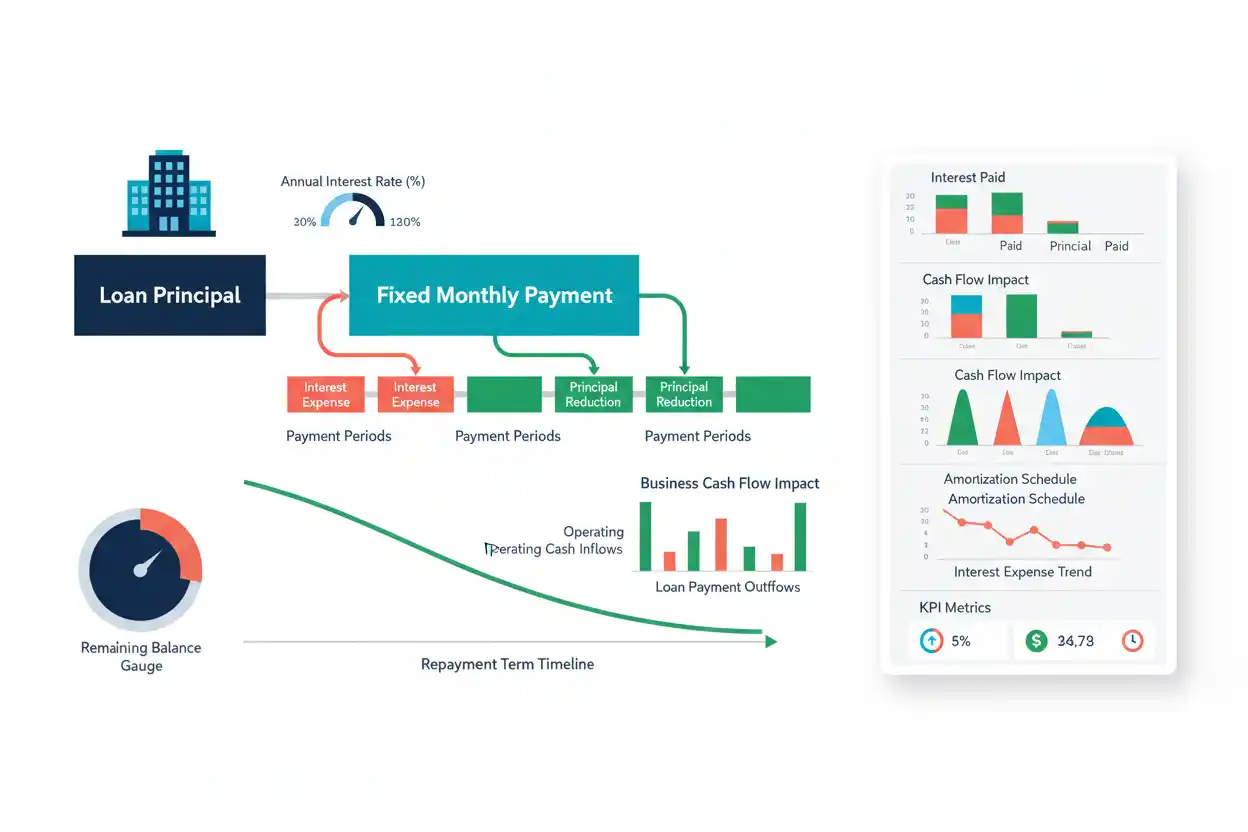

Business loan payments are the scheduled amounts a company must pay to service borrowed money.
For a conventional fixed-rate amortizing business loan, each payment usually covers interest and reduces principal. The payment depends primarily on the amount borrowed, periodic interest rate, number of payments, and repayment structure.
The standard fixed-payment formula is:
Business Loan Payment = P × [r(1 + r)ⁿ] ÷ [(1 + r)ⁿ − 1]
Where:
P = principal
r = periodic interest rate
n = total number of payments
The calculation itself is straightforward. The harder question is whether the payment fits the company’s operating cash flow without compromising payroll, inventory, taxes, capital investment, or other obligations.
That is why business loan payments should be analyzed as part of the broader Loans & Credit framework rather than as an isolated calculator output.
What Are Business Loan Payments?
Business loan payments are periodic cash outflows required under a commercial loan agreement.
Depending on the financing, payments may be:
monthly, weekly, biweekly, seasonal, interest-only for a period, or structured around another schedule.
Some loans fully amortize.
Others leave a balloon balance.
Variable-rate loans can also produce changing payment requirements.
Therefore, the familiar monthly amortization formula applies only when the contract actually uses fixed periodic payments.
Business Loan Payment Formula
For a standard fixed-rate amortizing loan:
Payment = P × [r(1 + r)ⁿ] ÷ [(1 + r)ⁿ − 1]
For monthly payments:
Monthly Rate = Annual Nominal Interest Rate ÷ 12
And:
Number of Payments = Loan Term in Years × 12
Suppose a business borrows for seven years.
Number of Payments = 7 × 12
Number of Payments = 84
Business Loan Payment Example
Assume:
Loan principal = $150,000
Annual interest rate = 9%
Term = 7 years
Payments = monthly
Step 1: Calculate the Monthly Rate
Monthly Rate = 9% ÷ 12
Monthly Rate = 0.75%
As a decimal:
r = 0.0075
Step 2: Determine Number of Payments
n = 7 × 12
n = 84
Step 3: Calculate the Payment
Payment = $150,000 × [0.0075(1.0075)⁸⁴] ÷ [(1.0075)⁸⁴ − 1]
The monthly payment is approximately:
Business Loan Payment ≈ $2,413.36
The company must therefore commit roughly $2,413.36 each month under the example assumptions.
Total Interest on the Example
Calculate total scheduled payments:
Total Payments = $2,413.36 × 84
Using full precision:
Total Payments ≈ $202,722.39
Then:
Total Interest = $202,722.39 − $150,000
Total Interest ≈ $52,722.39
The business receives $150,000 of principal but pays more than $52,000 of interest over seven years under these assumptions.
This is why monthly affordability and total cost should be reviewed together.
First Payment: Principal and Interest
The first month’s interest is:
Interest = Outstanding Principal × Monthly Rate
Interest = $150,000 × 0.0075
Interest = $1,125
Principal reduction is:
Principal Paid = $2,413.36 − $1,125
Principal Paid ≈ $1,288.36
The new balance is approximately:
New Balance = $150,000 − $1,288.36
New Balance ≈ $148,711.64
The next payment generates interest from a smaller principal under a conventional amortizing structure.
A full repayment schedule shows this process through every payment.
Business Loan Payments and APR
Business loan APR focuses on the annualized economic cost of borrowing.
The payment formula uses the contractual rate and financed balance.
These are not automatically the same calculation.
A lender can charge a 9% contractual interest rate plus an upfront financing fee.
The monthly payment may still be calculated from the contractual principal and rate, while the fee pushes the effective annualized borrowing cost higher.
The general APR concept helps explain that distinction.
Business Loan Payments and Origination Fees
A loan origination fee can affect the transaction in different ways.
If the fee is deducted from proceeds, the company receives less usable cash.
If the fee is financed, the principal can rise.
Suppose a $150,000 loan includes a $4,500 fee that is added to the debt.
The financed amount becomes:
Financed Principal = $150,000 + $4,500
Financed Principal = $154,500
At the same rate and term, the monthly payment increases because the borrower is financing a larger amount.
Loan Term and Business Payments
The loan term creates one of the most important payment tradeoffs.
A longer term generally reduces the required periodic payment.
However, it often increases total interest because principal remains outstanding longer.
Suppose a $150,000 business loan is available over five years or seven years.
The seven-year structure can create more breathing room each month.
The five-year structure can eliminate the debt sooner.
Neither is automatically superior. The decision depends on cash-flow capacity, expected return from the borrowed capital, financing risk, and total cost.
Fixed vs Variable Business Loan Payments
A fixed vs variable interest rate structure determines whether future interest rates can change.
With a fixed-rate business loan, the principal-and-interest payment can remain constant under a standard amortization schedule.
With a variable-rate loan, the lender may recalculate payment requirements after rate adjustments.
This creates budgeting risk.
A business using variable-rate financing should test whether it could still meet its obligations if rates rise materially.
SBA Loan Payments
Many SBA 7(a) term loans are repaid through monthly payments of principal and interest.
Fixed-rate payments can remain constant, while variable-rate financing can require a different payment when the rate changes.
However, SBA-backed financing covers multiple products and structures.
A borrower should use the actual lender terms rather than assuming every SBA loan follows the same amortization schedule.
Business Loan Payment vs Car Payment
Car payments and ordinary business term loans can use similar amortization mathematics.
The economics around them can still differ.
Business lending can involve commercial collateral, guarantees, covenants, irregular cash flows, larger origination fees, or variable rates.
Therefore, the formula may be reusable while the underwriting assumptions are not.
Business Loan Payment vs Boat Loan Payment
Boat loan payments can also use a conventional fixed-payment amortization formula.
The central mathematical structure is the same:
principal, periodic rate, and number of payments.
The purpose and risk differ.
A commercial loan should be evaluated against business cash generation rather than against household affordability alone.
Business Loan Payment vs Cash Advance Fee
A cash advance fee is a transaction charge associated with credit-card cash advances.
It does not belong in a normal business-loan payment formula unless a business is actually using that type of credit.
The mapped relationship is useful because financing costs should be separated into:
periodic interest, recurring payments, and upfront or transaction charges.
Business Loan Payment vs Balance Transfer Fee
A balance transfer fee belongs to revolving-card debt.
Again, its calculation differs from a business term loan.
The broader lesson is that the borrower should identify which costs affect the loan balance and which costs are charged separately.
Amortizing Business Loans
A conventional amortizing loan is designed so scheduled payments gradually eliminate the balance.
Early payments normally contain more interest.
Later payments contain more principal.
The principal balance therefore declines over time, assuming payments are made as scheduled.
Simple Interest Business Loans
Some commercial loans use a simple interest loan framework.
Under a declining-balance structure:
Interest = Outstanding Principal × Periodic Rate
Paying principal faster can reduce future interest.
However, the exact calculation depends on payment timing and contract terms.
Interest-Only Business Payments
Some commercial loans permit interest-only payments during part of the term.
A simplified interest-only payment is:
Interest-Only Payment = Principal × Annual Rate ÷ Payments Per Year
For a $150,000 balance at 9% with monthly payments:
Monthly Interest-Only Payment = $150,000 × 9% ÷ 12
Monthly Interest-Only Payment = $1,125
This is significantly lower than the $2,413.36 fully amortizing payment.
However, the $1,125 payment does not reduce principal under the simplified example.
The company still owes $150,000 later unless separate principal payments occur.
Balloon Payments
A partially amortizing business loan can leave principal outstanding at maturity.
For example, a loan might calculate payments as though it were being repaid over 15 years but require the remaining balance after five years.
That produces a lower periodic payment but a significant refinancing or payoff obligation at maturity.
A borrower should therefore verify whether the stated term is the amortization period, the maturity, or both.
Business Loan Payments and Cash Flow
A payment can be mathematically correct yet financially unsustainable.
The cash flow forecasting process helps determine whether future operating cash receipts are likely to arrive before debt payments are due.
This is especially important for seasonal businesses.
A company might earn enough across the full year while still experiencing temporary periods when monthly debt service exceeds available cash.
Working Capital and Business Loan Payments
Businesses often borrow to finance working capital.
For example, cash may be needed to purchase inventory before customers pay outstanding invoices.
If the operating cycle takes 120 days but loan payments begin immediately, the financing structure can create pressure before the borrowed capital generates a return.
Payment frequency should therefore match the economics of the funded activity whenever possible.
Debt Service Coverage Ratio
The debt service coverage ratio helps evaluate a company’s ability to cover required debt payments.
Conceptually:
DSCR = Cash Available for Debt Service ÷ Required Debt Service
A payment should not be judged solely by whether today’s bank balance can cover it.
The more important question is whether recurring operating cash flow can support the debt consistently.
Interest Coverage
The interest coverage ratio focuses more narrowly on the company’s ability to cover interest expense.
A business can have adequate interest coverage but still struggle with principal repayments.
That distinction is why debt-service and interest-coverage measures are complementary rather than interchangeable.
Secured vs Unsecured Business Loans
A secured loan is backed by specified collateral.
An unsecured loan does not rely on pledged collateral in the same way.
Collateral can influence available terms, but it also changes the consequences of default.
Payment affordability should therefore be considered alongside asset risk.
Prepayment
Paying principal early can reduce future interest on many declining-balance loans.
However, the business should review any prepayment penalty.
If the company decides to settle the debt, a current loan payoff quote is more reliable than multiplying the remaining payment count by the normal monthly payment.
Common Business Loan Payment Mistakes
One mistake is calculating payments from the cash received instead of the actual financed principal.
Another is forgetting to convert the annual interest rate to the proper periodic rate.
Businesses also sometimes choose a long term solely to lower the monthly payment without checking total interest.
A fourth mistake is assuming a fixed-payment formula applies to a variable-rate or balloon loan.
Finally, payment affordability should not be evaluated without forecasting the company’s operating cash flow.
Frequently Asked Questions
How are business loan payments calculated?
For a standard fixed-rate amortizing loan:
Payment = P × [r(1 + r)ⁿ] ÷ [(1 + r)ⁿ − 1]
What determines a business loan payment?
The major inputs are financed principal, interest rate, number of payments, payment frequency, and loan structure.
What is the payment on a $150,000 business loan?
At 9% for 84 monthly payments, the example payment is approximately $2,413.36 per month.
How much interest does that example cost?
Approximately $52,722.39 over seven years under the stated assumptions.
Does APR determine the monthly payment?
Not necessarily. The contractual interest rate and principal generally determine a standard amortized payment, while APR measures broader annualized borrowing cost.
Does a longer term lower the payment?
Generally yes, but it usually increases total interest when other variables remain constant.
Can business loan payments change?
Yes. Variable-rate loans, irregular repayment arrangements, and other structures can create changing payments.
What is an interest-only business loan payment?
It is a payment that covers interest without scheduled principal reduction during the interest-only period.
What is a balloon payment?
It is a remaining balance that becomes due at a specified maturity date after smaller scheduled payments.
Can I pay a business loan off early?
Often, but the contract may contain prepayment conditions or penalties.
Should I finance loan fees?
Financing a fee reduces upfront cash requirements but increases principal and can increase total interest.
How do I know whether the payment is affordable?
Compare required debt service with recurring operating cash flow, forecasted liquidity, and other business obligations rather than evaluating the payment in isolation.
Final Takeaway
Business loan payments convert principal, interest rate, term, and payment frequency into a recurring cash obligation.
The standard fixed-payment formula is:
Payment = P × [r(1 + r)ⁿ] ÷ [(1 + r)ⁿ − 1]
A $150,000 loan at 9% for seven years produces a monthly payment of approximately $2,413.36 and total interest of roughly $52,722.39.
But the correct payment is only part of the decision.
A business should also examine APR, fees, amortization, maturity, variable-rate risk, collateral, prepayment rules, and—most importantly—whether operating cash flow can support the payment throughout the entire loan term.