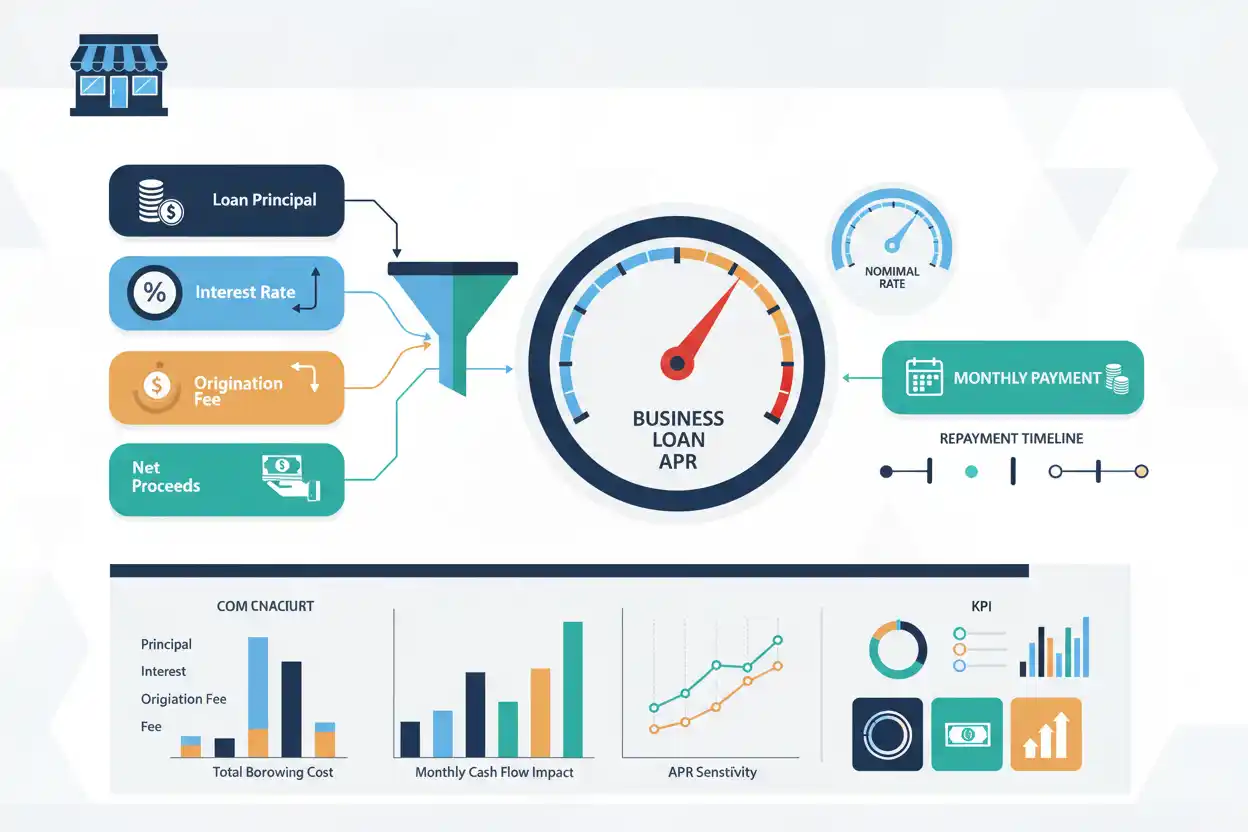

Business loan APR is an annualized measure used to describe the cost of borrowing after considering more than just the stated interest rate.
That distinction matters because two business loans can quote the same interest rate while delivering different amounts of usable cash, charging different upfront fees, or requiring different payment schedules. Looking only at the headline rate can therefore make the more expensive loan appear cheaper.
For business-purpose credit, however, APR needs an important qualification. Federal consumer-credit APR rules do not universally apply to ordinary business-purpose loans. A lender may still disclose or advertise an APR, but borrowers should verify exactly how it was calculated rather than assuming every commercial lender uses the same methodology.
The broader Loans & Credit framework connects business loan APR with payment calculations, fees, loan terms, interest structures, and payoff costs.
What Is Business Loan APR?
Business loan APR attempts to express borrowing cost as an annual percentage.
At a basic level, it considers the relationship among:
the amount borrowed, the amount of usable proceeds received, financing fees, interest, payment timing, and loan term.
The stated interest rate is only one component.
For example, a lender might offer a $100,000 business loan at a 10% interest rate while withholding a $3,000 origination charge from the proceeds.
The business owes payments based on the contractual loan amount but receives only $97,000 in usable funds.
That increases the economic cost of the financing.
Business Loan APR vs Interest Rate
The interest rate determines how interest is calculated under the loan agreement.
Business loan APR attempts to provide a broader annualized cost measure.
Conceptually:
Interest Rate = Cost Applied to the Loan Balance
while:
Business Loan APR = Annualized Borrowing Cost Including Applicable Financing Costs
Suppose two loans both quote a 10% rate.
Loan A has no upfront financing fee.
Loan B deducts a substantial origination fee.
Even though the contractual rates are identical, Loan B provides less usable cash for the same repayment obligation.
Its economic annualized borrowing cost is therefore higher.
The general APR guide explains the distinction between annualized credit cost and a contractual interest rate in greater depth.
Why Business Loan APR Is More Complicated Than Consumer APR
Business-purpose financing does not always operate under the same federal disclosure structure as consumer credit.
As a result, one lender may calculate an advertised business APR differently from another lender.
Some commercial products may not quote APR at all.
Instead, you might encounter:
a stated annual rate, periodic rate, factor rate, flat fee, origination percentage, draw fee, or total repayment amount.
For that reason, the most reliable way to compare business financing is to normalize the cash flows.
The central question becomes:
How much cash does the business actually receive, when must it repay that cash, and how much is paid in total?
Net Proceeds Formula
Start by determining how much usable cash the business receives.
Net Loan Proceeds = Gross Loan Amount − Upfront Fees Withheld
Suppose:
Gross loan = $100,000
Origination fee = 3%
First calculate the fee:
Origination Fee = $100,000 × 3%
Origination Fee = $3,000
Then:
Net Proceeds = $100,000 − $3,000
Net Proceeds = $97,000
The business receives $97,000 even though scheduled payments may be calculated from the $100,000 contractual balance.
The dedicated loan origination fee page owns the fee calculation itself.
Business Loan APR Formula
When regular payments are involved, an accurate economic comparison can be built from the rate that equates the loan’s net proceeds with the present value of its required payments.
Conceptually:
Net Proceeds = Σ [Paymentₜ ÷ (1 + r)ᵗ]
Where:
r = periodic borrowing-cost rate
t = payment period
Paymentₜ = payment due in that period
After solving for the periodic rate, an annualized nominal rate can be approximated as:
Annualized Periodic Rate = Periodic Rate × Payments Per Year
An effective annual borrowing rate can instead be calculated as:
Effective Annual Cost = (1 + Periodic Rate)ᵐ − 1
Where m is the number of payment periods per year.
These calculations are useful for analytical comparison. They should not automatically be labeled a legally standardized APR when a commercial transaction is not governed by a specific APR disclosure methodology.
Business Loan APR Example
Assume a company receives the following offer:
Loan amount = $100,000
Stated annual interest rate = 10%
Term = 60 months
Payments = monthly
Origination fee = 3% of the loan amount
Fee withheld at funding
First calculate the standard loan payment.
For an amortizing loan:
Payment = P × [r(1 + r)ⁿ] ÷ [(1 + r)ⁿ − 1]
Where:
P = $100,000
Monthly r = 10% ÷ 12
n = 60
The monthly payment is approximately:
Monthly Payment ≈ $2,124.70
Total scheduled payments are approximately:
Total Payments = $2,124.70 × 60
Total Payments ≈ $127,482.27
The contractual interest component is approximately:
Total Interest = $127,482.27 − $100,000
Total Interest ≈ $27,482.27
Now incorporate the fee.
Origination Fee = $100,000 × 3% = $3,000
The business receives:
Net Proceeds = $100,000 − $3,000 = $97,000
Solving for the monthly rate that equates $97,000 of proceeds with 60 payments of approximately $2,124.70 produces a periodic economic cost of approximately:
Monthly Economic Rate ≈ 0.9436%
Annualizing that periodic rate on a nominal basis:
Annualized Periodic Cost ≈ 0.9436% × 12
Annualized Periodic Cost ≈ 11.32%
On an effective annual basis:
Effective Annual Cost = (1 + 0.009436)¹² − 1
Effective Annual Cost ≈ 11.93%
The contractual rate is 10%, yet the financing produces a materially higher annualized economic cost after the upfront fee is considered.
That is the central reason business loan APR analysis matters.
Business Loan APR and Loan Payments
Business loan payments answer a different question.
APR asks:
How expensive is the financing on an annualized basis?
Payment calculation asks:
How much cash must the company pay each period?
A loan can have an attractive monthly payment but an expensive annualized cost if the term is extended or fees are substantial.
Likewise, a shorter-term loan can have a higher payment but lower total financing cost.
Business Loan APR and Loan Term
The loan term determines how long the debt remains outstanding.
Suppose two $100,000 loans have the same annual interest rate.
One is repaid over three years.
The other is repaid over seven years.
The seven-year loan generally produces a lower monthly payment, but the borrower typically pays interest for much longer.
Therefore:
Lower Monthly Payment ≠ Automatically Lower Total Cost
Term, APR, and total payments need to be considered together.
Fixed vs Variable Business Loan Rates
A fixed vs variable interest rate structure can materially affect business borrowing costs.
With a fixed-rate loan, the contractual rate normally remains unchanged according to the agreement.
With a variable-rate loan, the rate can adjust with the applicable benchmark or contractual mechanism.
If rates rise, payments or interest cost can rise as well.
For some SBA-backed term loans, fixed-rate payments remain constant while variable-rate loans can require payment changes as the rate changes.
Business Loan APR and SBA Loans
SBA-guaranteed financing is not one single loan product.
Programs, lenders, terms, guarantees, and rate structures differ.
For example, many SBA 7(a) term loans are repaid through monthly principal-and-interest payments, while rates can be fixed or variable.
Therefore, a business evaluating SBA financing should compare:
the contractual rate, fees, amount received, repayment period, payment schedule, collateral requirements, guarantees, and total financing cost.
Do not assume that the word “SBA” makes APR, fees, or payment structure identical across every loan.
Business Loan APR vs Boat Loan Payments
Boat loan payments use amortization mathematics to determine periodic payment size.
Business loan APR has a different purpose.
It annualizes business borrowing cost after considering the economics of the financing.
The same principle applies across borrowing products: payment and annualized cost are complementary measurements, not substitutes.
Business Loan APR vs Car Payments
Car payments focus on principal-and-interest allocation in vehicle financing.
Business loan APR instead focuses on commercial borrowing cost.
Although both can use similar amortization mathematics, the regulatory context, collateral, fees, and underwriting can differ substantially.
Business Loan APR vs Auto Loan Payments
Auto loan payments are driven primarily by amount financed, contractual rate, and term.
A business loan can use the same underlying payment equation, but payment frequency and financing structure may differ.
Some commercial loans use monthly amortization.
Others can include irregular payments, balloon balances, seasonal schedules, or lines of credit.
Do not force a conventional auto-loan formula onto a business loan whose contract behaves differently.
Business Loan APR vs Balance Transfer Fee
A balance transfer fee belongs to revolving consumer credit, not ordinary business term lending.
Still, it demonstrates the same analytical principle.
A low promotional interest rate can coexist with an upfront fee.
Likewise, a low business loan rate can coexist with substantial financing costs.
Headline rate alone is therefore an incomplete comparison.
Business Loan APR and Amortization
A conventional amortizing loan repays principal gradually through scheduled payments.
As the principal falls, the interest portion normally falls as well under a standard declining-balance structure.
A full repayment schedule can show exactly how each payment is allocated.
APR, however, evaluates the cost of obtaining and repaying the financing rather than merely tracking principal reduction.
Business Loan APR and Principal Balance
The principal balance is the remaining borrowed principal.
It is not the same as the amount of usable cash initially received.
A $100,000 contractual principal with a $3,000 fee withheld can give the business only $97,000 of usable proceeds.
That difference is one reason fees increase effective borrowing cost.
Business Loan APR and Debt Service Coverage
Businesses must evaluate more than rate.
The debt service coverage ratio compares cash available for debt service with required debt payments.
A low-rate loan can still be unsuitable if the required payments are too large relative to business cash flow.
Similarly, the interest coverage ratio helps evaluate whether operating earnings provide sufficient room for interest obligations.
Business Loan APR and Working Capital
A business borrowing to support working capital should compare financing cost with the operating benefit the borrowed funds are expected to produce.
For example, a company might finance inventory or receivables because its cash conversion cycle requires funding before customers pay.
A detailed cash flow forecast can show whether loan payments align with expected cash collections.
Business Loan APR and Prepayment
A company planning to repay early should inspect any prepayment penalty.
Early payoff can reduce future interest on many loans, but upfront fees have already been paid.
This can make a high-fee loan especially expensive when it is repaid much sooner than originally expected.
When settling debt, obtain a current loan payoff quote rather than assuming the displayed balance equals the amount required to close the loan.
Secured vs Unsecured Business Financing
A secured loan uses collateral according to the financing agreement.
An unsecured loan does not rely on pledged collateral in the same way.
Secured financing can sometimes carry different pricing because the lender has a claim against specified assets.
However, collateral introduces asset-loss risk if the borrower defaults.
APR should therefore never be the only factor considered.
Common Business Loan APR Mistakes
A frequent mistake is comparing advertised interest rates instead of net proceeds and total payments.
Another is assuming every lender’s business APR follows the same standardized consumer-credit calculation.
Businesses also sometimes ignore upfront fees because those charges are deducted automatically rather than paid from a separate bank account.
A fourth mistake is comparing a three-year loan with a seven-year loan solely by monthly payment.
Finally, an APR calculation should not replace cash-flow analysis. A relatively inexpensive loan can still create financial stress if payments arrive before the business generates the cash required to make them.
Frequently Asked Questions
What is business loan APR?
Business loan APR is an annualized measure intended to describe the cost of commercial borrowing after considering the loan’s rate and relevant financing costs.
Is business loan APR the same as the interest rate?
No. The interest rate determines contractual interest, while APR or an equivalent annualized-cost measure can reflect additional financing costs.
Do all business loans have a standardized APR?
No. Business-purpose credit does not universally follow the same federal consumer-credit APR disclosure rules, so calculation methods should be verified.
How do fees affect business loan APR?
Upfront financing fees reduce usable proceeds or increase the cost of obtaining the loan, raising its effective annualized cost.
What is the net-proceeds formula?
Net Proceeds = Gross Loan Amount − Upfront Fees Withheld
Is a lower APR always the better business loan?
Not necessarily. Term, payment flexibility, collateral, prepayment rules, funding speed, covenants, and total repayment also matter.
Does loan term affect borrowing cost?
Yes. A longer term can lower periodic payments while increasing total interest because the balance remains outstanding longer.
Should I compare business loans by monthly payment?
Not by payment alone. Compare net proceeds, interest rate, annualized cost, fees, term, total payments, and repayment conditions.
Can a business loan have a fixed or variable rate?
Yes. Commercial loans can use either structure, depending on the lender and product.
Why can a 10% loan cost more than 10% annually?
Upfront fees, payment timing, compounding conventions, and other financing charges can push the effective annualized borrowing cost above the stated rate.
Is APR the same as total interest?
No. APR is a percentage measure. Total interest is a dollar amount paid over the life of the loan.
What is the best way to compare unusual business financing?
Normalize the actual cash flows: determine how much cash is received, when each payment occurs, and how much is ultimately repaid.
Final Takeaway
Business loan APR is useful because the headline interest rate does not always reveal the full economic cost of financing.
A strong comparison begins with:
Net Proceeds = Gross Loan Amount − Upfront Fees
and then evaluates the periodic rate implied by the actual payment schedule.
In the worked example, a $100,000 business loan at a 10% stated rate with a 3% upfront fee provides only $97,000 in net proceeds. The contractual payment is approximately $2,124.70 for 60 months, producing an annualized periodic cost of about 11.32% and an effective annual cost of approximately 11.93%.
The practical lesson is simple: compare cash received with cash repaid, not merely one advertised percentage.