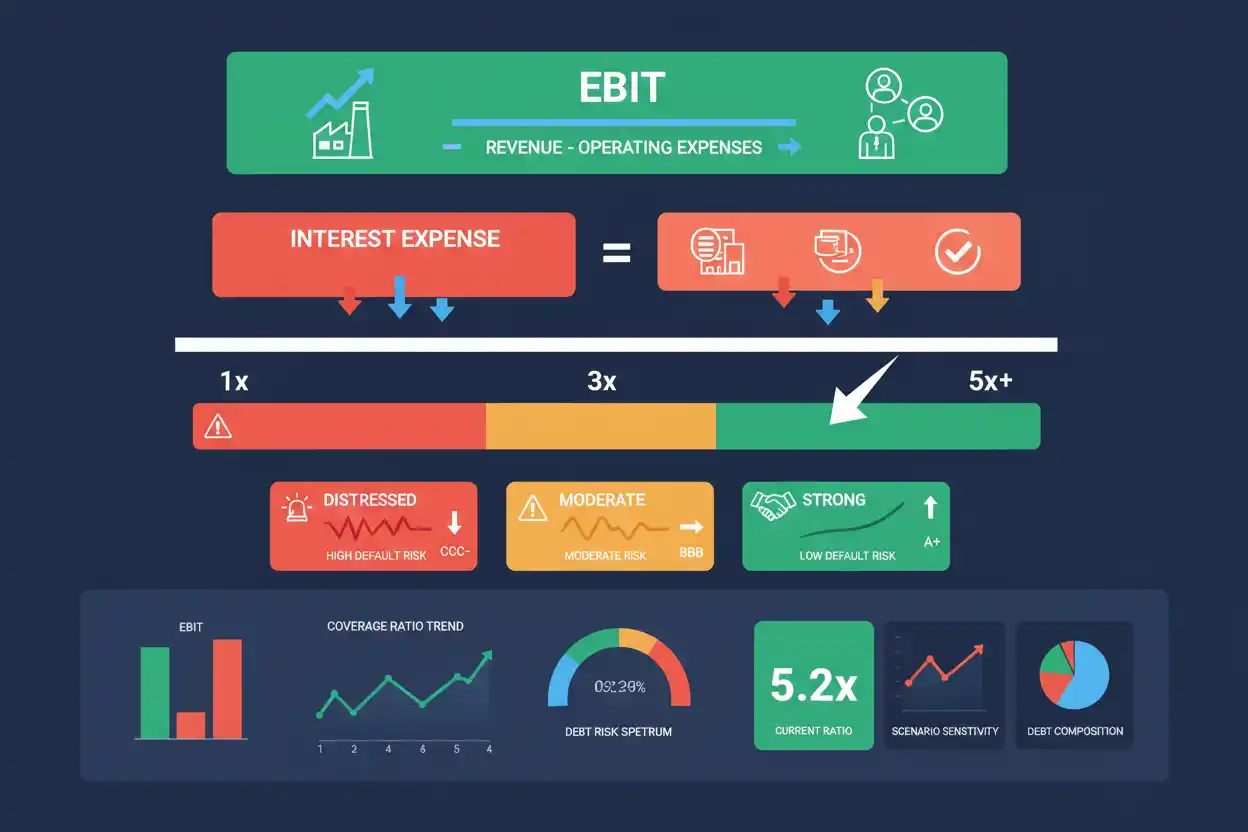

The interest coverage ratio measures how many times a company’s earnings can cover its interest expense.
A common formula is:
Interest Coverage Ratio = EBIT ÷ Interest Expense
If a company generates $500,000 of earnings before interest and taxes and incurs $100,000 of interest expense:
Interest Coverage Ratio = $500,000 ÷ $100,000
Interest Coverage Ratio = 5.0×
The company generates five dollars of EBIT for every dollar of interest expense under that calculation.
A higher ratio generally indicates a larger earnings cushion for servicing interest. A lower ratio indicates that interest consumes a larger share of operating earnings.
However, there is no single universal interest coverage formula. Loan agreements, analysts, rating frameworks, and companies can define the numerator differently. Some use EBIT, while others use EBITDA, adjusted EBITDA, fixed charges, cash interest, or another specifically defined earnings measure.
The definition must therefore be stated before the ratio is interpreted.
What Is the Interest Coverage Ratio?
The interest coverage ratio is a debt-capacity measure.
It asks:
How comfortably can the company’s selected earnings measure cover its interest obligation?
The most familiar version is:
Interest Coverage Ratio = EBIT ÷ Interest Expense
The ratio is usually expressed as a multiple rather than a percentage.
For example:
3.0× coverage means EBIT equals three times interest expense.
The concept fits within the Loans & Credit cluster because borrowing costs affect a company’s ability to service debt, while the broader Finance framework connects coverage with leverage, profitability, and cash flow.
Interest Coverage Ratio Example
Suppose a company reports:
Revenue = $4,000,000
Operating expenses before interest and tax = $3,400,000
EBIT is:
EBIT = $4,000,000 − $3,400,000
EBIT = $600,000
Interest expense:
Interest Expense = $150,000
Coverage:
Interest Coverage Ratio = $600,000 ÷ $150,000
Interest Coverage Ratio = 4.0×
The company produces four times the EBIT required to cover its interest expense.
What Does 4.0× Interest Coverage Mean?
A 4.0× ratio means interest expense represents approximately one-quarter of the EBIT measure used.
Another way to express it is:
Interest Expense as % of EBIT = $150,000 ÷ $600,000 × 100
Interest Expense = 25% of EBIT
That does not mean 75% of EBIT becomes free cash flow.
Taxes, capital spending, working capital, principal repayments, dividends, and other obligations still matter.
Interest coverage addresses one specific financing burden.
Interest Coverage of 1.0×
Suppose:
EBIT = $100,000
Interest expense = $100,000
Then:
Interest Coverage = 1.0×
Operating earnings before interest and tax exactly equal interest expense.
That leaves no EBIT cushion in this simple ratio.
Even a modest decline in operating earnings could push coverage below 1.0×.
Interest Coverage Below 1.0×
Suppose:
EBIT = $80,000
Interest expense = $100,000
Then:
Interest Coverage = $80,000 ÷ $100,000
Interest Coverage = 0.80×
The EBIT measure is insufficient to cover interest expense.
This can indicate significant financial pressure, although the company’s total liquidity position still requires further analysis.
Cash reserves, asset sales, financing, working-capital movements, or nonoperating cash flows can affect actual payment capacity.
EBIT-Based Interest Coverage
EBIT stands for earnings before interest and taxes.
Using EBIT makes intuitive sense because interest coverage compares operating earnings before financing costs with the interest cost itself.
The formula is:
EBIT Interest Coverage = EBIT ÷ Interest Expense
This is a widely used baseline definition.
EBITDA Interest Coverage
Some lenders or analysts use EBITDA instead.
EBITDA Interest Coverage = EBITDA ÷ Interest Expense
Suppose:
EBIT = $600,000
Depreciation and amortization = $200,000
EBITDA = $800,000
Interest = $150,000
EBIT coverage:
$600,000 ÷ $150,000 = 4.0×
EBITDA coverage:
$800,000 ÷ $150,000 ≈ 5.33×
The same business suddenly appears to have stronger coverage because the numerator changed.
This is why coverage ratios should never be compared without confirming definitions.
EBIT vs EBITDA Coverage
EBIT recognizes depreciation and amortization as operating costs before calculating coverage.
EBITDA adds them back.
The EBITDA version can be useful when analyzing cash-like operating earnings, but it can also overstate economic flexibility for businesses that require substantial recurring capital investment.
A capital-intensive company may need to replace assets even though depreciation is noncash in the current accounting period.
Operating Income and Interest Coverage
Operating income can sometimes be similar to EBIT, but the terms are not always perfectly interchangeable.
Nonoperating gains or losses can create differences.
Analysts should therefore use the actual definitions from the financial statements or lending agreement rather than substituting terms casually.
Interest Coverage and Debt Service Coverage Ratio
The debt service coverage ratio is broader.
Interest coverage typically evaluates:
Earnings ÷ Interest
DSCR commonly evaluates:
Cash Flow Available for Debt Service ÷ Principal and Interest Debt Service
A company can have strong interest coverage but weaker DSCR when substantial principal repayments are due.
Example: Interest Coverage vs DSCR
Suppose:
EBIT = $500,000
Interest = $100,000
Required principal repayment = $250,000
Interest coverage:
$500,000 ÷ $100,000 = 5.0×
If the same $500,000 were used purely as a simplified DSCR numerator:
DSCR = $500,000 ÷ ($100,000 + $250,000)
DSCR ≈ 1.43×
The company comfortably covers interest but has a much smaller cushion after principal payments are included.
Interest Coverage and Business Loan Payments
Business loan payments determine the recurring principal-and-interest burden.
Interest coverage focuses only on the interest portion when using the standard EBIT formula.
Businesses with heavily amortizing loans should therefore analyze both payment obligations and interest coverage.
Business Loan APR and Coverage
Business loan APR affects financing economics.
A higher borrowing rate can increase interest expense and weaken coverage.
Suppose:
EBIT = $600,000
Old interest = $100,000
New interest = $150,000
Old coverage:
6.0×
New coverage:
4.0×
Operating performance is unchanged; financing became more expensive.
Fixed vs Variable Rates and Coverage
The fixed vs variable interest rate distinction becomes especially important for leveraged businesses.
With fixed-rate debt, future interest expense is more predictable.
With variable-rate debt, benchmark increases can raise interest expense quickly.
A sensitivity analysis should therefore test multiple rate scenarios.
Interest Coverage Stress Test
Assume:
EBIT = $800,000
Interest expense = $200,000
Base coverage:
Coverage = $800,000 ÷ $200,000 = 4.0×
Now assume EBIT falls 20%:
New EBIT = $800,000 × 80% = $640,000
Coverage becomes:
$640,000 ÷ $200,000 = 3.2×
Now assume interest simultaneously rises to $250,000:
Stress Coverage = $640,000 ÷ $250,000
Stress Coverage = 2.56×
This shows why a single historical ratio can understate risk.
Interest Coverage and Flat vs Reducing Interest
The flat vs reducing balance interest method influences the real financing burden behind a loan quotation.
A deceptively low flat rate can create a larger effective cost than management expects.
Coverage analysis should therefore rely on actual accounting or cash interest rather than merely an advertised percentage.
Interest Coverage and Interest Rate Basics
Interest rate basics helps distinguish contractual rates, APR, periodic rates, and effective borrowing cost.
The coverage ratio uses interest expense, not the APR percentage itself.
For example, you do not divide EBIT by 10% APR.
You divide EBIT by the relevant dollar amount of interest expense.
Interest Coverage and EMI
An EMI contains both principal and interest.
Only the interest component normally enters a standard EBIT-based interest coverage denominator.
The entire EMI may be relevant to cash-flow or debt-service analysis instead.
Interest Coverage and Leasing Costs
Leasing costs can also create fixed financial obligations.
Depending on the accounting framework, contractual agreement, and analytical objective, lease-related charges can be handled differently in coverage measures.
Some credit agreements therefore use broader fixed-charge coverage rather than a simple interest-only ratio.
Interest Coverage and Debt Ratio
The debt ratio measures debt relative to assets.
Interest coverage measures earnings relative to interest expense.
A company can have a high debt ratio but still maintain strong interest coverage if earnings are robust and borrowing costs are low.
Conversely, a modest debt balance can create weak coverage if earnings collapse.
Interest Coverage and Debt-to-Equity Ratio
The debt-to-equity ratio focuses on financing structure.
Interest coverage focuses on the ability to absorb financing cost.
The metrics work well together:
leverage tells you how much debt exposure exists, while coverage helps show how manageable the associated interest burden is.
Interest Coverage and Working Capital
Strong working capital does not guarantee strong interest coverage.
Working capital is a balance-sheet liquidity measure.
Interest coverage is an earnings-based ratio.
A business can hold substantial inventory and receivables while generating weak operating earnings.
Likewise, a highly profitable company can temporarily have tight working capital.
Interest Coverage and Cash Flow Forecasting
A cash flow forecast can reveal whether interest payments are manageable in actual cash terms.
This matters because EBIT is an accounting measure.
A company can report adequate EBIT coverage while experiencing temporary cash shortages caused by receivables, inventory, taxes, or capital expenditure.
What Is a Good Interest Coverage Ratio?
There is no universal good ratio.
A 3.0× coverage ratio can be comfortable for one business and weak for another.
The appropriate cushion depends on:
- earnings volatility,
- industry cyclicality,
- debt maturity,
- fixed vs variable rates,
- capital expenditure needs,
- access to liquidity,
- lender covenants,
- and expected future performance.
Loan agreements can also specify their own minimum ratio definitions.
Interest Coverage and Covenants
Some credit agreements require borrowers to maintain a minimum interest coverage ratio.
The agreement may define:
EBIT, EBITDA, adjusted EBITDA, cash interest expense, or permitted adjustments in detail.
For covenant compliance, the contractual definition controls.
An analyst’s standard EBIT÷interest calculation cannot substitute for the lender’s specific formula.
Negative EBIT
If EBIT is negative, conventional interest coverage is also negative.
Suppose:
EBIT = −$200,000
Interest expense = $100,000
Coverage = −2.0×
The mathematical result is less useful as a conventional “times covered” interpretation.
The more important conclusion is that operating earnings are negative and do not cover interest.
Zero Interest Expense
If a company has no interest expense, dividing by zero does not produce a meaningful coverage ratio.
The appropriate conclusion is usually that the company has no applicable interest burden for the period rather than reporting infinite coverage mechanically.
Common Interest Coverage Mistakes
One mistake is mixing EBITDA coverage with EBIT coverage without labeling the difference.
Another is using total debt instead of interest expense in the denominator.
A third is ignoring variable-rate risk.
Analysts also sometimes treat one year’s strong coverage as permanent despite highly cyclical earnings.
Finally, coverage should not be confused with liquidity, profitability margin, DSCR, or leverage.
Frequently Asked Questions
What is the interest coverage ratio?
It measures how many times a selected earnings measure can cover interest expense.
What is the standard formula?
Interest Coverage Ratio = EBIT ÷ Interest Expense
What does 5× coverage mean?
It means EBIT equals five times the interest expense used in the calculation.
Is higher interest coverage better?
Generally, a higher ratio indicates a larger earnings cushion for interest, all else equal.
What does coverage below 1 mean?
It means the selected earnings measure is below interest expense.
Can EBITDA be used?
Yes, some analysts and loan agreements use EBITDA or adjusted EBITDA, but that produces a different ratio.
Is interest coverage the same as DSCR?
No. DSCR can include principal and interest debt service, while standard interest coverage focuses on interest.
Does principal repayment go into the standard ratio?
No, not in the basic EBIT÷interest formula.
Can variable rates reduce interest coverage?
Yes. Higher interest expense lowers the ratio when earnings remain unchanged.
Is there a universal minimum interest coverage ratio?
No. Requirements vary across industries, lenders, credit agreements, and risk profiles.
Can the ratio be negative?
Yes, mathematically, when the numerator is negative, although the conventional coverage interpretation becomes less useful.
Why do different sources report different coverage ratios?
They may use different definitions of earnings and interest expense.
Final Takeaway
The standard interest coverage ratio is:
Interest Coverage Ratio = EBIT ÷ Interest Expense
If EBIT is $600,000 and interest expense is $150,000:
Interest Coverage = 4.0×
That means the company’s EBIT equals four times its interest expense.
The formula is simple, but interpretation requires discipline. Confirm whether the numerator is EBIT, EBITDA, adjusted EBITDA, or another contractual measure, and determine whether interest expense includes all relevant borrowing costs.
Interest coverage is most useful when analyzed alongside debt-service coverage, leverage, cash flow, loan structure, and sensitivity to changes in earnings and interest rates.