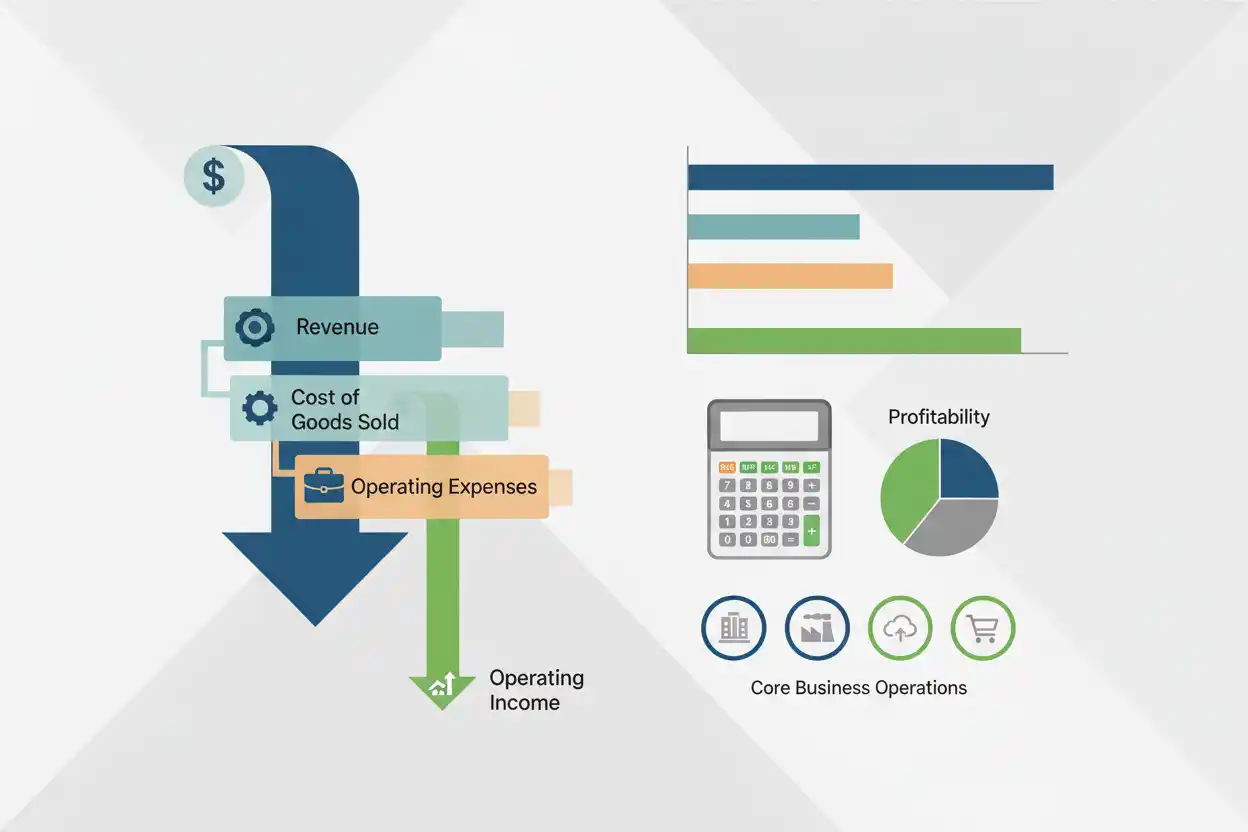

Operating income is the profit a business generates from its core operations after deducting operating costs but before accounting for certain non-operating items such as interest expense and income taxes.
If a company earns $1,000,000 in revenue, incurs $600,000 of cost of goods sold, and records $250,000 of operating expenses, its operating income is $150,000.
Operating Income = Revenue − Cost of Goods Sold − Operating Expenses
Operating Income = $1,000,000 − $600,000 − $250,000 = $150,000
Operating income helps separate the profitability of the underlying business from financing decisions, taxes, and certain non-operating gains or losses.
What Is Operating Income?
Operating income measures profit generated by normal business operations.
For a company that sells products, the calculation typically starts with revenue, subtracts cost of goods sold to determine gross profit, and then subtracts operating expenses.
A simplified sequence is:
Revenue − Cost of Goods Sold = Gross Profit
Then:
Gross Profit − Operating Expenses = Operating Income
Suppose a retailer generates $2 million of revenue and has $1.2 million of cost of goods sold.
Gross profit is:
$2,000,000 − $1,200,000 = $800,000
If operating expenses total $500,000:
Operating Income = $800,000 − $500,000 = $300,000
The company therefore generated $300,000 of profit from operations before the non-operating items that follow.
Operating Income Formula
The standard formula for a business that reports gross profit is:
Operating Income = Gross Profit − Operating Expenses
Because:
Gross Profit = Revenue − Cost of Goods Sold
the formula can also be written as:
Operating Income = Revenue − Cost of Goods Sold − Operating Expenses
For businesses without a conventional COGS structure, the presentation can differ.
A service company might calculate operating income by subtracting qualifying operating expenses directly from operating revenue.
The relevant formula should therefore match the company’s actual income-statement structure.
Operating Income Example
Suppose a business reports:
| Item | Amount |
|---|---|
| Revenue | $1,500,000 |
| Cost of goods sold | $900,000 |
| Gross profit | $600,000 |
| Selling expenses | $150,000 |
| Administrative expenses | $175,000 |
| Other operating expenses | $25,000 |
Total operating expenses are:
$150,000 + $175,000 + $25,000 = $350,000
Operating income is:
Operating Income = $600,000 − $350,000 = $250,000
The company’s operating income is $250,000.
As a percentage of revenue:
Operating Income ÷ Revenue × 100
$250,000 ÷ $1,500,000 × 100 ≈ 16.67%
This percentage describes operating profitability relative to revenue, although operating income itself remains the dollar amount.
How Operating Income Works on an Income Statement
Consider this simplified statement:
| Income Statement Item | Amount |
|---|---|
| Revenue | $3,000,000 |
| Cost of goods sold | $1,700,000 |
| Gross profit | $1,300,000 |
| Operating expenses | $800,000 |
| Operating income | $500,000 |
| Interest expense | $60,000 |
| Other income | $10,000 |
| Income before tax | $450,000 |
| Income tax expense | $100,000 |
| Net income | $350,000 |
Operating income is calculated before interest expense, other non-operating items, and taxes in this example.
That separation makes the figure useful for evaluating whether the core operating model is profitable without immediately mixing in the company’s financing structure.
Operating Income vs. Net Income
Operating income and net income measure different levels of profit.
Operating income focuses on core operations.
Net income represents the final accounting profit after additional recognized items are included.
Using the previous example:
Operating Income = $500,000
After subtracting $60,000 of interest, adding $10,000 of other income, and subtracting $100,000 of tax:
Net Income = $350,000
The $150,000 difference between operating income and net income comes from items below the operating-profit level.
A business can therefore have strong operating income but considerably lower net income because of debt costs, taxes, losses, or other non-operating charges.
Operating Income vs. Gross Profit
Gross profit measures what remains after subtracting the cost assigned to goods sold.
Operating income goes further by subtracting operating expenses.
Suppose:
Revenue = $1,000,000
Cost of Goods Sold = $550,000
Then:
Gross Profit = $450,000
If operating expenses are $300,000:
Operating Income = $450,000 − $300,000 = $150,000
Gross profit is $450,000, while operating income is only $150,000.
The $300,000 difference represents the operating-cost structure below gross profit.
This distinction helps determine whether weak profitability originates in product economics or the broader operating expense base.
Operating Income vs. Net Margin
Net margin uses final net income rather than operating income.
Suppose revenue is $2 million, operating income is $300,000, and net income is $180,000.
Operating income represents:
$300,000 ÷ $2,000,000 × 100 = 15% of Revenue
Net margin is:
$180,000 ÷ $2,000,000 × 100 = 9%
The six-percentage-point difference reflects the effect of items occurring after operating income.
Operating income therefore isolates core operating profitability more directly, while net margin describes the percentage of sales that ultimately survives to the bottom line.
Positive Operating Income
Positive operating income means the recognized revenue and gross profit generated by the business were sufficient to cover the operating expenses included in the calculation.
Suppose:
Gross Profit = $500,000
Operating Expenses = $400,000
Then:
Operating Income = $100,000
The business generated a positive $100,000 result from operations.
This does not necessarily mean the company earned positive net income.
If interest expense and other below-operating costs exceed $100,000, the company can still report a net loss.
Negative Operating Income
Negative operating income means operating expenses exceed gross profit.
Suppose:
Gross Profit = $350,000
Operating Expenses = $430,000
Then:
Operating Income = $350,000 − $430,000 = −$80,000
The business reports an $80,000 operating loss.
A negative operating result can arise from weak sales, low gross margin, excessive operating costs, early-stage investment, temporary disruptions, or an underlying business model that has not reached profitable scale.
The cause matters more than the negative sign alone.
How Revenue Growth Affects Operating Income
Revenue growth can increase operating income when the incremental gross profit exceeds the additional operating expenses required to support the new sales.
Suppose a company currently reports:
Revenue = $1,000,000
Gross Profit = $400,000
Operating Expenses = $300,000
Operating income:
$400,000 − $300,000 = $100,000
Now revenue grows and gross profit increases to $500,000, while operating expenses rise only to $340,000.
New operating income:
$500,000 − $340,000 = $160,000
Operating income rises by:
$160,000 − $100,000 = $60,000
The operating model generated $100,000 of additional gross profit while requiring only $40,000 of additional operating expenses.
Revenue Growth Can Occur While Operating Income Falls
Higher sales do not guarantee greater operating profit.
Suppose:
Year 1
Revenue = $2,000,000
Gross Profit = $800,000
Operating Expenses = $600,000
Operating Income = $200,000
Year 2
Revenue = $2,500,000
Gross Profit = $900,000
Operating Expenses = $750,000
Operating Income = $150,000
Revenue increased 25%, yet operating income fell 25%.
The company generated an additional $100,000 of gross profit but added $150,000 of operating expenses.
Looking only at revenue growth would therefore hide deteriorating operating profitability.
How Operating Expenses Affect Operating Income
Operating expenses have a direct relationship with operating income when gross profit remains unchanged.
Suppose gross profit is $700,000.
At $400,000 of operating expenses:
Operating Income = $700,000 − $400,000 = $300,000
If operating expenses rise to $475,000:
Operating Income = $700,000 − $475,000 = $225,000
The $75,000 increase in expenses reduces operating income by $75,000.
This makes expense classification and cost control central to operating-income analysis.
However, reducing expenses is not automatically beneficial if the reduction weakens sales capacity, service quality, compliance, maintenance, or future growth.
Operating Income and Fixed Costs
Businesses with substantial fixed operating expenses can experience significant operating leverage.
Suppose gross profit is $500,000 and fixed operating expenses are $400,000.
Operating income is:
$500,000 − $400,000 = $100,000
If gross profit rises to $650,000 while operating expenses remain $400,000:
Operating Income = $650,000 − $400,000 = $250,000
Gross profit increased by 30%:
($650,000 − $500,000) ÷ $500,000 × 100 = 30%
But operating income increased by:
($250,000 − $100,000) ÷ $100,000 × 100 = 150%
A relatively fixed expense structure can therefore magnify improvements in operating income as the business scales.
The same effect works in reverse when gross profit declines.
Operating Income and Variable Operating Costs
Not all operating expenses remain fixed as the business grows.
Suppose sales commissions equal 5% of revenue.
At $1 million of sales:
Commission Expense = $1,000,000 × 5% = $50,000
At $1.5 million:
Commission Expense = $1,500,000 × 5% = $75,000
The additional $500,000 of revenue brings an additional $25,000 of commission expense.
Operating-income forecasts therefore need to reflect how costs behave rather than assuming every operating expense remains constant.
Operating Income and Depreciation
Depreciation associated with operating assets can reduce operating income.
Suppose operating income before depreciation is $240,000 and operating depreciation expense is $40,000.
Operating Income After Depreciation = $240,000 − $40,000 = $200,000
The $40,000 depreciation expense reduces accounting operating profit.
However, recording depreciation does not create a matching $40,000 current-period cash payment.
This is one reason operating income and operating cash generation can differ.
Operating Income vs. Cash Flow
Operating income is an accounting profitability measure, not a cash-flow measure.
Suppose a company records $300,000 of operating income but customers have not yet paid $150,000 of recognized receivables.
The company can show strong operating profit while collecting substantially less cash.
Inventory purchases, supplier-payment timing, noncash depreciation, and other working-capital movements can create further differences.
Operating income therefore answers:
How profitable were the core operations under the accounting framework?
It does not answer:
How much cash did operations generate?
Operating Income and Owner Equity
Operating income can contribute indirectly to owner equity through the profit retained by the business.
Suppose a sole-owner business generates $150,000 of operating income.
After interest, taxes, and other applicable items, net income is $100,000.
If the owner leaves that $100,000 in the business rather than withdrawing it, the profit can increase owner equity, all else equal.
The relationship is indirect:
Operating Income → Net Income → Retained Profit → Owner Equity
Operating income itself should therefore not be added directly to equity without considering the remaining income-statement items and owner transactions.
Operating Income and Payables Turnover
Payables turnover measures how quickly a company pays suppliers relative to the applicable purchases or cost base.
Payment timing does not necessarily change operating income in the same period because an expense can be recognized before or after its related cash payment.
For example, a supplier expense may already be included in operating income calculations while the invoice remains unpaid in accounts payable.
Paying that invoice later reduces cash and the payable balance but does not normally create the same expense again.
This distinction prevents supplier-payment speed from being confused with operating profitability.
Supplier Prices Can Affect Operating Income
Although payment timing may not directly change operating income, supplier prices can.
Suppose a business previously incurs $300,000 of annual operating supplier costs.
Prices rise 10% with no change in volume:
New Cost = $300,000 × 1.10 = $330,000
Additional operating expense:
$330,000 − $300,000 = $30,000
If gross profit and all other operating expenses remain unchanged, operating income falls by $30,000.
Supplier management can therefore matter to operating profitability even when payment timing is analyzed separately.
Operating Income and Net Income Growth
Suppose operating income grows from $300,000 to $400,000 while interest expense and taxes also increase.
Year 1:
Operating Income = $300,000
Net Income = $200,000
Year 2:
Operating Income = $400,000
Net Income = $230,000
Operating income increased:
($400,000 − $300,000) ÷ $300,000 × 100 ≈ 33.33%
Net income increased:
($230,000 − $200,000) ÷ $200,000 × 100 = 15%
Core operations improved substantially, but higher below-operating costs prevented all of that improvement from reaching the bottom line.
Operating Income Trend Example
Suppose:
| Year | Revenue | Gross Profit | Operating Expenses | Operating Income |
|---|---|---|---|---|
| Year 1 | $4,000,000 | $1,600,000 | $1,300,000 | $300,000 |
| Year 2 | $4,500,000 | $1,850,000 | $1,400,000 | $450,000 |
| Year 3 | $5,000,000 | $2,050,000 | $1,500,000 | $550,000 |
Operating income rises from $300,000 to $550,000.
Growth:
($550,000 − $300,000) ÷ $300,000 × 100 ≈ 83.33%
Revenue grew only 25% over the same period:
($5,000,000 − $4,000,000) ÷ $4,000,000 × 100 = 25%
Operating income is therefore growing much faster than revenue, indicating improving operating economics in this simplified example.
Operating Income Percentage
Operating income can be expressed relative to revenue:
Operating Income Percentage = Operating Income ÷ Revenue × 100
Suppose:
Operating Income = $240,000
Revenue = $1,600,000
Then:
Operating Income Percentage = $240,000 ÷ $1,600,000 × 100 = 15%
The business generates $0.15 of operating income for every $1.00 of revenue.
This percentage should not be confused with net margin, which uses final net income.
Example of Improving Operating Profitability
Assume:
Period 1
Revenue = $1,000,000
Operating Income = $100,000
Operating income percentage:
10%
Period 2
Revenue = $1,200,000
Operating Income = $180,000
Operating income percentage:
$180,000 ÷ $1,200,000 = 15%
The operating-income percentage improved by:
15% − 10% = 5 Percentage Points
Relative improvement in the margin is:
(15% − 10%) ÷ 10% × 100 = 50%
The distinction between percentage points and percent change is important when interpreting profitability ratios.
Example of Deteriorating Operating Profitability
Suppose:
Period 1
Revenue = $2,000,000
Operating Income = $300,000
Operating Income Percentage = 15%
Period 2
Revenue = $2,400,000
Operating Income = $240,000
Operating Income Percentage = 10%
Revenue increased by 20%, but operating income fell by 20%.
The operating-income percentage also declined by five percentage points.
Possible explanations include lower gross margins, higher staffing costs, heavier marketing investment, inefficient expansion, unfavorable product mix, or rising administrative costs.
Operating Income and Business Expansion
Expansion often increases operating expenses before the associated revenue reaches full scale.
Suppose a company opens a new location and adds $500,000 of annual operating expenses.
During the first year, the location contributes only $350,000 of additional gross profit.
Incremental operating income is:
$350,000 − $500,000 = −$150,000
The expansion reduces company operating income by $150,000 during its initial year.
If the location later generates $800,000 of gross profit with $550,000 of operating expenses:
Incremental Operating Income = $800,000 − $550,000 = $250,000
The same expansion becomes operating-profit positive after scaling.
Operating income therefore helps show whether expansion is covering the operating resources required to support it.
Does Interest Expense Affect Operating Income?
Interest expense is generally treated as a non-operating financing cost rather than an operating expense in common multi-step income-statement presentations.
Suppose:
Operating Income = $200,000
Interest Expense = $50,000
Interest does not change the already calculated $200,000 operating income.
Instead:
Income Before Other Items and Tax = $200,000 − $50,000 = $150,000
This separation allows analysts to distinguish operating performance from how the company finances itself.
Do Income Taxes Affect Operating Income?
Income taxes generally occur below operating income in a standard multi-step presentation.
Suppose:
Operating Income = $300,000
Interest and Other Net Expense = $40,000
Pretax Income = $260,000
Income Tax Expense = $60,000
Then:
Net Income = $200,000
The $60,000 tax expense affects net income but does not retrospectively reduce the $300,000 operating-income subtotal.
One-Time Operating Costs
A one-time cost can still reduce operating income if it is classified within operations.
Suppose normal operating expenses are $700,000, but the company incurs a $100,000 relocation expense classified within operating costs.
Reported operating expenses become:
$800,000
If gross profit is $1 million:
Reported Operating Income = $1,000,000 − $800,000 = $200,000
Without the one-time amount:
Underlying Comparison = $1,000,000 − $700,000 = $300,000
The reported $200,000 remains important, but identifying the nonrecurring cost can improve trend interpretation.
High Operating Income Does Not Guarantee Strong Cash Flow
Suppose a company generates $500,000 of operating income while accounts receivable increases by $400,000.
Much of the recognized revenue may not yet have turned into cash.
Similarly, inventory can absorb cash and suppliers can be paid on different schedules from expense recognition.
Operating income therefore indicates profitability under accounting rules, not immediate liquidity.
A business can be operationally profitable and still require financing because of working-capital or capital-investment needs.
Common Operating Income Mistakes
One common mistake is subtracting interest expense when calculating operating income even though interest is generally below the operating subtotal.
Another is confusing operating income with net income.
Businesses can also treat every cash payment as an operating expense even when some payments relate to capital assets, debt principal, inventory, or prior-period obligations.
Another error is comparing operating income between companies without considering differences in accounting classifications.
A high operating-income number can also be misleading if revenue scale differs substantially, which is why percentage analysis is useful.
Finally, one period should not be interpreted in isolation. Trends and the drivers behind changes usually matter more.
Frequently Asked Questions
What is operating income in simple terms?
Operating income is the profit generated from core business operations after deducting operating costs but before certain non-operating items such as interest and income taxes.
What is the operating income formula?
A common formula is:
Operating Income = Gross Profit − Operating Expenses
It can also be expressed as:
Operating Income = Revenue − Cost of Goods Sold − Operating Expenses
for an income statement with that structure.
Is operating income the same as net income?
No.
Net income includes additional items such as interest, taxes, and applicable non-operating income or expenses.
Operating income stops at the operating-profit level.
Is operating income the same as gross profit?
No.
Gross profit subtracts cost of goods sold from revenue.
Operating income then deducts operating expenses from gross profit.
Can operating income be negative?
Yes.
When operating expenses exceed gross profit, the business reports an operating loss.
Does interest expense reduce operating income?
Under a common multi-step income-statement presentation, interest expense is treated below operating income and therefore does not reduce the operating subtotal itself.
Do taxes reduce operating income?
Income taxes generally affect the calculation after operating income rather than being included within the operating subtotal.
Does depreciation reduce operating income?
Operating depreciation can reduce operating income when it is recognized within operating costs. Production-related depreciation may flow through inventory and cost of goods sold depending on its classification.
Can operating income rise while net income falls?
Yes.
Higher interest costs, taxes, losses, or other below-operating expenses can cause net income to decline even when operating income improves.
Can revenue increase while operating income declines?
Yes.
If cost of goods sold or operating expenses increase faster than revenue, operating income can fall despite higher sales.
Is operating income a cash-flow metric?
No.
It is an accounting profitability measure. Revenue recognition, receivables, inventory, payables, noncash expenses, and other items can cause operating income and cash generation to differ.
Why is operating income useful?
Operating income isolates the profitability of core operations before financing and many non-operating effects. Tracking it over time can show whether the underlying business model is becoming more or less profitable.