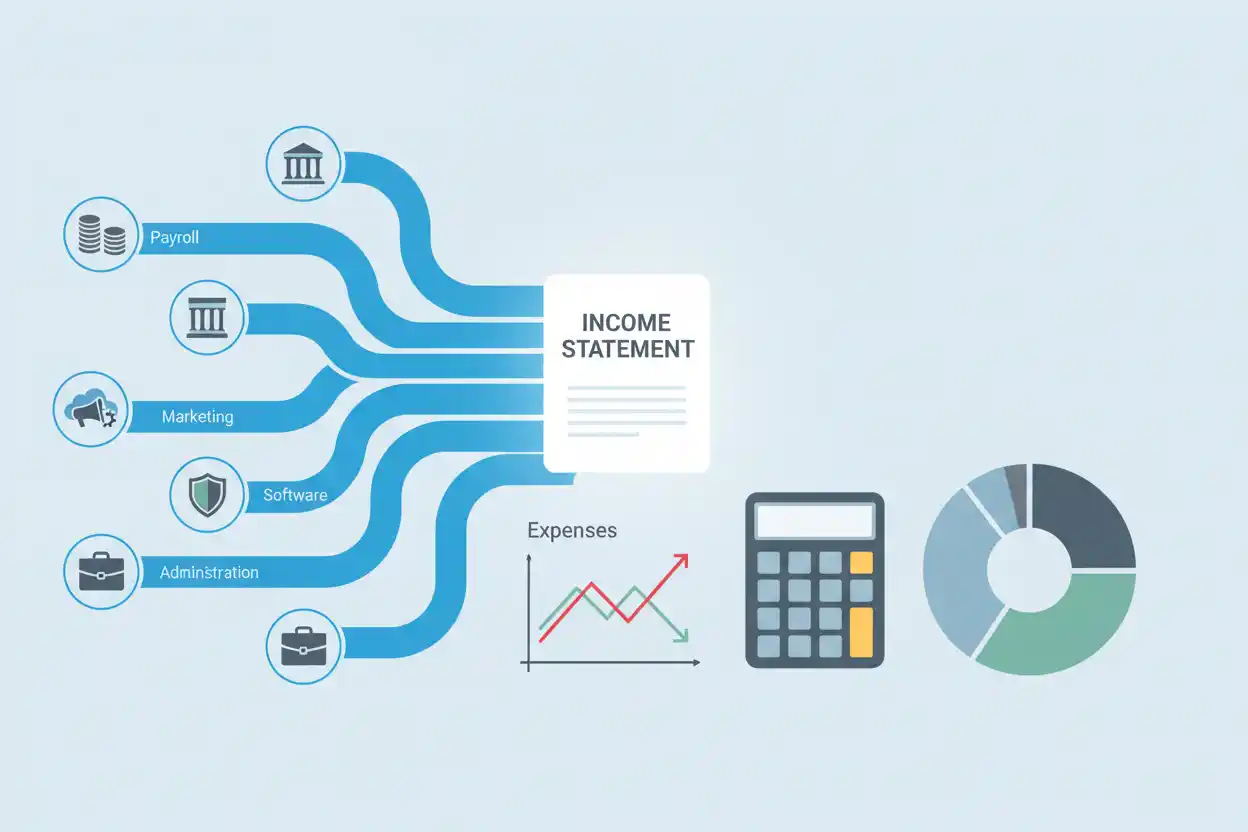

Operating expenses are the costs a business recognizes from running its ordinary operations that are not classified as cost of goods sold or other separately presented non-operating items.
Depending on the business, operating expenses can include administrative payroll, rent, marketing, software, insurance, professional services, office expenses, research and development, and depreciation associated with operating assets.
If a company incurs $300,000 of selling expenses, $250,000 of administrative expenses, and $50,000 of other operating expenses, total operating expenses are $600,000.
Operating Expenses = Selling Expenses + Administrative Expenses + Other Operating Expenses
Operating Expenses = $300,000 + $250,000 + $50,000 = $600,000
Operating expenses are a major link between gross profit and operating income.
What Are Operating Expenses?
Operating expenses are the recognized costs required to operate the business beyond the product or service costs classified elsewhere.
They often include expenses associated with:
- administration;
- sales;
- marketing;
- offices and facilities;
- technology;
- insurance;
- professional services;
- research and development;
- depreciation; and
- other ongoing business functions.
The precise classification varies by industry and accounting policy.
A retailer, manufacturer, bank, software company, and consulting business will not necessarily present operating expenses in identical ways.
The key issue is the nature and function of the cost, not merely whether the company paid cash for it.
Operating Expenses Formula
When expense categories are available individually:
Operating Expenses = Sum of All Qualifying Operating Expense Categories
For example:
Operating Expenses = Selling Expenses + General & Administrative Expenses + Research & Development + Other Operating Expenses
Another useful relationship can be derived from a multi-step income statement when gross profit and operating income are known:
Operating Expenses = Gross Profit − Operating Income
This rearranged formula assumes operating expenses are the only items between those two subtotals in the statement being analyzed.
It should not be applied mechanically when the income statement contains additional operating income, gains, losses, or unusual classifications between gross profit and operating income.
Operating Expenses Example
Suppose a company reports:
| Operating Expense | Amount |
|---|---|
| Administrative salaries | $180,000 |
| Marketing | $80,000 |
| Office rent | $60,000 |
| Software and technology | $35,000 |
| Insurance | $15,000 |
| Professional services | $20,000 |
| Depreciation expense | $10,000 |
| Total operating expenses | $400,000 |
Calculate:
Operating Expenses = $180,000 + $80,000 + $60,000 + $35,000 + $15,000 + $20,000 + $10,000
Operating Expenses = $400,000
The company recognized $400,000 of operating expenses during the period.
Operating Expenses on the Income Statement
Operating expenses generally appear after gross profit in a multi-step income statement.
Suppose:
Revenue = $2,000,000
Cost of Goods Sold = $1,100,000
Gross profit is:
Gross Profit = $2,000,000 − $1,100,000 = $900,000
If operating expenses are $600,000:
Operating Income = $900,000 − $600,000 = $300,000
The sequence is:
Revenue − Cost of Goods Sold = Gross Profit
Gross Profit − Operating Expenses = Operating Income
Additional non-operating items can then affect the final net income.
Operating Expenses vs. Cost of Goods Sold
Operating expenses should not be confused with cost of goods sold.
COGS represents costs assigned to goods or products sold.
Operating expenses generally represent the costs of running the broader business outside that product-cost category.
For a retailer, merchandise cost sold generally belongs in COGS, while corporate office rent may be an operating expense.
For a manufacturer, the distinction can be more complicated because qualifying manufacturing labor, materials, and overhead can become part of inventory and eventually COGS.
The correct classification therefore depends on what the expense supports and how the relevant accounting rules treat it.
Operating Expenses vs. Capital Expenditures
A cash payment does not automatically become an operating expense.
Suppose a business buys machinery for $300,000.
The $300,000 cash outflow may be capitalized as an asset rather than recognized immediately as a $300,000 operating expense.
The cost can then affect future periods through depreciation expense, subject to the applicable accounting treatment.
This distinction is important because capital expenditures and operating expenses affect financial statements differently.
A large asset purchase may produce a significant cash outflow without reducing current-period operating income by the full purchase price.
Operating Expenses vs. Cash Expenses
Operating expenses are accounting expenses, not necessarily cash payments made during the same period.
Suppose a company recognizes $50,000 of an operating expense in March but pays the supplier in April.
March’s income statement can include the expense even though cash remains unchanged until April.
The opposite can also happen.
A company may prepay an expense before the amount is fully recognized.
This timing distinction is one reason the cash flow statement should be analyzed separately from operating expenses.
Fixed Operating Expenses
Some operating expenses remain relatively stable across a range of activity.
Examples can include office rent, certain salaried positions, insurance contracts, and fixed software subscriptions.
Suppose monthly office rent is $25,000.
Whether the company produces 10,000 or 12,000 units that month, the rent may remain $25,000 within the relevant operating range.
That makes it relatively fixed over that range.
However, “fixed” does not mean permanent. Lease renewals, facility expansions, staffing changes, and contract adjustments can change the expense.
Variable Operating Expenses
Other operating expenses can change with sales or activity.
Examples may include sales commissions, payment-processing fees, certain shipping costs, usage-based software, and other activity-driven expenses when classified as operating expenses.
Suppose a company pays a 5% sales commission.
At $500,000 of qualifying sales:
Commission Expense = $500,000 × 5% = $25,000
At $800,000:
Commission Expense = $800,000 × 5% = $40,000
The operating expense rises as sales increase.
Understanding cost behavior helps management forecast how operating expenses respond to growth.
Semi-Variable Operating Expenses
Some costs contain both fixed and variable components.
Suppose a cloud-software contract costs:
Base Subscription = $10,000 per Month
plus:
$0.02 per Transaction
At 500,000 transactions:
Variable Component = 500,000 × $0.02 = $10,000
Total:
Operating Expense = $10,000 + $10,000 = $20,000
If volume rises to 1 million transactions:
Variable Component = $20,000
Total Expense = $10,000 + $20,000 = $30,000
Classifying every operating expense as purely fixed or purely variable can therefore oversimplify real cost structures.
Selling Expenses
Selling expenses are costs associated with acquiring customers and generating sales.
Depending on the business, these can include sales salaries, commissions, advertising, promotional activity, travel, certain distribution costs, and customer-facing software.
Suppose:
Sales Payroll = $120,000
Advertising = $70,000
Commissions = $45,000
Sales Software = $15,000
Total selling expense:
$120,000 + $70,000 + $45,000 + $15,000 = $250,000
These costs may be grouped within broader operating expenses.
General and Administrative Expenses
General and administrative expenses support the company rather than a specific product sale.
Common examples include executive and administrative salaries, accounting, legal costs, office expenses, human resources, insurance, and corporate technology.
Suppose:
Administrative Payroll = $200,000
Professional Fees = $40,000
Office Costs = $35,000
Insurance = $25,000
Total:
G&A Expense = $300,000
Separating G&A from selling expenses can help management identify which parts of the cost structure are growing.
Research and Development Expense
Research and development can be a significant operating cost for technology, pharmaceutical, engineering, and product-focused businesses.
Suppose a software company spends:
- $300,000 on engineering salaries;
- $50,000 on testing infrastructure;
- $25,000 on external development services.
If these amounts qualify as current-period R&D operating expenses under the applicable accounting treatment:
R&D Expense = $300,000 + $50,000 + $25,000 = $375,000
The exact accounting treatment of development activities can depend on the relevant reporting rules, so not every technical expenditure should be automatically classified the same way.
Depreciation as an Operating Expense
Depreciation associated with assets used in ordinary operations can affect operating expenses.
Suppose office equipment produces annual depreciation of $20,000.
That amount can reduce operating income even though no $20,000 cash payment occurs when the depreciation is recorded.
Production-related depreciation may be treated differently. It can become part of manufacturing overhead and flow through inventory and COGS rather than necessarily appearing as a separate operating-expense line.
The purpose for which the asset is used therefore matters.
Operating Expenses and Operating Income
Operating expenses directly influence operating income.
Suppose gross profit is $700,000.
Scenario A:
Operating Expenses = $400,000
Operating Income = $700,000 − $400,000 = $300,000
Scenario B:
Operating Expenses = $500,000
Operating Income = $700,000 − $500,000 = $200,000
A $100,000 increase in operating expenses reduces operating income by $100,000 in this simplified example.
This relationship makes operating-expense control central to operating profitability.
Operating Expenses and Net Income
Operating expenses can also affect final net income.
Suppose:
Gross Profit = $500,000
Operating Expenses = $300,000
Operating Income = $200,000
Then assume:
Interest Expense = $30,000
Tax Expense = $40,000
Simplified net income:
$200,000 − $30,000 − $40,000 = $130,000
If operating expenses rise by $20,000 with no other changes:
New Operating Income = $180,000
New Net Income = $180,000 − $30,000 − $40,000 = $110,000
The additional operating expense reduces bottom-line profit.
Operating Expenses and Net Margin
Because operating expenses affect net income, they can also influence net margin.
Suppose:
Revenue = $2,000,000
Net Income = $200,000
Net margin:
$200,000 ÷ $2,000,000 × 100 = 10%
If operating expenses increase by $50,000 and every other item remains constant, ignoring related tax effects:
New Net Income = $150,000
New Net Margin = $150,000 ÷ $2,000,000 × 100 = 7.5%
The additional operating cost reduces net margin by 2.5 percentage points.
Operating Expenses and Net Burn
Operating expenses and net burn are related but not identical.
Net burn measures cash consumption.
Operating expenses measure recognized accounting expenses from ordinary operations.
Suppose a company recognizes:
Operating Expenses = $300,000
Included in that amount is:
Noncash Depreciation = $30,000
If all other operating expenses were paid immediately, simplified operating cash spending represented by those amounts might be:
$300,000 − $30,000 = $270,000
But working-capital timing can create further differences.
Supplier invoices may remain unpaid.
Prepaid expenses may have been paid in earlier months.
Other cash outflows may relate to items that are not current-period operating expenses.
Operating-expense totals therefore should not simply be copied into a burn calculation.
Operating Expenses and Gross Burn
Gross burn focuses on gross cash spending before operating inflows are considered.
Many operating expenses generate cash outflows and therefore contribute to gross burn.
Payroll, rent, software subscriptions, marketing, and professional fees are common examples.
However, depreciation is a clear reason the two measures can differ.
Likewise, cash paid to settle an expense recognized in a prior period can affect current burn without being a current-period operating expense.
Gross burn and operating expenses should therefore be reconciled rather than assumed equal.
Operating Expenses and Owner Equity
Operating expenses can ultimately reduce owner equity through their effect on profit.
Suppose a sole-owner business earns $200,000 of revenue and recognizes $150,000 of total expenses.
Simplified profit is:
$200,000 − $150,000 = $50,000
If the owner retains that profit in the business, it can increase equity.
If operating expenses instead rise by $20,000:
New Profit = $200,000 − $170,000 = $30,000
Only $30,000 of additional profit remains before considering distributions and other equity changes.
Operating expenses do not normally reduce owner equity through a direct standalone formula; their effect flows through earnings.
Operating Expenses and Labor Productivity
Labor often represents a significant operating cost.
Improving labor productivity can allow output to rise without labor expenses increasing proportionally.
Suppose an administrative processing team handles 20,000 transactions using 4,000 labor hours:
Productivity = 20,000 ÷ 4,000 = 5 Transactions per Hour
After workflow improvements, the team handles 24,000 transactions using the same 4,000 hours:
Productivity = 24,000 ÷ 4,000 = 6 Transactions per Hour
Productivity improves by:
(6 − 5) ÷ 5 × 100 = 20%
The company can process 20% more transactions per labor hour without increasing the measured labor input.
Whether this reduces operating expenses depends on staffing, wages, overtime, technology costs, and other factors.
Operating Expense Ratio
Businesses sometimes compare operating expenses with revenue.
A simple operating-expense ratio can be calculated as:
Operating Expense Ratio = Operating Expenses ÷ Revenue × 100
Suppose:
Operating Expenses = $600,000
Revenue = $2,000,000
Then:
Operating Expense Ratio = $600,000 ÷ $2,000,000 × 100 = 30%
Thirty cents of operating expense are recognized for each $1.00 of revenue.
This ratio can be useful for internal trend analysis, but interpretation depends on how operating expenses are classified and whether businesses being compared use consistent definitions.
Operating Expense Growth
Expense growth can be measured over time.
Suppose operating expenses increase from $800,000 to $920,000.
Increase:
$920,000 − $800,000 = $120,000
Percentage growth:
$120,000 ÷ $800,000 × 100 = 15%
Operating expenses grew by 15%.
That growth should then be compared with changes in revenue, gross profit, headcount, customer volume, and operating capacity.
A 15% expense increase may be reasonable if the business is expanding rapidly. It may be concerning if revenue is flat.
Operating Expenses Growing Faster Than Revenue
Suppose:
Year 1:
Revenue = $5,000,000
Operating Expenses = $1,500,000
Operating-expense ratio:
30%
Year 2:
Revenue = $5,500,000
Operating Expenses = $1,925,000
Operating-expense ratio:
$1,925,000 ÷ $5,500,000 = 35%
Revenue increased 10%, while operating expenses increased:
($1,925,000 − $1,500,000) ÷ $1,500,000 × 100 ≈ 28.33%
Operating expenses grew much faster than revenue, increasing the expense burden from 30% to 35% of sales.
Unless offset elsewhere, that trend puts pressure on profitability.
Operating Leverage and Expenses
A business with substantial fixed operating costs can experience operating leverage.
Suppose fixed operating expenses remain at $400,000 while gross profit rises from $500,000 to $700,000.
Original operating income:
$500,000 − $400,000 = $100,000
New operating income:
$700,000 − $400,000 = $300,000
Gross profit increased by 40%:
($700,000 − $500,000) ÷ $500,000 = 40%
Operating income tripled from $100,000 to $300,000.
Fixed operating expenses can therefore magnify profit growth when revenue expands, but they can also magnify losses when business activity falls.
Cutting Operating Expenses
Reducing operating expenses can improve profitability when the reductions remove genuinely unnecessary costs.
Suppose annual operating expenses are $1 million.
Management identifies:
- $40,000 of duplicate software;
- $60,000 of unnecessary external services;
- $25,000 of avoidable facility costs.
Total reduction:
$40,000 + $60,000 + $25,000 = $125,000
New operating expenses:
$1,000,000 − $125,000 = $875,000
Reduction percentage:
$125,000 ÷ $1,000,000 × 100 = 12.5%
If the savings do not damage revenue, quality, compliance, capacity, or future growth, the lower cost structure can improve operating income.
Why Lower Operating Expenses Are Not Always Better
Aggressively reducing operating expenses can create hidden costs.
Cutting customer service may increase churn.
Reducing maintenance can create equipment failures.
Eliminating marketing can weaken future sales.
Underinvesting in technology can reduce productivity.
Reducing accounting or compliance resources can create control problems.
The objective is therefore not simply to minimize operating expenses. It is to spend at a level that supports sustainable business performance.
Operating Expense Budget Example
Suppose management prepares a monthly operating-expense plan:
| Category | Budget |
|---|---|
| Payroll | $150,000 |
| Rent | $30,000 |
| Marketing | $40,000 |
| Software | $25,000 |
| Professional services | $15,000 |
| Other | $10,000 |
| Total | $270,000 |
Actual operating expenses reach $290,000.
Difference:
$290,000 − $270,000 = $20,000
Actual operating expenses are:
$20,000 ÷ $270,000 × 100 ≈ 7.41%
above budget.
The next step is to identify the individual expense categories responsible for the difference rather than treating the entire $20,000 as one unexplained problem.
Operating Expense Trend Example
Suppose:
| Quarter | Revenue | Operating Expenses | Opex as % of Revenue |
|---|---|---|---|
| Q1 | $1,000,000 | $350,000 | 35% |
| Q2 | $1,100,000 | $363,000 | 33% |
| Q3 | $1,250,000 | $387,500 | 31% |
| Q4 | $1,400,000 | $420,000 | 30% |
Operating expenses rise from $350,000 to $420,000.
Yet they fall from 35% to 30% of revenue.
The business is spending more in absolute terms but less relative to its revenue base.
This can indicate improving operating leverage if the classification and underlying business remain comparable.
Recurring vs. One-Time Operating Expenses
A business may incur unusual expenses that are still related to operations.
Suppose normal quarterly operating expenses are $500,000, but a one-time office relocation adds $150,000.
Reported operating expenses become:
$650,000
That is the correct recorded amount if the costs are classified as operating expenses.
For internal planning, management may also distinguish:
Recurring Operating Expenses = $500,000
from:
One-Time Operating Expenses = $150,000
Doing so helps forecast future periods without hiding the actual expense incurred.
Operating Expenses per Employee
For labor-intensive organizations, management may compare certain operating expenses with workforce size.
Suppose relevant annual operating expenses are $6 million and the company averages 100 employees.
Operating Expenses per Employee = $6,000,000 ÷ 100 = $60,000
If employee count rises to 120 while the same expense base increases to $6.6 million:
$6,600,000 ÷ 120 = $55,000
Total expenses increased, but expenses per employee declined.
The usefulness of this measure depends on the company’s business model and whether employee count is a meaningful activity driver.
Common Operating Expense Mistakes
One common mistake is treating every cash payment as an operating expense.
Another is including inventory purchases directly as operating expenses even when the inventory remains an asset.
Businesses can also confuse COGS with operating expenses.
Capital expenditures are another frequent source of error because acquiring a long-term asset does not necessarily create an immediate operating expense equal to the cash purchase price.
Another mistake is assuming lower operating expenses automatically indicate greater efficiency.
Finally, comparisons across companies can be misleading when expense classifications differ substantially.
Frequently Asked Questions
What are operating expenses in simple terms?
Operating expenses are the recognized costs of running a company’s normal business operations outside costs classified elsewhere, such as cost of goods sold or certain non-operating items.
What is the operating expenses formula?
A broad formula is:
Operating Expenses = Sum of All Qualifying Operating Expense Categories
In a simple multi-step income statement:
Operating Expenses = Gross Profit − Operating Income
when no other operating items occur between those subtotals.
What are examples of operating expenses?
Depending on the company, operating expenses can include administrative salaries, rent, marketing, insurance, software, professional services, office costs, research and development, and certain depreciation expenses.
Are salaries operating expenses?
Many administrative, sales, management, and other non-production salaries can be operating expenses.
Labor directly involved in manufacturing inventory may receive different accounting treatment.
Is rent an operating expense?
Rent for offices, stores, or other operating facilities can be an operating expense depending on the nature and function of the space.
Manufacturing-facility costs may require different treatment.
Is depreciation an operating expense?
Depreciation related to operating assets can affect operating expenses.
Production-related depreciation may instead become part of inventory and COGS depending on the accounting treatment.
Is cost of goods sold an operating expense?
COGS and operating expenses are generally presented as distinct categories in a multi-step income statement.
Both affect profitability, but they represent different cost classifications.
Are operating expenses the same as cash expenses?
No.
Some operating expenses are noncash when recognized, such as depreciation, while some expenses are paid in periods different from when they are recognized.
Are capital expenditures operating expenses?
Not necessarily.
Purchases of qualifying long-term assets are generally capitalized rather than immediately expensed in full. Their costs may affect later periods through depreciation or other applicable accounting treatment.
How do operating expenses affect operating income?
All else equal, higher operating expenses reduce operating income.
Operating Income = Gross Profit − Operating Expenses
under a simplified multi-step structure.
How do operating expenses affect net margin?
Higher operating expenses can reduce net income and therefore lower net margin when revenue and other factors remain unchanged.
Are operating expenses the same as net burn?
No.
Operating expenses are accounting costs. Net burn measures cash consumption after relevant operating cash inflows.
Can operating expenses rise while a company becomes more efficient?
Yes.
If revenue or output grows faster than operating expenses, costs can rise in absolute dollars while declining as a percentage of revenue or per unit of activity.
Is reducing operating expenses always good?
No.
Cuts that damage sales, product quality, service, maintenance, compliance, employee capacity, or future growth can reduce long-term economic performance even if current expenses fall.
Why are operating expenses important?
Operating expenses reveal how much of the company’s gross profit is consumed by the cost structure required to run the business. Tracking their composition and trend helps explain changes in operating income, net income, margins, and cash requirements.