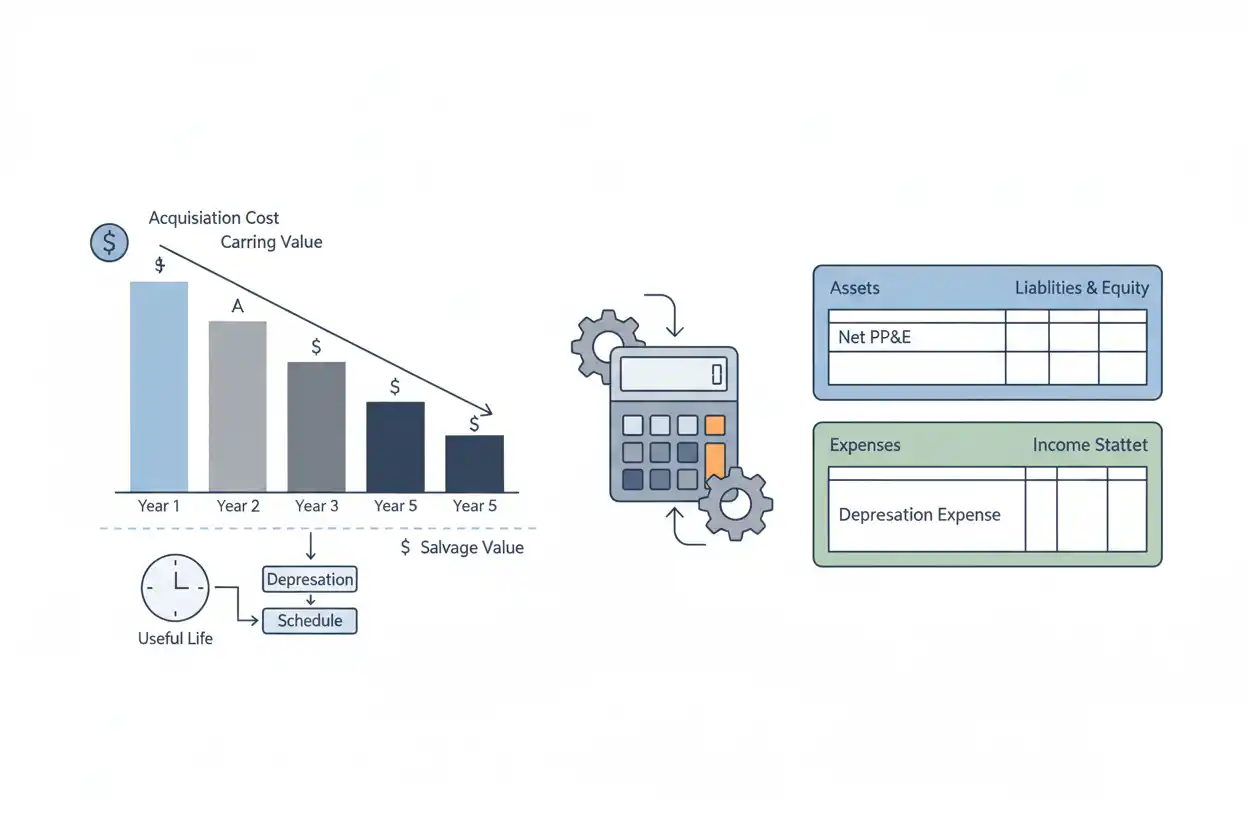

Depreciation expense is the portion of a depreciable asset’s cost allocated to an accounting period. Instead of recognizing the entire cost of a long-lived asset as an expense immediately, depreciation spreads the depreciable amount across the periods in which the asset is used.
For example, if equipment costs $50,000, is expected to have a $5,000 residual value, and has a five-year useful life, straight-line depreciation allocates $9,000 of expense to each full year.
Depreciation reduces accounting profit, but recording depreciation itself does not create a current-period cash payment.
What Is Depreciation Expense?
Depreciation expense represents the periodic allocation of the depreciable cost of a tangible long-term asset.
Businesses commonly depreciate assets such as machinery, equipment, vehicles, furniture, buildings, and certain other tangible assets with useful lives extending beyond one accounting period.
The expense reflects cost allocation rather than an attempt to continuously estimate what the asset could be sold for.
That distinction matters. An asset’s market value can rise or fall differently from its accounting depreciation schedule.
Depreciation Expense Formula
Under the straight-line method, the basic annual formula is:
Annual Depreciation Expense = (Asset Cost − Salvage Value) ÷ Useful Life
Where:
Asset cost is the capitalized cost assigned to the asset.
Salvage value is the estimated residual value remaining at the end of its useful life.
Useful life is the number of periods over which the depreciable amount is allocated.
The depreciable amount is:
Depreciable Amount = Asset Cost − Salvage Value
If an asset costs $80,000 and has a $10,000 expected salvage value:
Depreciable Amount = $80,000 − $10,000 = $70,000
If the useful life is seven years:
Annual Depreciation Expense = $70,000 ÷ 7 = $10,000
Depreciation Expense Example
Suppose a company purchases production equipment with:
- Cost: $65,000
- Estimated salvage value: $5,000
- Useful life: 6 years
First calculate the depreciable amount:
Depreciable Amount = $65,000 − $5,000 = $60,000
Then divide by the useful life:
Annual Depreciation Expense = $60,000 ÷ 6 = $10,000
Under straight-line depreciation, the business records $10,000 of depreciation expense per full year, subject to the applicable timing convention.
After six full years:
Total Scheduled Depreciation = $10,000 × 6 = $60,000
The asset’s remaining carrying amount would be:
$65,000 − $60,000 = $5,000
That equals the assumed salvage value.
Monthly Depreciation Expense
When straight-line depreciation is recorded monthly, a simple full-year amount can be converted to a monthly amount:
Monthly Depreciation Expense = Annual Depreciation Expense ÷ 12
Using annual depreciation of $10,000:
Monthly Depreciation Expense = $10,000 ÷ 12 = $833.33
After 12 months:
$833.33 × 12 ≈ $10,000
Small rounding adjustments may be necessary depending on the accounting system.
Businesses may also use specific placed-in-service conventions rather than simply recording exactly one-twelfth each calendar month.
Why Businesses Record Depreciation
Suppose a company buys a machine for $120,000 that is expected to support operations for 10 years.
Recognizing all $120,000 as an ordinary expense in the purchase month would concentrate the cost in one period even though the asset provides economic service over many periods.
Depreciation allocates that capitalized cost over its useful life.
This produces a more informative relationship between the periods receiving the asset’s use and the expense associated with that asset.
Depreciation Expense Journal Entry
The standard periodic entry illustrates how debit and credit mechanics apply to depreciation.
Assume monthly depreciation is $2,000.
A simplified entry is:
| Account | Debit | Credit |
|---|---|---|
| Depreciation Expense | $2,000 | — |
| Accumulated Depreciation | — | $2,000 |
| Total | $2,000 | $2,000 |
Depreciation expense is debited because expenses normally have debit balances.
Accumulated depreciation is credited.
The entry remains balanced:
Total Debits = Total Credits = $2,000
These paired entries operate within double-entry bookkeeping.
What Is Accumulated Depreciation?
Accumulated depreciation is the cumulative depreciation recorded against an asset since depreciation began.
It differs from depreciation expense.
Depreciation expense normally represents the amount recognized for a particular period.
Accumulated depreciation represents the total recorded depreciation from prior periods plus the current period.
For example, if annual depreciation is $8,000:
| End of Year | Current-Year Depreciation | Accumulated Depreciation |
|---|---|---|
| 1 | $8,000 | $8,000 |
| 2 | $8,000 | $16,000 |
| 3 | $8,000 | $24,000 |
| 4 | $8,000 | $32,000 |
The annual expense remains $8,000 under straight-line assumptions, while accumulated depreciation continues to grow.
Depreciation Expense and Book Value
The asset’s carrying amount can be expressed as:
Net Book Value = Asset Cost − Accumulated Depreciation
Suppose equipment originally cost $100,000 and accumulated depreciation is $36,000.
Net Book Value = $100,000 − $36,000 = $64,000
The $64,000 carrying amount is an accounting value.
It should not automatically be interpreted as the asset’s current market price.
An asset can be worth more or less than its accounting carrying amount.
Depreciation on the Balance Sheet
The original asset cost and accumulated depreciation help determine the net carrying amount shown through the balance sheet presentation.
Suppose:
Equipment at Cost = $250,000
Accumulated Depreciation = $90,000
Then:
Net Carrying Amount = $250,000 − $90,000 = $160,000
The asset has not necessarily lost exactly $90,000 of market value. The amount reflects accumulated accounting depreciation.
Depreciation on the Income Statement
Current-period depreciation expense reduces reported income.
If a company has:
- Revenue: $500,000
- Other operating costs: $310,000
- Depreciation expense: $25,000
Then, in a simplified illustration:
Operating Result Before Depreciation = $500,000 − $310,000 = $190,000
After depreciation:
Operating Result After Depreciation = $190,000 − $25,000 = $165,000
The actual income statement presentation depends on the nature of the asset and how the depreciation is classified.
Is Depreciation Expense an Operating Expense?
Depreciation may appear within operating expenses when it relates to assets used in the business’s operations.
However, not every dollar of depreciation necessarily appears as a separate operating-expense line.
For a manufacturer, depreciation on production equipment may become part of manufacturing overhead and can ultimately flow through inventory and cost of goods sold as products are sold.
Depreciation on office equipment may instead be recognized through administrative expenses.
The correct classification depends on the function of the depreciated asset.
Example: Depreciation Included in Product Cost
Suppose a factory has annual equipment depreciation of $120,000.
If the equipment is used in manufacturing, that depreciation may be part of manufacturing overhead rather than immediately treated as a standalone period expense.
Some of the cost could remain within inventory until the related products are sold.
This illustrates why “depreciation expense” and “cash paid for equipment” cannot be treated as the same event.
The equipment may have been purchased years earlier even though its cost continues to affect current-period product costs.
Depreciation Expense vs. Amortization Expense
Amortization expense and depreciation both allocate capitalized costs across periods, but they generally apply to different types of assets.
Depreciation is commonly associated with tangible assets such as machinery, vehicles, buildings, and equipment.
Amortization commonly applies to qualifying intangible assets.
The detailed calculation and accounting treatment can vary according to the asset and applicable accounting framework, so the terms should not be used interchangeably merely because both involve cost allocation.
Depreciation Expense vs. Cash Flow
Depreciation expense is a noncash expense in the period it is recorded.
If a company records $30,000 of depreciation this year, that entry does not mean the company paid $30,000 in cash this year.
The cash outflow usually occurred when the asset was purchased, though financing can affect the timing.
This distinction becomes visible on the cash flow statement.
Under an indirect operating-cash-flow presentation, depreciation is commonly added back to net income because it reduced accounting income without itself consuming current-period operating cash.
That does not make depreciation “free.” Businesses may still need substantial cash to replace or expand depreciable assets.
Worked Cash Flow Example
Assume a company reports:
Net Income = $90,000
Included in expenses is:
Depreciation Expense = $20,000
Ignoring other adjustments for illustration, an indirect reconciliation starts with:
$90,000 + $20,000 = $110,000
The $20,000 is added back because it reduced net income without being a $20,000 current-period cash payment.
The original asset purchase remains a separate cash event.
Does Depreciation Reduce Net Income?
Yes, when depreciation is recognized as an expense affecting the period’s income.
Suppose profit before depreciation is $150,000 and depreciation expense is $35,000.
Income After Depreciation = $150,000 − $35,000 = $115,000
All else equal, depreciation reduces net income by reducing recognized profit before any related downstream effects such as taxes are considered.
However, the precise financial-statement impact depends on classification, tax rules, and other accounting items.
Depreciation and Operating Income
Depreciation connected with operating assets can also reduce operating income.
For example:
- Gross profit: $400,000
- Other operating expenses: $230,000
- Depreciation expense: $30,000
Then:
Operating Income = $400,000 − $230,000 − $30,000 = $140,000
If depreciation were incorrectly omitted, operating income would be overstated by $30,000 in this simplified example.
Depreciation Expense and Cost Variance
Actual depreciation may differ from budgeted depreciation, producing a cost variance.
Suppose depreciation was budgeted at $8,000 per month but actual depreciation is $8,750.
Using an actual-minus-budget convention:
Depreciation Cost Variance = $8,750 − $8,000 = $750 Unfavorable
The difference could result from newly placed assets, asset disposals occurring later than expected, revised accounting estimates, or other changes in the depreciable asset base.
This variance does not mean an additional $750 of cash was necessarily paid during the month.
Depreciation Expense and Asset Purchases
Buying a $100,000 asset and recording $100,000 of depreciation are two different events.
Assume equipment costs $100,000, has a $10,000 residual value, and a nine-year straight-line useful life.
The depreciable amount is:
$100,000 − $10,000 = $90,000
Annual depreciation is:
$90,000 ÷ 9 = $10,000
The company may pay $100,000 at acquisition, yet recognize only $10,000 of straight-line depreciation expense in each full year under these assumptions.
This timing difference is one reason capital investment decisions should not be evaluated solely from a single period’s reported expense.
Does Economic Order Quantity Include Depreciation?
The standard economic order quantity model focuses on the relationship among ordering cost, holding cost, and demand.
Depreciation expense should not automatically be inserted into EOQ calculations merely because warehouse or equipment assets depreciate.
If depreciation genuinely contributes to the incremental holding-cost assumptions used by a particular business model, the economics should be analyzed carefully. Otherwise, forcing general accounting depreciation into an operational formula can distort the decision.
This is a good example of why financial-accounting costs and decision-relevant costs are not always identical.
Straight-Line Depreciation Schedule Example
Consider an asset with:
- Cost: $52,000
- Salvage value: $4,000
- Useful life: 6 years
Depreciable amount:
$52,000 − $4,000 = $48,000
Annual depreciation:
$48,000 ÷ 6 = $8,000
The schedule is:
| Year | Depreciation Expense | Accumulated Depreciation | Ending Book Value |
|---|---|---|---|
| Start | — | $0 | $52,000 |
| 1 | $8,000 | $8,000 | $44,000 |
| 2 | $8,000 | $16,000 | $36,000 |
| 3 | $8,000 | $24,000 | $28,000 |
| 4 | $8,000 | $32,000 | $20,000 |
| 5 | $8,000 | $40,000 | $12,000 |
| 6 | $8,000 | $48,000 | $4,000 |
The final $4,000 carrying amount equals the assumed salvage value.
What Happens When Salvage Value Is Zero?
If salvage value is estimated at zero, the straight-line formula becomes:
Depreciation Expense = Asset Cost ÷ Useful Life
Suppose equipment costs $36,000 and has a six-year useful life with no residual value.
Annual Depreciation = $36,000 ÷ 6 = $6,000
After six full years:
Accumulated Depreciation = $36,000
Book Value = $0
The asset could still remain physically usable even though its accounting carrying amount has been fully depreciated.
What Happens When an Asset Is Purchased Midyear?
A business may need to recognize only a portion of a full year’s depreciation when an asset is placed in service partway through the year.
Suppose annual straight-line depreciation is $12,000 and, under a simple monthly convention, the asset is depreciated for four months in the first year.
Monthly Depreciation = $12,000 ÷ 12 = $1,000
First-Year Depreciation = $1,000 × 4 = $4,000
Actual accounting and tax conventions may use different timing rules. The relevant framework should therefore be applied rather than assuming every partial year uses exact monthly proration.
Changes in Useful Life or Salvage Value
Useful life and salvage value are estimates.
If expectations change, future depreciation may need to be recalculated under the applicable accounting rules rather than simply rewriting prior periods.
Suppose an asset has a remaining depreciable carrying amount of $24,000 and management revises its remaining useful life to four years.
A simplified prospective straight-line calculation would be:
Future Annual Depreciation = $24,000 ÷ 4 = $6,000
The important analytical point is that depreciation depends on estimates as well as original cost.
Depreciation Expense Is Not Market Value Loss
Suppose a building has a $20,000 annual accounting depreciation expense.
Its market value could increase by $50,000 during the same year because of local real-estate conditions.
Accounting depreciation and market appreciation can exist simultaneously because they measure different things.
Depreciation allocates recorded cost.
Market value estimates what the asset might be worth in a transaction.
Confusing the two can lead to incorrect interpretation of a company’s assets.
Common Depreciation Expense Mistakes
One common mistake is depreciating the asset’s full cost without considering an applicable residual value.
Another is treating depreciation as though cash leaves the business every time the expense is recorded.
Businesses can also confuse depreciation expense with accumulated depreciation. One is a period expense; the other is a cumulative contra-asset balance.
Another error is assuming every asset uses the same useful life or depreciation pattern.
It is also incorrect to assume the book value after depreciation must equal current market value.
Finally, depreciation related to production assets can require different presentation from depreciation on administrative assets, so classification should reflect how the asset is used.
Frequently Asked Questions
What is depreciation expense in simple terms?
Depreciation expense is the portion of a depreciable asset’s cost allocated to a particular accounting period.
It spreads the depreciable amount across the asset’s estimated useful life instead of treating the entire capitalized cost as an immediate expense.
What is the depreciation expense formula?
For straight-line depreciation:
Annual Depreciation Expense = (Asset Cost − Salvage Value) ÷ Useful Life
How do you calculate monthly depreciation expense?
Under simple monthly straight-line allocation:
Monthly Depreciation = Annual Depreciation ÷ 12
For example, $24,000 of annual depreciation equals $2,000 per month.
Is depreciation expense a cash expense?
No. Recording depreciation does not itself require a current-period cash payment.
The cash outflow usually relates to the earlier purchase of the asset.
What is the difference between depreciation expense and accumulated depreciation?
Depreciation expense is the amount recognized for the current accounting period.
Accumulated depreciation is the total depreciation recorded against the asset over time.
Does depreciation reduce profit?
Yes.
Depreciation is an expense and therefore generally reduces accounting income when recognized.
Does depreciation reduce the original cost of the asset?
Accounting records commonly preserve the asset’s original recorded cost while accumulating depreciation in a separate contra-asset account.
The two are then used to determine net carrying amount.
Can an asset be fully depreciated and still be used?
Yes.
A fully depreciated asset can remain operational after its accounting carrying amount reaches its residual value or zero, depending on the assumptions used.
Is depreciation the same as a fall in market value?
No.
Depreciation is an accounting allocation of cost. Market value reflects what an asset may currently be worth economically.
Is land depreciated?
Land itself is generally treated differently from depreciable assets because it ordinarily does not have the same finite useful-life pattern as equipment or buildings. Separate depreciable components or improvements can require their own treatment.
Why is depreciation added back on the cash flow statement?
Under the indirect method, depreciation is commonly added back because it reduced accounting net income but did not itself require a current-period operating cash payment.
Depreciation remains an important cost allocation within the broader accounting and operations framework even though its timing differs from the underlying asset’s cash expenditure.