Double-Entry Bookkeeping: Formula, Meaning & Example

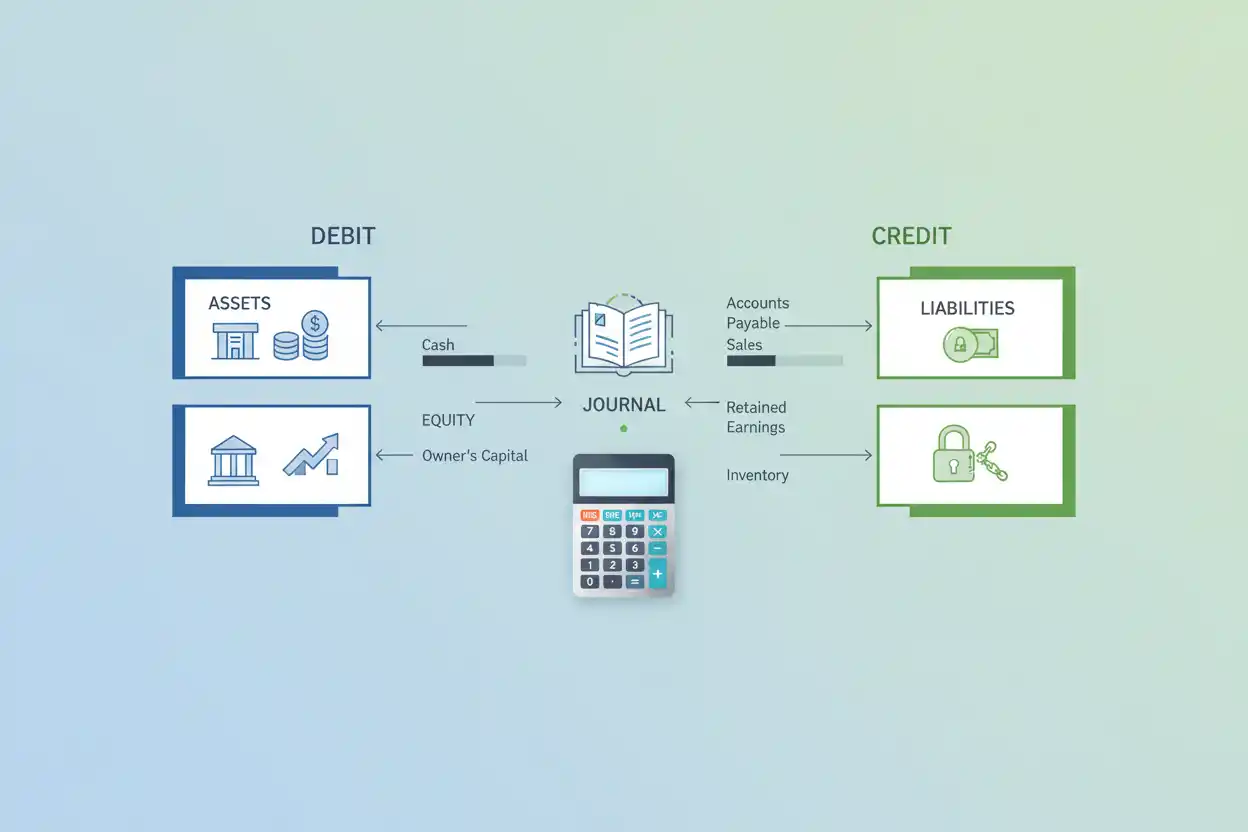
Double-entry bookkeeping is an accounting system in which every transaction affects at least two accounts and total debits must equal total credits. The system keeps the accounting equation balanced while creating a traceable record of how business transactions affect assets, liabilities, equity, revenue, and expenses.
If a company receives $20,000 from a bank loan, for example, cash increases by $20,000 and the loan liability increases by $20,000. Recording only the cash increase would leave the accounting records incomplete.
The defining rule is:
Total Debits = Total Credits
That balancing mechanism is the foundation of double-entry bookkeeping.
What Is Double-Entry Bookkeeping?
Double-entry bookkeeping records both sides of each financial transaction.
A transaction may exchange one asset for another, increase both an asset and a liability, create revenue and a receivable, recognize an expense and reduce cash, or affect several accounts simultaneously.
Suppose a business buys $8,000 of equipment with cash.
Equipment increases by $8,000, while cash decreases by $8,000.
| Account | Debit | Credit |
|---|---|---|
| Equipment | $8,000 | — |
| Cash | — | $8,000 |
| Total | $8,000 | $8,000 |
The monetary value on each side is equal even though different accounts are affected.
The underlying mechanics are explained through debit and credit, but double-entry bookkeeping is the broader system that requires those entries to remain balanced.
Double-Entry Bookkeeping Formula
The primary balancing formula is:
Total Debits = Total Credits
The accounting system also operates around the accounting equation:
Assets = Liabilities + Equity
Every properly recorded transaction preserves this relationship.
Suppose a business begins with:
Assets = $150,000
Liabilities = $90,000
Equity = $60,000
The equation balances:
$150,000 = $90,000 + $60,000
Now the company borrows another $25,000.
Cash increases by $25,000 and liabilities increase by $25,000.
The new balances are:
Assets = $175,000
Liabilities = $115,000
Equity = $60,000
Check the equation:
$175,000 = $115,000 + $60,000
The transaction changed the amounts but preserved the balance.
Why Every Transaction Needs Two Sides
A financial transaction normally has both a source and an effect.
If a company receives cash, the accounting system must explain why cash increased.
The money might have come from:
- a customer payment;
- a bank loan;
- an owner’s investment;
- the sale of an asset; or
- another source.
Recording only the increase in cash would not identify the corresponding economic event.
Double-entry bookkeeping solves this by requiring an offsetting entry.
Double-Entry Bookkeeping Example: Cash Sale
Suppose a consulting business earns $3,500 and receives cash immediately.
Cash increases, so it is debited.
Revenue increases, so it is credited.
| Account | Debit | Credit |
|---|---|---|
| Cash | $3,500 | — |
| Service Revenue | — | $3,500 |
| Total | $3,500 | $3,500 |
The entry balances:
Debits = $3,500
Credits = $3,500
The transaction increases assets through cash and increases equity through earned revenue.
Example: Sale on Account
Assume the business performs $6,000 of services but allows the customer to pay later.
Accounts receivable increases because the company now has a claim against the customer.
| Account | Debit | Credit |
|---|---|---|
| Accounts Receivable | $6,000 | — |
| Service Revenue | — | $6,000 |
| Total | $6,000 | $6,000 |
When the customer later pays:
| Account | Debit | Credit |
|---|---|---|
| Cash | $6,000 | — |
| Accounts Receivable | — | $6,000 |
| Total | $6,000 | $6,000 |
The collection itself does not create another $6,000 of revenue. It converts one asset—receivables—into another asset—cash.
This timing distinction is particularly important under accrual accounting.
Example: Purchasing Inventory on Credit
Suppose a retailer buys $12,000 of inventory from a supplier and agrees to pay later.
Inventory increases:
Debit Inventory = $12,000
Accounts payable also increases:
Credit Accounts Payable = $12,000
The entry is:
| Account | Debit | Credit |
|---|---|---|
| Inventory | $12,000 | — |
| Accounts Payable | — | $12,000 |
| Total | $12,000 | $12,000 |
Assets and liabilities both increase by $12,000.
When the supplier is paid, the liability decreases and cash decreases:
Debit Accounts Payable = $12,000
Credit Cash = $12,000
Again, the entry remains balanced.
Example: Recording Cost of Goods Sold
Under a perpetual inventory system, selling inventory generally involves more than the revenue entry.
Suppose merchandise costing $700 is sold for $1,100 cash.
The revenue side is:
| Account | Debit | Credit |
|---|---|---|
| Cash | $1,100 | — |
| Sales Revenue | — | $1,100 |
The inventory-cost side is:
| Account | Debit | Credit |
|---|---|---|
| Cost of Goods Sold | $700 | — |
| Inventory | — | $700 |
The second entry transfers the sold product’s cost from inventory into cost of goods sold.
Together, the entries record both the sales proceeds and the cost of the inventory that left the business.
Example: Paying an Operating Expense
Suppose a company pays $4,000 of office rent.
The expense increases:
Debit Rent Expense = $4,000
Cash decreases:
Credit Cash = $4,000
The entry is:
| Account | Debit | Credit |
|---|---|---|
| Rent Expense | $4,000 | — |
| Cash | — | $4,000 |
Rent is one of many possible operating expenses that can reduce reported profit while also affecting the accounting records through paired entries.
Example: Borrowing $50,000
Suppose a company signs a loan and receives $50,000 in cash.
The entry is:
| Account | Debit | Credit |
|---|---|---|
| Cash | $50,000 | — |
| Loan Payable | — | $50,000 |
Cash is an asset and increases with a debit.
The loan is a liability and increases with a credit.
The loan proceeds do not become revenue simply because cash increased.
Example: Owner Investment
Suppose the owner contributes $30,000 to the company.
Cash increases:
Debit Cash = $30,000
Owner equity increases:
Credit Owner Equity = $30,000
The accounting equation changes by equal amounts:
Assets +$30,000 = Equity +$30,000
Owner contributions and business revenue therefore create different accounting entries even though both can increase cash.
Double-Entry Bookkeeping and Depreciation
Some accounting entries do not involve current-period cash.
Assume monthly depreciation expense is $2,500.
A simplified entry is:
| Account | Debit | Credit |
|---|---|---|
| Depreciation Expense | $2,500 | — |
| Accumulated Depreciation | — | $2,500 |
The transaction records an accounting expense and increases accumulated depreciation without paying $2,500 of cash at that moment.
This example demonstrates why double-entry bookkeeping tracks more than cash receipts and payments.
Double-Entry Bookkeeping and the Balance Sheet
The balance sheet is built around the accounting equation:
Assets = Liabilities + Equity
Double-entry bookkeeping helps keep that equation in balance as transactions occur.
Suppose a business purchases $40,000 of equipment using:
- $10,000 cash; and
- $30,000 financing.
The entry is:
| Account | Debit | Credit |
|---|---|---|
| Equipment | $40,000 | — |
| Cash | — | $10,000 |
| Loan Payable | — | $30,000 |
| Total | $40,000 | $40,000 |
Assets increase by a net $30,000 because equipment rises by $40,000 while cash falls by $10,000.
Liabilities increase by $30,000.
The accounting equation remains balanced.
Double-Entry Bookkeeping and the Income Statement
Revenue and expense entries eventually determine profit reported on the income statement.
Revenue accounts normally increase through credits.
Expense accounts normally increase through debits.
Suppose a company earns $100,000 of revenue and records $72,000 of expenses.
In simplified terms:
Profit = $100,000 − $72,000 = $28,000
Those revenue and expense amounts originate from underlying journal entries that followed double-entry rules.
The resulting profit ultimately affects equity.
Double-Entry Bookkeeping and Net Income
Net income is not itself the rule that balances journal entries, but the revenue and expense transactions that produce net income are captured through the double-entry system.
If revenue exceeds expenses, retained earnings or another appropriate equity account ultimately reflects the increase in accumulated profit, subject to the entity’s accounting structure.
This creates a connection between the income statement and the balance sheet without turning either statement into a separate bookkeeping system.
Double-Entry Bookkeeping vs. Cash Accounting
Double-entry bookkeeping describes how transactions are recorded across accounts.
Cash accounting describes when certain revenue and expense transactions are recognized under a cash-based method.
The concepts therefore answer different questions.
A business may use double-entry mechanics while applying a particular accounting basis for recognition.
The existence of debit and credit entries does not by itself determine whether an organization uses cash or accrual accounting.
Double-Entry Bookkeeping vs. Single-Entry Bookkeeping
Single-entry systems commonly focus on a simpler record of receipts and payments.
Double-entry bookkeeping captures both sides of transactions and maintains the relationship among assets, liabilities, equity, revenue, and expenses.
For example, a simple record may show that $10,000 left the bank account.
Double-entry bookkeeping additionally identifies whether that $10,000 represented:
- equipment;
- inventory;
- rent;
- debt repayment;
- an owner’s withdrawal; or
- another transaction.
That additional classification supports more complete financial statements and reconciliation.
Compound Entries
A transaction does not have to contain exactly one debit and one credit.
It can contain multiple entries on either side as long as total debits equal total credits.
Suppose a company purchases equipment costing $25,000 by paying $5,000 cash and financing $20,000.
Debit Equipment = $25,000
Credit Cash = $5,000
Credit Loan Payable = $20,000
Check:
Total Debits = $25,000
Total Credits = $5,000 + $20,000 = $25,000
The entry balances.
Example With Multiple Debits
Suppose a company pays a $10,000 supplier invoice covering:
- $7,500 of inventory; and
- $2,500 of equipment.
If the appropriate accounts are recorded directly in this simplified example:
Debit Inventory = $7,500
Debit Equipment = $2,500
Credit Cash = $10,000
Total debits:
$7,500 + $2,500 = $10,000
Total credits:
$10,000
The number of debit lines and credit lines can differ. Only the monetary totals must match.
How to Record a Double-Entry Transaction
A practical sequence begins with the economics of the transaction rather than memorizing journal entries.
First identify what happened. Did the company receive cash, incur an expense, acquire an asset, earn revenue, create a liability, or repay an obligation?
Next identify every account affected.
Then determine whether each account increased or decreased.
Finally apply the appropriate debit and credit rule and confirm:
Total Debits = Total Credits
For example, suppose a company receives a $9,000 supplier invoice for services that will be paid next month.
Expense increases, so it is debited.
Accounts payable increases, so it is credited:
Debit Expense = $9,000
Credit Accounts Payable = $9,000
The transaction is recorded even though no cash has yet left the business.
How Double-Entry Records Connect to Cash Flow
The cash flow statement organizes cash movements into operating, investing, and financing activities.
Double-entry bookkeeping supplies the underlying transaction records from which financial statements can be prepared, but not every double-entry transaction creates an immediate cash movement.
Depreciation is one example.
A credit sale is another: revenue and accounts receivable can be recorded before customer cash is received.
This is why a business can report profit while its cash balance moves differently.
Double-Entry Bookkeeping and Cost Variance
A cost variance compares actual costs with budgeted, expected, or standard costs.
Double-entry bookkeeping records the actual transactions underlying those costs.
Suppose materials actually cost $24,000 when the comparable benchmark was $22,000.
The bookkeeping system records the actual $24,000 transaction through the appropriate accounts.
Variance analysis separately calculates:
Cost Variance = $24,000 − $22,000 = $2,000 Unfavorable
One process records what happened. The other evaluates performance against a benchmark.
Double-Entry Bookkeeping and Forecast Variance
A forecast variance similarly compares actual or updated results with forecast expectations.
Forecasts do not change the basic debit-credit requirement.
If a company forecasts $100,000 of monthly expenses but records $108,000, the accounting system still records the actual transactions according to the accounts involved.
Management can then compare those recorded results against the forecast to understand the $8,000 difference.
Double-Entry Bookkeeping and Operational Models
Operational calculations do not become journal-entry rules merely because they use accounting data.
For example, economic order quantity helps determine an inventory order size under a specific set of cost and demand assumptions.
When inventory is actually purchased, however, the transaction is recorded through the bookkeeping system using the relevant inventory, payable, cash, or other accounts.
The analytical model helps make the decision; double-entry bookkeeping records its financial effects.
Trial Balance and the Debit-Credit Check
A trial balance lists account balances and compares total debit balances with total credit balances.
Its fundamental check is:
Total Debit Balances = Total Credit Balances
If the totals differ, at least one posting or calculation problem exists.
However, equal totals do not prove that every transaction was recorded correctly.
For example, recording a $5,000 equipment purchase as a $5,000 office expense could still create a balanced debit and credit entry even though the classification is wrong.
Double-entry bookkeeping provides mathematical control, not automatic protection against every accounting error.
Common Double-Entry Bookkeeping Errors
One common mistake is recording only one side of a transaction.
Another is choosing the wrong account while still producing a balanced entry.
Businesses can also transpose numbers. A $5,400 debit paired with a $4,500 credit would create an immediate imbalance, while identical incorrect amounts on both sides could remain mathematically balanced.
Another problem is recognizing transactions in the wrong period.
Finally, equal debits and credits should never be interpreted as proof that financial statements are accurate. Correct amounts, accounts, timing, and supporting documentation still matter.
Frequently Asked Questions
What is double-entry bookkeeping in simple terms?
Double-entry bookkeeping records at least two effects for every transaction.
The basic rule is:
Total Debits = Total Credits
This keeps the accounting records balanced.
What is the double-entry bookkeeping formula?
The fundamental bookkeeping equation is:
Total Debits = Total Credits
It also supports the accounting equation:
Assets = Liabilities + Equity
Does every transaction have one debit and one credit?
Not necessarily.
A transaction can have several debit and credit lines. The requirement is that total debits equal total credits.
Why is double-entry bookkeeping called double-entry?
The term reflects the principle that a transaction has at least two accounting effects rather than being recorded as a single isolated amount.
For example, paying cash for equipment decreases cash while increasing equipment.
Is debit always money coming in?
No.
A debit can increase an asset or expense, but it can also decrease certain credit-balance accounts.
Its meaning depends on the account involved.
Is credit always money going out?
No.
Credits can increase liabilities, equity, or revenue, while a credit to cash reduces cash.
Credit therefore does not automatically mean cash left the company.
Can a journal entry balance and still be incorrect?
Yes.
An entry can use the wrong accounts or wrong timing while still having equal debit and credit totals.
Balance is necessary, but it does not guarantee correct accounting.
Does double-entry bookkeeping track cash only?
No.
It records cash and noncash transactions, including receivables, payables, depreciation, accrued expenses, inventory movements, financing, and many other items.
How does double-entry bookkeeping affect financial statements?
The account balances created by journal entries feed into financial statements. Assets, liabilities, and equity appear on the balance sheet, while revenue and expenses determine income-statement results.
Is double-entry bookkeeping the same as accrual accounting?
No.
Double-entry describes the recording structure. Accrual accounting describes recognition timing and related accounting principles.
A bookkeeping system and an accounting basis are separate concepts.
Why are equal debits and credits important?
Equal debits and credits provide a built-in mathematical check and help preserve the accounting equation as transactions are recorded.
That structure is central to reliable accounting records and the wider accounting and operations process.