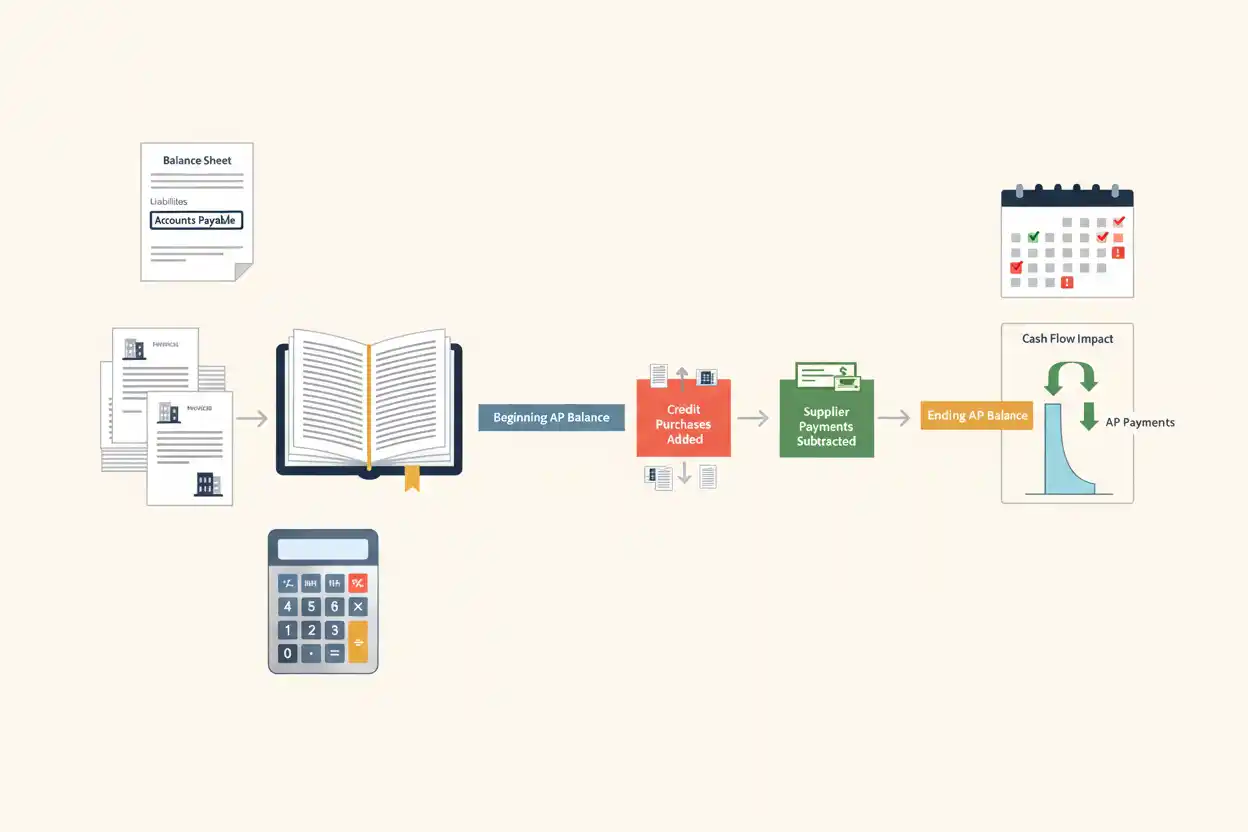

Accounts payable represents amounts a business owes suppliers or other creditors for qualifying goods and services already received but not yet paid for.
Suppose a company begins the month owing suppliers $40,000, receives another $90,000 of purchases on credit, and pays vendors $75,000.
Ending Accounts Payable = $40,000 + $90,000 − $75,000
= $55,000
The company ends the month owing $55,000.
Accounts payable is therefore both an accounting balance and an operating cash-flow issue. It tells management how much supplier-related obligation remains unpaid at a point in time.
Accounts Payable Formula
A simplified accounts payable roll-forward is:
Ending Accounts Payable = Beginning Accounts Payable + New Credit Purchases or Expenses − Payments and Other Reductions
The formula should use transactions that actually affect accounts payable.
Cash purchases paid immediately normally do not create an unpaid supplier balance.
Accounts Payable Example
Suppose:
Beginning AP = $25,000
New qualifying credit purchases:
$70,000
Cash paid to suppliers:
$60,000
Assume no credits, returns, foreign-exchange adjustments, or other changes.
Then:
Ending AP = $25,000 + $70,000 − $60,000
= $35,000
Accounts payable increased:
$35,000 − $25,000
= $10,000
The business added obligations faster than it paid existing and new vendor balances.
Solve for Supplier Payments
The formula can be rearranged:
Supplier Payments = Beginning AP + Credit Purchases − Ending AP
Suppose:
Beginning AP = $50,000
Credit Purchases = $120,000
Ending AP = $45,000
Then:
Supplier Payments = $50,000 + $120,000 − $45,000
= $125,000
Under the simplified assumptions, the company paid suppliers $125,000 during the period.
Solve for Credit Purchases
If beginning AP, ending AP, and payments are known:
Credit Purchases = Ending AP − Beginning AP + Supplier Payments
Suppose:
Beginning AP = $30,000
Ending AP = $42,000
Payments = $88,000
Then:
Credit Purchases = $42,000 − $30,000 + $88,000
= $100,000
This reconstruction can help reconcile purchasing records with the general ledger.
Accounts Payable vs Accounts Receivable
Accounts receivable represents money customers owe the business.
Accounts payable represents money the business owes suppliers.
Suppose:
Accounts Receivable = $80,000
Accounts Payable = $50,000
Subtracting them gives:
$30,000
but that does not mean the company has $30,000 of cash.
The two balances have different counterparties, timing, collectability, and payment conditions.
Accounts Payable Under Accrual Accounting
Accrual accounting helps explain why a liability can exist before payment occurs.
Suppose a vendor delivers $10,000 of supplies in December and allows payment in January.
A simplified December entry can recognize:
Expense or Asset = $10,000
and:
Accounts Payable = $10,000
Cash remains unchanged until payment.
The liability exists because the company has received economic value and owes the vendor.
Accounts Payable on the Balance Sheet
Accounts payable normally appears among current liabilities on the balance sheet when the obligation is expected to be settled within the normal short-term operating cycle.
Suppose a company has:
Cash = $60,000
Accounts Receivable = $100,000
Inventory = $90,000
Current assets:
$250,000
If accounts payable is $70,000 and other current liabilities are $80,000:
Current Liabilities = $150,000
Working capital:
$250,000 − $150,000
= $100,000
AP therefore contributes directly to short-term liquidity analysis.
Paying Accounts Payable
Suppose the company pays:
$20,000
of vendor invoices.
The simplified effects are:
Cash Decreases by $20,000
and:
Accounts Payable Decreases by $20,000
The payment does not create a new expense if the expense or asset was properly recognized when the obligation originally arose.
This is a common point of confusion.
Expense Recognition vs Payment
Suppose a company receives a $12,000 service in March and pays the invoice in April.
March:
Expense Recognized = $12,000
AP Created = $12,000
April:
AP Reduced = $12,000
Cash Reduced = $12,000
The April cash payment does not mean April should automatically record another $12,000 expense.
Doing so would double count the cost.
Accounts Payable Increase and Cash Flow
All else equal, an increase in accounts payable can preserve cash temporarily because the business has recognized costs or purchases without yet paying all of them.
Suppose AP increases:
$30,000 → $45,000
Increase:
$15,000
The business has $15,000 more unpaid supplier obligations than at the beginning of the period.
This can support current cash flow temporarily, but the liability still needs to be settled later.
Accounts Payable Decrease
Suppose AP falls:
$45,000 → $25,000
Decrease:
$20,000
If the decrease results from supplier payments exceeding new credit purchases, cash is being used to reduce obligations.
A declining AP balance can therefore reduce operating cash even when expenses themselves are stable.
High Accounts Payable Is Not Automatically Good
Delaying payments can conserve cash.
However, excessive delays can produce:
late fees, damaged supplier relationships, suspended deliveries, weaker negotiating power, or loss of early-payment discounts.
The goal is not simply to maximize AP.
The goal is to manage payment timing economically while honoring supplier terms.
Low Accounts Payable Is Not Automatically Good
A very low AP balance can mean the company pays vendors quickly.
That may be beneficial when early-payment discounts exceed the value of keeping the cash.
However, paying significantly before invoices are due can also consume liquidity unnecessarily.
The correct balance depends on terms, discounts, cash availability, risk, and supplier relationships.
Early-Payment Discount Example
Suppose a supplier offers:
2% Discount on a $50,000 Invoice
Discount:
$50,000 × 2%
= $1,000
Discounted payment:
$49,000
If the business has adequate liquidity, saving $1,000 may justify paying earlier.
The economic value should be compared with the benefit of retaining the cash for the additional days.
Accounts Payable Aging
An AP aging schedule groups unpaid invoices by how long they have been outstanding or when they are due.
Suppose total AP is:
$100,000
with:
$70,000 Current
$20,000 Moderately Overdue
$10,000 Significantly Overdue
The total liability is $100,000, but the aging profile reveals more operational risk than the headline balance alone.
Vendor Credits and Returns
Suppose a company owes:
$20,000
to a supplier.
The supplier issues a:
$3,000 Credit
Revised AP:
$17,000
If the credit relates to returned goods or corrected pricing, the corresponding asset or expense may also need adjustment.
The accounts payable roll-forward should therefore include supplier credits when reconciling the balance.
Invoice Reconciliation
Suppose the general ledger shows:
Accounts Payable = $125,000
while the detailed supplier ledger totals:
$122,500
Difference:
$2,500
That discrepancy should be investigated.
Possible causes include unposted invoices, duplicate entries, timing differences, vendor credits, or posting errors.
A control account is useful only when it reconciles to the underlying details.
Accounts Payable and Amortization Expense
Amortization expense is a noncash allocation of a qualifying intangible asset’s cost over time.
Accounts payable represents unpaid obligations.
If a company purchases an eligible intangible asset from a vendor on credit:
Intangible Asset Increases
and:
Accounts Payable Increases
Later amortization expense reduces accounting profit over the asset’s useful life, while paying the vendor reduces AP and cash.
Those are separate accounting events.
Accounts Payable and Break-Even Sales
Break-even sales focuses on the sales level needed to cover a defined cost structure.
Accounts payable tells you whether some costs remain unpaid.
Suppose a company reaches accounting break-even but has a large amount of supplier debt due immediately.
The company can still experience liquidity pressure.
Profitability and payment timing should therefore be analyzed separately.
Accounts Payable Percentage of Current Liabilities
Suppose:
Accounts Payable = $90,000
Total Current Liabilities = $180,000
AP share:
$90,000 ÷ $180,000 × 100
= 50%
Half of current liabilities consist of accounts payable.
A large concentration can make vendor terms especially important to liquidity planning.
Accounts Payable Growth Rate
Suppose AP rises:
$80,000 → $100,000
Percentage increase:
($100,000 − $80,000) ÷ $80,000 × 100
= 25%
If purchases increased only 5%, the much faster AP growth may indicate slower payment timing.
That is a signal for investigation rather than proof of a problem.
Forecasting Accounts Payable
Suppose management expects monthly credit purchases of:
$120,000
and historically carries approximately:
45 Days of Purchases in AP
A rough planning estimate using a 30-day month is:
Estimated AP ≈ $120,000 × 45 ÷ 30
= $180,000
This is a planning approximation, not a substitute for an invoice-level payment schedule.
Cash Budget Connection
Suppose next month’s supplier payments are expected to be:
$150,000
while expected customer collections are:
$130,000
Before considering other cash flows, supplier payments exceed customer collections by:
$20,000
A cash budget that ignores AP payment timing can therefore misstate near-term liquidity even when the income statement looks healthy.
Common Accounts Payable Mistakes
A common error is recording an expense again when an existing payable is paid.
Another is including cash purchases in AP merely because they are purchases.
Businesses can also focus on the total payable balance without reviewing overdue invoices, fail to reconcile the ledger to supplier records, or delay payment without considering lost discounts and supplier risk.
Frequently Asked Questions
What is accounts payable?
Accounts payable represents qualifying unpaid amounts a business owes suppliers or other creditors.
What is the basic accounts payable formula?
Ending AP = Beginning AP + Credit Purchases or Expenses − Payments and Other Reductions
Is accounts payable an asset or liability?
It is generally a liability.
Does paying accounts payable create an expense?
Not when the expense or asset was already recognized when the payable arose.
What causes AP to increase?
New credit purchases or expenses exceeding payments and credits can increase AP.
What causes AP to decrease?
Supplier payments, credits, returns, and other reductions can lower the balance.
Is accounts payable the opposite of accounts receivable?
They are counterpart working-capital concepts: AP is money owed by the business, while AR is money owed to the business.
Does higher AP improve cash flow?
It can preserve cash temporarily, but it also represents obligations that remain unpaid.
Is low AP always better?
No. Paying suppliers earlier than necessary can reduce available liquidity.
Why review AP aging?
It identifies upcoming, current, and overdue supplier obligations that the total balance alone does not reveal.
Why reconcile the AP ledger?
It helps detect missing invoices, duplicate postings, incorrect credits, and other accounting errors.
Can a profitable business struggle because of accounts payable?
Yes. Profitability does not guarantee sufficient cash to meet supplier obligations when they become due.