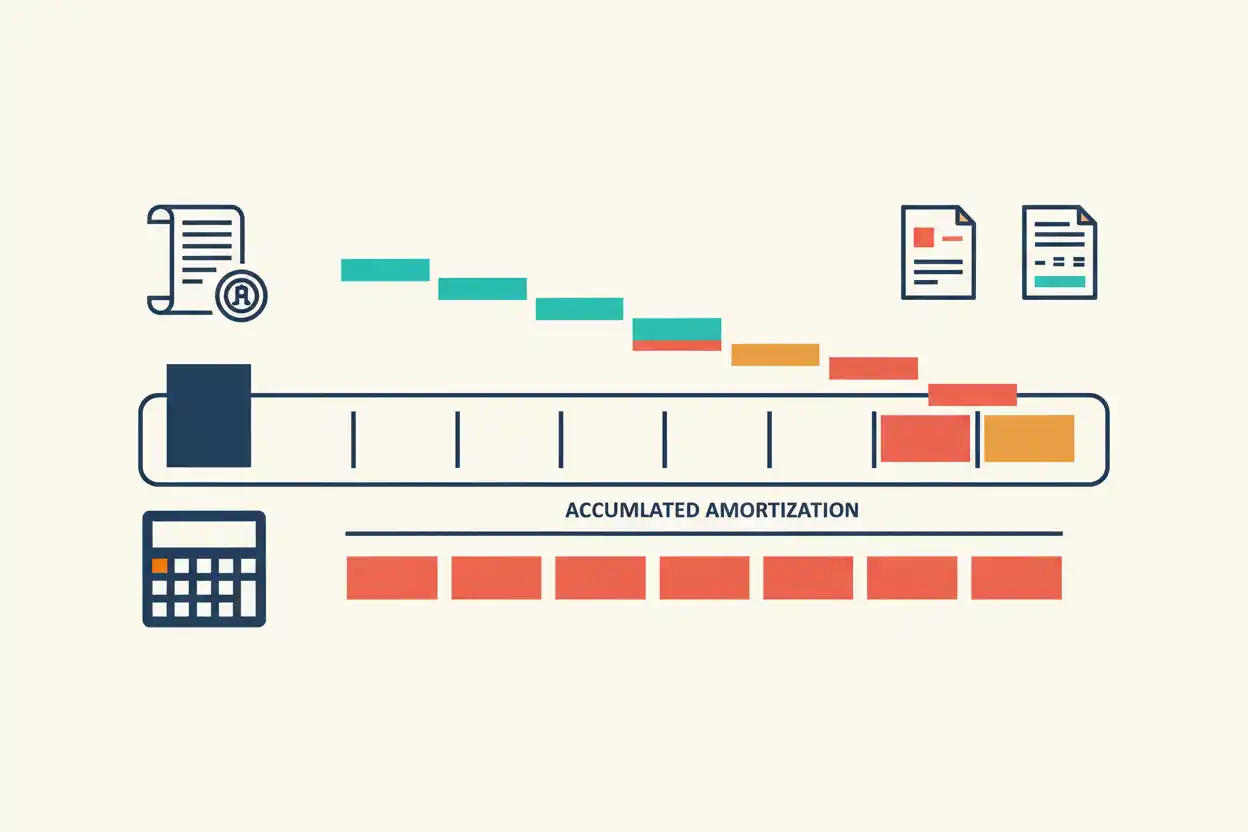

Amortization expense allocates the depreciable or amortizable amount of a qualifying intangible asset across the periods expected to benefit from that asset.
Suppose a finite-lived intangible asset costs $120,000, has no residual value, and is expected to provide benefits for six years.
Using straight-line amortization:
Annual Amortization Expense = $120,000 ÷ 6
= $20,000
The company recognizes $20,000 of expense each full year under the simplified assumptions.
The original $120,000 cash expenditure and the annual $20,000 accounting expense are different events.
Amortization Expense Formula
A common straight-line formula is:
Annual Amortization Expense = (Asset Cost − Residual Value) ÷ Useful Life
Suppose:
Cost = $90,000
Residual Value = $6,000
Useful Life = 7 Years
Amortizable amount:
$90,000 − $6,000
= $84,000
Annual expense:
$84,000 ÷ 7
= $12,000
Monthly Amortization Expense
When straight-line amortization is recognized evenly each month:
Monthly Amortization = Annual Amortization ÷ 12
Using:
Annual Expense = $12,000
Monthly expense:
$12,000 ÷ 12
= $1,000
A full 12-month year therefore produces:
$1,000 × 12 = $12,000
Amortization Schedule Example
Suppose:
Asset Cost = $100,000
Residual Value = $0
Useful Life = 5 Years
Annual amortization:
$100,000 ÷ 5
= $20,000
A simplified schedule is:
| Year | Amortization Expense | Accumulated Amortization | Ending Carrying Value |
|---|---|---|---|
| 1 | $20,000 | $20,000 | $80,000 |
| 2 | $20,000 | $40,000 | $60,000 |
| 3 | $20,000 | $60,000 | $40,000 |
| 4 | $20,000 | $80,000 | $20,000 |
| 5 | $20,000 | $100,000 | $0 |
The asset’s carrying amount declines as amortization accumulates.
Carrying Value Formula
A simplified carrying-value calculation is:
Carrying Value = Original Cost − Accumulated Amortization
Suppose:
Original Cost = $100,000
and after three full years:
Accumulated Amortization = $60,000
Then:
Carrying Value = $100,000 − $60,000
= $40,000
This is an accounting carrying amount, not necessarily the asset’s market value.
Accumulated Amortization
Accumulated amortization tracks total amortization recognized since the asset began being amortized.
Under straight-line treatment:
Accumulated Amortization = Annual Expense × Number of Full Periods Recognized
For:
Annual Expense = $12,000
after four complete years:
Accumulated Amortization = $48,000
subject to partial-period adjustments or later accounting changes.
Amortization Expense Under Accrual Accounting
Accrual accounting explains why amortization expense can occur without a matching current-period cash payment.
Suppose the company purchases an eligible intangible asset for:
$100,000 Cash
on January 1.
The cash leaves the business immediately.
If the asset is amortized over five years, only:
$20,000
of amortization expense is recognized in each full year under straight-line treatment.
The remaining carrying value stays on the balance sheet.
Amortization on the Balance Sheet
The asset’s unamortized carrying value remains part of the balance sheet until it is fully amortized, disposed of, impaired, or otherwise adjusted.
Suppose:
Cost = $150,000
Accumulated Amortization = $60,000
Net carrying amount:
$90,000
The original cost and accumulated amortization may be presented separately or through another permitted presentation depending on the accounting framework and financial statement detail.
Amortization Expense on the Income Statement
Amortization expense reduces accounting income for the period in which it is recognized.
Suppose:
Revenue = $500,000
Other Expenses = $360,000
Amortization Expense = $20,000
Simplified profit:
$500,000 − $360,000 − $20,000
= $120,000
Without amortization expense, reported profit would have been $140,000 in this simplified example.
Amortization Is Usually Noncash in the Recognition Period
Suppose annual amortization expense is:
$20,000
The company does not necessarily pay:
$20,000 Cash
each year simply because it recognizes the accounting expense.
The original asset may have been paid for entirely at acquisition.
This distinction becomes important when reconciling accounting earnings to cash flow.
Purchase on Credit
Suppose a company acquires a qualifying intangible asset for:
$120,000
but does not pay the vendor immediately.
At acquisition, the simplified accounting may include:
Intangible Asset +$120,000
and:
Accounts Payable +$120,000
The unpaid amount can appear in accounts payable.
Later vendor payment reduces cash and AP, while amortization expense is recognized according to the asset’s useful-life schedule.
Purchase and Accounts Receivable Are Different
Accounts receivable tracks customer amounts owed to the company.
Amortization expense allocates intangible asset cost.
If a company sells products on credit and simultaneously owns an amortizable intangible, it can report both:
Accounts Receivable
and:
Amortization Expense
in the same period.
They represent entirely different economic activities.
Amortizable Amount
The portion allocated over the useful life is:
Amortizable Amount = Cost − Residual Value
Suppose:
Cost = $200,000
Residual Value = $20,000
Then:
Amortizable Amount = $180,000
If useful life is nine years:
Annual Expense = $180,000 ÷ 9
= $20,000
The asset would retain the modeled $20,000 residual value at the end of the amortization period under these assumptions.
Useful Life Matters
Suppose the same $120,000 amortizable amount is allocated over:
Four years:
$120,000 ÷ 4 = $30,000 per Year
Six years:
$20,000 per Year
Ten years:
$12,000 per Year
A shorter useful life produces higher annual amortization expense.
A longer useful life produces lower annual expense.
The total amount allocated remains $120,000 under the simplified straight-line assumptions.
Partial-Year Amortization
Suppose annual amortization is:
$24,000
and the asset is amortized for only four months during the first reporting year.
Monthly expense:
$24,000 ÷ 12
= $2,000
First-year amortization:
$2,000 × 4
= $8,000
The exact convention used for partial periods depends on the company’s accounting policy and applicable framework.
Midyear Example
Suppose a $60,000 asset has a five-year useful life and no residual value.
Annual amortization:
$60,000 ÷ 5
= $12,000
If six months of amortization are recognized during the first year:
$12,000 × 6 ÷ 12
= $6,000
Ending carrying value:
$60,000 − $6,000
= $54,000
Remaining Carrying Value
Suppose an asset originally cost:
$150,000
Annual amortization:
$25,000
After four complete years:
Accumulated Amortization = $100,000
Carrying value:
$50,000
If useful life totals six years and no other adjustments occur, two full years of $25,000 expense remain.
Change in Useful-Life Estimate
Suppose a finite-lived asset has:
Carrying Value = $60,000
and management revises the remaining useful life from:
4 Years to 3 Years
If no residual value and no other accounting adjustment applies:
Old future annual amount:
$60,000 ÷ 4 = $15,000
Revised prospective annual amount:
$60,000 ÷ 3 = $20,000
A change in estimate can therefore alter future expense without changing the asset’s original cost.
The accounting treatment should follow the applicable framework.
Amortization vs Depreciation
Both amortization and depreciation allocate long-lived asset costs across periods.
Amortization is commonly associated with finite-lived intangible assets.
Depreciation is commonly associated with tangible long-lived assets.
The exact accounting rules depend on asset type and reporting framework, so the terms should not be used interchangeably merely because their formulas can look similar.
Finite-Lived vs Indefinite-Lived Intangibles
A finite-lived intangible has a determinable period over which its economic benefits are expected to be consumed.
Straight-line amortization is commonly used when the pattern of consumption cannot be reliably determined another way.
Certain indefinite-lived intangible assets are generally treated differently and may be subject to impairment assessment rather than routine finite-life amortization under the applicable accounting framework.
Therefore:
Not Every Intangible Asset Automatically Receives Annual Amortization
The asset classification comes before the formula.
Amortization and Break-Even Sales
Break-even sales can include fixed accounting costs depending on the analysis being performed.
Suppose annual fixed costs include:
Cash Fixed Costs = $180,000
Amortization Expense = $20,000
Total accounting fixed costs:
$200,000
At a 40% contribution margin ratio:
Accounting break-even sales:
$200,000 ÷ 40%
= $500,000
If management instead wants a cash break-even view, the noncash amortization component may need separate interpretation.
The objective of the break-even calculation determines which costs belong in the model.
Accounting Break-Even vs Cash Break-Even
Using the same example:
Accounting fixed costs:
$200,000
Cash fixed costs:
$180,000
At a 40% contribution margin ratio:
Accounting break-even:
$500,000
Simplified cash break-even:
$180,000 ÷ 40%
= $450,000
Difference:
$50,000 of Sales
Amortization therefore can affect accounting-profit break-even even though it does not represent the same-period cash outflow.
Amortization Expense Percentage of Revenue
Suppose:
Revenue = $1,000,000
Amortization Expense = $40,000
Ratio:
$40,000 ÷ $1,000,000 × 100
= 4%
Amortization consumes 4% of revenue in this simplified income-statement view.
The ratio can help compare periods when the company’s intangible asset base changes.
Effect on Operating Margin
Suppose profit before amortization is:
$150,000
Revenue:
$600,000
Pre-amortization margin:
25%
Amortization:
$30,000
Profit after amortization:
$120,000
Margin:
$120,000 ÷ $600,000
= 20%
Amortization reduces accounting operating margin by five percentage points in this example.
Fully Amortized Asset
Suppose an asset cost:
$100,000
has no residual value and accumulated amortization reaches:
$100,000
Carrying value:
$0
Under the simplified schedule, regular amortization should not continue below zero.
Continuing to recognize another $20,000 would overstate expense and create a negative carrying value.
Disposal Before Fully Amortized
Suppose an intangible asset has:
Carrying Value = $30,000
when disposed of.
The accounting result depends on disposal proceeds and applicable accounting rules.
If simplified proceeds are $20,000:
Difference = $20,000 − $30,000
= −$10,000
This can indicate a $10,000 disposal loss under a simplified example.
The remaining carrying amount should not simply continue being amortized after the asset has been removed.
Common Amortization Expense Mistakes
A common mistake is expensing the full purchase price immediately and then also amortizing it.
Another is confusing cash payment with annual amortization expense.
Businesses can also continue amortization after carrying value reaches the applicable residual amount, ignore partial-year timing, or assume every intangible asset must be amortized regardless of its accounting classification.
Frequently Asked Questions
What is amortization expense?
Amortization expense allocates the amortizable cost of a qualifying finite-lived intangible asset across its useful life.
What is the straight-line formula?
Annual Amortization = (Cost − Residual Value) ÷ Useful Life
How do I calculate monthly amortization?
Monthly Amortization = Annual Amortization ÷ 12
when expense is allocated evenly by month.
Is amortization expense a cash payment?
Not necessarily. The related cash payment may have occurred when the asset was acquired.
What is accumulated amortization?
It is the cumulative amortization recognized on the asset to date.
How do I calculate carrying value?
Carrying Value = Cost − Accumulated Amortization
subject to other applicable accounting adjustments.
Does every intangible asset get amortized?
No. Classification and applicable accounting rules determine whether routine amortization is appropriate.
What happens when useful life changes?
Future amortization may need to be recalculated prospectively under the applicable accounting rules.
Can amortization affect profit?
Yes. It is an expense and therefore reduces accounting income.
Can amortization affect cash break-even differently from accounting break-even?
Yes, because amortization is generally a noncash expense in the recognition period.
What happens when an asset is fully amortized?
Routine amortization should not continue below the applicable residual carrying amount.
Why separate asset purchase from amortization expense?
The purchase records acquisition of an economic resource, while amortization allocates that resource’s cost across the periods expected to benefit from it.