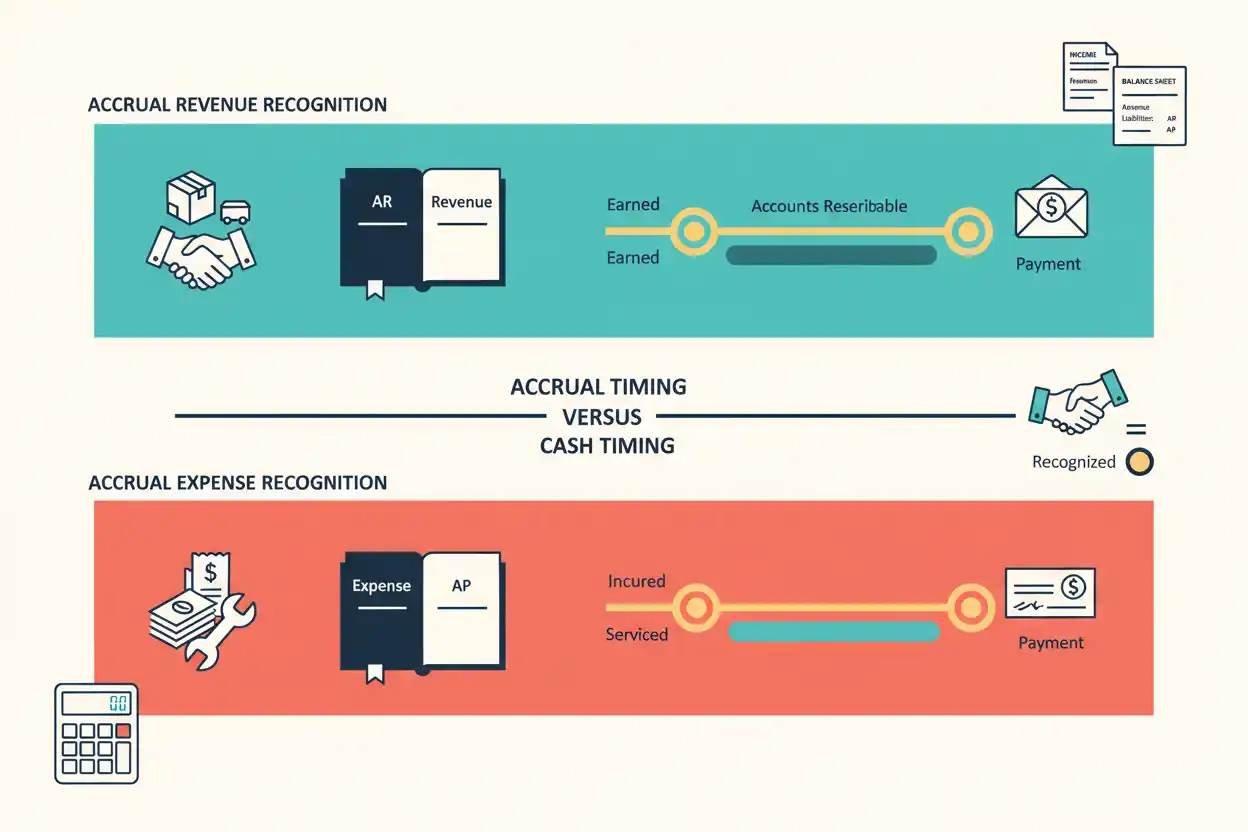

Accrual accounting records qualifying revenue when it is earned and expenses when they are incurred, rather than basing financial performance only on the dates cash is received or paid.
Suppose a consulting company completes $20,000 of work in December but receives the customer’s payment in January.
Under a simplified accrual approach:
December Revenue = $20,000
December Cash Collection = $0
The unpaid $20,000 can become accounts receivable.
The method therefore separates economic activity from cash timing.
The Core Accrual Accounting Principle
A simplified accrual framework asks:
Revenue Recognition Period = Period in Which Revenue Is Earned
and:
Expense Recognition Period = Period in Which the Related Cost Is Incurred or Consumed
Cash may occur before, during, or after those periods.
This is why accrual-based profit can differ substantially from changes in cash.
Accrual Revenue Formula
When beginning and ending accounts receivable are the primary timing differences and other adjustments are ignored:
Accrual Revenue = Cash Collected From Customers + Ending Accounts Receivable − Beginning Accounts Receivable
Suppose:
Cash Collected = $90,000
Beginning AR = $20,000
Ending AR = $35,000
Then:
Accrual Revenue = $90,000 + $35,000 − $20,000
= $105,000
The company earned $105,000 of simplified accrual revenue even though it collected only $90,000 in cash.
Why the Formula Works
Beginning receivables represent revenue recognized previously but collected during or after that earlier period.
Ending receivables represent current-period revenue not yet collected.
Therefore:
Cash Collections + New Uncollected Revenue − Collections Related to Prior AR
produces the current-period revenue under the simplified assumptions.
Actual revenue accounting can include additional contract liabilities, returns, adjustments, and recognition rules.
Accrual Expense Formula Using Payables
When accounts payable is the principal timing difference:
Accrual Expense or Purchases = Cash Paid + Ending Accounts Payable − Beginning Accounts Payable
Suppose:
Cash Paid to Suppliers = $75,000
Beginning AP = $15,000
Ending AP = $25,000
Then:
Accrual Expense or Purchases = $75,000 + $25,000 − $15,000
= $85,000
The business incurred or acquired $85,000 under the simplified model while paying only $75,000 in cash.
Cash Expense vs Accrual Expense
Using the previous example:
Cash Outflow = $75,000
Accrual Amount = $85,000
Difference:
$10,000
That $10,000 corresponds to the net increase in unpaid obligations:
$25,000 − $15,000 = $10,000
The liability increased because the company incurred more supplier-related cost than it paid.
Accounts Receivable Under Accrual Accounting
Accounts receivable is one of the clearest expressions of accrual accounting.
Suppose a company delivers goods worth $12,000 on credit.
Simplified entry:
Accounts Receivable +$12,000
Revenue +$12,000
When the customer later pays:
Cash +$12,000
Accounts Receivable −$12,000
The later collection changes asset composition but does not create another $12,000 of revenue.
Accounts Payable Under Accrual Accounting
Accounts payable handles the opposite timing difference.
Suppose a company receives $9,000 of qualifying services but will pay next month.
Simplified entry:
Expense +$9,000
Accounts Payable +$9,000
When payment occurs:
Accounts Payable −$9,000
Cash −$9,000
The cash payment settles the liability rather than creating the expense again.
Accrued Expense
Some expenses are incurred before the business even receives the supplier invoice.
Suppose employees earn:
$15,000
during the final days of December but payroll is paid in January.
A December accrual can recognize:
Wage Expense = $15,000
and:
Accrued Liability = $15,000
January payment then reduces cash and the liability.
This ensures December includes the labor cost that generated December activity.
Accrued Revenue
Suppose a company has earned:
$8,000
of service revenue by month-end but has not yet billed the customer.
A simplified accrual can recognize:
Accrued Revenue or Receivable = $8,000
Revenue = $8,000
Billing later can reclassify or formalize the receivable according to the accounting system without creating revenue twice.
Deferred Revenue Is Different
Cash received before revenue is earned creates a different timing issue.
Suppose a customer prepays:
$12,000
for 12 months of qualifying service.
At payment:
Cash Increases $12,000
but the full $12,000 may not yet be earned.
If recognized evenly under the simplified arrangement:
Monthly Revenue = $12,000 ÷ 12
= $1,000
The remaining unearned amount is generally treated as a liability until the performance obligation is satisfied under the relevant accounting framework.
Prepaid Expense
Cash can also be paid before an expense is recognized.
Suppose a business prepays:
$24,000
for 12 months of insurance.
If the coverage is consumed evenly:
Monthly Expense = $24,000 ÷ 12
= $2,000
The initial cash payment creates a prepaid asset under the simplified treatment.
The expense is recognized over the periods receiving the benefit.
Accrual Accounting and Amortization
Amortization expense reflects the same broader timing principle.
Suppose a qualifying finite-lived intangible costs:
$100,000
and provides benefits over:
5 Years
Straight-line annual amortization:
$20,000
The cash purchase may occur once, but expense recognition is spread across multiple accounting periods.
Accrual Accounting and the Balance Sheet
The balance sheet contains many accounts created by accrual timing.
Receivables arise when revenue precedes cash collection.
Payables and accrued liabilities arise when expense or asset recognition precedes payment.
Prepaid assets arise when cash payment precedes expense recognition.
Deferred revenue arises when cash collection precedes revenue recognition.
These balances connect one reporting period to the next.
Cash Basis vs Accrual Basis Example
Suppose a company completes:
$20,000 of December Work
and receives payment in January.
It also incurs:
$8,000 of December Expenses
but pays suppliers in January.
Under a simplified accrual approach:
December Profit = $20,000 − $8,000
= $12,000
Under a pure cash-timing view for December:
Cash Revenue = $0
Cash Expense = $0
The cash view would show no December operating activity despite significant economic activity occurring.
Another Cash vs Accrual Example
Suppose January receives the prior customer payment and pays the prior supplier bill.
January cash movement:
Cash In = $20,000
Cash Out = $8,000
Net cash increase:
$12,000
But if all of that revenue and expense belonged economically to December, accrual accounting prevents January from appearing to generate that same $12,000 of new profit.
It separates performance timing from settlement timing.
Accrual Accounting and Break-Even Sales
Break-even sales measures how much revenue is needed to cover a defined cost structure.
Under accrual accounting, the relevant revenue and expenses should generally correspond to the same economic period.
Suppose a company records $500,000 of annual sales but customers pay only $420,000 before year-end.
Break-even analysis based only on cash collections could understate the economic sales activity.
Cash planning should still analyze the uncollected $80,000 separately.
Matching Revenue and Expenses
One practical purpose of accrual accounting is to prevent timing mismatches from distorting performance.
Suppose a company earns:
$100,000 Revenue
using:
$60,000 of Related Costs
If the customer pays immediately but the vendor is not paid until next month, a pure cash view might show:
Current month:
$100,000 Cash In
Next month:
$60,000 Cash Out
Accrual accounting can associate the $60,000 cost with the same economic period as the $100,000 revenue.
Adjusting Entries
Accrual accounting often requires period-end adjustments.
Typical adjustments can involve:
accrued expenses, accrued revenue, prepaid expenses, deferred revenue, depreciation, amortization, and other timing items.
The purpose is not to manipulate profit.
The purpose is to ensure the period reflects economic activity that may not yet be fully captured by routine cash transactions or invoices.
Reversing Accruals
Some operational accounting systems use reversing entries for selected accruals.
Suppose a $10,000 wage accrual is recorded at year-end.
A reversing entry in the next period can simplify later payroll posting, depending on the company’s accounting process.
The key control is that the expense should be recognized once—not zero times and not twice.
Accrual Profit vs Cash
Suppose:
Accrual Revenue = $200,000
Accrual Expenses = $150,000
Profit:
$50,000
However:
Customer Collections = $160,000
Cash Supplier Payments = $145,000
Simplified operating cash difference:
$15,000
The company reports $50,000 of accrual profit but only $15,000 of net cash from these selected transactions.
Working-capital movements explain much of the difference.
Receivable Increase
Using:
Beginning AR = $20,000
Ending AR = $60,000
Increase:
$40,000
That increase means more current or prior recognized revenue remains uncollected at period-end.
All else equal, it can reduce cash flow relative to accrual revenue.
Payable Increase
Suppose:
Beginning AP = $30,000
Ending AP = $50,000
Increase:
$20,000
The company has delayed $20,000 more supplier payment relative to the beginning balance.
All else equal, that can support current cash flow relative to accrual expense.
Accrual Quality
Accrual accounting depends heavily on estimates and cut-off accuracy.
If receivables include revenue not genuinely earned, profit can be overstated.
If expenses incurred before period-end are omitted, profit can also be overstated.
Strong closing procedures therefore verify that transactions are recognized in the correct period.
Common Accrual Accounting Mistakes
One common error is recognizing revenue only when cash arrives despite using an accrual framework.
Another is recording an expense both when the invoice is received and again when it is paid.
Businesses can also overlook unbilled expenses, fail to defer customer prepayments appropriately, or assume accrual profit and cash flow should always be identical.
Frequently Asked Questions
What is accrual accounting?
Accrual accounting recognizes qualifying revenue and expenses according to when the underlying economic activity occurs rather than simply when cash moves.
What is a simplified accrual revenue formula?
Accrual Revenue = Cash Collections + Ending AR − Beginning AR
when receivables are the relevant timing difference and other adjustments are ignored.
What is a simplified expense formula using accounts payable?
Accrual Expense or Purchases = Cash Paid + Ending AP − Beginning AP
under the stated assumptions.
Why can revenue be recorded before cash is collected?
Because the business may already have earned the revenue and obtained a valid receivable from the customer.
Why can an expense exist before payment?
Because the business may already have incurred or consumed the economic benefit associated with the cost.
What is an accrued expense?
It is a cost recognized before the related cash payment, often before the final invoice is paid.
What is deferred revenue?
It generally represents cash received before the associated revenue has been earned.
What is a prepaid expense?
It is generally a payment made before the related economic benefit is consumed.
Does collecting accounts receivable create revenue again?
No, when the revenue was already recognized.
Does paying accounts payable create the expense again?
No, when the expense was already recognized.
Why can accrual profit differ from cash flow?
Receivables, payables, prepayments, deferred revenue, and noncash expenses create timing differences.
Why are adjusting entries important?
They help place revenue, expenses, assets, and liabilities in the periods that reflect the underlying economic activity.