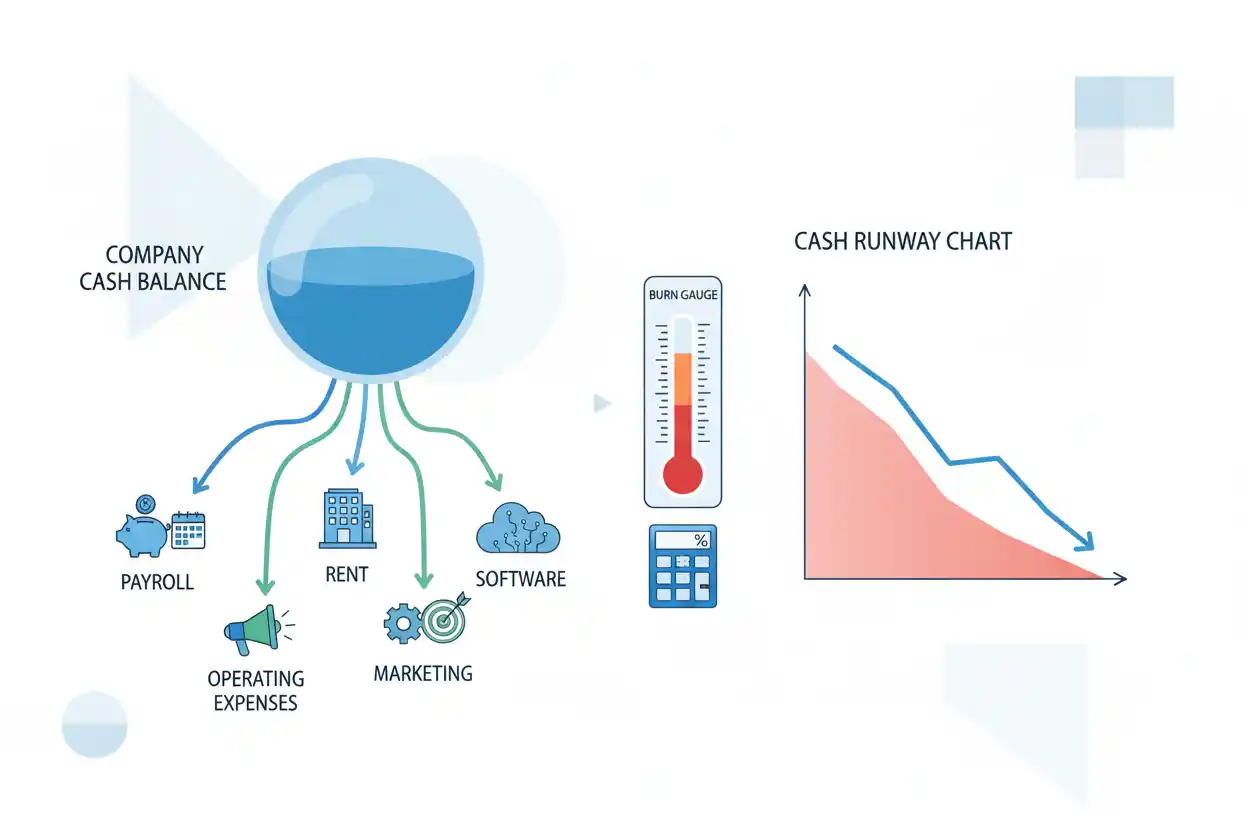

Gross burn measures how much cash a business spends over a period before subtracting cash inflows from customers or other operating receipts. It is commonly expressed as an average monthly amount and is particularly useful for startups and other businesses deliberately operating with significant cash expenditure.
If a company spends $180,000 in cash each month on payroll, rent, software, marketing, professional services, and other operating needs, its monthly gross burn is approximately $180,000 regardless of how much customer cash it collects during that month.
This makes gross burn different from net burn, which considers cash inflows as well as outflows.
What Is Gross Burn?
Gross burn represents the business’s total cash operating spending over a defined period.
It answers:
How much cash does the business spend before considering incoming cash?
Suppose a startup spends:
- $90,000 on payroll;
- $20,000 on office and facility costs;
- $25,000 on marketing;
- $15,000 on software and technology;
- $10,000 on professional services; and
- $20,000 on other operating cash costs.
Total monthly cash spending is:
Gross Burn = $90,000 + $20,000 + $25,000 + $15,000 + $10,000 + $20,000
Gross Burn = $180,000 per Month
If the company collects $120,000 from customers during the same month, gross burn remains $180,000 because customer inflows are not deducted from gross burn.
Gross Burn Formula
For a single month:
Monthly Gross Burn = Total Operating Cash Outflows During the Month
For a period covering several months, an average monthly measure can be calculated as:
Average Monthly Gross Burn = Total Operating Cash Outflows During Period ÷ Number of Months
Suppose a company spends $570,000 over three months:
Average Monthly Gross Burn = $570,000 ÷ 3 = $190,000
The company’s average monthly gross burn is $190,000.
The exact categories included should remain consistent across periods so that the metric is comparable.
Gross Burn Example
Assume a startup reports the following cash operating expenditures for one month:
| Cash Outflow | Amount |
|---|---|
| Payroll | $110,000 |
| Rent and facilities | $18,000 |
| Software and cloud services | $22,000 |
| Marketing | $35,000 |
| Professional services | $12,000 |
| Insurance and administration | $8,000 |
| Other operating cash spending | $5,000 |
| Total | $210,000 |
Therefore:
Gross Burn = $210,000 per Month
Now assume the company also collected $140,000 from customers.
That cash inflow does not reduce gross burn.
Gross burn remains:
$210,000 per Month
The difference between cash inflows and spending belongs to the separate concept of net burn.
Gross Burn Over Multiple Months
Monthly spending often fluctuates, so averaging several months can provide a more representative number.
Suppose cash operating expenditures were:
| Month | Gross Cash Spending |
|---|---|
| January | $180,000 |
| February | $195,000 |
| March | $210,000 |
Total spending:
$180,000 + $195,000 + $210,000 = $585,000
Average monthly gross burn:
$585,000 ÷ 3 = $195,000
The average gross burn is $195,000 per month.
The monthly trend also shows that spending rose during the period, which may be important even though the average is $195,000.
Gross Burn vs. Net Burn
Gross burn looks at cash outflows before deducting operating cash inflows.
Net burn accounts for the difference between cash outflows and relevant inflows.
For example:
Gross Cash Outflows = $200,000
Operating Cash Inflows = $130,000
Gross burn is:
Gross Burn = $200,000
A simplified net burn calculation would focus on the $70,000 difference.
The distinction matters because two companies can have the same gross burn but dramatically different dependence on external funding.
Company A might spend $200,000 while collecting $190,000.
Company B might spend $200,000 while collecting only $20,000.
Their gross burn is identical, but their net cash consumption is not.
Gross Burn vs. Burn Rate
Burn rate is a broader term used to describe the speed at which a business consumes cash.
Gross burn is one specific way of measuring that spending rate before inflows are deducted.
When someone says a company has a “burn rate of $200,000 per month,” the statement can be ambiguous unless it specifies whether the number refers to gross burn or net burn.
For financial planning, the distinction should be explicit.
Gross Burn and the Cash Flow Statement
The cash flow statement provides a more complete accounting of cash movements.
Gross burn is a focused management metric rather than a complete financial statement.
The cash flow statement separates movements into operating, investing, and financing activities. Gross burn is typically concerned with recurring operating cash spending.
For example, raising $2 million from investors increases cash but does not reduce gross burn.
Similarly, receiving a bank loan does not make operating spending disappear.
External financing changes liquidity; gross burn measures spending behavior.
Gross Burn Is a Cash Metric
Gross burn should be based on cash spending rather than simply copying total expenses from the income statement.
The two can differ because accounting expense and cash payment do not always occur in the same period.
Suppose a business records $10,000 of depreciation expense.
That expense reduces accounting profit, but no $10,000 cash payment occurs merely because depreciation was recorded.
Including depreciation expense mechanically in gross burn would therefore overstate cash spending.
Conversely, a cash payment may occur for an item whose accounting recognition happens at another time.
Gross Burn vs. Operating Expenses
Operating expenses and gross burn can overlap substantially, but they are not necessarily identical.
Operating expenses are an accounting classification.
Gross burn focuses on cash leaving the business.
Suppose monthly accounting expenses include:
- Payroll expense: $100,000
- Rent expense: $20,000
- Software expense: $15,000
- Depreciation expense: $10,000
If the first three items were paid in cash but depreciation was noncash:
Accounting Expense Total = $145,000
But the simplified cash spending represented by those items is:
Gross Cash Spending = $100,000 + $20,000 + $15,000 = $135,000
The distinction matters when a business is calculating how quickly its cash reserves are being consumed.
Gross Burn and Accounts Payable
Timing can also differ because of accounts payable.
Suppose a company incurs $30,000 of supplier expenses in March but does not pay the invoice until April.
The expense may affect March’s accounting results under accrual accounting.
The related $30,000 cash outflow occurs in April.
A cash-based gross burn calculation therefore needs to focus on when cash was actually spent rather than simply using the expense-recognition date.
Gross Burn and Inventory Purchases
Inventory can create another important difference between accounting expense and cash burn.
Suppose a retailer pays $100,000 to purchase inventory but sells only $40,000 of that inventory’s cost during the month.
The cash purchase can affect liquidity immediately.
Yet the unsold portion generally remains inventory rather than becoming current-period cost of goods sold.
A business with large inventory purchases can therefore experience substantial cash burn even when accounting expenses follow a different timing pattern.
Gross Burn Example With Accounting Adjustments
Suppose the income statement contains $250,000 of total operating expenses.
Included in that figure is $20,000 of depreciation.
The company also pays $15,000 this month for supplier obligations recognized as expenses in an earlier period.
A simplified cash-spending adjustment would be:
Accounting Operating Expenses = $250,000
Remove noncash depreciation:
$250,000 − $20,000 = $230,000
Add the current cash payment associated with earlier expenses:
$230,000 + $15,000 = $245,000
The simplified gross cash spending estimate becomes $245,000.
Real cash-flow reconciliation can involve additional working-capital and classification adjustments, which is why the cash records remain the better source for an exact burn calculation.
Gross Burn and Double-Entry Bookkeeping
Double-entry bookkeeping records the individual transactions behind gross burn.
For example, a cash payroll payment may reduce cash and recognize or settle the appropriate payroll-related account.
Gross burn then aggregates relevant cash outflows for management analysis.
The two concepts therefore operate at different levels:
Double-entry bookkeeping records transactions.
Gross burn summarizes the rate of cash spending.
Gross Burn and Economic Order Quantity
Inventory-management decisions can affect gross burn.
Suppose an economic order quantity model suggests purchasing 5,000 units at a time.
If each unit costs $20 and the supplier requires immediate payment:
Cash Purchase = 5,000 × $20 = $100,000
That purchase can create a significant cash outflow in the month it occurs.
However, EOQ determines an economically efficient replenishment quantity under its assumptions. Gross burn measures actual cash spending.
The EOQ formula itself should not be changed merely to force a desired burn-rate outcome.
Gross Burn and Forecast Variance
Businesses often forecast gross burn before a period begins.
A forecast variance can then measure how actual spending compared with that expectation.
Suppose forecast gross burn was $220,000 and actual gross burn was $242,000.
Gross Burn Forecast Variance = $242,000 − $220,000 = $22,000
Percentage variance:
$22,000 ÷ $220,000 × 100 = 10%
Actual gross burn was 10% above forecast.
Management can then identify whether the overspend came from hiring, marketing, cloud infrastructure, inventory, professional services, or another category.
Gross Burn and Cost Variance
A gross-burn increase may also be associated with individual cost variance problems.
Suppose software infrastructure was expected to require $30,000 of monthly cash spending but actually required $38,000.
Cost Difference = $38,000 − $30,000 = $8,000
That $8,000 cash-spending increase contributes to higher gross burn.
However, gross burn should not become a substitute for detailed cost analysis.
The burn metric identifies overall spending velocity; cost variance helps isolate deviations within individual cost categories.
Fixed and Variable Components of Gross Burn
Gross burn can contain both fixed and variable spending.
Relatively fixed cash commitments might include office rent, salaried payroll, insurance, or contracted software.
Variable spending can include transaction fees, usage-based infrastructure, shipping, performance marketing, or other costs that change with activity.
Suppose monthly gross burn is $200,000:
Fixed Cash Spending = $140,000
Variable Cash Spending = $60,000
If revenue volume falls sharply, the $60,000 variable component might decline while much of the $140,000 fixed component remains.
Understanding this mix helps management estimate how quickly burn can realistically be reduced.
Gross Burn Before and After Hiring
Suppose a startup has monthly gross burn of $150,000.
It hires five employees whose combined monthly cash compensation and related incremental cash costs total $45,000.
New gross burn becomes approximately:
New Gross Burn = $150,000 + $45,000 = $195,000
Increase:
$195,000 − $150,000 = $45,000
Percentage increase:
$45,000 ÷ $150,000 × 100 = 30%
The hiring plan raises gross burn by 30%, assuming other cash spending remains unchanged.
This helps quantify the liquidity effect of a hiring decision before considering additional revenue the new employees may help generate.
Gross Burn Before and After Cost Reductions
Suppose monthly gross burn is $300,000 and management reduces recurring cash costs by:
- $20,000 in marketing;
- $10,000 in contractors; and
- $15,000 in software and infrastructure.
Total reduction:
$20,000 + $10,000 + $15,000 = $45,000
New gross burn:
$300,000 − $45,000 = $255,000
Percentage reduction:
$45,000 ÷ $300,000 × 100 = 15%
Gross burn has fallen by 15%.
Whether the reductions are economically sensible depends on their effect on growth, product development, service quality, and future revenue.
Gross Burn Trend Example
Tracking burn over time reveals spending direction.
| Month | Gross Burn |
|---|---|
| January | $160,000 |
| February | $170,000 |
| March | $185,000 |
| April | $205,000 |
From January to April:
Increase = $205,000 − $160,000 = $45,000
Percentage increase:
$45,000 ÷ $160,000 × 100 = 28.125%
Gross burn increased approximately 28.1% over the period.
That rise may be intentional if the company is scaling, but management should understand what is driving it and whether available financing can support the spending.
Gross Burn and Revenue Growth
Higher gross burn is not automatically bad.
Suppose Company A increases gross burn from $100,000 to $150,000 while monthly customer cash collections grow from $20,000 to $130,000.
Company B keeps gross burn fixed at $100,000 while customer collections remain $20,000.
Company A is spending more in absolute terms, but its operating economics may be improving much faster.
Gross burn should therefore be interpreted alongside revenue, cash inflows, margins, growth, and funding requirements rather than treated as an isolated score.
When High Gross Burn Is a Warning Sign
High gross burn deserves scrutiny when spending rises without corresponding progress, when cash reserves are limited, or when large portions of spending cannot be reduced if financing becomes difficult.
Potential warning signs include:
- burn rising much faster than operational scale;
- recurring spending that management cannot explain;
- repeated overspending against forecast;
- hiring commitments made without sufficient liquidity planning;
- large inventory purchases unsupported by demand; or
- dependency on future financing to meet ordinary obligations.
The number itself is not enough. The trajectory and reasons behind it matter.
When High Gross Burn Can Be Intentional
A growing company may deliberately increase gross burn to fund product development, customer acquisition, geographic expansion, hiring, infrastructure, or inventory.
Suppose a business raises spending from $200,000 to $350,000 per month after completing a financing round.
If that additional spending follows a defined expansion plan and produces measurable progress, the higher burn can be intentional rather than evidence of poor control.
The important questions are whether the spending was planned, whether the company can finance it, and whether the investment is creating the expected results.
Gross Burn Should Use a Consistent Definition
Different companies may classify certain cash outflows differently.
One business might include all recurring operating cash spending.
Another may exclude unusual legal settlements or one-time restructuring payments from its recurring gross-burn metric.
Consistency matters.
If one month’s calculation includes a major one-time payment but another month’s does not, comparisons can become misleading unless the difference is clearly identified.
A useful internal definition should specify what is included and be applied consistently across reporting periods.
Common Gross Burn Mistakes
One mistake is subtracting customer revenue from gross burn. Doing so moves the calculation toward net burn.
Another is copying accounting expenses directly from the income statement without adjusting for noncash items and payment timing.
Businesses can also distort the metric by mixing financing cash flows with operating spending.
Another problem is comparing monthly gross burn calculated from one month with a quarterly total that has not been converted to a monthly average.
Finally, a lower burn is not automatically better. Cutting spending that is generating highly profitable growth can weaken the business even though the gross-burn number improves.
Frequently Asked Questions
What is gross burn in simple terms?
Gross burn is the amount of cash a business spends during a period before subtracting customer cash inflows or other operating receipts.
It is commonly reported as a monthly amount.
What is the gross burn formula?
For one month:
Monthly Gross Burn = Total Operating Cash Outflows During the Month
For several months:
Average Monthly Gross Burn = Total Operating Cash Outflows ÷ Number of Months
What does a gross burn of $200,000 mean?
It means the business is spending approximately $200,000 of cash per month under the categories included in its gross-burn definition.
It does not tell you how much customer cash the company receives.
Is gross burn the same as net burn?
No.
Gross burn measures spending before operating inflows are deducted.
Net burn considers the cash consumed after relevant cash inflows.
Is gross burn the same as expenses?
Not necessarily.
Accounting expenses can contain noncash items such as depreciation, while cash payments can occur in periods different from expense recognition.
Gross burn focuses on actual cash spending.
Does revenue reduce gross burn?
No.
Revenue or customer cash receipts are not subtracted when calculating gross burn.
Subtracting inflows changes the analysis toward net burn.
Does depreciation count in gross burn?
Depreciation expense itself generally does not represent a current cash outflow, so it should not mechanically increase cash-based gross burn.
Do inventory purchases affect gross burn?
They can when cash is actually paid for inventory.
The timing can differ from cost of goods sold because unsold inventory remains an asset rather than becoming an immediate accounting expense.
Can gross burn increase even when a company is improving?
Yes.
A growing business may intentionally increase spending to hire employees, acquire customers, develop products, or expand capacity.
The key issue is whether the higher spending is sustainable and economically productive.
Why track gross burn separately from net burn?
Gross burn shows the underlying scale of cash spending without allowing rising cash inflows to conceal expenditure growth.
Net burn answers a different question about the amount of cash the business is actually losing after inflows.
Should gross burn include one-time expenses?
That depends on the reporting purpose.
Actual cash outflows should not be hidden, but businesses may separately identify one-time spending so that recurring gross burn remains comparable across periods.
How often should gross burn be calculated?
Monthly measurement is common because it aligns well with payroll, rent, subscriptions, financial reporting, and short-term liquidity planning.
Businesses with tight liquidity may review the underlying cash spending more frequently even if the formal gross-burn metric remains monthly.