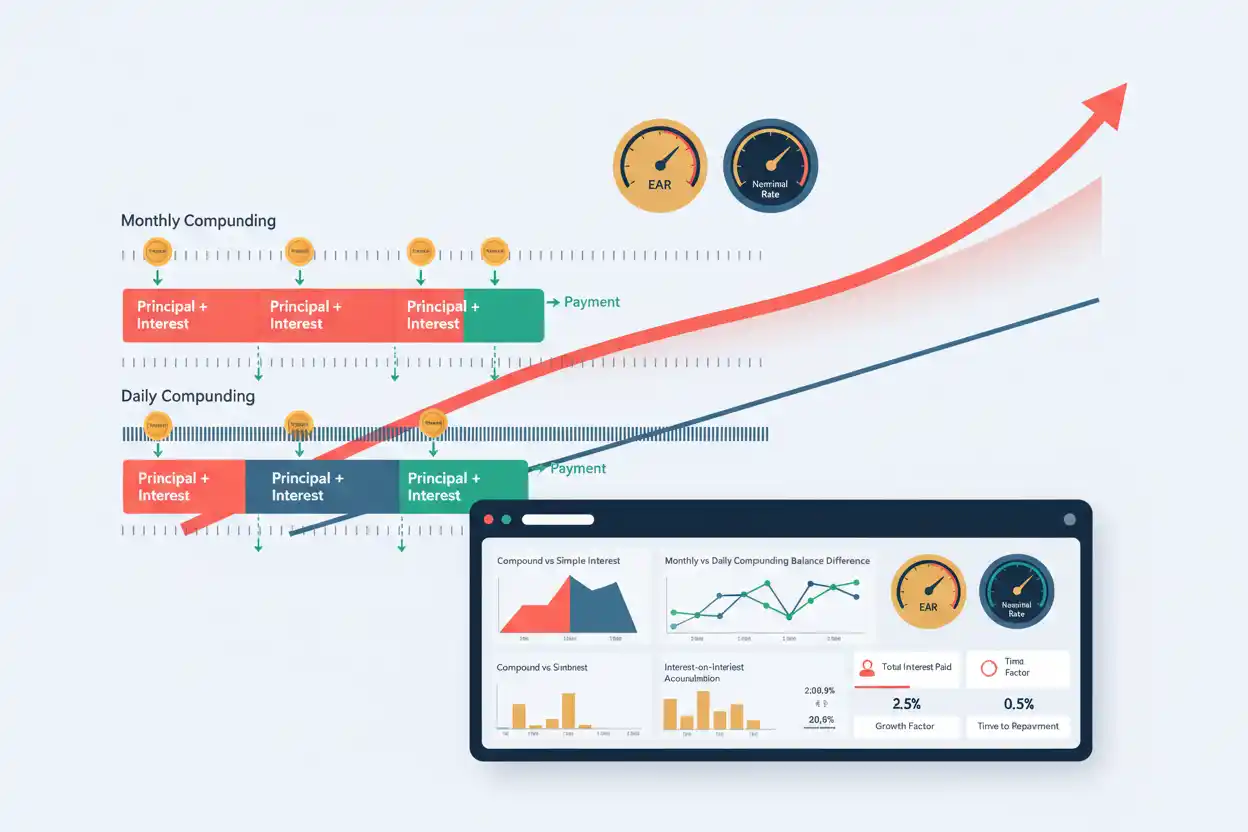

A compound interest loan is a borrowing structure in which interest can be calculated on a balance that includes previously added interest.
That is the defining feature of compounding:
Interest can generate additional interest.
This differs from a simple-interest structure where interest is calculated only from the relevant principal balance.
The distinction matters because borrowers sometimes assume that any loan with monthly payments is a compound interest loan. That is not necessarily true. Amortization describes how debt is repaid, while compounding describes what balance is used to calculate interest.
Credit cards provide a familiar example of how compounding can occur. Some issuers use daily periodic rates and add each day’s interest to the balance used for later calculations.
The broader Loans & Credit framework separates compound interest from APR, simple interest, amortization, payment schedules, and transaction fees.
What Is a Compound Interest Loan?
A compound interest loan allows unpaid or credited interest to become part of the amount on which later interest is calculated.
Suppose a $10,000 balance earns or incurs 1% interest during a period.
After one period:
New Balance = $10,000 × 1.01
New Balance = $10,100
If the $100 interest remains in the balance and the next period also charges 1%:
Next Interest = $10,100 × 1%
Next Interest = $101
The second period produces $101 rather than $100 because interest is now being calculated on both:
the original principal and the previous $100 of interest.
Compound Interest Loan Formula
For a balance with no intervening payments:
Future Balance = P × (1 + r ÷ m)^(mt)
Where:
P = starting principal
r = nominal annual interest rate
m = compounding periods per year
t = number of years
Compound interest itself is:
Compound Interest = Future Balance − Principal
This formula assumes a constant rate, regular compounding intervals, and no payments or additional borrowing.
Real loan accounts can be more complicated.
Compound Interest Loan Example
Suppose:
Principal = $10,000
Nominal annual rate = 12%
Compounding = monthly
Time = 1 year
No payments during the example
Monthly rate:
Monthly Rate = 12% ÷ 12
Monthly Rate = 1%
Then:
Future Balance = $10,000 × (1.01)¹²
Future Balance ≈ $11,268.25
Therefore:
Compound Interest = $11,268.25 − $10,000
Compound Interest ≈ $1,268.25
The balance grows by approximately $1,268.25 during the year.
Simple Interest Comparison
Now compare the same $10,000 principal at 12% simple annual interest for one year.
Simple Interest = Principal × Rate × Time
Simple Interest = $10,000 × 12% × 1
Simple Interest = $1,200
Ending balance:
Simple Interest Balance = $10,000 + $1,200
Simple Interest Balance = $11,200
Under monthly compounding, the ending balance was approximately $11,268.25.
Difference:
Compounding Difference = $11,268.25 − $11,200
Compounding Difference = $68.25
The difference exists because previously generated interest also contributes to later interest.
The dedicated simple interest loan page owns the non-compounding calculation.
Why Compounding Frequency Matters
For the same nominal annual rate, more frequent compounding produces a higher effective annual rate when the rate is positive.
For a 12% nominal rate:
Annual compounding:
Effective Rate = (1 + 0.12)¹ − 1 = 12%
Monthly compounding:
Effective Rate = (1 + 0.12 ÷ 12)¹² − 1
Effective Rate ≈ 12.68%
Daily compounding produces a slightly higher effective result under the same nominal-rate assumption.
The nominal vs effective interest rate page owns that rate-conversion comparison.
Effective Annual Rate Formula
The effective annual rate is:
Effective Annual Rate = (1 + r ÷ m)^m − 1
For 18% nominal interest compounded monthly:
Effective Annual Rate = (1 + 0.18 ÷ 12)¹² − 1
Effective Annual Rate ≈ 19.56%
That means an 18% nominal rate compounded monthly produces an effective one-year rate of approximately 19.56% when no payments alter the balance.
This is one reason a nominal rate should not automatically be treated as the true annual growth rate of a compounding balance.
Compound Interest vs APR
APR is an annualized borrowing-cost concept.
Compound interest describes how interest is generated.
They are not interchangeable.
For example, a credit product can quote an APR while calculating interest using a daily periodic rate.
The interest mechanics determine how the balance evolves.
APR provides an annual rate disclosure or comparison measure in the applicable context.
Compound Interest vs APR and APY
APR vs APY is often used to explain the effect of compounding.
APY explicitly incorporates compound yield in the deposit-account context.
A loan’s borrowing cost should not simply be relabeled APY.
When analyzing debt, it is usually clearer to distinguish among:
nominal rate, periodic rate, effective annual rate, APR, and actual dollar interest.
Compound Interest vs Daily Simple Interest
Daily simple interest and daily compounding can look similar because both calculate interest frequently.
The key difference is the balance used.
Under daily simple interest, interest is calculated from the outstanding principal according to the contract.
Under daily compounding, previously added interest can become part of the next day’s interest-bearing balance.
Those mechanisms should not be confused.
Compound Interest vs Accrued Interest
Accrued interest simply means interest has accumulated.
It does not automatically mean that interest has compounded.
Suppose $100 of interest accrues but remains separate from principal.
If later interest is still calculated only on the original principal, the debt is not compounding that accrued interest.
Compounding begins when the applicable balance used for later interest includes previous interest.
Compound Interest vs Amortization
An amortizing loan uses scheduled payments to reduce a balance.
Compounding is a separate concept.
A loan can amortize while calculating interest from outstanding principal without adding unpaid interest to principal under normal payment conditions.
Likewise, a balance can compound even when no conventional amortization schedule exists.
Compound Interest and Loan Payments
The general loan payments calculation should match the actual interest structure.
For a standard fixed-rate amortizing loan with periodic interest:
Payment = P × [r(1 + r)ⁿ] ÷ [(1 + r)ⁿ − 1]
That equation reflects periodic interest and scheduled repayment.
It does not mean that every amortizing loan is allowing unpaid interest to compound in the same way as an unpaid credit-card balance.
Compound Interest and Business Loan Payments
Business loan payments can use amortization, interest-only periods, variable rates, or other commercial structures.
Do not assume a business loan compounds interest merely because its payment formula contains powers.
The mathematical exponent in an amortization equation reflects repeated periods.
The contractual question is whether unpaid interest becomes part of the balance used to calculate future interest.
Compound Interest and Car Payments
Car payments commonly allocate each scheduled amount between interest and principal.
Many vehicle loans instead use declining-balance simple-interest mechanics.
Therefore:
Amortization ≠ Automatically Compound Interest
That distinction prevents a common misunderstanding when examining auto-loan schedules.
Compound Interest and Credit Card APR
Credit card APR can be converted into a daily periodic rate according to the issuer’s method.
If daily interest is added to the balance before the next day’s interest calculation, compounding occurs daily.
For example, with a 24% APR and a 365-day basis:
Daily Periodic Rate ≈ 24% ÷ 365
Daily Periodic Rate ≈ 0.06575%
The actual card calculation depends on the agreement, balance method, transactions, and payment timing.
Compound Interest and Credit Card Grace Period
A credit card grace period can prevent purchase interest from being charged when the cardholder satisfies the required conditions.
If no interest is charged, there is nothing to compound on those qualifying purchase balances during the grace-period treatment.
Once interest applies, account mechanics become important.
Compound Interest and Cash Advances
A cash advance fee can immediately increase the balance associated with a cash-advance transaction.
Cash advances can also begin accruing interest immediately.
If that interest is added to the balance used for later daily calculations, the financing cost can compound.
Fees and compound interest are separate, but they can operate simultaneously.
Credit Card Minimum Payments
A credit card minimum payment can be too small to eliminate high-rate debt quickly.
When compounding interest continues while only small payments are made, a substantial portion of each payment may be consumed by financing cost.
The debt can therefore decline slowly.
Credit Card Payoff
A structured credit card payoff plan reduces the balance exposed to future interest.
If principal falls faster, subsequent interest calculations start from a smaller base.
That effect can materially reduce the total financing cost over time.
Compound Interest and Principal Balance
The principal balance is especially important when discussing compounding.
If unpaid interest is capitalized into principal or another interest-bearing balance, the base for future interest increases.
Suppose:
Original principal = $20,000
Unpaid interest added = $1,500
Then:
New Interest-Bearing Balance = $20,000 + $1,500
New Balance = $21,500
Future interest can then be generated from $21,500 under the applicable terms.
Capitalized Interest vs Compounding
Capitalization and compounding are related but distinct concepts.
Capitalization is the act of adding unpaid interest to the principal or interest-bearing balance.
Compounding is the resulting process through which future interest can be charged on that previously added interest.
A loan can have accrued unpaid interest for some time before capitalization occurs.
Negative Amortization
Negative amortization occurs when required payments are insufficient to cover the interest generated and the unpaid amount increases the balance.
Conceptually:
Balance Increase = Interest Due − Payment Applied Toward Interest
If interest due is $500 but the payment covers only $350:
Unpaid Interest = $500 − $350
Unpaid Interest = $150
If the $150 is added to the balance, future interest can be calculated from a larger amount.
This is one mechanism through which debt can grow despite payments being made.
Compound Interest and Repayment Schedules
A repayment schedule should identify how the balance changes after each payment.
For compound-interest debt, the sequence matters:
beginning balance, interest added, payments, new borrowing, fees, and ending balance.
Changing the order or timing of these events can change the result.
Loan Term and Compounding
A longer loan term gives interest more time to accumulate.
When interest compounds and the balance is not being reduced sufficiently, time becomes especially powerful.
For example, leaving a compounding balance untouched for two years rather than one does more than simply double the one-year interest because the second year begins from a larger balance.
Compound Interest and Fixed vs Variable Rates
A fixed vs variable interest rate determines whether the rate itself can change.
Compounding determines how interest interacts with the balance.
A loan can therefore be:
fixed-rate and compounding, variable-rate and compounding, or structured differently.
These are separate contract characteristics.
Prepayment and Compound Interest
A borrower who reduces the balance earlier can generally reduce the base on which future interest is calculated, subject to contract terms.
A prepayment penalty can change the economics of doing so.
Therefore, early repayment savings should be evaluated net of any applicable penalty.
Common Compound Interest Loan Mistakes
The first mistake is assuming every installment loan compounds unpaid interest.
The second is confusing monthly amortization with monthly interest capitalization.
A third is comparing nominal rates without considering compounding frequency.
Borrowers can also confuse accrued interest with compounded interest.
Finally, an effective annual rate calculation should not automatically be substituted for a disclosed APR because the measures can follow different rules.
Frequently Asked Questions
What is a compound interest loan?
It is a loan or credit structure in which interest can be calculated on a balance that includes previously added interest.
What is the compound interest formula?
For a balance with no payments:
Future Balance = P × (1 + r ÷ m)^(mt)
What is the difference between simple and compound interest?
Simple interest does not charge interest on previously generated interest, while compound interest can.
Does every loan use compound interest?
No. Many loans use simple-interest or other declining-balance structures.
Are amortizing loans compound interest loans?
Not necessarily. Amortization describes repayment, while compounding describes how interest is calculated.
Does a credit card use compound interest?
Some card issuers calculate interest daily and add that interest to the balance used for subsequent daily interest calculations.
What is compounding frequency?
It is how often interest is added to the interest-bearing balance, such as monthly or daily.
Why does more frequent compounding increase cost?
Interest is added to the balance sooner, allowing previously added interest to contribute to later interest.
What is effective annual rate?
It is the annual rate after accounting for within-year compounding.
Effective Annual Rate = (1 + r ÷ m)^m − 1
Is compound interest the same as APR?
No. Compounding describes balance growth mechanics. APR is an annualized borrowing-cost measure.
What is capitalized interest?
It is unpaid interest added to the loan’s principal or interest-bearing balance.
How can compound interest cost be reduced?
Reducing the balance earlier generally limits the amount on which later interest can be calculated, subject to the loan’s payment and prepayment terms.
Final Takeaway
A compound interest loan allows previously added interest to contribute to future interest.
The core formula is:
Future Balance = P × (1 + r ÷ m)^(mt)
For a $10,000 balance at a 12% nominal rate compounded monthly for one year with no payments, the ending balance is approximately $11,268.25.
Simple 12% annual interest over the same year would produce a balance of $11,200.
The difference—about $68.25—comes entirely from interest being charged on earlier interest.
The most important distinction is therefore not whether the loan has monthly payments. It is whether previously generated interest becomes part of the balance used to calculate future interest.