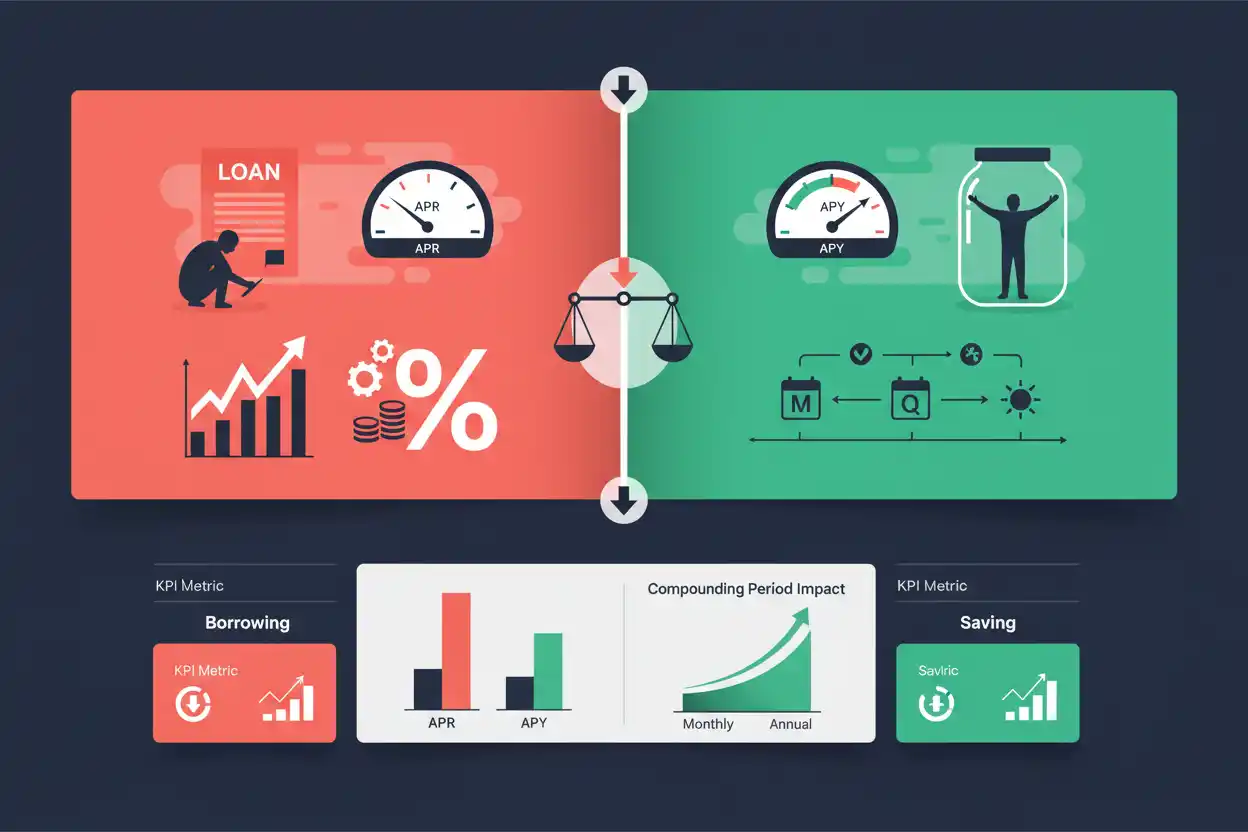

APR and APY are both annual percentage measures, but they are not interchangeable.
APR is primarily associated with the annualized cost of borrowing.
APY is primarily associated with the annual yield earned on deposit accounts and incorporates the effect of compounding.
The simplest way to remember APR vs APY is:
APR focuses on annualized credit cost; APY focuses on annual yield after compounding.
However, that shortcut is only the beginning. The formal calculations, legal disclosure frameworks, and financial purposes differ.
What Is APR?
APR stands for annual percentage rate.
For U.S. consumer credit covered by Regulation Z, APR is a measure of the cost of credit expressed as a yearly rate and is calculated from the amount and timing of credit provided and payments required.
The dedicated APR guide covers fees and true borrowing cost in detail.
APR should not automatically be interpreted as the contractual interest rate.
A lender can quote:
Interest rate = 8.00%
APR = 8.70%
when applicable financing costs make the annualized credit cost higher.
What Is APY?
APY stands for annual percentage yield.
Under Regulation DD, APY reflects the total amount of interest paid on a deposit account based on the interest rate and the frequency of compounding over a 365-day period.
That means APY captures the benefit of earning interest on previously credited interest when compounding occurs.
For a conventional compound-yield calculation:
APY = (1 + r ÷ n)^n − 1
where:
r = nominal annual interest rate
n = number of compounding periods per year
This formula is a useful mathematical illustration of compounding. Actual deposit disclosures must follow the applicable account terms and regulatory calculation requirements.
APR vs APY at a Glance
| Feature | APR | APY |
| Full name | Annual Percentage Rate | Annual Percentage Yield |
| Common use | Credit and borrowing | Deposits and savings |
| Main purpose | Express annualized credit cost | Express annual yield |
| Compounding | Not simply an APY-style compounding formula | Explicitly reflects compounding |
| Fees | Applicable finance charges can affect APR | Deposit-account yield focuses on interest earned under applicable terms |
| Best interpretation | Borrowing-cost comparison | Savings-yield comparison |
The crucial point is that APR and APY answer different financial questions.
APY Formula Example
Suppose a savings account pays a nominal annual interest rate of 5%, compounded monthly.
The monthly rate is:
Monthly Rate = 5% ÷ 12
Then:
APY = (1 + 0.05 ÷ 12)^12 − 1
APY ≈ 5.116%
Rounded:
APY ≈ 5.12%
The APY is higher than the 5% nominal rate because each month’s credited interest can contribute to later interest.
Why Compounding Raises APY
Suppose $10,000 earns a nominal 5% annual rate compounded monthly.
After the first month’s interest is credited, the account balance rises.
The next month’s interest can then be calculated from a slightly larger balance.
Over repeated periods, the effect accumulates.
That is why:
APY > Nominal Rate
when there is positive intra-year compounding and the assumptions otherwise match.
APR Does Not Work Like a Simple APY Mirror Image
It is tempting to assume that APR is merely a nominal rate without compounding while APY is the same rate after compounding.
That can be mathematically useful in a narrow rate-conversion exercise, but it is not a complete description of real credit APR.
APR can involve finance charges and actuarial timing rules.
For covered closed-end consumer credit, formal APR calculations relate the amount financed to scheduled payments rather than merely applying:
APR = Periodic Rate × Number of Periods
in every transaction.
Therefore, APR and APY should not be treated as symmetric labels for the same calculation.
Mathematical Compounding Example
Suppose, purely for rate-conversion illustration, a periodic rate is 1% per month.
A nominal annual rate would be:
Nominal Annual Rate = 1% × 12 = 12%
The effective annual rate is:
Effective Annual Rate = (1 + 0.01)^12 − 1
Effective Annual Rate ≈ 12.68%
This shows the mathematical impact of monthly compounding.
It does not mean every 12% consumer-loan APR necessarily has a 12.68% “APY,” because credit disclosures and deposit APY use different frameworks.
The nominal vs effective interest rate page owns that conversion question.
APR vs APY Example With $10,000
Consider two completely different financial situations.
Borrowing
A borrower receives a $10,000 loan.
Suppose the disclosed APR is 9%.
That 9% helps describe annualized borrowing cost according to the applicable loan terms and credit-cost calculation.
The actual dollars paid depend on principal, amortization, fees, term, and payment timing.
Saving
A saver deposits $10,000 into an account with an APY of 5%.
Ignoring withdrawals, taxes, account changes, and other adjustments, a one-year illustration is:
Ending Balance = $10,000 × (1 + 5%)
Ending Balance = $10,500
The APY is designed to make that annual yield easier to understand.
These are fundamentally different uses of annual percentages.
APR vs Interest Rate
A loan’s contractual interest rate describes how interest is charged.
APR provides an annualized measure of credit cost.
A loan can therefore show:
Interest rate = 7.5%
APR = 8.1%
The difference can arise when qualifying financing charges affect the credit-cost calculation.
Accrued interest then determines how much interest has accumulated during a particular elapsed period.
APY vs Interest Rate
For deposits, a stated interest rate can differ from APY because APY reflects compounding.
Suppose the nominal rate is 4.00% compounded daily.
The resulting APY will be slightly greater than 4% because interest is repeatedly credited and becomes part of the earning balance under the assumptions.
The more frequently compounding occurs, the greater the difference for the same positive nominal rate, although the incremental benefit becomes progressively smaller.
APR vs Effective Rate
The interest rate basics framework distinguishes several rate concepts that are easy to mix together.
APR is a regulated credit-cost measure in applicable consumer-credit contexts.
An effective annual rate is a mathematical representation of the annual result after within-year compounding.
APY is a standardized annual-yield measure for deposit accounts.
These terms can produce similar-looking percentages without representing the same economic or regulatory concept.
APR vs APY for Loans
For ordinary loan comparison, APR is generally the relevant standardized borrowing-cost measure rather than APY.
If you are comparing an amortizing loan with another loan, examine:
APR, contractual interest rate, applicable fees, payment amount, term, and total repayment.
Trying to convert the loan into “APY” can create more confusion than clarity unless you are performing a specific effective-rate analysis.
APR vs APY for Credit Cards
A credit card APR is not simply the same as the annual effective cost a cardholder actually experiences.
The amount of interest paid depends on balances, transaction timing, payment behavior, account terms, grace-period eligibility, and applicable APR categories.
A credit card grace period can even allow a cardholder to avoid purchase interest under qualifying circumstances despite the account showing a positive purchase APR.
Therefore, disclosed APR and realized dollar cost should remain distinct.
APR vs APY for Auto Loans
When evaluating vehicle financing, auto loan APR is typically more decision-useful than attempting an APY conversion.
A borrower should compare:
amount financed, APR, term, required payment, total payment obligation, and applicable fees.
The related auto loan payments calculation then shows the periodic cash-flow burden.
APR vs APY for Personal Loans
A personal loan APR can expose differences created by origination fees and other qualifying costs.
Suppose:
Loan A interest rate = 10%, APR = 10.2%
Loan B interest rate = 9.5%, APR = 11%
Loan B’s lower headline rate does not automatically make it cheaper.
APY would not be the appropriate primary comparison measure for these loan offers.
APR vs APY and Compounding Frequency
For APY, compounding frequency matters directly.
Using a nominal 6% rate:
Annual compounding:
APY = (1 + 0.06)^1 − 1 = 6.00%
Monthly compounding:
APY = (1 + 0.06 ÷ 12)^12 − 1
APY ≈ 6.17%
Daily compounding produces a slightly higher result under the same nominal-rate assumption.
This is why comparing savings accounts by APY is more useful than comparing nominal rates with different compounding schedules.
Does Higher APR Mean Better?
For a borrower, a higher APR generally indicates higher annualized credit cost when substantially comparable loans are being evaluated.
So, all else equal, lower is preferable.
However, “all else equal” matters.
A shorter loan may have a slightly higher APR but produce fewer total dollars of interest because the debt disappears much sooner.
APR should therefore not be the sole decision variable.
Does Higher APY Mean Better?
For a saver, a higher APY generally indicates a higher annual yield when account conditions are otherwise comparable.
However, account restrictions can matter.
Consider:
minimum balances, fees, withdrawal restrictions, tiered rates, introductory rates, and eligibility rules.
A headline APY is most useful when the underlying account terms also fit the saver.
How Fees Affect APR vs APY
Fees interact with the two concepts differently.
On the credit side, a qualifying loan origination fee can influence APR.
For a balance transfer, the balance transfer fee can create a meaningful borrowing cost even when the promotional APR is low.
On the deposit side, APY expresses interest yield, but account fees can still reduce the net economic benefit a customer actually retains.
Therefore, neither percentage should be considered without the related fee schedule.
APR vs APY and Loan Payments
APR does not directly tell you the scheduled payment.
A standard loan payment depends on the contractual financing amount, periodic rate, number of payments, and loan structure.
Two loans with similar APRs can have very different monthly payments if their principal amounts or terms differ.
APR vs APY and Simple Interest
A simple interest loan calculates interest from principal without the same interest-on-interest mechanism used in compound-growth formulas.
However, that does not mean its APR can always be obtained by simply multiplying a daily or monthly interest rate by the number of periods.
Fees and regulatory calculation conventions can still matter.
APR vs APY and Compound Interest
A compound interest loan demonstrates why an effective annual cost can exceed a nominal periodic-rate multiple when interest compounds.
APY explicitly captures this compounding effect for yield.
APR should remain identified according to the applicable credit-cost calculation rather than renamed APY.
Common APR vs APY Mistakes
One mistake is assuming the higher number is always worse.
A high APR is generally undesirable for a borrower, while a high APY is generally attractive to a saver.
Another mistake is converting APR into APY mechanically and assuming the result is a legally disclosed borrowing metric.
A third is comparing a savings APY directly with a loan APR and concluding that the percentage-point difference represents guaranteed profit.
Taxes, credit risk, liquidity, fees, timing, and fundamentally different cash-flow structures make that comparison incomplete.
Finally, borrowers and savers should distinguish percentages from actual dollars.
Frequently Asked Questions
What is the main difference between APR and APY?
APR generally measures annualized borrowing cost, while APY measures annual yield and incorporates compounding for deposit accounts.
What does APR stand for?
APR stands for annual percentage rate.
What does APY stand for?
APY stands for annual percentage yield.
Does APY include compounding?
Yes. APY reflects the effect of compounding in its annual yield calculation.
Does APR include fees?
Applicable finance charges can affect APR in covered credit transactions, but not every fee is necessarily included.
Is APR always lower than APY?
No universal mathematical rule applies because APR and APY can describe different products and calculations.
Why is APY higher than a nominal savings rate?
When interest compounds more than once per year, previously credited interest can generate additional interest, raising the effective annual yield.
Should I use APR or APY to compare loans?
APR is generally the relevant standardized metric for borrowing-cost comparison.
Should I use APR or APY to compare savings accounts?
APY is generally more useful because it incorporates compounding into the annual yield.
Is APR the same as an effective annual rate?
Not necessarily. An effective annual rate is a mathematical compounding measure, while APR can follow specific credit disclosure rules.
Can a 0% APR loan still have costs?
Yes. Depending on the product, fees or other charges can exist even when a promotional interest APR is 0%.
Which is better: high APR or high APY?
For a borrower, lower APR is generally preferable when comparable terms are being evaluated. For a saver, higher APY is generally preferable when account conditions are comparable.
Final Takeaway
APR and APY both annualize financial percentages, but they serve different purposes.
APR = Primarily an annualized borrowing-cost measure
APY = Annual yield that reflects compounding
For savings, a nominal 5% rate compounded monthly produces an APY of approximately 5.12%.
For loans, APR should not be reduced to that same compounding formula because applicable fees, cash-flow timing, and credit-disclosure rules can affect its calculation.
The practical rule is simple: use APR to evaluate borrowing cost and APY to evaluate deposit yield, then read the underlying rates, fees, terms, and cash flows before making the decision.