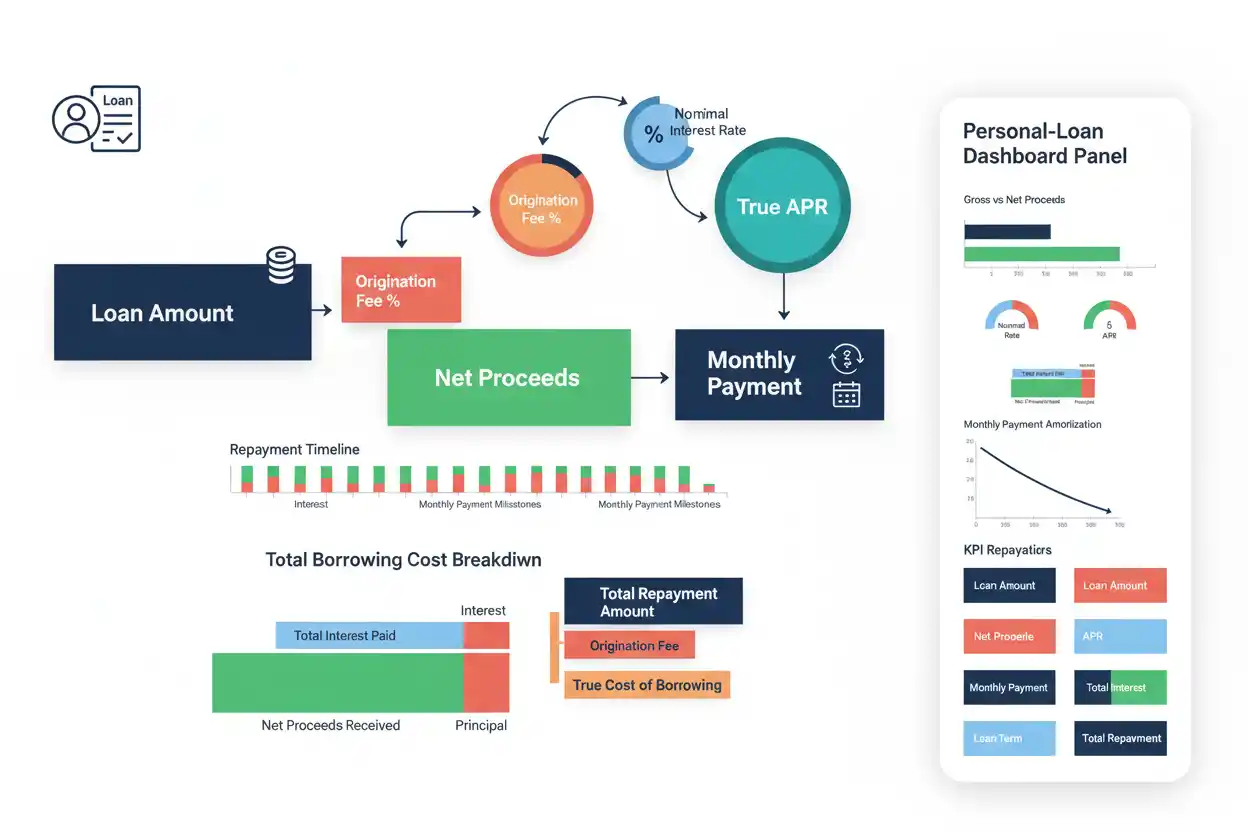

Personal loan APR expresses the annualized cost of borrowing and can provide a more complete comparison than the loan’s stated interest rate alone.
That matters when personal loans carry origination fees or other finance charges.
Suppose two lenders both quote a 12% interest rate.
One charges no origination fee.
The other withholds 5% of the loan amount before disbursing the funds.
The contractual rates are identical, but the borrower receives less usable cash from the second loan while still assuming a substantial repayment obligation.
Its APR can therefore be materially higher.
The essential relationship is:
Interest Rate = Contractual Cost Applied to the Loan Balance
while:
APR = Annualized Cost of Credit Including Applicable Finance Charges
What Is Personal Loan APR?
Personal loan APR is the annual percentage rate associated with obtaining and repaying a personal loan.
For a straightforward loan with no fees, the APR and contractual interest rate can be close or identical under the applicable calculation method.
When finance charges are added, APR can exceed the stated rate.
That makes APR especially useful when comparing similar offers within the Loans & Credit cluster.
Personal Loan APR vs Interest Rate
Suppose:
Loan A rate = 10%
APR = 10%
Loan B rate = 9%
APR = 11%
If the products otherwise have comparable terms, the lower stated rate on Loan B does not prove that it is cheaper.
The annualized cost represented by APR is higher.
The interest rate basics page explains why rate terminology must be separated carefully.
Why Origination Fees Raise APR
Suppose a borrower signs for:
Loan amount = $10,000
Origination fee = 5%
The loan origination fee is:
Origination Fee = $10,000 × 5%
Origination Fee = $500
If the lender withholds that amount:
Net Proceeds = $10,000 − $500
Net Proceeds = $9,500
The borrower receives $9,500 but contractual payments may still be calculated from the $10,000 principal.
That difference raises annualized borrowing cost.
Personal Loan APR Example
Assume:
Gross loan = $10,000
Contractual interest rate = 12%
Term = 36 months
Origination fee = 5%
Fee withheld from proceeds
Payments = monthly
Step 1: Calculate the Monthly Contractual Rate
Monthly Rate = 12% ÷ 12
Monthly Rate = 1%
Step 2: Calculate the Monthly Payment
The standard fixed-payment formula is:
Payment = P × [r(1 + r)^n] ÷ [(1 + r)^n − 1]
Therefore:
Payment = $10,000 × [0.01(1.01)^36] ÷ [(1.01)^36 − 1]
Monthly Payment ≈ $332.14
Step 3: Calculate Total Scheduled Payments
Total Payments ≈ $332.14 × 36
Using full precision:
Total Payments ≈ $11,957.15
Contractual interest is approximately:
$11,957.15 − $10,000 = $1,957.15
Step 4: Calculate Net Proceeds
Net Proceeds = $10,000 − $500
Net Proceeds = $9,500
The borrower receives only $9,500.
Rate Implied by the Actual Cash Flows
For analytical purposes, solve for the monthly rate that equates $9,500 of net proceeds with 36 monthly payments of approximately $332.14.
That periodic rate is approximately:
Implied Monthly Rate ≈ 1.3004%
A nominal annualization is:
Annualized Periodic Rate ≈ 1.3004% × 12
Annualized Periodic Rate ≈ 15.61%
The effective annual rate implied by monthly compounding is:
Effective Annual Rate = (1 + 0.013004)^12 − 1
Effective Annual Rate ≈ 16.77%
This example illustrates why a 12% contractual loan can have a substantially higher annualized economic cost after a large fee.
The lender’s disclosed APR should be used for regulatory comparison because exact disclosure calculations depend on applicable rules, payment timing, and rounding.
Personal Loan APR vs Effective Rate
The nominal vs effective interest rate distinction is relevant here.
APR and effective annual rate are not necessarily identical.
APR is an annualized credit-cost measure.
Effective annual rate is a mathematical compounding measure.
In the example:
Contractual nominal rate = 12%
Illustrative annualized cash-flow rate ≈ 15.61%
Illustrative effective annual cost ≈ 16.77%
These percentages answer related but different questions.
Personal Loan APR and Payments
Personal loan payments answer:
How much must I pay each month?
APR answers:
How expensive is the credit on an annualized basis?
A loan can have a low monthly payment because the loan term is long while still carrying a high APR and substantial total interest.
Payment and rate should therefore be evaluated together.
Personal Loan APR and Loan-to-Income Ratio
The loan-to-income ratio compares principal with annual income.
Suppose:
Loan = $20,000
Income = $80,000
LTI = 25%
Whether the APR is 8% or 20%, LTI stays 25%.
APR measures cost.
LTI measures the scale of borrowing relative to income.
Personal Loan APR and Debt-to-Income Ratio
The debt-to-income ratio uses monthly payments rather than principal.
A lower-rate personal loan generally produces a smaller payment when principal and term remain unchanged, which can reduce the loan’s DTI contribution.
However, a longer term can also reduce the payment while increasing total interest.
Personal Loan APR and Credit Profile
A borrower’s credit score factors can influence the pricing or terms offered by lenders.
However, APR can also depend on:
loan amount, term, lender, fees, product type, and underwriting policy.
A credit score alone does not mathematically determine personal loan APR.
Personal Loan APR and Debt Consolidation
A debt consolidation loan is attractive only when the replacement financing produces a sensible improvement.
Suppose existing credit-card debt costs 25% APR and a personal consolidation loan costs 14% APR.
The rate reduction can be meaningful.
But origination fees and a longer repayment term can reduce the savings.
Personal Loan APR and Prepayment
A prepayment penalty can affect the economics of paying a personal loan off early when such a charge applies.
APR is useful for comparing the financing at origination, but an early-payoff decision should compare:
future interest avoided with any early-repayment charge.
Personal Loan APR and Loan Payoff
A loan payoff quote shows what is required to settle the debt on a particular date.
It is a dollar amount.
APR is a percentage.
Do not estimate payoff by multiplying principal by APR.
Fixed vs Variable Personal Loan APR
Many familiar personal loans use fixed rates, but products can differ.
The fixed vs variable interest rate distinction matters because future borrowing cost can become less predictable when the contractual rate adjusts.
A fixed-rate loan generally makes scheduled principal-and-interest payments easier to forecast.
Personal Loan APR vs Credit Card APR
A personal loan can be used to replace revolving card debt.
However, the comparison must be made carefully.
Credit cards can have variable balances and revolving payments.
Personal loans typically have a fixed principal and defined term.
A lower personal loan APR can reduce borrowing cost, but only if the borrower does not rebuild the credit-card balances afterward.
Personal Loan APR and Net Proceeds
Net proceeds are particularly important when fees are withheld.
Suppose:
Loan face amount = $15,000
Origination fee = 6%
Fee = $900
Net Proceeds = $15,000 − $900
Net Proceeds = $14,100
If the borrower needs exactly $15,000 of cash, this loan is insufficient even though its face amount is $15,000.
The borrower may need a larger gross loan, which increases payments and total interest.
Personal Loan APR and Financed Fees
If the fee is added to the loan instead:
Cash needed = $15,000
Fee = $900
Financed Principal = $15,900
The borrower gets the desired $15,000 but pays interest on the larger balance.
The fee therefore affects borrowing cost whether it is withheld or financed.
Short Loan Terms and APR
Upfront fees can have a particularly large annualized effect on short loans.
Suppose:
Loan = $5,000
Fee = $250
The fee equals:
5% of the Loan Amount
On a five-year loan, that cost is spread economically across a long period.
On a six-month loan, the same 5% fee represents a much heavier annualized burden.
Longer Terms and Personal Loan Cost
Longer terms lower the monthly payment but usually raise lifetime interest.
Suppose a lender offers:
36 months at 13% APR
60 months at 13% APR
The percentage can be identical while the 60-month loan produces substantially more total interest because the balance remains outstanding longer.
APR vs Total Finance Charge
APR is a percentage.
Total finance cost is expressed in dollars.
Two loans can have the same APR while creating different total dollar costs because their principal amounts or terms differ.
For example:
$5,000 at 12% APR
$50,000 at 12% APR
The larger loan obviously exposes the borrower to much more dollar interest.
Comparing Personal Loan Offers
A strong comparison places each offer on the same basis.
Compare:
amount received, amount financed, APR, contractual rate, fees, monthly payment, number of payments, total repayment, prepayment rules, and collateral requirements if any.
Do not select a loan from APR alone when another important term materially changes risk.
Common Personal Loan APR Mistakes
A common mistake is assuming APR and interest rate are identical.
Another is ignoring origination fees deducted from proceeds.
Borrowers also compare monthly payment without comparing term.
A fourth mistake is treating effective annual rate as though it were necessarily the lender-disclosed APR.
Finally, a low promotional or advertised APR may not be the rate for which every applicant qualifies.
Frequently Asked Questions
What is personal loan APR?
It is the annualized cost of credit associated with a personal loan under the applicable calculation methodology.
Is personal loan APR the same as interest rate?
Not necessarily. Applicable loan fees can make APR higher than the contractual interest rate.
Why does an origination fee increase APR?
It increases the cost of obtaining the financing or reduces the usable proceeds while repayment obligations remain.
What is the payment on $10,000 at 12% for 36 months?
Approximately $332.14 per month.
What if a 5% fee is withheld?
The borrower receives only $9,500 while still making payments based on the $10,000 contractual loan in the example.
Is APR the same as effective annual rate?
No. APR follows annualized credit-cost conventions, while effective annual rate reflects mathematical compounding.
Does a longer term reduce APR?
Not automatically. Term and APR are separate loan characteristics.
Does a lower APR always mean the better loan?
Usually it signals lower annualized credit cost among otherwise comparable loans, but term, payment, collateral, and flexibility still matter.
Can a personal loan APR change?
It can if the loan uses a variable-rate structure. Fixed-rate loans provide more predictable rate behavior.
Does credit score affect personal loan APR?
Credit profile can influence pricing, but lenders also consider other underwriting and product factors.
Should I compare personal loan APR with credit card APR?
Yes when considering debt consolidation, while also accounting for fees, term, payment structure, and the risk of adding new card debt.
Does paying early reduce APR?
Early repayment can reduce total dollar interest, but it does not retroactively rewrite the original disclosed APR.
Final Takeaway
Personal loan APR provides a broader borrowing-cost comparison than the contractual interest rate alone.
In the example:
Gross loan = $10,000
Contractual rate = 12%
Term = 36 months
Origination fee = 5%
Net proceeds = $9,500
Monthly payment ≈ $332.14
The periodic rate implied by those simplified cash flows is approximately 1.3004% per month, or about 15.61% on a nominal annualized basis, with an effective annual rate near 16.77%.
The lesson is straightforward: compare the cash you actually receive with the payments you actually make, not merely the interest rate printed at the top of the loan offer.