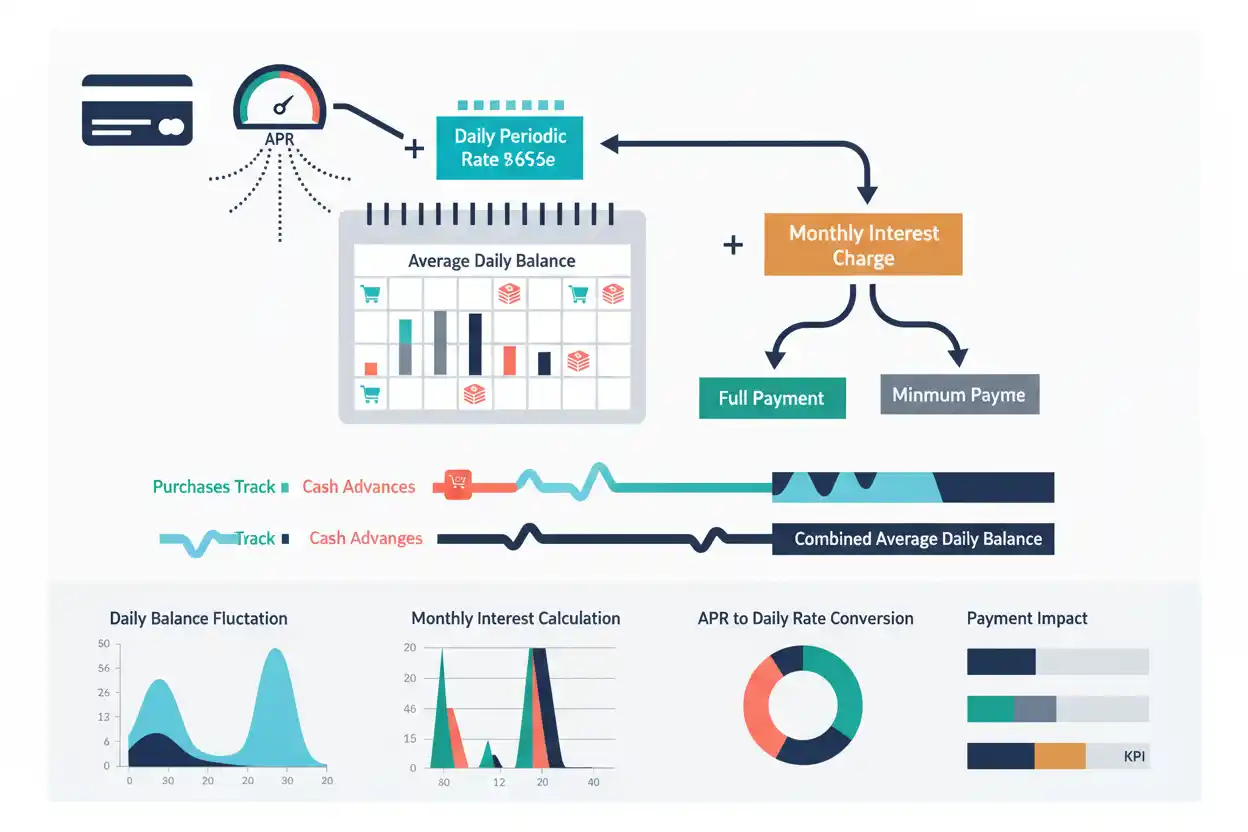

Credit card APR is the annual percentage rate associated with borrowing on a credit card. It expresses the card’s interest rate on an annual basis, but the actual interest charged on a statement depends on the applicable APR, balance, number of days, transactions, payments, and the issuer’s interest-calculation method.
A card showing a 24% APR does not normally add 24% of your balance to every monthly statement. Instead, the issuer converts the annual rate into a periodic rate—often a daily periodic rate—and applies it according to the account agreement.
A simplified daily-rate relationship is:
Daily Periodic Rate = Credit Card APR ÷ 365
If a card has a 24% APR:
Daily Periodic Rate = 24% ÷ 365 ≈ 0.06575% per day
Understanding that conversion is the key to understanding how credit card interest builds.
What Is Credit Card APR?
Credit card APR is the annualized interest rate associated with a particular type of credit-card balance.
Unlike a standard installment loan, a credit card is revolving credit. The balance can change throughout the billing cycle as you make purchases, payments, transfers, refunds, or cash advances.
A single card may also have several APRs.
For example, an account could have:
Purchase APR: 21.99%
Balance transfer APR: 21.99%
Cash advance APR: 29.99%
Promotional purchase APR: 0% for a limited period
The applicable rate depends on the transaction and card terms.
The broader APR concept explains annual percentage rate across borrowing products, while this page specifically owns how APR functions on revolving credit cards.
Credit Card APR Formula
A basic annual-to-daily conversion is:
Daily Periodic Rate = APR ÷ Days in Year
Using a 24% APR and a 365-day year:
Daily Periodic Rate = 0.24 ÷ 365
Daily Periodic Rate ≈ 0.0006575
As a percentage:
Daily Periodic Rate ≈ 0.06575%
If a simplified balance stayed at $5,000 for 30 days and the issuer calculated simple daily interest without other transactions:
Approximate Interest = Balance × Daily Periodic Rate × Days
Approximate Interest = $5,000 × 0.0006575 × 30
Approximate Interest ≈ $98.63
Real credit-card statements can differ because balances commonly change throughout the billing cycle.
Average Daily Balance Method
Many credit cards determine interest using an average daily balance or closely related daily-balance method.
A simplified average daily balance calculation is:
Average Daily Balance = Sum of Daily Balances ÷ Number of Days in Billing Cycle
Suppose a card has these balances during a 30-day cycle:
$4,000 for 10 days
$3,000 for 10 days
$2,000 for 10 days
First calculate the total daily-balance amount:
Total Daily Balances = ($4,000 × 10) + ($3,000 × 10) + ($2,000 × 10)
Total Daily Balances = $90,000
Then:
Average Daily Balance = $90,000 ÷ 30
Average Daily Balance = $3,000
With a 24% APR:
Daily Rate = 24% ÷ 365 ≈ 0.0006575
Approximate interest for the 30-day cycle is:
Interest ≈ $3,000 × 0.0006575 × 30
Interest ≈ $59.18
This demonstrates why the timing of purchases and payments can affect interest.
APR Does Not Tell You Exactly How Much Interest You Will Pay
APR is a rate, not a dollar amount.
Two cardholders with the same credit card APR can pay dramatically different amounts of interest.
One person might pay the statement balance in full and qualify for a credit card grace period, resulting in no purchase interest for that cycle.
Another might carry a $10,000 balance throughout the year and incur substantial financing costs.
Your actual interest therefore depends on both the rate and how you use the account.
Purchase APR
The purchase APR applies to qualifying purchase balances according to the card agreement.
Suppose:
Purchase balance = $2,500
Purchase APR = 20%
A simplified annual interest illustration would be:
Annualized Interest Illustration = $2,500 × 20%
Annualized Interest Illustration = $500
That does not mean the card will necessarily charge exactly $500 over a year.
Payments, purchases, daily balances, grace-period eligibility, statement timing, and compounding can all change the result.
Cash Advance APR
Cash advances often carry different pricing from purchases.
A cash advance fee may apply immediately, and the cash advance can have its own APR.
Suppose:
Cash advance = $1,000
Cash advance APR = 30%
Cash advance fee = 5%
The immediate fee is:
Cash Advance Fee = $1,000 × 5% = $50
If the fee is added to the balance:
Starting Balance = $1,000 + $50 = $1,050
Interest can then begin accumulating according to the account terms.
That makes a cash advance potentially much more expensive than an ordinary purchase.
Balance Transfer APR
A balance transfer can have its own APR.
Some cards offer promotional rates such as 0% for a specified number of billing cycles or months.
However, a balance transfer fee can still apply.
For example:
Transferred amount = $8,000
Promotional APR = 0%
Transfer fee = 3%
Transfer Fee = $8,000 × 3%
Transfer Fee = $240
Even with a 0% promotional APR, the transaction is not necessarily free.
Variable Credit Card APR
Many credit-card rates are variable.
A variable APR may be expressed as a benchmark rate plus a margin.
Conceptually:
Variable APR = Reference Rate + Issuer Margin
Suppose:
Reference rate = 8.5%
Issuer margin = 15%
Then:
Variable APR = 8.5% + 15%
Variable APR = 23.5%
If the benchmark changes and the account terms allow the rate to adjust, the APR can change.
The broader fixed vs variable interest rate comparison explains the distinction between fixed and adjustable borrowing rates.
Credit Card APR and Compound Interest
A compound interest loan allows interest to contribute to future interest when it becomes part of the interest-bearing balance.
Credit cards can produce a compounding effect when interest is calculated daily and accumulated amounts become part of future balance calculations.
Suppose a balance grows by interest today and tomorrow’s calculation uses the larger balance.
Then interest is effectively contributing to later interest.
That is one reason revolving high-APR debt can become expensive when it remains unpaid for long periods.
Credit Card APR vs APR
General APR and credit card APR share the same annualized-rate concept, but revolving credit behaves differently from a conventional installment loan.
A normal installment loan begins with a defined principal and repayment schedule.
Credit-card balances constantly change.
That is why credit card interest calculations depend heavily on transaction and payment timing.
Credit Card APR vs APY
The APR vs APY distinction becomes useful when compounding is discussed.
APR is primarily a borrowing-rate measure.
APY measures annual yield with compounding in a savings context.
You should therefore not interpret a credit card’s APR as though it were a deposit APY.
Credit Card APR and Minimum Payments
The credit card minimum payment is the smallest required payment shown on the statement.
It does not represent an efficient payoff amount.
If a cardholder carries a high-APR balance while paying only the minimum, repayment can take years because interest consumes part of each payment.
Suppose:
Balance = $5,000
Monthly interest ≈ $100
Payment = $150
Only approximately:
Principal Reduction ≈ $150 − $100 = $50
reduces the balance in that simplified month.
Credit Card APR and Payoff Planning
A deliberate credit card payoff plan works in the opposite direction.
Larger payments reduce principal more quickly.
A smaller balance then generates less future interest.
This can create a reinforcing payoff effect:
Higher Payment → Faster Principal Reduction → Less Future Interest → Faster Payoff
Credit Card APR and Credit Limits
A credit limit controls the maximum revolving balance the issuer generally permits under the account terms.
It does not determine APR directly.
However, borrowing close to the limit can create a large dollar interest expense because more money is outstanding.
For example:
$1,000 balance at 24% APR creates far less interest than a $10,000 balance at the same rate.
Credit Card APR and Credit Utilization
The credit utilization ratio compares revolving balances with revolving credit limits.
APR determines financing cost.
Utilization measures balance relative to available revolving credit.
They are separate concepts.
Paying a balance down can reduce both future interest and utilization, but those are two different financial effects.
Credit Card APR and Credit Score Factors
APR is not itself a credit score.
The credit score factors page explains the information commonly considered in scoring models, including payment history, amounts owed, credit usage, account history, and new credit activity.
A higher credit score can sometimes help a borrower qualify for more competitive pricing, but a particular issuer’s rate decision depends on its underwriting and product terms.
Credit Card APR vs Car Payments
Car payments normally follow a predetermined amortization schedule.
Credit-card payments do not.
A revolving balance can rise again immediately after being reduced if new purchases are made.
That makes credit-card debt less predictable when spending continues.
What Is a Good Credit Card APR?
There is no universal APR that is good for every borrower or market environment.
A useful comparison looks at cards serving similar borrowers and purposes.
More importantly, someone who consistently pays qualifying purchase balances in full during the grace period may pay no purchase interest regardless of the card’s stated purchase APR.
For a borrower expecting to carry debt, however, even a few percentage points can materially affect total cost.
How Much Does a 30% APR Cost?
Suppose a balance stays at $10,000 for a simplified 30-day period.
Daily Rate = 30% ÷ 365 ≈ 0.08219%
Estimated interest:
Interest ≈ $10,000 × 0.30 ÷ 365 × 30
Interest ≈ $246.58
That is roughly $247 of interest for one 30-day period under the simplified assumptions.
Repeated over many months, high-rate revolving debt can consume a substantial amount of cash.
Common Credit Card APR Mistakes
A common mistake is dividing APR by 12 and assuming that calculation always reproduces the statement interest charge.
Another is assuming every balance on the card uses the same APR.
Cardholders also sometimes confuse APR with transaction fees.
A 0% promotional APR can still coexist with a balance transfer fee.
Another common error is assuming the grace period automatically protects purchases while another balance is being carried.
Finally, focusing only on APR can obscure the importance of payment size. A high payment can eliminate a balance quickly, while minimum payments can keep even moderate-rate debt outstanding for years.
Frequently Asked Questions
What does credit card APR mean?
Credit card APR is the annual percentage rate associated with borrowing on a credit card.
How do I convert credit card APR to a daily rate?
A common calculation is:
Daily Periodic Rate = APR ÷ 365
Use the day-count method stated in your card agreement.
What is the daily rate on a 24% APR?
24% ÷ 365 ≈ 0.06575% per day
Does a 24% APR mean I pay 2% every month?
Not necessarily. Dividing by 12 provides a rough monthly-rate concept, but many cards calculate interest using daily balances.
Do I pay credit card interest if I pay in full?
Qualifying purchases may avoid interest when the account provides a grace period and its requirements are satisfied.
Can one credit card have multiple APRs?
Yes. Purchases, cash advances, balance transfers, promotions, and penalty situations can have different rates.
Is cash advance APR usually different?
It can be. Cash advances can also carry transaction fees and different interest timing.
Is APR the same as interest charged?
No. APR is a rate. Interest charged is a dollar amount calculated from the rate and account balance over time.
Does APR affect minimum payment?
Interest created by the APR can affect the balance and therefore the minimum-payment calculation, but issuers use their own disclosed minimum-payment formulas.
Can my credit card APR change?
Variable APRs can change when the underlying benchmark changes, and other rate changes may occur according to account terms and applicable rules.
Does credit utilization affect APR?
Not mechanically. Utilization is a credit-balance ratio, while APR is the card’s borrowing rate. Credit profile and underwriting can influence offers more broadly.
How can I reduce credit card interest?
Reducing the balance earlier, avoiding unnecessary new charges, maintaining grace-period eligibility when possible, and using lower-cost financing appropriately can reduce interest expense.
Final Takeaway
Credit card APR expresses the annual interest rate associated with revolving credit, but actual interest usually depends on daily or periodic balances.
A useful starting formula is:
Daily Periodic Rate = APR ÷ 365
At a 24% APR, the daily rate is approximately 0.06575%.
If a $5,000 balance remained unchanged for 30 days under a simplified daily-interest calculation, the resulting interest would be about $98.63.
The most important lesson is that APR alone does not determine your credit-card cost. The balance you carry, transaction type, grace-period eligibility, payment timing, fees, and repayment speed determine how much you actually pay.