
Student loan interest is the cost charged for borrowing money to pay for education.
For many student loans, including federal Direct Loans, interest is calculated using a daily interest method based on the outstanding principal balance.
A general daily formula is:
Student Loan Daily Interest = Outstanding Principal × Annual Interest Rate ÷ Days in Year
Interest over a period can then be estimated as:
Interest Accrued = Daily Interest × Number of Days
For example, using a $20,000 principal balance, 6.5% annual interest rate, and a 365.25-day calculation basis:
Daily Interest = $20,000 × 6.5% ÷ 365.25
Daily Interest ≈ $3.56
Across 30 days:
Interest ≈ $3.56 × 30
Interest ≈ $106.78
The actual amount depends on principal, rate, elapsed days, payments, loan type, and the servicer’s applicable calculation conventions.
What Is Student Loan Interest?
Student loan interest is the financing cost added to educational debt.
The principal is the amount borrowed.
Interest is the additional amount generated from that principal according to the loan’s rate.
Within the broader Loans & Credit framework, student loan interest is closely connected with repayment timing, principal balances, payment plans, and debt ratios across the Finance category.
Student Loan Interest Formula
Federal student loan guidance describes a daily interest formula based on:
outstanding principal, interest-rate factor, and days since the relevant payment date.
Conceptually:
Interest Amount = Outstanding Principal × Interest Rate Factor × Days
Where:
Interest Rate Factor = Annual Interest Rate ÷ Number of Days in the Year
A servicer can use an appropriate year-based divisor in its implementation.
For estimation, some federal servicer examples use 365.25 days.
Student Loan Interest Example
Assume:
Outstanding principal = $20,000
Annual interest rate = 6.5%
Calculation basis = 365.25 days
Elapsed time = 30 days
Step 1: Calculate Daily Interest
Daily Interest = $20,000 × 0.065 ÷ 365.25
Daily Interest ≈ $3.5592
Step 2: Calculate 30 Days of Interest
Interest = $3.5592 × 30
Interest ≈ $106.78
Approximately $106.78 of interest accrues over 30 days if principal and rate remain unchanged during the period.
Payment Allocation Example
Suppose the borrower then pays $300.
If $106.78 of unpaid accrued interest must be satisfied first:
Principal Reduction = $300 − $106.78
Principal Reduction ≈ $193.22
New principal:
New Principal = $20,000 − $193.22
New Principal ≈ $19,806.78
Future daily interest becomes approximately:
Daily Interest = $19,806.78 × 6.5% ÷ 365.25
Daily Interest ≈ $3.52
Principal reduction has therefore lowered future daily interest.
Student Loan Interest Is Often Simple Interest
The simple interest loan concept is important here.
Under daily simple interest:
interest is calculated from outstanding principal rather than routinely charging interest on previously accrued interest.
However, capitalization can change that.
If unpaid interest is added to principal at a permitted capitalization event, future interest can then be calculated from the larger principal balance.
Student Loan Interest vs Compound Interest
A compound interest loan automatically emphasizes interest-on-interest.
Student-loan interest generally accrues separately from principal until a capitalization event changes the balance.
Therefore:
Accrued Interest ≠ Automatically Principal
But after qualifying capitalization:
New Principal = Previous Principal + Capitalized Interest
Future interest is then generated from that new principal.
Interest Capitalization Example
Suppose:
Principal = $20,000
Unpaid interest = $1,500
If the $1,500 is capitalized:
New Principal = $20,000 + $1,500
New Principal = $21,500
At 6.5%, approximate daily interest using 365.25 days becomes:
Before capitalization:
$20,000 × 6.5% ÷ 365.25 ≈ $3.56 per Day
After capitalization:
$21,500 × 6.5% ÷ 365.25 ≈ $3.83 per Day
Capitalization raises the base used for future interest.
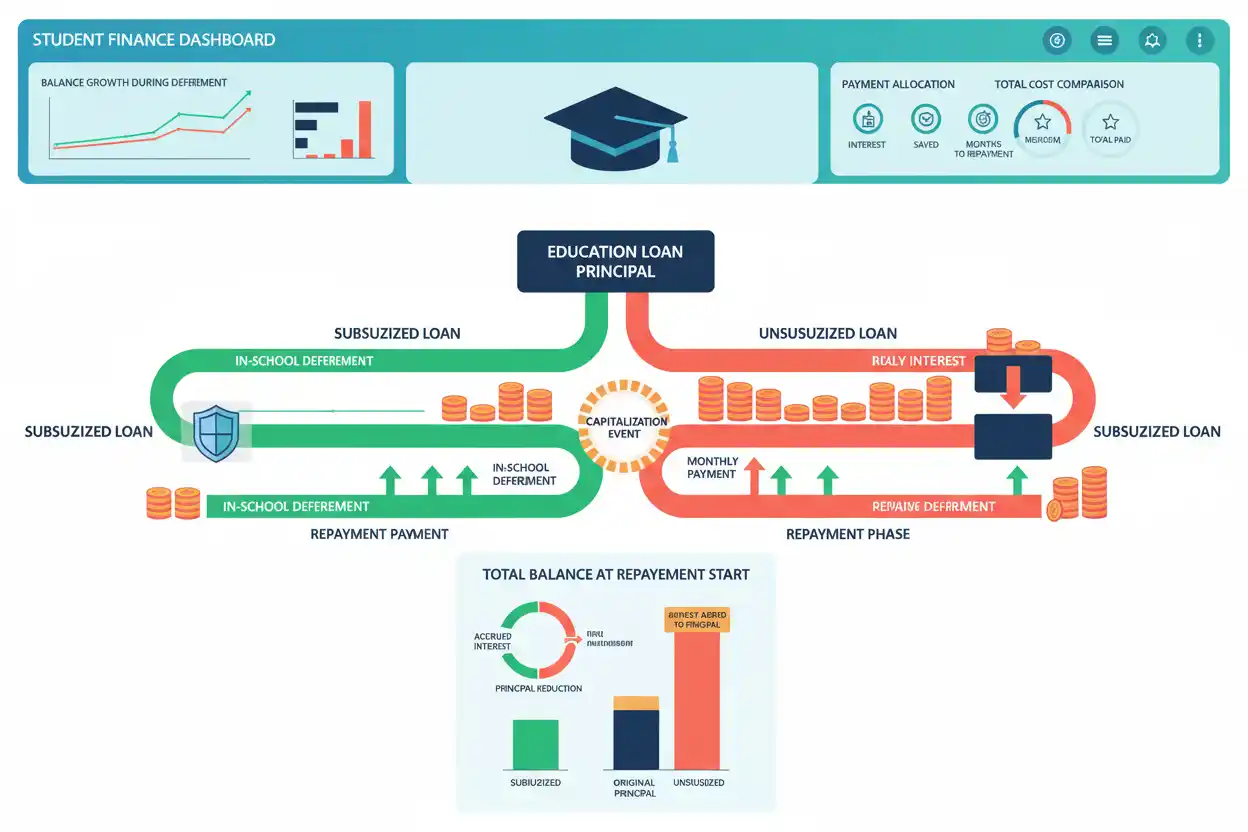
Subsidized vs Unsubsidized Federal Loans
Federal Direct Subsidized and Direct Unsubsidized Loans differ in who is responsible for interest during certain periods.
With Direct Subsidized Loans, the government can pay interest during qualifying periods defined by the program.
With Direct Unsubsidized Loans, the borrower is generally responsible for the interest that accrues.
That distinction can materially change how much debt exists when repayment begins.
The exact treatment depends on loan type and status.
Unsubsidized Loan Example
Suppose:
Unsubsidized principal = $10,000
Rate = 6%
No payments toward interest for one year
A rough simple-interest illustration is:
Annual Interest ≈ $10,000 × 6%
Interest ≈ $600
If unpaid interest is later capitalized when permitted:
New Principal ≈ $10,600
Future daily interest is then based on approximately $10,600 rather than $10,000.
Student Loan Payments
The specialist student loan payments page owns repayment-plan and payment-timeline intent.
Interest calculation is a separate question.
A low required payment can still allow substantial interest to accrue when the payment does not reduce principal quickly.
Conversely, a larger payment can reduce principal and therefore reduce future daily interest.
Student Loan Repayment Schedules
A repayment schedule can estimate principal and interest across time.
However, student loans using daily accrual can differ slightly from a simple fixed monthly amortization table because:
months contain different numbers of days and actual payment dates can vary.
A schedule should therefore be treated as an estimate unless it exactly matches the servicer’s calculation conventions.
Student Loan Principal Balance
The principal balance is the amount on which daily interest is generally calculated.
Suppose:
Principal falls from $20,000 to $15,000.
At 6.5%, approximate daily interest falls from:
$3.56
to:
$15,000 × 6.5% ÷ 365.25 ≈ $2.67
That is why principal reduction matters so much.
Accrued Student Loan Interest
Accrued interest can accumulate between payments.
Suppose daily interest equals $3.56.
After 15 days:
Accrued Interest ≈ $3.56 × 15
Accrued Interest ≈ $53.39
After 31 days:
Accrued Interest ≈ $110.34
Different numbers of days between payments can therefore change the interest portion of each payment.
Fixed Federal Student Loan Rates
Many federal Direct Loans issued under current structures have fixed interest rates for the life of each loan once the rate is established.
However, newly issued federal loans can receive different statutory rates depending on loan type and disbursement period.
Therefore, two borrowers can both hold federal Direct Loans while paying different fixed rates.
Fixed vs Variable Student Loans
The fixed vs variable interest rate distinction is especially relevant when comparing federal and private education financing.
Private student loans can use different rate structures depending on the lender and agreement.
A variable rate can change future interest cost.
A fixed rate provides greater predictability.
Student Loan Interest and APR
APR provides a broader annualized credit-cost concept.
Student-loan interest rate and APR should not automatically be treated as identical when applicable finance charges exist.
However, daily interest calculations normally use the contractual interest rate rather than simply substituting APR into the daily-interest formula.
Student Loan Interest and Loan Term
The loan term determines how long principal can remain outstanding.
A lower monthly payment stretched over a longer period can create significantly more total interest.
The borrower should therefore compare:
monthly affordability with lifetime cost.
Interest While No Payment Is Required
A period without a required payment does not necessarily mean no interest is accruing.
Interest treatment depends on:
loan type, deferment or forbearance status, subsidy eligibility, and program rules.
Borrowers should distinguish:
No Payment Currently Due
from:
No Interest Currently Accruing
Those are different conditions.
Making Interest Payments Early
When the borrower is responsible for accruing interest, voluntary payments can prevent unpaid interest from building.
Suppose:
Monthly accrued interest ≈ $100
Paying that $100 during a period when no regular payment is required can keep the unpaid-interest balance from increasing.
Whether this is the best use of cash depends on the borrower’s overall finances, but the arithmetic is straightforward.
Student Loan Interest and Prepayment
A prepayment penalty is not a normal feature borrowers should assume applies universally to education loans.
Loan-specific and legal rules matter.
When additional payments are permitted without penalty, reducing principal earlier can lower future interest.
Borrowers should still verify how their servicer applies additional amounts among multiple loans.
Multiple Student Loans
A borrower can have several loans with different:
principal balances, interest rates, and disbursement dates.
Suppose:
Loan A = $10,000 at 5%
Loan B = $15,000 at 7%
Daily interest should be calculated separately.
Loan A:
Daily Interest ≈ $10,000 × 5% ÷ 365.25
≈ $1.37
Loan B:
Daily Interest ≈ $15,000 × 7% ÷ 365.25
≈ $2.87
Combined:
Total Daily Interest ≈ $4.24
Using one average rate without proper weighting can produce an inaccurate result.
Weighted Average Student Loan Rate
If several loans are being analyzed together, a weighted average can be calculated as:
Weighted Rate = Σ(Loan Balance × Loan Rate) ÷ Total Loan Balance
Using:
$10,000 at 5%
$15,000 at 7%
Weighted rate:
Weighted Rate = [($10,000 × 5%) + ($15,000 × 7%)] ÷ $25,000
Weighted Rate = 6.2%
This is useful for portfolio-level analysis, though actual interest still accrues separately on individual loans.
Federal Consolidation
Federal Direct Consolidation Loans use a weighted-average approach under the applicable program rules.
However, consolidation can change more than payment convenience.
It can affect repayment terms, program eligibility, and other borrower benefits.
The calculation should therefore not be treated as a purely interest-rate decision.
Student Loan Interest and Debt-to-Income Ratio
The debt-to-income ratio focuses on required monthly debt payments rather than interest accrual.
A student loan can generate substantial daily interest while temporarily having a low required payment.
Conversely, a higher monthly payment can improve long-term interest economics while increasing current DTI.
Total Debt Service Ratio
The total debt service ratio is another payment-burden measure.
Student-loan payments can contribute to the monthly debt obligations included in such calculations depending on the underwriting framework.
Interest rate itself is not the same as the debt-service ratio.
Secured vs Student Loans
A secured loan is supported by pledged collateral.
Student loans generally do not operate like conventional vehicle or mortgage financing in which a purchased asset serves as specific collateral.
That means the risk structure differs even though both create contractual repayment obligations.
Credit Score Factors and Student Loans
Credit score factors can include repayment history on reported student loans.
Interest calculation itself does not determine a credit score.
However, payment behavior and outstanding debt information can affect the broader credit profile.
Private Student Loan Interest
Private student loans are governed by the specific lender agreement and applicable law.
They can differ from federal loans in:
rates, variable-rate provisions, cosigner requirements, hardship options, repayment terms, and capitalization rules.
Do not automatically apply federal loan rules to a private loan.
Common Student Loan Interest Mistakes
One mistake is dividing the annual interest rate by 12 when the loan actually accrues interest daily and expecting an exact monthly figure.
Another is assuming no required payment means no interest accrues.
Borrowers also confuse accrued interest with principal before capitalization.
A fourth mistake is combining several loans using a simple unweighted average of their rates.
Finally, federal and private student-loan rules should not be treated as interchangeable.
Frequently Asked Questions
How is student loan interest calculated?
Many student loans use daily simple interest based on outstanding principal, annual rate, and elapsed days.
What is the student loan daily-interest formula?
Daily Interest = Outstanding Principal × Annual Interest Rate ÷ Days in Year
How much interest does $20,000 at 6.5% generate daily?
Using 365.25 days:
Approximately $3.56 per Day
How much is that over 30 days?
Approximately $106.78 if the balance and rate stay unchanged.
Does student loan interest compound every day?
Not in the same way as ordinary compound-interest debt. Interest generally accrues separately until capitalization changes the principal.
What is capitalization?
It is the addition of unpaid interest to principal when a qualifying event and applicable rules permit it.
What is the difference between subsidized and unsubsidized federal loans?
The government covers interest during certain qualifying periods on Direct Subsidized Loans, while borrowers generally bear the interest on Direct Unsubsidized Loans.
Are federal student loan rates fixed?
Many Direct Loans have rates fixed for the life of each loan once issued, though rates for newly issued loans can differ by loan type and period.
Does interest accrue while I am in school?
It depends on the loan type. Unsubsidized loans generally accrue borrower-responsible interest, while subsidized loans can receive qualifying interest subsidies.
Can paying extra reduce future student loan interest?
Yes, when additional payment reduces principal after applicable accrued interest is satisfied.
Why is my monthly interest different each month?
Daily accrual, different month lengths, principal changes, and payment timing can change the dollar amount.
Are private student loan interest rules the same as federal rules?
No. Private loan contracts can differ materially.
Final Takeaway
Student loan interest often depends on three variables:
Outstanding Principal × Interest Rate × Time
For daily calculations:
Daily Interest = Principal × Annual Rate ÷ Days in Year
A $20,000 student loan at 6.5% generates approximately:
$3.56 per Day
using a 365.25-day basis, or roughly:
$106.78 over 30 Days
If a $300 payment first satisfies that interest, approximately $193.22 reduces principal, lowering the balance to about $19,806.78.
The most important concepts are therefore principal balance, daily accrual, payment timing, subsidized vs unsubsidized treatment, and capitalization. Understanding those mechanics makes it far easier to predict why student-loan balances change and how extra payments affect future interest.