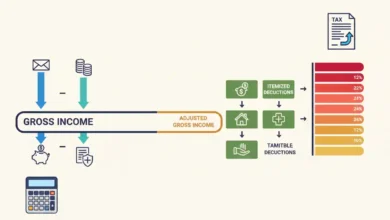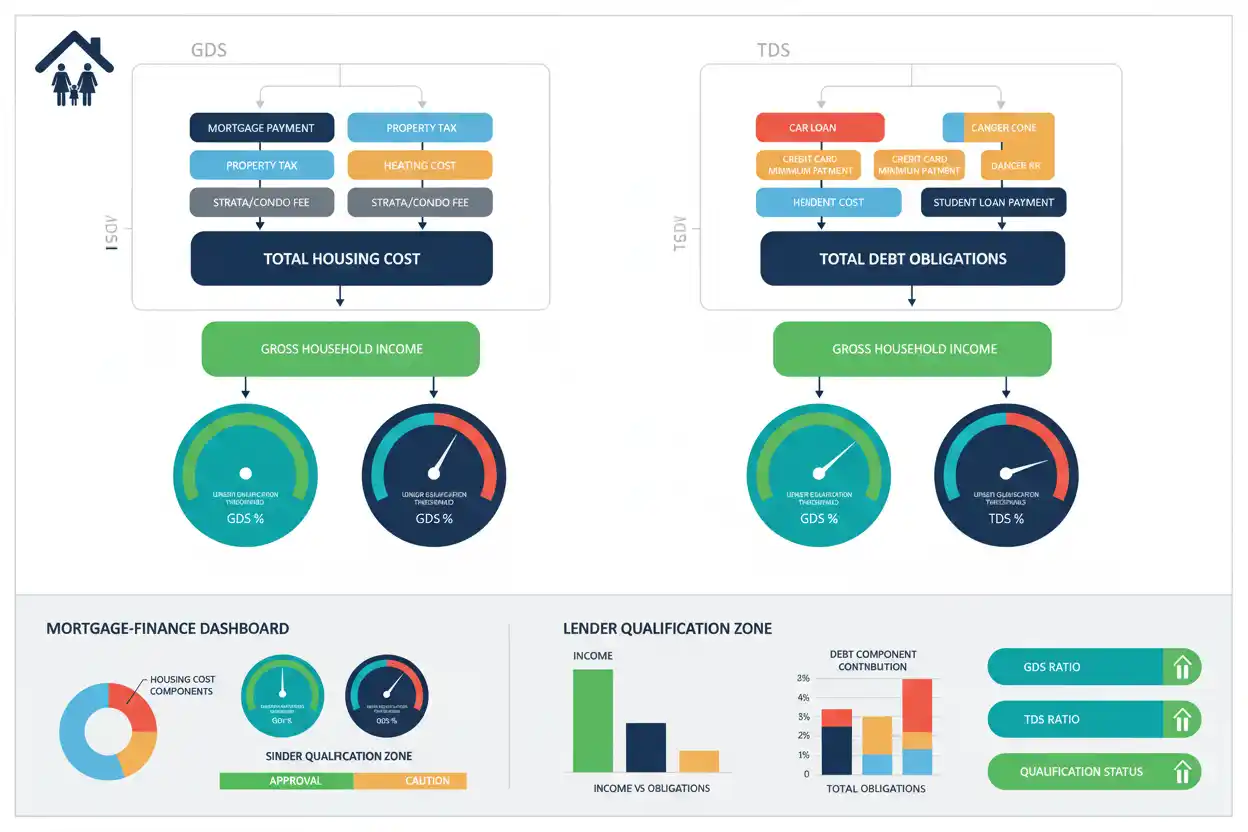

The total debt service ratio, commonly abbreviated TDS, measures how much of gross income is required to cover housing costs plus other qualifying debt obligations.
A general formula is:
Total Debt Service Ratio = (Housing Costs + Other Qualifying Debt Payments) ÷ Gross Income × 100
The measurement period must be consistent.
For a monthly calculation:
Monthly TDS = Monthly Qualifying Debt Costs ÷ Gross Monthly Income × 100
Suppose:
Housing costs = $2,850 per month
Other debt obligations = $900 per month
Gross household income = $8,500 per month
Then:
TDS = ($2,850 + $900) ÷ $8,500 × 100
TDS ≈ 44.1%
That means approximately 44.1% of gross monthly income is represented by the obligations included in the calculation.
What Is Total Debt Service Ratio?
Total debt service ratio measures payment burden relative to income.
It is especially associated with mortgage affordability analysis in Canada, where TDS is commonly considered alongside a gross debt service measure.
Conceptually:
TDS = Housing Debt Burden + Other Qualifying Debt Burden
divided by:
Gross Income
The exact included expenses and acceptable limits can depend on the lender, mortgage program, jurisdiction, and underwriting rules.
This article owns the general total debt service ratio calculation rather than the narrower U.S.-style debt-to-income ratio or specialist mortgage underwriting pages.
Total Debt Service Ratio Formula
A general monthly formula is:
TDS = (Housing Costs + Other Debt Payments) ÷ Gross Monthly Income × 100
Depending on the underwriting framework, housing costs can include items such as:
mortgage principal and interest, property taxes, heating costs, and specified condominium or housing charges.
Other debt obligations can include qualifying payments on:
vehicle loans, lines of credit, credit cards, personal loans, and student debt.
The applicable underwriting methodology determines the exact treatment.
Total Debt Service Ratio Example
Suppose a household has:
Mortgage principal and interest = $2,000
Property taxes = $400
Heating cost = $150
Recognized condominium-fee portion = $300
Other debt payments = $900
Gross monthly household income = $8,500
Housing costs:
Housing Costs = $2,000 + $400 + $150 + $300
Housing Costs = $2,850
Total qualifying obligations:
Total Debt Service = $2,850 + $900
Total Debt Service = $3,750
TDS:
TDS = $3,750 ÷ $8,500 × 100
TDS ≈ 44.1%
Gross Debt Service vs Total Debt Service
Gross debt service focuses primarily on qualifying housing costs.
Total debt service adds other debts.
Using the previous example:
GDS = $2,850 ÷ $8,500 × 100
GDS ≈ 33.5%
TDS:
TDS = $3,750 ÷ $8,500 × 100
TDS ≈ 44.1%
The difference comes from the $900 of other monthly debt obligations.
TDS vs Debt-to-Income Ratio
The debt-to-income ratio uses a similar mathematical structure:
DTI = Monthly Debt Payments ÷ Gross Monthly Income × 100
However, TDS can have a specifically defined housing-cost framework under Canadian mortgage underwriting.
The labels should therefore not be swapped casually.
Two ratios can use similar arithmetic while including different components.
TDS vs Debt Service Coverage Ratio
The debt service coverage ratio is fundamentally different.
TDS:
Debt Costs ÷ Income
DSCR:
Available Cash Flow ÷ Debt Service
With TDS, lower is generally associated with less payment burden.
With DSCR, higher generally represents greater debt-service coverage.
Total Debt Service and Student Loan Payments
Student loan payments can contribute to total debt obligations when the applicable methodology includes them.
Suppose:
Current qualifying obligations = $3,000
New student-loan payment = $400
Gross income = $8,000
Before:
TDS = $3,000 ÷ $8,000 × 100
TDS = 37.5%
After:
TDS = $3,400 ÷ $8,000 × 100
TDS = 42.5%
The additional payment raises TDS by five percentage points.
Student Loan Interest Is Not the Same as the Payment
Student loan interest determines financing cost.
TDS normally focuses on the qualifying payment obligation.
A student loan can have a large principal and considerable interest while its recognized monthly payment is comparatively small.
Therefore:
Interest Expense ≠ Automatically TDS Payment
The underwriting methodology controls the payment figure used.
Secured Loan Payments and TDS
A secured loan can contribute to total debt obligations.
For example, a vehicle loan secured by the vehicle can create a recurring monthly payment.
The fact that collateral exists does not remove the debt-service burden.
TDS is concerned with cash obligations relative to income.
Unsecured Loan Payments and TDS
An unsecured loan can affect TDS in the same payment-burden sense.
Suppose:
Personal loan payment = $500
That $500 can matter regardless of whether the debt has collateral.
Secured versus unsecured describes lender security.
TDS describes affordability.
Simple Interest Loan and TDS
A simple interest loan can have a fixed or varying payment structure.
The interest method does not itself determine the TDS ratio.
What matters for TDS is the qualifying periodic obligation used under the underwriting rules.
Total Debt Service and Loan Payments
The loan payments formula can help estimate a proposed new monthly obligation.
Suppose a new loan would require $600 per month.
Current qualifying monthly obligations = $2,800
Gross monthly income = $8,000
Current ratio:
$2,800 ÷ $8,000 × 100 = 35%
After new loan:
($2,800 + $600) ÷ $8,000 × 100
TDS = 42.5%
A prospective payment can therefore be evaluated before the loan is taken.
How Higher Income Changes TDS
Suppose:
Qualifying obligations = $3,500
Gross income = $8,000
TDS = 43.75%
If gross qualifying income rises to $10,000:
TDS = $3,500 ÷ $10,000 × 100
TDS = 35%
The debt payments did not change.
The denominator increased.
How Paying Off Debt Changes TDS
Suppose:
Gross income = $8,000
Current obligations = $3,600
TDS = 45%
A $600 monthly loan is completely repaid.
New obligations:
$3,600 − $600 = $3,000
New TDS:
$3,000 ÷ $8,000 × 100
TDS = 37.5%
Eliminating one obligation improves the ratio by 7.5 percentage points.
TDS and Personal Loan Payments
Personal loan payments can therefore influence mortgage affordability even when the personal loan itself has nothing to do with housing.
A borrower preparing for a mortgage application can sometimes improve payment-based ratios by eliminating installment debts.
Whether accelerated payoff is financially optimal depends on interest rates, available cash, and the underwriting timeline.
TDS and Credit Card Minimum Payments
The credit card minimum payment can also matter when revolving debt is included.
A lower balance can eventually lower the required payment, depending on issuer and lender methodology.
However, using borrowed money simply to shift the payment elsewhere does not necessarily improve the household’s underlying financial position.
TDS and Credit Utilization
The credit utilization ratio is separate.
Utilization:
Credit Card Balance ÷ Credit Limit
TDS:
Qualifying Debt Payments ÷ Gross Income
Paying down a credit card can improve both, but through different mechanisms.
TDS and Credit Score Factors
The credit score factors framework is also separate.
A borrower could have:
an excellent credit score but high TDS.
Another borrower could have:
a lower score but low TDS.
Underwriting can consider both repayment history and current payment capacity.
TDS and Loan-to-Income Ratio
The loan-to-income ratio compares principal with annual income.
TDS compares periodic obligations with periodic income.
Suppose:
Loan = $100,000
Annual income = $100,000
LTI:
100%
If the loan payment is $1,000 and gross monthly income is $8,333:
Payment-to-Income Contribution ≈ 12%
The ratios answer different questions.
TDS and Mortgage Affordability
The planned mortgage affordability page owns the mortgage-specific affordability calculation.
TDS is only one input.
A realistic housing budget should also account for:
closing costs, maintenance, insurance, utilities, taxes, cash reserves, and income stability.
Passing a lender ratio does not prove that the household will find the payment comfortable.
TDS and Home Affordability
Similarly, home affordability should consider the broader household budget.
TDS uses gross income.
Actual living expenses are paid from after-tax cash flow.
Two households with identical TDS can therefore experience very different financial pressure.
Changing Interest Rates
If a variable-rate debt payment increases, TDS can increase even if no new debt is taken.
Suppose:
Original payment = $1,500
New payment = $1,800
Gross monthly income = $8,000
TDS rises by:
$300 ÷ $8,000 × 100
3.75 Percentage Points
The fixed vs variable interest rate structure can therefore affect future affordability.
What Is a Good TDS?
There is no universal ratio that should be applied to every borrower in every jurisdiction.
Mortgage insurers, lenders, and loan programs can specify their own limits and exceptions.
A borrower should therefore distinguish between:
a general financial guideline
and:
the actual underwriting requirement applying to a specific application.
TDS Does Not Equal a Household Budget
Gross monthly income does not equal spendable cash.
A household can have significant:
taxes, childcare, healthcare expenses, food costs, insurance, transportation, or support obligations.
Those expenses may not all appear in TDS.
Therefore, the maximum payment a lender permits can exceed what a household considers comfortable.
Common Total Debt Service Ratio Mistakes
One mistake is using net income instead of the required gross-income measure.
Another is mixing annual income with monthly obligations.
Borrowers also confuse TDS with GDS, DTI, or DSCR.
A fourth mistake is including or excluding debts without following the applicable underwriting methodology.
Finally, a ratio that qualifies for financing should not automatically become the household’s target spending level.
Frequently Asked Questions
What is total debt service ratio?
It measures qualifying housing and other debt obligations relative to gross income.
What is the TDS formula?
TDS = (Housing Costs + Other Qualifying Debt Payments) ÷ Gross Income × 100
What does 40% TDS mean?
It means the obligations included in the calculation equal 40% of the gross income used.
What is the difference between TDS and GDS?
GDS focuses on housing costs. TDS adds other qualifying debt obligations.
Is TDS the same as DTI?
The arithmetic can be similar, but terminology and included obligations can differ across underwriting systems.
Is TDS the same as DSCR?
No. TDS measures debt burden relative to income. DSCR measures available cash flow relative to debt service.
Do student loans affect TDS?
They can when qualifying student-loan payments are included under the applicable methodology.
Do credit-card payments affect TDS?
They can, depending on the lender’s prescribed treatment of revolving debt.
Does paying off a loan reduce TDS?
Yes when it removes a qualifying monthly payment and income remains unchanged.
Does higher income reduce TDS?
Yes when qualifying debt obligations remain unchanged.
Is there one universal maximum TDS?
No. Requirements vary by lender, program, and jurisdiction.
Does a low TDS guarantee affordability?
No. TDS excludes many normal household expenses and uses gross rather than spendable income.
Final Takeaway
The total debt service ratio measures the share of gross income committed to housing costs and other qualifying debt obligations.
The general formula is:
TDS = (Housing Costs + Other Debt Payments) ÷ Gross Income × 100
In the example:
Housing costs = $2,850
Other debts = $900
Gross monthly income = $8,500
Therefore:
TDS = $3,750 ÷ $8,500 × 100 ≈ 44.1%
The calculation is straightforward, but the definition of qualifying costs matters.
Use the exact underwriting rules applicable to the loan rather than assuming every lender includes the same expenses or uses the same acceptable ratio.