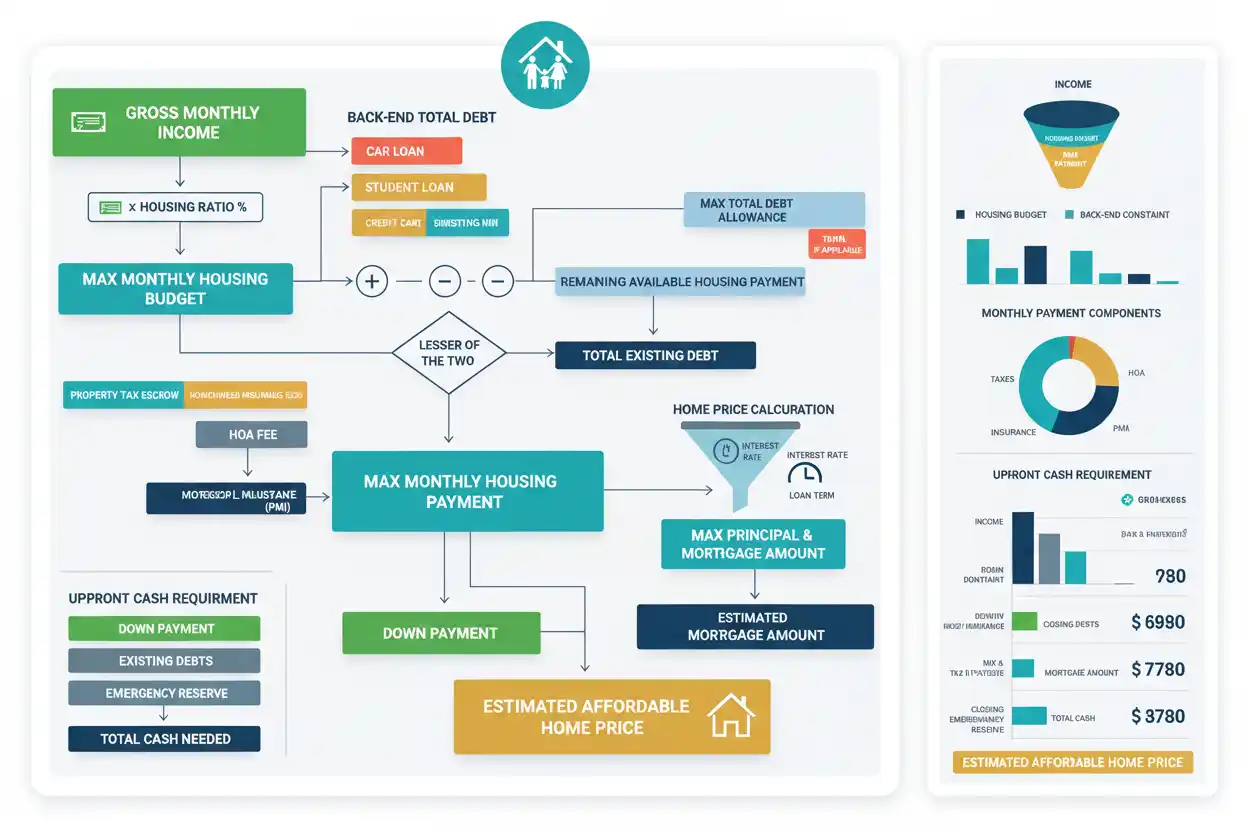

Home affordability is the price range a household can reasonably support without allowing housing costs to overwhelm the rest of its financial life.
That is deliberately different from the maximum mortgage a lender is willing to approve.
CFPB emphasizes this distinction: the amount a lender qualifies someone to borrow can be different from the amount that fits comfortably after considering family expenses, savings priorities, taxes, insurance, repairs, and other obligations.
A useful affordability framework is:
Affordable Total Housing Payment = Minimum of Personal Housing Budget and Acceptable Total-Debt Budget
Then:
Affordable Principal & Interest = Total Housing Budget − Taxes − Insurance − HOA − Mortgage Insurance − Other Required Housing Charges
Once the affordable principal-and-interest payment is known, the mortgage amount can be estimated using the mortgage payment formula.
The goal is not to produce the largest possible home price.
It is to find a purchase that leaves enough financial margin to continue saving and absorb inevitable surprises.
Home Affordability Starts With Monthly Cash Flow
Before calculating a home price, determine how much recurring housing cost fits the household.
Suppose:
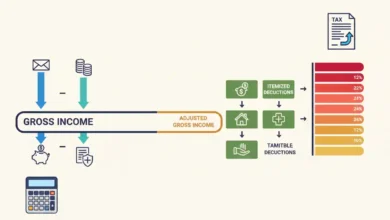
Gross monthly income = $10,000
Existing monthly debt payments = $800
For illustration, the household personally decides that:
housing should not exceed 30% of gross income, and total debt commitments should not exceed 40% of gross income.
These are example budgeting choices, not universal lending limits.
Personal housing budget:
$10,000 × 30% = $3,000
Personal total-debt ceiling:
$10,000 × 40% = $4,000
Subtract existing debts:
Maximum Housing Under Total-Debt Budget = $4,000 − $800
$3,200
Compare the two:
Personal housing budget = $3,000
Debt-based housing budget = $3,200
The lower amount is:
$3,000 per Month
That becomes the household’s illustrative total housing budget.
Housing Payment Is More Than Principal and Interest
Suppose estimated monthly costs are:
Property taxes = $600
Homeowners insurance = $180
HOA = $100
Non-principal-and-interest housing costs:
$600 + $180 + $100
$880
Affordable principal-and-interest payment:
$3,000 − $880
$2,120 per Month
CFPB specifically advises homebuyers to include taxes, homeowners insurance, possible mortgage insurance, association fees, repairs, maintenance, and savings priorities rather than equating lender qualification with affordability.
Convert Affordable Payment to Mortgage Principal
Assume:
Affordable P&I = $2,120
Mortgage rate = 6.5%
Term = 30 years
The inverse mortgage-payment relationship gives a maximum principal of approximately:
Mortgage Principal ≈ $335,406.94
This is a payment-based estimate.
Actual lender approval can differ because underwriting uses its own verified income, debt, credit, loan-program, property, and rate assumptions.
Estimate Home Price With 20% Down
If the borrower wants a 20% down payment, the mortgage represents 80% of the purchase price.
Home Price = Mortgage ÷ 80%
Home Price ≈ $335,406.94 ÷ 0.80
Home Price ≈ $419,258.67
Down payment:
Down Payment ≈ $419,258.67 × 20%
Down Payment ≈ $83,851.73
The example therefore points toward a home price around $419,000 before considering closing costs, reserves, and differences between estimated and actual taxes or insurance.
What If the Buyer Puts 10% Down?
The same affordable mortgage principal of approximately $335,407 would represent 90% of the purchase price.
Home Price ≈ $335,406.94 ÷ 0.90
Home Price ≈ $372,674.37
Down payment:
≈ $37,267.44
The smaller down payment preserves cash but reduces the home price supported by the same mortgage-payment budget.
It can also create mortgage insurance costs that were not included in the simplified example.
Why Income Alone Is Not Enough
Two households can each earn $120,000 annually and have very different home affordability.
Household A:
minimal debts, low childcare expense, large emergency savings.
Household B:
large student loans, vehicle payments, childcare costs, and irregular income.
A simple income multiple cannot capture those differences.
That is why home affordability must start from the household budget rather than a headline salary.
Home Affordability and Debt-to-Income Ratio
The mortgage debt-to-income ratio is useful for underwriting-oriented payment analysis.
However:
Qualification Ratio ≠ Personal Budget
A lender can approve a payment that leaves too little money for priorities that do not appear fully in the underwriting calculation.
CFPB explicitly advises borrowers to focus on what they can afford given their own priorities rather than only what they qualify to borrow.
Home Affordability and Fixed-Rate Mortgage
A fixed-rate mortgage gives the borrower greater certainty over principal and interest.
That makes long-term affordability easier to model.
The total housing budget can still change through:
taxes, insurance, HOA assessments, maintenance, or mortgage insurance.
Stable principal and interest therefore reduces one risk without making ownership costs completely fixed.
Home Affordability and Interest-Only Mortgage
An interest-only mortgage can create an artificially attractive initial payment.
Suppose the household can afford the introductory interest-only payment but not the later principal-and-interest payment.
The home is not truly affordable under the full loan structure.
Affordability should be tested using the future payment, not merely the lowest introductory payment.
Home Affordability and HELOC
A HELOC can reduce future affordability after the home is purchased.
A borrower who uses substantial HELOC credit creates another property-secured payment.
For example:
Original housing cost = $3,000
Later HELOC payment = $500
New total debt burden rises by $500 even though the home price has not changed.
Home equity borrowing should therefore be treated as new debt, not free access to existing wealth.
Home Affordability and Home Equity Loan
A home equity loan has the same broad effect.
The homeowner receives cash but adds another required payment secured by the property.
A home that was initially comfortable can become financially tight after multiple equity loans.
Home Affordability and FHA Loans
FHA loans can reduce the down payment needed to purchase a home.
That can improve cash accessibility, but it does not automatically improve monthly affordability.
FHA mortgage insurance must be included in the payment.
A buyer should therefore distinguish:
Can I get into the home with the cash I have?
from:
Can I comfortably carry the home every month?
Home Affordability and Loan-to-Value Ratio
The loan-to-value ratio measures mortgage leverage.
A lower LTV generally means more borrower equity at purchase.
However, a low LTV does not guarantee affordability.
Someone could make a huge down payment but still choose a home with excessive taxes, insurance, maintenance, or association costs.
Home Affordability and Mortgage APR
The mortgage APR helps compare financing cost.
A higher APR can reduce the mortgage principal supportable by a fixed payment budget.
For example, if the affordable P&I payment is $2,120, a higher mortgage rate means less principal can be financed with that payment.
Therefore:
Higher Rate → Lower Affordable Loan Amount
when the payment budget and term are unchanged.
Rate Sensitivity Example
At 6.5%, the $2,120 P&I budget supports approximately:
$335,407
over 30 years.
If mortgage rates rise materially, the affordable principal falls.
That is why home-price budgets should be recalculated when rates change rather than carrying forward an affordability estimate obtained months earlier.
Home Affordability and Discount Points
Discount points can reduce the mortgage rate but consume more cash at closing.
Suppose points cost $6,000 and lower the payment sufficiently to raise mortgage affordability.
The buyer must still ask whether spending $6,000 upfront leaves enough reserves after closing.
Lower payment and lower liquidity can occur at the same time.
Closing Costs Matter
The mortgage closing costs are separate from the down payment.
Suppose:
Home price ≈ $419,259
Down payment ≈ $83,852
Closing costs and prepaids = $12,000
Total cash requirement:
≈ $95,852
before deposits, credits, and other adjustments.
A buyer with only $84,000 saved could theoretically have the down payment but still lack sufficient cash to complete the transaction safely.
Emergency Savings Matter
CFPB advises buyers not to sacrifice savings simply to purchase a larger home and specifically highlights the need to plan for emergencies and repairs.
A home can create irregular expenses such as:
roof repairs, plumbing, appliance replacement, insurance deductibles, and property maintenance.
An affordability model that leaves the buyer with almost no liquidity is incomplete.
Maintenance Budget
Suppose the household sets aside:
$350 per Month
for long-term repairs and maintenance.
If the earlier $3,000 housing budget was intended to include maintenance, the financing portion should be reduced further.
That would lower the affordable mortgage principal.
This shows why home affordability is ultimately a budgeting exercise—not merely a mortgage formula.
Home Affordability and Property Taxes
Property taxes can vary dramatically between homes with similar purchase prices.
Suppose:
Home A taxes = $300/month
Home B taxes = $900/month
Difference:
$600 per Month
With a fixed total housing budget, Home B leaves $600 less for principal and interest.
That can reduce the affordable mortgage by tens of thousands of dollars.
Insurance Can Change the Answer
The same is true for homeowners insurance.
A property with elevated catastrophe exposure can have materially higher insurance costs.
CFPB advises homebuyers to include insurance and consider the possibility that home-related costs can rise over time.
The purchase price therefore should not be chosen before property-specific insurance estimates are available.
HOA Fees
A condominium or planned community can have recurring association dues.
Suppose:
HOA = $500/month instead of $100.
That additional $400 reduces the amount available for mortgage principal and interest if the household keeps the same total housing budget.
High HOA fees can therefore make a lower-priced property less affordable than a slightly higher-priced home without comparable dues.
Home Affordability and Conforming Loan Limits
A conforming loan limit can constrain mortgage structure for high-priced purchases.
However, conforming eligibility is not an affordability measure.
A household can technically borrow within the conforming limit and still choose a payment that is too high for its lifestyle.
Home Affordability vs Mortgage Affordability
The specialist mortgage affordability page owns the mortgage-focused calculation.
Home affordability is broader.
It includes:
purchase price, down payment, mortgage, ownership costs, household budget, closing cash, savings, and maintenance.
That distinction prevents the two pages from competing for the same search intent.
Home Price Is Not the Only Decision Variable
A stronger home-buying decision considers:
monthly housing cost, cash required at closing, remaining emergency savings, expected maintenance, commute costs, future family expenses, and how long the buyer expects to stay.
Two homes with the same $400,000 price can create very different financial outcomes.
Frequently Asked Questions
What is home affordability?
It is the home price and ownership-cost range that fits a household’s income, debts, savings, and spending priorities without creating excessive financial strain.
Is the amount a lender approves the same as what I can afford?
No. CFPB specifically distinguishes borrowing qualification from personal affordability.
What costs should be included?
Include principal, interest, property taxes, homeowners insurance, mortgage insurance when applicable, association fees, maintenance, and other recurring ownership costs.
How does debt affect home affordability?
Existing monthly debt reduces the cash-flow capacity available for housing and can affect mortgage qualification.
Does a larger down payment increase affordability?
It reduces the mortgage required for a given home price and can lower the monthly payment.
Does a lower rate increase affordable home price?
Yes, when the monthly payment budget and other assumptions remain unchanged.
Should I use gross or take-home income?
Lender calculations commonly use verified gross income, but personal budgeting should also test affordability against actual after-tax cash flow.
Does HOA reduce affordability?
Yes. HOA dues consume part of the monthly housing budget.
Should maintenance be included?
Yes. Maintenance is a real ownership cost even when it is not collected by the mortgage servicer.
Can FHA financing make a home more affordable?
It can reduce the initial down-payment requirement, but mortgage insurance and monthly payment still need to fit the budget.
Should I spend all my savings on the down payment?
Usually that creates unnecessary liquidity risk. CFPB recommends preserving savings for emergencies and other priorities.
How often should I recalculate home affordability?
Recalculate when mortgage rates, income, debt, down-payment savings, taxes, insurance estimates, or intended home price materially change.
Final Takeaway
Home affordability should begin with the household budget—not the maximum mortgage approval.
In the worked example:
Gross income = $10,000 per Month
Existing debts = $800
Illustrative personal housing budget = $3,000
Taxes, insurance, and HOA = $880
That leaves:
$2,120
for mortgage principal and interest.
At an illustrative 6.5% for 30 years, that payment supports approximately:
$335,407 of Mortgage Principal
With 20% down, the corresponding home price is roughly:
$419,259
But that number is still only a starting point.
A genuinely affordable home must leave room for closing costs, emergency savings, maintenance, changing insurance and taxes, other debts, and the rest of the household’s financial priorities.