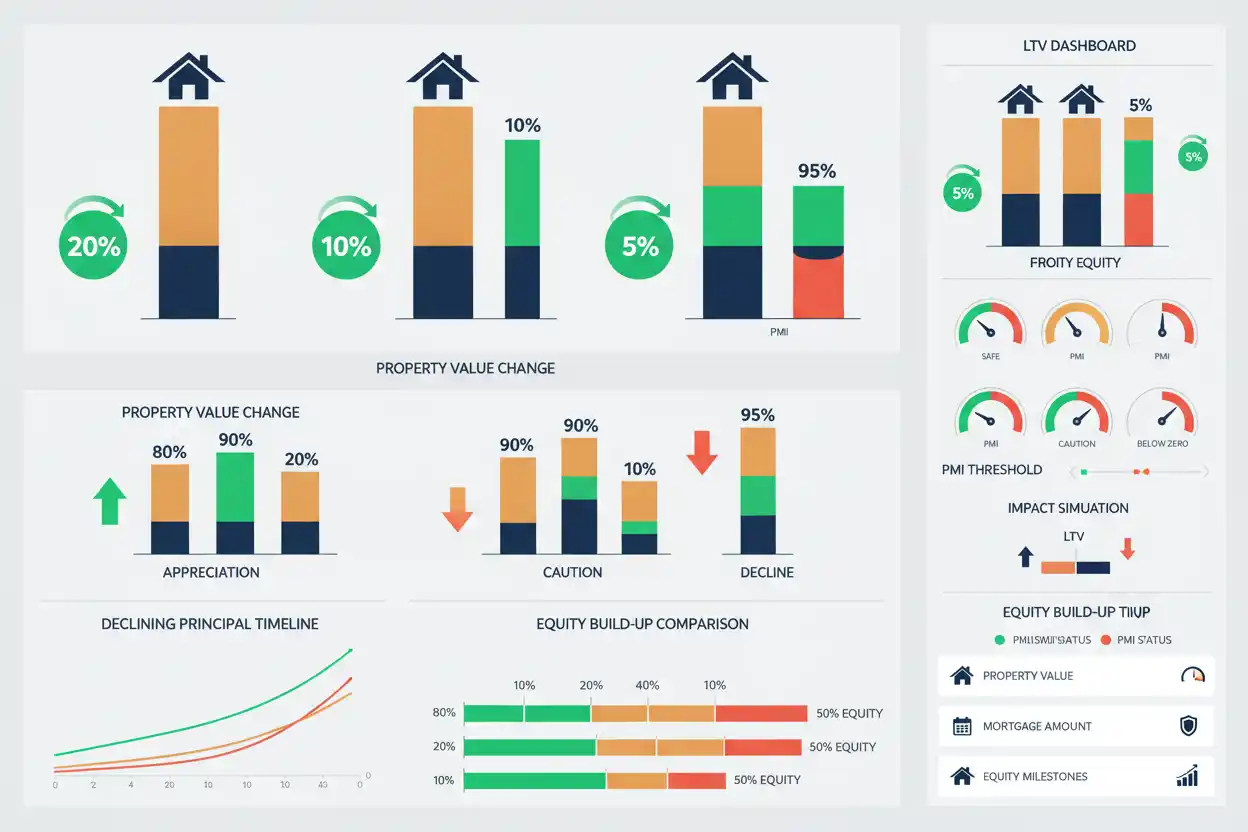

Loan-to-value ratio, or LTV, measures a mortgage amount relative to the value used for the property.
The basic formula is:
Loan-To-Value Ratio = Mortgage Amount ÷ Property Value × 100
Suppose:
Mortgage amount = $405,000
Property value = $450,000
Then:
LTV = $405,000 ÷ $450,000 × 100
LTV = 90%
That means the mortgage equals 90% of the value used in the calculation.
CFPB defines mortgage LTV as a comparison between the amount being financed and the appraised value of the property, and notes that a larger down payment generally produces a lower LTV.
What Does LTV Mean?
LTV is a leverage ratio.
It divides:
loan amount
by:
property value
and expresses the result as a percentage.
A higher LTV means a larger proportion of the property’s value is being financed.
A lower LTV means the borrower has more equity relative to the mortgage.
Within the Mortgages & Home Loans cluster, this page owns the single-loan loan-to-value ratio calculation rather than the combined loan-to-value ratio, which incorporates additional property-secured debt.
LTV Formula
LTV = Loan Amount ÷ Property Value × 100
If:
Loan = $320,000
Property value = $400,000
Then:
LTV = $320,000 ÷ $400,000 × 100
LTV = 80%
Borrower equity in the simplified example is:
Equity = $400,000 − $320,000
Equity = $80,000
Equity percentage:
$80,000 ÷ $400,000 × 100
20%
Therefore:
80% LTV + 20% Equity = 100%
when one mortgage is the only property-secured debt and the same value basis is used.
LTV and Down Payment
At purchase, the down payment directly affects LTV.
Suppose a $500,000 home is purchased with 10% down.
Down payment:
$500,000 × 10% = $50,000
Mortgage:
$500,000 − $50,000 = $450,000
LTV:
$450,000 ÷ $500,000 × 100
90%
With 20% down:
Mortgage:
$400,000
LTV:
80%
CFPB notes that larger down payments reduce LTV and can improve mortgage terms or reduce mortgage-insurance costs in applicable situations.
LTV Comparison Table
| Down Payment | Mortgage on $500,000 Home | LTV |
|---|---|---|
| 5% | $475,000 | 95% |
| 10% | $450,000 | 90% |
| 20% | $400,000 | 80% |
| 30% | $350,000 | 70% |
| 40% | $300,000 | 60% |
The arithmetic is straightforward:
More Cash Down → Smaller Mortgage → Lower LTV
Why LTV Matters
LTV helps lenders evaluate how much collateral value supports the mortgage.
Suppose two borrowers each want a $400,000 loan.
Borrower A’s home value:
$500,000
LTV:
80%
Borrower B’s home value:
$425,000
LTV:
94.12%
The mortgage amount is identical, but the lender has a much smaller value cushion in Borrower B’s transaction.
CFPB notes that higher LTV can affect whether a loan is approved and what borrowing costs apply.
LTV vs CLTV
LTV generally focuses on the primary mortgage being analyzed.
CLTV includes applicable subordinate property-secured debt.
Suppose:
First mortgage = $300,000
Home equity loan = $50,000
Home value = $500,000
First-mortgage LTV:
$300,000 ÷ $500,000 × 100
60%
CLTV:
($300,000 + $50,000) ÷ $500,000 × 100
70%
Both ratios are useful.
They simply answer different questions.
LTV and Home Equity Loan
A home equity loan does not change the first mortgage’s original LTV merely because a second loan is added.
Instead, total property leverage rises.
That is why a combined ratio is necessary.
For example:
First mortgage LTV = 60%
Second loan adds another 10% of property value
Combined leverage becomes:
70% CLTV
The distinction matters when evaluating total home-secured debt.
LTV and HELOC
A HELOC can also increase combined leverage.
Suppose:
First mortgage = $300,000
HELOC drawn balance = $75,000
Property value = $500,000
First LTV:
60%
Current combined leverage:
$375,000 ÷ $500,000 × 100
75%
Looking only at the first mortgage would understate the debt secured by the property.
LTV and Jumbo Mortgage
A jumbo mortgage is defined by mortgage size relative to conforming limits—not by LTV.
Suppose:
Home value = $1.5 million
Mortgage = $900,000
LTV:
60%
Yet the $900,000 mortgage exceeds the 2026 baseline conforming limit of $832,750 in most areas.
Therefore, a mortgage can be jumbo despite having a relatively low LTV.
LTV and Mortgage Affordability
The mortgage affordability calculation focuses on payment capacity.
LTV focuses on property leverage.
For example:
Borrower A may have 50% LTV but an unaffordable payment because income is low.
Borrower B may have 90% LTV but a manageable payment because income is high.
LTV does not measure household cash-flow affordability.
LTV and Interest-Only Mortgages
An interest-only mortgage can keep LTV elevated because scheduled payments may not reduce principal during the interest-only period.
Suppose:
Mortgage = $400,000
Property value = $500,000
Initial LTV:
80%
Five years later, if principal remains $400,000 and property value remains $500,000:
LTV = 80%
The borrower has not improved LTV through scheduled principal reduction.
LTV and Mortgage Amortization
A normal mortgage amortization schedule gradually reduces principal.
Suppose:
Original mortgage = $400,000
Original property value = $500,000
Initial LTV:
80%
Later principal falls to $350,000 while the property remains worth $500,000.
New LTV:
$350,000 ÷ $500,000 × 100
70%
Principal repayment improves LTV even if the home’s market value does not change.
Property Appreciation and LTV
Suppose:
Mortgage balance = $350,000
Home value rises from $500,000 to $550,000
New LTV:
$350,000 ÷ $550,000 × 100
≈ 63.64%
The ratio improves because the denominator increased.
However, lender underwriting normally requires an accepted property valuation rather than a homeowner’s informal estimate.
Falling Home Values
LTV can deteriorate even when the borrower makes every payment.
Suppose:
Mortgage = $350,000
Home value falls to $400,000
LTV = $350,000 ÷ $400,000 × 100
87.5%
If the property value falls to $325,000:
LTV = $350,000 ÷ $325,000 × 100
≈ 107.69%
The mortgage now exceeds the estimated property value.
LTV Above 100%
An LTV above 100% means:
Mortgage Balance > Property Value
For example:
Loan = $330,000
Property value = $300,000
LTV = $330,000 ÷ $300,000 × 100
LTV = 110%
The property has negative equity relative to that mortgage balance under the stated valuation.
LTV and Mortgage Insurance
Mortgage insurance can be connected with LTV because insurance requirements often depend partly on the amount financed relative to property value and the loan program.
CFPB notes that mortgage insurance is typically required on some conventional mortgages when the down payment is below 20%, though program details vary.
The exact insurance rule should be taken from the actual mortgage program rather than inferred solely from a generic LTV percentage.
LTV and FHA Loans
FHA loans can permit relatively high initial LTV because qualifying borrowers can use a low down payment.
The FHA program has its own mortgage-insurance structure, so an FHA LTV should not be analyzed using conventional PMI rules.
LTV and Cash-Out Refinance
A cash-out refinance generally increases mortgage principal.
Suppose:
Home value = $500,000
Old mortgage = $250,000
New cash-out mortgage = $350,000
Old LTV:
50%
New LTV:
70%
The homeowner converted part of the equity cushion into new mortgage debt.
LTV and Mortgage Recast
A mortgage recast follows a large principal reduction on an eligible loan.
Suppose:
Mortgage before lump sum = $350,000
Principal payment = $50,000
Property value = $500,000
New balance:
$300,000
New LTV:
60%
The recast can then change the required future payment without necessarily changing the interest rate.
LTV and Refinancing
Refinancing generally requires a new property and borrower analysis.
A lower current LTV can improve refinancing flexibility.
A high LTV can reduce available options or increase costs.
Therefore, borrowers monitoring future refinancing should track both:
mortgage balance and property value.
LTV and Mortgage APR
The mortgage APR measures borrowing cost, not leverage.
A mortgage can have:
low LTV and high APR, or high LTV and low APR.
The two metrics should never be substituted for one another.
Common LTV Mistakes
One mistake is dividing the down payment by the property value and calling the result LTV.
Another is forgetting subordinate financing.
Borrowers also assume their original purchase price remains the correct property value forever.
A fourth mistake is treating 80% LTV as a universal approval threshold.
Finally, LTV should not be confused with affordability or debt-to-income ratio.
Frequently Asked Questions
What is loan-to-value ratio?
It compares the mortgage amount with the property’s value.
What is the LTV formula?
LTV = Loan Amount ÷ Property Value × 100
What is the LTV on a $405,000 loan against a $450,000 property?
90%
What is 80% LTV on a $500,000 home?
$400,000 Mortgage
Does a larger down payment reduce LTV?
Yes.
Is LTV the same as equity?
No. LTV measures debt as a percentage of value; equity measures the value remaining after debt.
Is LTV the same as CLTV?
No. CLTV incorporates applicable additional property-secured financing.
Can LTV exceed 100%?
Yes, when the mortgage exceeds the property’s current value.
Does mortgage amortization reduce LTV?
Yes, if principal falls and property value does not fall enough to offset that reduction.
Can rising home prices reduce LTV?
Yes, assuming the higher property value is accepted for the relevant calculation.
Does low LTV mean the mortgage is affordable?
No. LTV measures collateral leverage, not household payment capacity.
Why do lenders care about LTV?
It is one measure of the amount financed relative to the value supporting the mortgage.
Final Takeaway
Loan-to-value ratio measures mortgage leverage:
LTV = Mortgage ÷ Property Value × 100
A $405,000 mortgage on a $450,000 property has:
90% LTV
A $400,000 mortgage on a $500,000 property has:
80% LTV
LTV generally improves when:
principal falls, property value rises, or the borrower contributes a larger down payment.
It deteriorates when:
property value falls or new mortgage debt increases.
The most important distinction is that LTV measures the relationship between one mortgage and property value—it does not measure income, monthly affordability, total borrowing cost, or every additional lien secured by the home.