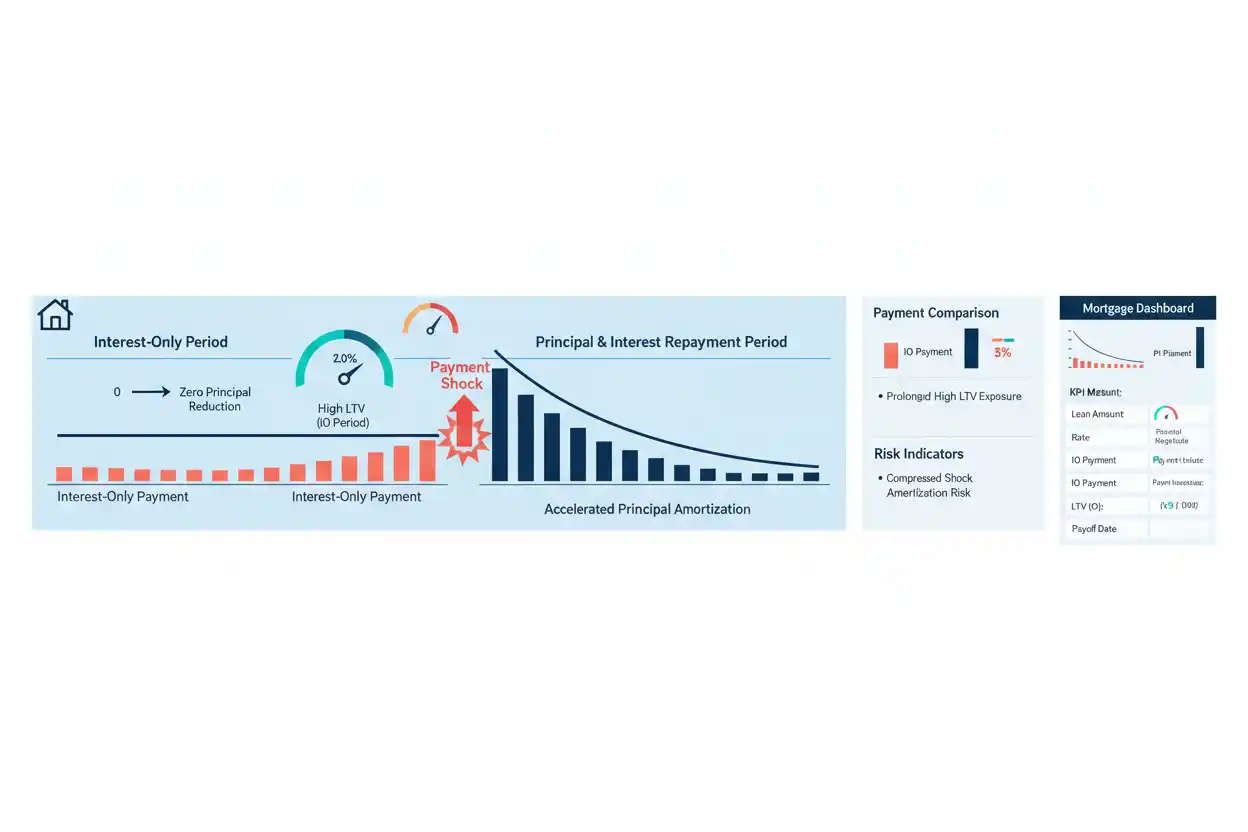

An interest-only mortgage allows the borrower to make scheduled payments that cover only interest for a specified period before principal repayment begins.
During that interest-only period:
Principal Reduction = $0
when the borrower pays only the required interest and makes no additional principal payment.
CFPB describes an interest-only mortgage as a loan whose scheduled payments require only interest for a specified amount of time. It also warns that the balance does not decline through those interest-only payments and that later principal-and-interest payments can be substantially higher.
The basic interest-only payment formula is:
Interest-Only Payment = Mortgage Principal × Annual Interest Rate ÷ Payments per Year
Suppose:
Mortgage = $400,000
Rate = 6.5%
Then:
Monthly Interest-Only Payment = $400,000 × 6.5% ÷ 12
Monthly Payment = $2,166.67
That payment keeps current interest satisfied under the simplified example but does not repay the $400,000 principal.
How an Interest-Only Mortgage Works
A common structure contains two phases.
During the first phase:
the borrower pays interest only.
During the second phase:
the borrower begins repaying both principal and interest, refinances, sells, or otherwise satisfies the balance according to the mortgage terms.
The Mortgages & Home Loans pillar covers the broader mortgage framework, while this article focuses specifically on interest-only payment mechanics and the transition risk when principal repayment begins.
Interest-Only Mortgage Formula
Assume:
Principal = $400,000
Annual rate = 6.5%
Payments = monthly
Monthly Interest = $400,000 × 0.065 ÷ 12
Monthly Interest = $2,166.67
After one payment:
Principal Balance = $400,000
After 12 interest-only payments:
Principal Balance = $400,000
After 120 interest-only payments:
Principal Balance = $400,000
assuming no extra principal payments, capitalization, or other balance changes.
That is the central difference from normal mortgage amortization.
Ten-Year Interest-Only Example
Suppose:
Original mortgage = $400,000
Rate = 6.5%
Interest-only period = 10 years
Total mortgage horizon = 30 years
Rate assumed unchanged for the entire example
Monthly interest-only payment:
$2,166.67
Number of interest-only payments:
10 × 12 = 120
Total interest paid during the first 10 years:
$2,166.67 × 120
≈ $260,000
Principal remaining:
$400,000
The borrower has paid approximately $260,000 during the first decade without reducing principal through the required interest-only payments.
Payment After the Interest-Only Period
At the end of year 10, suppose the $400,000 principal must now be amortized over the remaining 20 years.
Same illustrative rate:
6.5%
Remaining payment periods:
20 × 12 = 240
Using the standard mortgage payment formula:
Payment = P × [r(1 + r)ⁿ] ÷ [(1 + r)ⁿ − 1]
the new principal-and-interest payment becomes approximately:
$2,982.29 per Month
Payment Shock
Old interest-only payment:
$2,166.67
New amortizing payment:
$2,982.29
Increase:
$2,982.29 − $2,166.67
$815.63 per Month
Percentage increase:
$815.63 ÷ $2,166.67 × 100
≈ 37.6%
The payment rises almost 38% even though the assumed interest rate did not change.
That is payment shock caused purely by compressing principal repayment into the remaining 20 years.
What If the Interest Rate Also Rises?
The previous example assumes the rate remains at 6.5%.
Some interest-only mortgages can also have adjustable-rate features.
If the rate rises before amortization begins, the borrower can face two simultaneous effects:
principal must finally be repaid, and the interest rate is higher.
That can create a much larger payment increase.
The adjustable-rate mortgage page owns the separate rate-reset mechanics.
Total Interest Under the Example
First 10 years of interest-only payments:
$260,000
Interest during the following 20-year amortization at 6.5%:
≈ $315,750.21
Total interest:
≈ $575,750.21
For comparison, a standard 30-year fully amortizing $400,000 mortgage at the same 6.5% rate produces total interest of approximately:
$510,177.95
Difference:
$575,750.21 − $510,177.95
≈ $65,572.26
The interest-only version costs more in this simplified same-rate comparison because principal remains at $400,000 for the first decade.
Interest-Only vs Fixed-Rate Mortgage
A fixed-rate mortgage normally begins amortizing principal immediately when it is a standard fully amortizing structure.
For a $400,000 mortgage at 6.5% over 30 years:
Standard payment:
≈ $2,528.27
Interest-only payment:
≈ $2,166.67
Initial difference:
≈ $361.61 per Month
The interest-only option improves early cash flow.
The standard fixed amortizing mortgage reduces debt immediately.
Neither comparison is complete without considering future payment and total interest.
Interest-Only Mortgage and Home Affordability
The mapped home affordability relationship is critical.
Suppose a buyer says:
“I can afford $2,200 per month.”
The $400,000 interest-only mortgage appears affordable at:
$2,166.67
But after year 10, the payment becomes:
$2,982.29
before taxes and insurance.
If the household cannot support the later payment, the property was not comfortably affordable under the full mortgage structure.
CFPB specifically warns borrowers not to assume they will necessarily be able to sell or refinance when an interest-only payment increases.
Interest-Only Mortgage and Home Equity Loan
Adding a home equity loan while the first mortgage remains interest-only can increase property debt without the primary mortgage balance falling.
Suppose:
Interest-only first mortgage = $400,000
Home equity loan = $50,000
Combined secured debt:
$450,000
If the home is worth $600,000:
CLTV = $450,000 ÷ $600,000 × 100
75%
Without scheduled first-mortgage principal reduction, combined leverage can improve more slowly.
Interest-Only Mortgage and HELOC
A HELOC can create even more payment variability because its balance and rate can change.
A homeowner with:
an interest-only first mortgage plus a variable-rate HELOC
has exposure to both:
future mortgage amortization shock and variable second-lien payments.
The combined household payment should be stress-tested rather than evaluated from today’s minimums.
Interest-Only Mortgage and Jumbo Mortgage
A jumbo mortgage can sometimes include specialized repayment structures.
With large balances, interest-only payment differences become substantial.
For example:
$1,000,000 at 6.5%
Interest-only payment:
$5,416.67 per Month
Even a modest rate increase or transition to amortization can move the required payment by thousands of dollars.
Interest-Only Mortgage and Loan-to-Value Ratio
The loan-to-value ratio can remain relatively high when principal is not being reduced.
Suppose:
Home value = $500,000
Interest-only mortgage = $400,000
Initial LTV:
80%
After five years, if the property remains worth exactly $500,000 and principal is still $400,000:
LTV = 80%
A conventional amortizing mortgage would have reduced its balance during those five years.
Property Appreciation Can Hide the Lack of Principal Reduction
Suppose the $500,000 home rises to $600,000.
Mortgage remains:
$400,000
LTV becomes:
$400,000 ÷ $600,000 × 100
66.7%
The homeowner gained equity through property appreciation rather than principal repayment.
If prices fall instead, the opposite can happen.
An interest-only borrower should not assume appreciation will substitute reliably for amortization.
Interest-Only Mortgage and Mortgage Principal
The mortgage principal is the key risk variable.
Under ordinary interest-only payments:
Payment Covers Interest
but:
Principal Remains Outstanding
That means the borrower continues paying interest on the full principal for the entire interest-only period.
Interest-Only Mortgage and Mortgage Interest
The mortgage interest burden therefore remains high.
On $400,000 at 6.5%:
Annual Interest = $26,000
If principal does not decline:
the same simplified annual interest continues at the same rate.
With an amortizing loan, interest gradually falls because principal falls.
Interest-Only Mortgage and Balloon Mortgage
An balloon mortgage can require a large principal payment at maturity.
Some interest-only structures can similarly leave a substantial principal obligation.
However, not every interest-only mortgage is a balloon loan.
A mortgage can transition from interest-only payments into normal amortization without requiring the full principal immediately.
CFPB notes that when the interest-only period ends, possibilities can include repayment of the balance, refinancing if available, or beginning higher principal-and-interest payments.
Interest-Only Mortgage and Refinancing
Many borrowers may expect to refinance before principal payments begin.
That strategy carries uncertainty.
Future refinancing depends on:
property value, income, employment, credit, market rates, closing costs, and lender requirements.
CFPB specifically warns against assuming sale or refinancing will necessarily be available when the payment rises.
Interest-Only Mortgage and Cash-Out Refinance
A cash-out refinance can worsen the principal problem if the borrower replaces the interest-only mortgage with an even larger loan.
The transaction can solve a short-term liquidity need while extending the amount of home-secured debt.
The new repayment schedule should therefore be compared with simply beginning principal repayment.
Interest-Only Mortgage and Mortgage APR
The mortgage APR can provide a broader borrowing-cost comparison.
An attractive initial interest-only payment should not distract from:
APR, points, origination charges, adjustment features, and total expected repayment.
Interest-Only Mortgage and Discount Points
Discount points can reduce the rate if offered by the lender, but the value of points depends on how long the borrower keeps the mortgage.
On an interest-only structure, lower rate payments can produce significant short-term savings.
However, paying thousands upfront remains wasteful if the borrower exits before reaching break-even.
Interest-Only Mortgage and Mortgage Payoff Strategies
Mortgage payoff strategies can include voluntary principal payments during the interest-only period when the loan permits them.
Suppose:
Mortgage = $400,000
Voluntary principal payment = $50,000
New principal:
$350,000
At 6.5%, simplified monthly interest becomes:
$350,000 × 6.5% ÷ 12
≈ $1,895.83
That is approximately:
$270.83 Less per Month
than interest on $400,000.
Interest-Only Mortgage and Mortgage Recast
A mortgage recast should not be assumed available or applicable merely because the borrower has made a large principal payment.
Interest-only loans can have specialized terms.
The lender must confirm how voluntary principal reduction affects future payments.
Interest-Only Mortgage and Closing Costs
Mortgage closing costs remain part of the transaction even though the initial payment is lower.
Comparing an interest-only mortgage with an amortizing alternative therefore requires:
initial payment, future payment, total interest, fees, and expected holding period.
When Interest-Only Can Be Useful
An interest-only structure can provide temporary cash-flow flexibility for borrowers whose income is uneven but substantial, or whose financial strategy genuinely requires a lower initial contractual payment.
However, the structure only works safely when the borrower understands the future principal obligation and can withstand the transition.
It should not be used to make an otherwise unaffordable property appear affordable.
Common Interest-Only Mortgage Mistakes
One mistake is believing the loan balance declines through required interest-only payments.
Another is comparing only the introductory payment with a normal amortizing mortgage.
Borrowers also assume refinancing will solve the later payment increase.
A fourth mistake is ignoring the possibility of simultaneous rate increases.
Finally, property appreciation should not be treated as guaranteed principal repayment.
Frequently Asked Questions
What is an interest-only mortgage?
It is a mortgage whose scheduled payments require only interest for a specified initial period.
What is the interest-only payment formula?
Payment = Principal × Annual Rate ÷ Payments per Year
What is the payment on $400,000 at 6.5%?
Approximately:
$2,166.67 per Month
during the simplified interest-only period.
Does that payment reduce principal?
No, not if it only covers the required interest.
What happens when the interest-only period ends?
The borrower may need to begin higher principal-and-interest payments, repay the balance, or refinance if refinancing is available under the mortgage terms.
How much can the payment increase?
It depends on principal, remaining term, and future rate. In the worked example, it increases about 37.6% even with no rate change.
Can an interest-only mortgage have an adjustable rate?
Yes. Interest-only and adjustable-rate features can coexist.
Does LTV decline during the interest-only period?
Not through scheduled principal repayment. LTV can still change if property value changes or voluntary principal is paid.
Is an interest-only mortgage the same as a balloon mortgage?
No. Some interest-only loans later amortize instead of requiring the full balance at once.
Can I pay principal during the interest-only period?
Some loans permit additional principal payments, but the mortgage terms should be checked.
Can I refinance before the payment increases?
Potentially, but future refinancing is not guaranteed.
Who should be cautious about interest-only mortgages?
Anyone who can afford only the introductory payment and would struggle with the later fully amortizing payment should treat the structure as particularly risky.
Final Takeaway
An interest-only mortgage lowers the initial required payment by postponing principal repayment.
For a $400,000 mortgage at 6.5%:
Interest-Only Payment = $2,166.67 per Month
After 10 years of interest-only payments, approximately:
$260,000
has been paid in interest while principal can still remain:
$400,000
If that balance must then be repaid over the remaining 20 years at the same 6.5% rate, the payment rises to approximately:
$2,982.29 per Month
an increase of about:
37.6%
The attraction is lower initial cash outflow.
The risk is that principal does not disappear—it is postponed, often into a shorter repayment period when the required payment can become much larger.