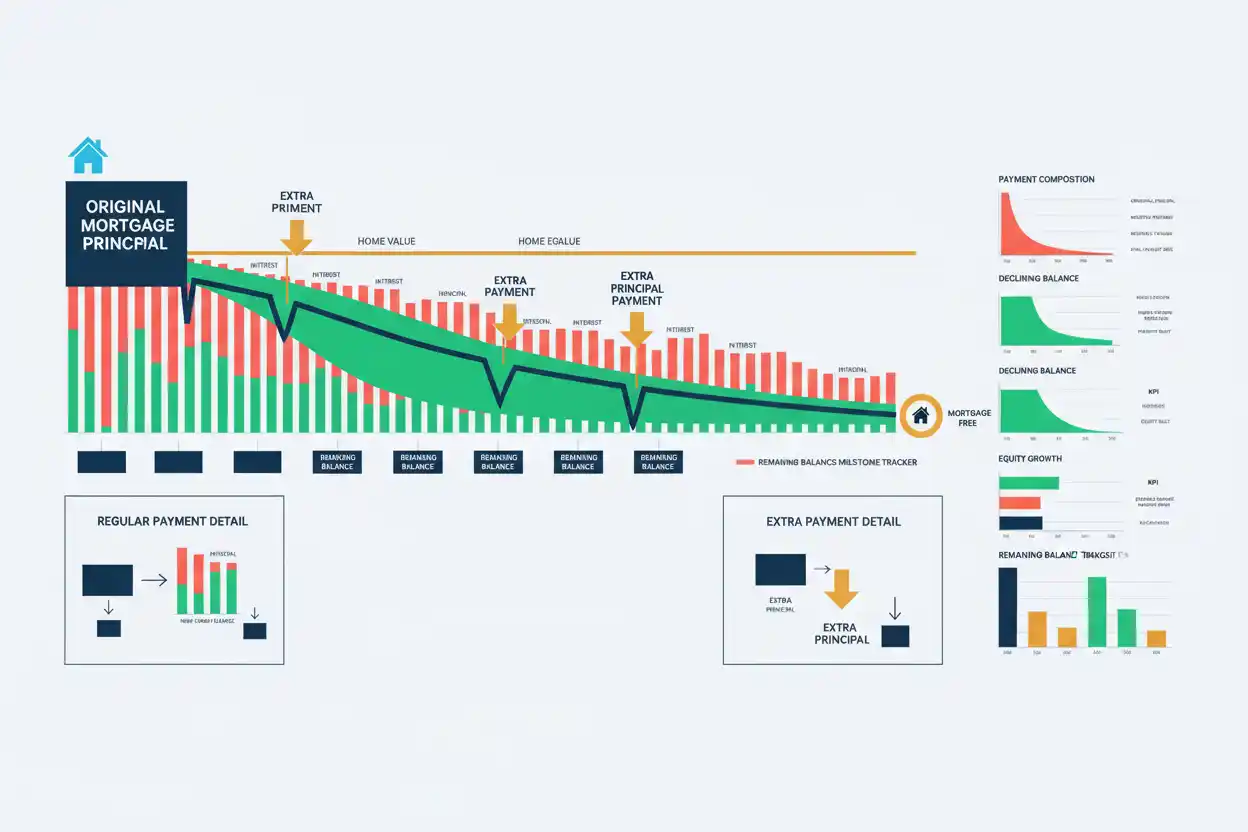

Mortgage principal is the amount of mortgage debt that remains unpaid.
At origination:
Starting Mortgage Principal = Amount Borrowed
As payments are made:
Remaining Principal = Starting Principal − Cumulative Principal Repaid
for a straightforward mortgage without later balance additions.
CFPB describes principal as the amount borrowed through the mortgage, or the outstanding mortgage balance, and distinguishes it from interest charged for borrowing that money.
Mortgage Principal Example
Suppose:
Home price = $500,000
Down payment = $100,000
Starting mortgage principal:
$500,000 − $100,000
$400,000
That $400,000 is the amount that must be repaid through scheduled or extra principal payments, unless the mortgage is otherwise refinanced, modified, assumed, or settled.
Mortgage Principal vs Interest
Principal is debt.
Interest is the cost of borrowing the debt.
Suppose:
Beginning principal = $400,000
Rate = 6.5%
First-month interest:
$400,000 × 6.5% ÷ 12
$2,166.67
If the scheduled payment is:
$2,528.27
then first-month principal repayment is:
$2,528.27 − $2,166.67
$361.61
CFPB explains that mortgage payments typically allocate part to principal and part to interest, with only the principal portion reducing the mortgage balance.
New Principal After First Payment
New Principal = $400,000 − $361.61
≈ $399,638.39
The next month’s interest is then calculated from this lower mortgage balance.
Principal After Five Years
Using the same:
$400,000 principal
6.5% rate
30-year term
after 60 scheduled payments, the remaining balance is approximately:
$374,443.91
Cumulative principal repaid:
$400,000 − $374,443.91
≈ $25,556.09
Even though the borrower has made roughly $151,696 in principal-and-interest payments, only about $25,556 has reduced principal because early mortgage payments are interest-heavy.
Remaining Principal Formula
For a fixed-rate fully amortizing mortgage after k payments:
Bₖ = P(1 + r)ᵏ − A[((1 + r)ᵏ − 1) ÷ r]
Where:
Bₖ = remaining principal
P = original principal
r = periodic interest rate
A = scheduled periodic payment
k = number of payments made
This lets you estimate principal at a future point without constructing the complete amortization schedule.
Mortgage Principal and Amortization
The mortgage amortization schedule shows how principal declines month by month.
The cycle is:
Interest = Beginning Principal × Periodic Rate
Principal Payment = Scheduled P&I − Interest
Ending Principal = Beginning Principal − Principal Payment
As principal declines, interest declines.
That allows more of the same fixed payment to reduce principal.
Mortgage Principal and Mortgage Interest
The mapped mortgage interest page explains the cost generated by principal.
The direct relationship is:
Higher Outstanding Principal → Higher Dollar Interest
when rate and time remain unchanged.
Reducing principal therefore reduces the amount on which future interest is computed.
Mortgage Principal and Extra Payments
Suppose:
Current principal = $374,443.91
Extra payment = $20,000
New principal:
$374,443.91 − $20,000
$354,443.91
At 6.5%, the approximate monthly interest reduction immediately after that payment is:
$20,000 × 6.5% ÷ 12
≈ $108.33
Future savings continue because the mortgage remains $20,000 lower than it otherwise would have been, before considering subsequent amortization.
CFPB notes that extra principal payments may allow borrowers to repay sooner and pay less interest, and recommends verifying that extra amounts are applied to principal.
Mortgage Principal and Payoff Strategies
The mortgage payoff strategies page focuses on deliberately reducing principal faster through:
monthly extra payments, lump sums, or other repayment structures.
Every payoff strategy ultimately works by reducing:
Remaining Mortgage Principal
earlier than scheduled.
Mortgage Principal and Mortgage Recast
A mortgage recast can follow a substantial principal reduction on an eligible mortgage.
Suppose:
Principal before lump sum = $350,000
Lump-sum payment = $100,000
New principal:
$250,000
A recast then recalculates the required payment from the lower principal using the remaining term and existing contractual rate, subject to lender requirements.
Without a recast, the borrower can generally continue the prior payment and pay the mortgage off earlier.
Mortgage Principal and Mortgage Points
Mortgage points do not ordinarily reduce mortgage principal simply because they are paid at closing.
Suppose:
Mortgage principal = $400,000
One point = $4,000
If the borrower pays the $4,000 point in cash:
Mortgage Principal Remains $400,000
The point changes pricing.
A $4,000 principal payment instead would reduce debt to:
$396,000
These are different uses of cash.
Mortgage Principal and Rate Lock
A mortgage rate lock protects specified interest-rate pricing before closing.
The principal is the amount ultimately borrowed.
The lock rate influences how expensive that principal is to finance.
Suppose:
Principal = $400,000
At 6.25%:
Payment ≈ $2,462.87
At 6.75%:
Payment ≈ $2,594.39
Same principal.
Different financing cost.
Mortgage Principal and Preapproval
A mortgage preapproval can state a tentative amount a lender is willing to lend.
That is not yet actual mortgage principal.
If the borrower is preapproved for:
$500,000
but ultimately borrows:
$380,000
the starting mortgage principal is $380,000.
Principal vs Home Value
Mortgage principal should not be confused with home value.
Suppose:
Home value = $500,000
Principal = $350,000
The difference is:
$150,000
before considering other property-secured debts and transaction costs.
This relationship contributes to home equity.
However, property value can change independently of mortgage principal.
Principal and LTV
The loan-to-value ratio uses principal relative to property value:
LTV = Mortgage Principal ÷ Property Value × 100
Using:
Principal = $350,000
Value = $500,000
LTV = 70%
If principal falls to $300,000 while value remains $500,000:
LTV = 60%
Principal repayment therefore improves leverage when property value remains stable.
Principal and Mortgage Payoff Amount
The mortgage payoff amount is normally greater than or equal to principal because it can include interest through the payoff date and other applicable amounts.
CFPB states that payoff amount and current principal balance can differ for exactly this reason.
Therefore:
Principal Balance ≠ Exact Payoff Quote
Principal and Refinancing
When refinancing, the old mortgage principal is paid off by the new transaction.
Suppose:
Old payoff = $300,000
New refinance principal = $310,000
The extra $10,000 can reflect financing of costs, cash received, or other transaction adjustments.
The new principal begins a new amortization schedule.
Principal and Interest-Only Mortgages
With an interest-only mortgage, required payments during the interest-only period can leave principal unchanged.
Suppose:
Principal = $400,000
After 60 pure interest-only payments:
Principal Can Still Be $400,000
if no additional principal has been paid.
That is why interest-only financing can delay equity growth from debt repayment.
Principal and Mortgage Insurance
Mortgage insurance does not ordinarily reduce principal.
If the borrower pays:
$200 Mortgage Insurance
that $200 is an insurance cost rather than principal repayment.
The same principle applies to property taxes and homeowners insurance.
Common Mortgage Principal Mistakes
One mistake is assuming the entire monthly mortgage payment reduces principal.
Another is confusing principal with home value.
Borrowers also confuse mortgage balance with exact payoff amount.
A fourth mistake is assuming points reduce principal.
Finally, extra payments must actually be credited to principal to create the intended debt reduction.
Frequently Asked Questions
What is mortgage principal?
It is the amount borrowed through the mortgage that remains unpaid.
What is the starting principal formula?
Starting Principal = Purchase Price − Down Payment
for a simple purchase with no other financed amounts.
What is the remaining principal formula?
Remaining Principal = Starting Principal − Principal Repaid
for a straightforward mortgage without later additions.
Does mortgage interest reduce principal?
No.
Does escrow reduce principal?
No.
Does mortgage insurance reduce principal?
No.
What reduces principal?
The principal portion of scheduled payments and properly applied extra principal payments.
Why is principal repaid slowly at first?
Early payments contain more interest because the balance is largest early in the mortgage.
Can I pay extra principal?
Potentially, subject to mortgage terms and servicing procedures.
Does a recast reduce principal?
The lump-sum payment reduces principal; the recast recalculates the future required payment.
Is principal the same as payoff amount?
No.
Does lower principal mean lower future interest?
Yes, when rate and other assumptions remain unchanged.
Final Takeaway
Mortgage principal is the debt itself:
Starting Principal = Amount Borrowed
and:
Remaining Principal = Starting Principal − Principal Repaid
On a $400,000 mortgage at 6.5%, the first scheduled $2,528.27 principal-and-interest payment contains approximately:
$2,166.67 Interest
and only:
$361.61 Principal
leaving:
$399,638.39
after the first payment.
That remaining principal drives future interest.
The most important concept is simple: interest, taxes, insurance, and most fees do not reduce mortgage debt—principal payments do.