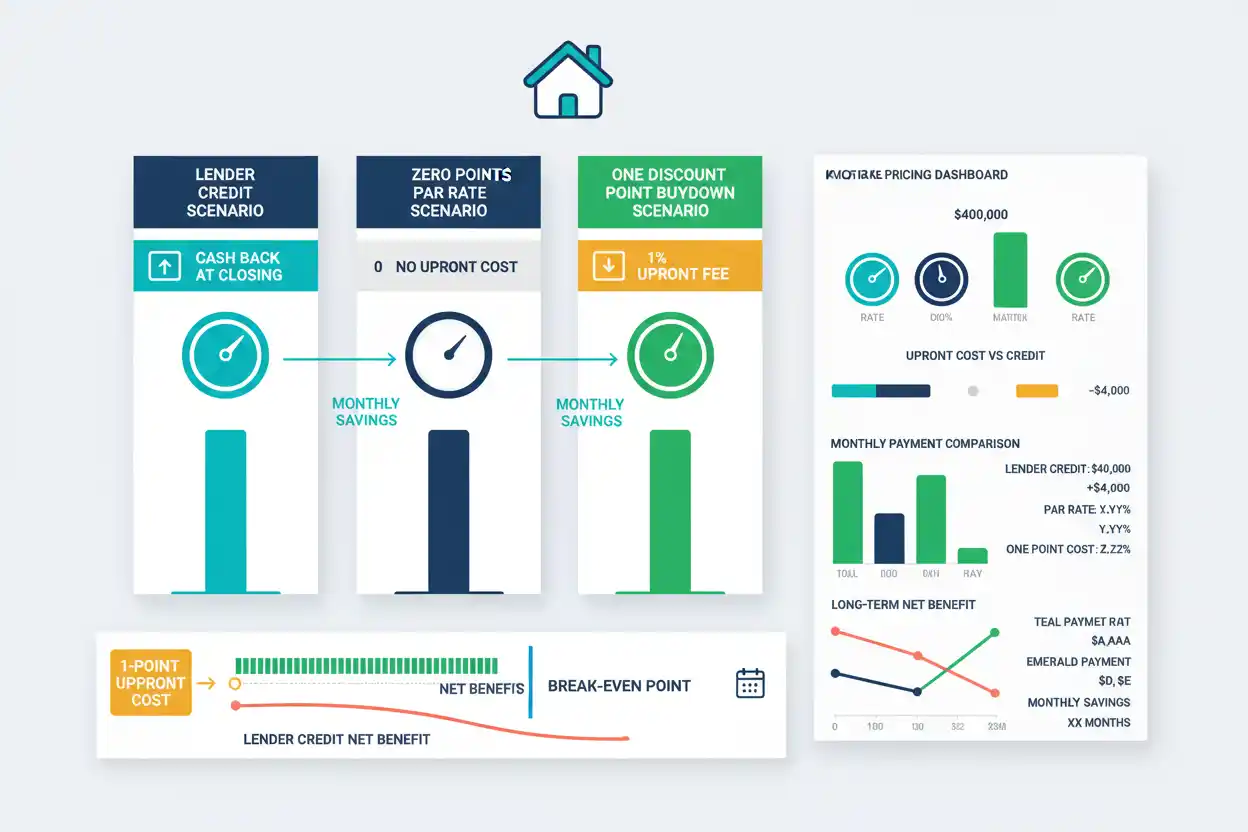

Mortgage points are percentage-based upfront charges associated with mortgage pricing.
When people talk about “buying points,” they usually mean discount points: paying more at closing in exchange for a lower mortgage interest rate.
CFPB defines one discount point as 1% of the loan amount and emphasizes that there is no fixed rule saying one point always reduces the interest rate by a specific amount.
The basic point-cost formula is:
Mortgage Point Cost = Mortgage Amount × Points × 1%
Suppose:
Mortgage = $400,000
Points = 1
Then:
Point Cost = $400,000 × 1%
Point Cost = $4,000
What Is One Mortgage Point?
One point equals:
1% of the Mortgage Amount
Therefore:
On $200,000:
1 Point = $2,000
On $400,000:
1 Point = $4,000
On $750,000:
1 Point = $7,500
Half a point equals 0.5%.
Two points equal 2%.
Mortgage Points Example
Suppose a lender offers two otherwise comparable 30-year fixed mortgages:
Option A
Mortgage = $400,000
Rate = 6.50%
Points = 0
Payment:
≈ $2,528.27
Option B
Mortgage = $400,000
Rate = 6.25%
Points = 1
Point cost:
$4,000
Payment:
≈ $2,462.87
Monthly savings:
$2,528.27 − $2,462.87
≈ $65.40
Mortgage Point Break-Even
The simplest break-even formula is:
Break-Even Months = Extra Point Cost ÷ Monthly Payment Savings
Using the example:
$4,000 ÷ $65.40
≈ 61.2 Months
That is approximately:
5 Years and 1 Month
If the borrower expects to keep the mortgage longer than about 61 months, the lower payment has enough time to recover the $4,000 point cost under the simplified comparison.
If the borrower expects to refinance after two years, the points do not reach break-even.
Five-Year Result
Monthly savings:
$65.40
Over 60 months:
$65.40 × 60
≈ $3,924.20
Point cost:
$4,000
The borrower is still approximately:
$75.80
short of simple payment break-even after five years.
Ten-Year Result
Over 120 months:
$65.40 × 120
≈ $7,848.40
Subtract point cost:
Simplified Net Payment Savings ≈ $3,848.40
A complete economic comparison can also consider remaining mortgage balances under the two rate scenarios.
One Point Does Not Equal a Fixed Rate Reduction
A widespread shortcut claims:
1 Point = 0.25% Lower Rate
That is not a universal rule.
CFPB specifically states that discount points have no fixed value in terms of the interest-rate change obtained.
Actual pricing depends on:
the lender, mortgage type, market conditions, loan characteristics, and lock period.
The borrower needs actual side-by-side offers.
Mortgage Points vs Discount Points
In ordinary consumer mortgage shopping, “points” often refers to discount points.
The dedicated discount points article focuses narrowly on the upfront-cost-versus-rate-reduction decision.
This page keeps the broader mortgage points intent, including lender credits, point costs, mortgage size, principal, and payoff implications.
Mortgage Points vs Origination Charges
A percentage-based mortgage origination fee is not automatically a discount point.
For example:
1% origination fee can compensate the lender for origination.
1 discount point can buy a lower rate.
Both may equal $4,000 on a $400,000 loan, yet they serve different purposes.
Review how the charge appears on the Loan Estimate.
Mortgage Points and Lender Credits
CFPB describes lender credits as the reverse pricing tradeoff from points:
points generally mean higher upfront cost and lower rate, while lender credits generally mean lower upfront closing cost in exchange for a higher rate.
Conceptually:
Points = More Cash Now, Lower Rate
Lender Credits = Less Cash Now, Higher Rate
Neither structure is automatically better.
Holding period matters.
Points and Mortgage Principal
The mortgage principal determines the dollar cost of percentage-based points.
At one point:
$300,000 mortgage:
$3,000
$500,000 mortgage:
$5,000
$1,000,000 mortgage:
$10,000
Therefore, the same point quote becomes much more expensive on a large mortgage.
Points and Down Payment
Suppose a buyer has:
$80,000 Cash
They can allocate that cash among:
down payment, mortgage points, mortgage closing costs, and reserves.
Paying $8,000 in points leaves $8,000 less available for down payment or emergency cash unless additional funds are available.
The lowest rate is not necessarily the strongest overall balance-sheet decision.
Points and Mortgage Preapproval
A mortgage preapproval can estimate how much a lender is tentatively willing to finance.
However, the final mortgage pricing can depend on the selected property, market conditions, rate lock, and actual loan structure.
A preapproval amount therefore should not be interpreted as guaranteeing a particular point-and-rate combination.
CFPB states that preapproval letters are based on assumptions and are not guaranteed loan offers.
Points and Rate Lock
A point quote should be compared with its associated mortgage rate lock.
Suppose:
6.25% with one point is quoted on a 30-day lock.
Another lender quotes:
6.25% with 0.75 points on a 60-day lock.
These are not necessarily identical offers because lock duration can affect pricing.
Points and Mortgage Payoff
The mortgage payoff amount normally does not refund points simply because the borrower pays off the mortgage early.
Points are an upfront pricing cost.
If a borrower pays $4,000 for points and refinances 18 months later, much of the expected rate benefit can remain unrecovered.
That is why expected holding period matters before closing.
Points and Payoff Strategies
The mapped mortgage payoff strategies page creates another alternative use for cash.
Suppose you have:
$4,000
You could:
buy one point, or apply $4,000 to mortgage principal.
Buying the point changes the rate.
Paying principal changes the amount owed.
The superior choice depends on the lender’s actual rate reduction and how long the mortgage will remain open.
Mortgage Points and APR
The mortgage APR can help compare mortgages with different points and fees because APR incorporates applicable borrowing charges into an annualized measure.
However, APR does not replace break-even analysis.
A borrower expecting to keep the mortgage only briefly can prefer lower upfront cost even when another option has a slightly lower APR.
Mortgage Points and Closing Costs
Points are paid as part of the mortgage closing transaction and therefore increase cash required upfront.
CFPB identifies discount points as upfront fees paid at closing to obtain a lower interest rate.
The buyer should evaluate:
Cash to Close After Points
rather than focusing only on the future monthly payment.
When Mortgage Points Make More Sense
Points become more attractive when:
the rate reduction is meaningful, the point price is competitive, the borrower has sufficient closing cash, and the mortgage is likely to remain outstanding well beyond break-even.
They become less attractive when:
the borrower expects an early sale or refinance, cash reserves are thin, or the rate reduction is small relative to the point cost.
Common Mortgage Point Mistakes
One mistake is assuming one point always buys the same rate reduction.
Another is comparing monthly payments without calculating break-even.
Borrowers also confuse origination fees with discount points.
A fourth mistake is using all available closing cash to buy points while leaving inadequate reserves.
Finally, points should be compared using actual lender offers from similar dates and lock periods.
Frequently Asked Questions
What is one mortgage point?
One discount point equals:
1% of the Loan Amount.
How much is one point on $400,000?
$4,000
How much is half a point?
$400,000 × 0.5% = $2,000
Does one point always reduce the rate by 0.25%?
No. The rate reduction is not standardized.
What is the break-even formula?
Break-Even Months = Point Cost ÷ Monthly Savings
What is the break-even in the worked example?
Approximately:
61 Months
What are lender credits?
They generally reduce upfront closing costs in exchange for a higher mortgage rate.
Are points the same as origination fees?
Not necessarily.
Can points affect APR?
Yes, applicable points can affect the disclosed APR.
Do I get points back if I refinance early?
Typically the economic benefit must be recovered through the lower rate; an early refinance can therefore leave the original point cost unrecovered.
Should I buy points or make a larger down payment?
Compare how each option affects rate, mortgage principal, monthly payment, mortgage insurance, cash reserves, and expected holding period.
Are points worth it?
They can be when the mortgage remains outstanding beyond break-even and the rate reduction justifies the upfront cost.
Final Takeaway
Mortgage points convert upfront cash into mortgage pricing.
The basic formula is:
Point Cost = Mortgage Amount × Point Percentage
On a:
$400,000 Mortgage
one point costs:
$4,000
If that reduces the rate from an illustrative 6.50% to 6.25%, the monthly principal-and-interest payment falls from approximately:
$2,528.27 to $2,462.87
Monthly savings:
$65.40
Break-even:
≈ 61 Months
The decision therefore depends less on whether the lower rate looks attractive and more on whether the actual rate reduction, point cost, available cash, and expected mortgage holding period make the upfront investment worthwhile.