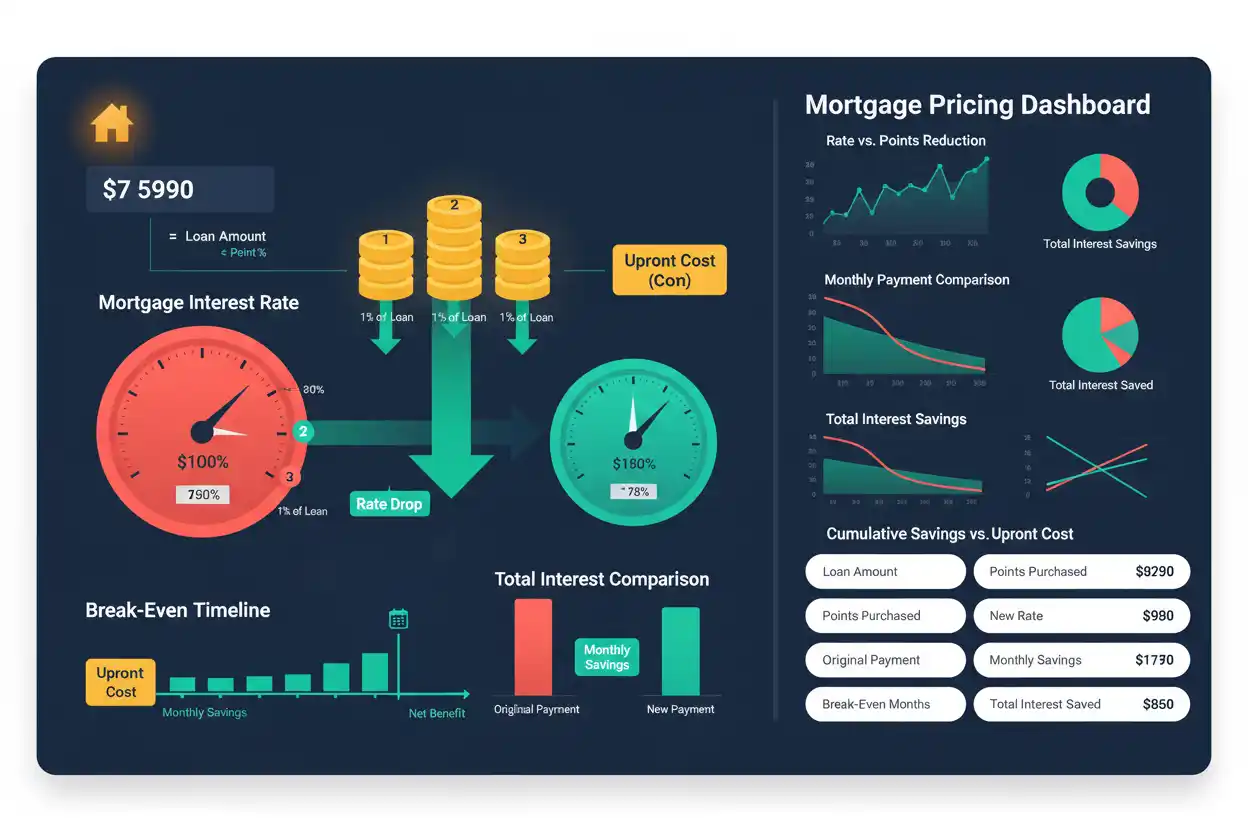

Discount points are upfront mortgage charges paid to obtain a lower interest rate than the rate available on an otherwise comparable zero-point loan.
One discount point equals:
1% of the Mortgage Amount
CFPB guidance states that one point equals 1% of the loan amount and that points shown as points on the Loan Estimate and Closing Disclosure must be associated with a discounted interest rate. The amount by which a point reduces the rate is not standardized; it depends on lender pricing, loan type, and market conditions.
The basic cost formula is:
Discount Point Cost = Mortgage Amount × Number of Points × 1%
The decision formula is then:
Break-Even Months = Upfront Point Cost ÷ Monthly Payment Savings
That break-even period is usually more useful than asking whether points are “good” or “bad.”
What Are Discount Points?
Discount points let a borrower exchange more cash at closing for a lower mortgage interest rate.
The basic tradeoff is:
More Upfront Cost → Lower Rate → Lower Monthly Principal-and-Interest Payment
Whether this creates savings depends heavily on how long the borrower keeps the mortgage.
If the mortgage is sold or refinanced before the upfront cost is recovered, the points can produce a net loss.
Discount Points Formula
Suppose:
Mortgage = $400,000
Points = 1.5
The point percentage is:
1.5 × 1% = 1.5%
Cost:
Point Cost = $400,000 × 1.5%
Point Cost = $6,000
Half a point would cost:
$400,000 × 0.5% = $2,000
Two points would cost:
$400,000 × 2% = $8,000
The dollar cost scales directly with mortgage principal.
Discount Points Example
Suppose a lender offers the same 30-year $400,000 fixed-rate mortgage in two versions:
Option A: 6.625%, zero discount points
Option B: 6.25%, 1.5 discount points
Point cost:
$400,000 × 1.5% = $6,000
The examples assume the offers are otherwise comparable.
Payment Without Points
At 6.625%:
Monthly Principal-and-Interest Payment ≈ $2,561.24
Payment With 1.5 Points
At 6.25%:
Monthly Principal-and-Interest Payment ≈ $2,462.87
Monthly savings:
Monthly Savings = $2,561.24 − $2,462.87
Monthly Savings ≈ $98.38
Break-Even Period
Break-Even Months = $6,000 ÷ $98.38
Break-Even ≈ 61 Months
That is approximately:
5 Years and 1 Month
If the borrower keeps the mortgage beyond roughly 61 months, the accumulated monthly principal-and-interest savings begin to exceed the upfront points under this simplified comparison.
If the borrower refinances or sells after only three years, the points have not recovered their upfront cost.
Five-Year Example
Monthly savings:
$98.38
Over 60 months:
Savings ≈ $98.38 × 60
Savings ≈ $5,902.50
Points cost:
$6,000
Net after five years:
$5,902.50 − $6,000
≈ −$97.50
The borrower is still slightly below break-even after exactly five years in the simplified payment-only analysis.
Ten-Year Example
Over 120 months:
Gross Payment Savings ≈ $98.38 × 120
≈ $11,805
Subtract the $6,000 point cost:
Simplified Net Cash Savings ≈ $5,805
This still does not capture every economic effect because mortgage balances also differ slightly after 120 months.
A complete analysis can compare both cash payments and remaining principal.
Points Do Not Have a Fixed Rate Reduction
A common misconception is:
One Point = 0.25 Percentage Point Rate Reduction
That is not a universal formula.
CFPB explicitly notes that the rate reduction associated with points varies by lender, mortgage type, and market conditions.
Therefore, the correct approach is to request actual side-by-side lender pricing.
Discount Points vs Mortgage Points
The planned mortgage points guide owns the broader terminology around points.
This page focuses specifically on discount points used to lower the mortgage rate.
Not every charge expressed as a percentage of a loan should automatically be called a discount point.
Discount Points and Closing Costs
Points are paid at closing and increase mortgage closing costs.
Suppose:
Other closing costs = $10,000
Discount points = $6,000
Total upfront transaction costs:
$10,000 + $6,000 = $16,000
before down payment and other cash requirements.
A borrower needs to consider whether reducing liquidity by another $6,000 is worth the lower rate.
Discount Points and Down Payments
Down payments compete for the same cash at closing.
Suppose the borrower has $80,000 available.
Option 1:
larger down payment, no points.
Option 2:
smaller down payment plus $6,000 in points.
The correct answer depends on how each option changes:
mortgage amount, LTV, mortgage insurance, interest rate, and monthly payment.
Discount Points and FHA Loans
FHA loans can also involve mortgage pricing choices, but FHA mortgage insurance creates another major cost layer.
A borrower should therefore compare:
interest rate, points, upfront MIP, annual MIP, and total cash required.
A low FHA note rate obtained with substantial points is not automatically a low-cost mortgage.
Discount Points and Conforming Loans
On a conforming loan, points can become large in dollar terms as the mortgage approaches the conforming limit.
For example, one point on an $800,000 mortgage costs:
$800,000 × 1%
$8,000
A 1.5-point structure costs:
$12,000
The break-even period must justify that large upfront expenditure.
Discount Points and Construction Loans
A construction loan can involve separate construction and permanent financing phases.
Before paying points, determine:
which rate the points reduce and for how long.
Paying significant points for a rate that applies only during a short construction period can produce very different economics from paying points on a 30-year permanent mortgage.
Discount Points and CLTV
The combined loan-to-value ratio does not directly include points.
However, if points are financed into a mortgage or reduce cash available for the down payment, the financing structure can indirectly affect property leverage.
The lender’s actual transaction treatment matters.
Discount Points and Mortgage APR
The mortgage APR is particularly useful when points are present.
Two offers can show:
6.25% with large points and 6.50% with no points.
The lower note rate looks cheaper, but the APR and closing-cost comparison can reveal the effect of the upfront charge.
Discount Points and Mortgage Break-Even
The mortgage break-even point is the core decision tool.
Break-Even = Upfront Cost ÷ Monthly Savings
If points cost $4,000 and save $80 per month:
Break-Even = $4,000 ÷ $80
Break-Even = 50 Months
If you expect to refinance after 36 months, the points do not recover their cost through payment savings.
Discount Points and Rate Locks
A mortgage rate lock matters because mortgage pricing can change.
When comparing point options, make sure:
the rate and points are from the same pricing date and comparable lock period.
A 6.25% rate with one point today should not be compared casually with a 6.5% zero-point quote obtained under different market conditions.
Discount Points and Fixed-Rate Mortgages
A fixed-rate mortgage makes break-even analysis easier because the rate reduction is expected to persist while the loan remains outstanding.
On an adjustable mortgage, the future value of upfront points can be more complicated if the rate later resets.
Discount Points and Refinancing
Refinancing is a major risk to point recovery.
Suppose the point break-even is 61 months.
If market rates fall dramatically after 30 months and the borrower refinances, the original points are sunk costs.
The borrower received only 30 months of the lower-rate benefit.
Cash-Out Refinance and Points
A cash-out refinance can involve a large mortgage amount, making points expensive.
If:
New mortgage = $500,000
Points = 2
Point Cost = $500,000 × 2%
Point Cost = $10,000
That $10,000 should be evaluated against both the monthly savings and how long the borrower expects to keep the new refinance.
Lender Credits
CFPB describes lender credits as the reverse tradeoff: the borrower receives a credit toward closing costs in exchange for a higher rate.
Conceptually:
Points = More Cash Now, Lower Rate
Lender Credits = Less Cash Now, Higher Rate
A borrower expecting a short holding period can sometimes prefer lower upfront cost.
A long-term borrower can sometimes benefit more from the lower rate.
Discount Points and Mortgage Term
The mortgage term influences point value.
A borrower taking a 15-year mortgage has less time to recover points than someone keeping a 30-year mortgage for decades.
However, the shorter mortgage can also produce different rate reductions and monthly savings.
Always calculate from the actual offer.
Are Discount Points Tax Deductible?
Tax treatment depends on the transaction, applicable tax law, use of the property, timing, and other facts.
Because tax rules can change, do not assume the entire point cost is immediately deductible.
Tax treatment belongs in specialist tax guidance rather than the mortgage-cost calculation itself.
Common Discount Point Mistakes
One mistake is assuming one point always reduces the rate by the same amount.
Another is comparing only monthly payments.
Borrowers also overlook how long they expect to keep the mortgage.
A fourth mistake is spending too much closing cash on points while leaving inadequate reserves.
Finally, comparing quotes with different lock periods or unrelated lender pricing can produce a misleading break-even calculation.
Frequently Asked Questions
What is one discount point?
One Point = 1% of the Mortgage Amount
How much is one point on $400,000?
$4,000
How much are 1.5 points?
$400,000 × 1.5% = $6,000
Does one point always lower the rate by 0.25%?
No. The rate reduction varies by lender, product, and market.
What is the break-even formula?
Break-Even Months = Point Cost ÷ Monthly Payment Savings
What is the break-even in the example?
Approximately 61 months.
Are points part of closing costs?
Yes, points paid at closing increase the upfront closing cost.
Are discount points the same as a down payment?
No. A down payment reduces the amount borrowed. Points pay for mortgage pricing.
Can FHA loans have points?
Mortgage pricing can include points, but FHA mortgage-insurance costs must be evaluated separately.
Should I pay points if I plan to refinance soon?
Usually the short holding period makes recovery harder. Calculate the actual break-even.
What are lender credits?
They are the reverse pricing tradeoff: lower upfront cost in exchange for a higher interest rate.
Are points always worth paying?
No. Their value depends on cost, rate reduction, holding period, available cash, and alternatives.
Final Takeaway
Discount points are an upfront investment in a lower mortgage rate.
The basic formula is:
Point Cost = Mortgage Amount × Points Percentage
On a $400,000 mortgage, 1.5 points cost:
$6,000
If that lowers the payment from approximately $2,561.24 to $2,462.87, monthly savings are about:
$98.38
Break-even:
$6,000 ÷ $98.38 ≈ 61 Months
The question is therefore not whether a lower rate looks attractive. It is whether you will keep the mortgage long enough for the payment savings to recover the extra cash paid at closing.