
A fixed-rate mortgage is a home loan whose contractual interest rate remains unchanged throughout the fixed-rate term.
That stability makes the principal-and-interest portion of the mortgage payment predictable. The borrower knows the rate used to calculate interest today will remain the same later, assuming the mortgage is not refinanced, modified, or otherwise replaced.
CFPB currently defines a fixed-rate mortgage as a home loan in which the interest rate is set when the borrower takes out the loan and does not change. It also notes an important distinction: even when principal and interest remain fixed, the total monthly housing payment can still change if property taxes, homeowners insurance, or mortgage insurance change.
For a standard fully amortizing fixed-rate mortgage, the payment formula is:
Monthly Payment = P × [r(1 + r)ⁿ] ÷ [(1 + r)ⁿ − 1]
Where:
P = mortgage principal
r = monthly interest rate
n = total number of monthly payments
The fixed-rate mortgage belongs within the broader Mortgages & Home Loans framework, but this page owns the specific intent of how a fixed mortgage rate translates into payments, amortization, and total interest.
How a Fixed-Rate Mortgage Works
Suppose you borrow $350,000 with a 6.25% fixed annual interest rate for 30 years.
The mortgage rate remains 6.25% for the contractual fixed term.
The monthly principal-and-interest payment is calculated once from:
the starting principal, fixed rate, and number of payments.
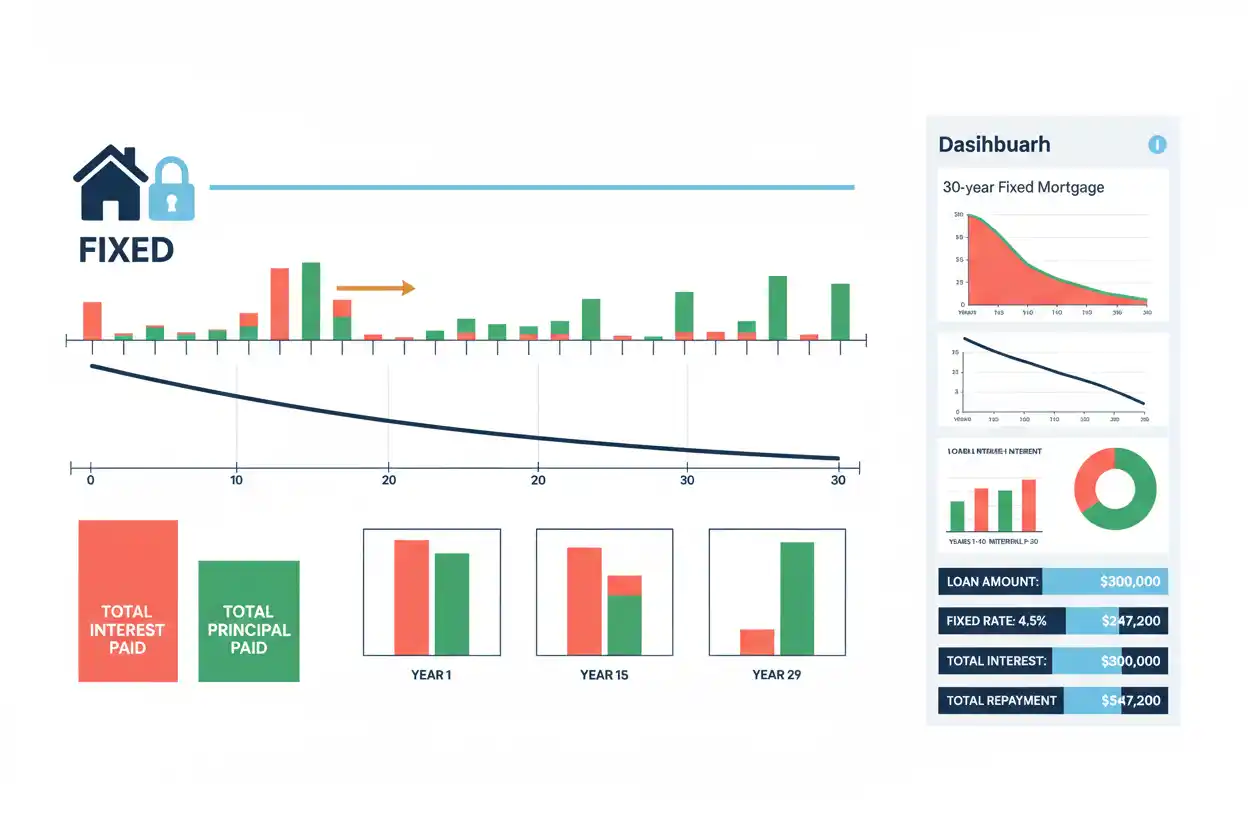
Although that payment remains level, the amount allocated to interest and principal changes each month.
Early payments contain relatively more interest.
Later payments contain more principal.
That changing allocation is the foundation of mortgage amortization.
Fixed-Rate Mortgage Formula
Assume:
Mortgage principal = $350,000
Annual fixed rate = 6.25%
Mortgage term = 30 years
First calculate the monthly rate:
Monthly Rate = 6.25% ÷ 12
Monthly Rate ≈ 0.520833%
As a decimal:
r ≈ 0.00520833
The number of payments is:
n = 30 × 12
n = 360
Apply the mortgage formula:
Payment = $350,000 × [0.00520833(1.00520833)³⁶⁰] ÷ [(1.00520833)³⁶⁰ − 1]
The principal-and-interest payment is approximately:
$2,155.01 per Month
This calculation excludes taxes, insurance, mortgage insurance, homeowners association charges, and other housing expenses.
First Mortgage Payment Breakdown
The first month’s interest is:
Interest = $350,000 × 6.25% ÷ 12
Interest ≈ $1,822.92
Principal repaid is:
Principal = $2,155.01 − $1,822.92
Principal ≈ $332.09
The new balance becomes:
Balance = $350,000 − $332.09
Balance ≈ $349,667.91
Only about $332 of the first $2,155 payment reduces mortgage principal.
That often surprises first-time borrowers.
Why Principal Repayment Accelerates
The second month’s interest is calculated from a slightly smaller principal balance.
As the balance falls:
Interest Charge Falls
while:
Principal Portion of the Fixed Payment Rises
The total principal-and-interest payment does not need to change because its internal composition changes.
A full repayment schedule makes the transition visible month by month.
Balance After Five Years
After 60 scheduled payments in the example, the remaining mortgage principal is approximately:
$326,680.35
The borrower originally financed $350,000.
Principal reduction after five years is therefore:
$350,000 − $326,680.35
≈ $23,319.65
Total principal-and-interest payments during those five years are approximately:
$2,155.01 × 60
≈ $129,300.61
The large difference between payments made and principal reduction is explained primarily by mortgage interest.
Balance After Ten Years
After 120 scheduled payments, the remaining principal is approximately:
$294,832.00
Principal repaid:
$350,000 − $294,832
≈ $55,168
The mortgage balance falls progressively faster because an increasing portion of each fixed payment is being directed to principal.
Total Interest on a 30-Year Fixed Mortgage
If the mortgage continues for all 360 payments:
Total Payments ≈ $2,155.01 × 360
Using full-precision calculations:
Total Payments ≈ $775,803.67
Subtract original principal:
Total Interest ≈ $775,803.67 − $350,000
Total Interest ≈ $425,803.67
The borrower therefore pays more than $425,000 of interest over 30 years in this example.
That does not make the mortgage incorrectly calculated. It reflects the combination of a large principal, 6.25% rate, and long borrowing period.
Fixed Rate Does Not Mean Every Housing Cost Is Fixed
The phrase fixed-rate mortgage refers to the interest rate.
It does not guarantee that your complete monthly housing outflow never changes.
CFPB notes that property taxes, homeowners insurance, and mortgage insurance can change even when the mortgage rate and principal-and-interest payment remain fixed.
If the mortgage uses mortgage escrow, changing taxes or insurance can therefore change the amount collected by the servicer each month.
Fixed-Rate Mortgage and Down Payment
The down payments amount determines how much of the purchase price must be financed.
Suppose:
Home price = $450,000
Down payment = $100,000
Mortgage principal:
$450,000 − $100,000 = $350,000
A larger down payment reduces principal.
With the rate and term unchanged:
Lower Principal → Lower Monthly Payment
It can also reduce the loan-to-value ratio and potentially affect mortgage-insurance requirements.
Fixed-Rate Mortgage and FHA Loans
An FHA loan can use a fixed-rate structure.
These concepts describe different characteristics.
FHA describes the government mortgage-insurance program.
Fixed-rate describes how the interest rate behaves.
An FHA fixed-rate mortgage can therefore have both FHA mortgage insurance and a rate that remains stable.
Fixed-Rate Mortgage and HELOC
A homeowner can later add a HELOC while keeping the original fixed-rate mortgage.
That creates two separate credit obligations.
For example:
First mortgage = fixed 6.25%
HELOC = variable 8.5%
The first mortgage keeps its fixed rate, while the HELOC rate can move.
This arrangement can preserve attractive first-mortgage pricing while allowing additional home-equity borrowing.
Fixed Mortgage vs Adjustable-Rate Mortgage
An adjustable-rate mortgage can change rate after its initial period.
A fixed-rate mortgage does not expose the borrower to that contractual rate-reset risk.
The tradeoff is that an ARM can sometimes begin with lower pricing.
The decision is therefore not simply:
Which rate is lower today?
It is also:
How much future rate uncertainty am I willing to accept?
Fixed Mortgage vs Interest-Only Mortgage
An interest-only mortgage can require only interest payments during an introductory period.
A standard fixed-rate amortizing mortgage immediately begins reducing principal.
A fixed-rate mortgage can therefore have a higher early payment than an interest-only structure while building equity through scheduled principal repayment.
Fixed Mortgage and Discount Points
Discount points allow a borrower to pay an upfront charge for a lower mortgage rate when offered by the lender.
Suppose:
Mortgage = $350,000
One point = 1%
Point Cost = $350,000 × 1%
Point Cost = $3,500
If that payment reduces the fixed rate, the borrower should calculate the monthly savings and mortgage break-even point.
Fixed Mortgage and Home Affordability
Home affordability should include the complete housing budget rather than the fixed principal-and-interest payment alone.
Someone who can technically afford $2,155 of principal and interest still needs room for:
property taxes, insurance, maintenance, utilities, and other household priorities.
A stable mortgage payment reduces uncertainty but does not eliminate the broader cost of homeownership.
Fixed Mortgage and Mortgage APR
The mortgage APR can exceed the fixed note rate because APR can account for specified finance charges.
For example:
Mortgage rate = 6.25%
APR = 6.48%
The mortgage can still be fixed-rate.
APR and interest rate simply measure different aspects of the transaction.
Fixed Mortgage and Mortgage Term
The mortgage term has a major effect on payment and total interest.
Using the same $350,000 principal and the same 6.25% rate purely for comparison:
30-year payment:
≈ $2,155.01
15-year payment:
≈ $3,000.98
The 15-year mortgage requires approximately:
$845.97 More per Month
However, total interest on the 15-year version is only approximately:
$190,176.41
compared with:
$425,803.67
over 30 years.
Shorter repayment dramatically reduces lifetime interest when the rate is held constant.
Fixed Mortgage and Refinancing
A major limitation of a fixed-rate mortgage is that the rate does not automatically fall when market rates decline.
To replace the mortgage rate, the borrower generally needs to consider refinancing.
That introduces:
closing costs, a new mortgage, possible term extension, and a new break-even period.
A rate reduction alone does not guarantee refinancing savings.
Fixed Mortgage and Cash-Out Refinance
A cash-out refinance can be especially consequential when the existing fixed mortgage has a favorable rate.
Suppose:
Existing fixed rate = 3.5%
New cash-out refinance = 6.5%
The borrower is not merely financing the new cash at 6.5%.
The entire existing first-mortgage balance can be replaced at the new rate.
That opportunity cost should be compared with alternatives such as a HELOC or home equity loan.
Fixed Mortgage and Biweekly Payments
Biweekly mortgage payments can accelerate a fixed-rate mortgage when the schedule results in extra principal being paid each year.
The rate remains fixed.
The principal simply declines faster.
That can shorten the effective repayment period and reduce total interest.
Fixed Mortgage and Mortgage Recast
A mortgage recast can lower future required payments on an eligible existing mortgage after a large principal reduction.
Unlike refinancing, recasting usually does not replace the original interest rate.
That can be valuable when the borrower wants a lower payment while preserving an attractive fixed rate.
Fixed Mortgage and Mortgage Insurance
Mortgage insurance is separate from the fixed rate.
A mortgage can have:
fixed interest rate plus changing mortgage-insurance cost under applicable rules.
The total housing payment should therefore be monitored even when the note rate never moves.
Fixed Mortgage and Closing Costs
Mortgage closing costs influence the effective cost of obtaining the fixed-rate loan.
A lender quoting 6.00% with large upfront points can be more expensive over a short holding period than another lender quoting 6.25% with much lower upfront costs.
Compare actual Loan Estimates rather than rate alone.
Fixed Mortgage and Rate Lock
A mortgage rate lock operates before closing.
It protects specified pricing for a defined period during the mortgage process.
Once a fixed-rate mortgage closes, the contractual fixed-rate feature governs the loan itself.
A pre-closing rate lock and a post-closing fixed mortgage are therefore related but distinct concepts.
Frequently Asked Questions
What is a fixed-rate mortgage?
It is a mortgage whose contractual interest rate remains unchanged during its fixed-rate term.
What is the fixed-rate mortgage payment formula?
Payment = P × [r(1 + r)ⁿ] ÷ [(1 + r)ⁿ − 1]
What is the payment on $350,000 at 6.25% for 30 years?
Approximately:
$2,155.01 per Month
for principal and interest.
Does the entire monthly mortgage payment stay fixed?
Not necessarily. Taxes, homeowners insurance, and mortgage insurance can change.
Why does principal fall slowly at first?
Early payments contain more interest because the outstanding balance is largest early in the mortgage.
Does a fixed-rate mortgage build equity?
Scheduled principal payments reduce the mortgage balance, which can increase homeowner equity if other factors remain favorable.
Can I refinance a fixed-rate mortgage?
Yes, if you qualify and refinancing is financially worthwhile.
Can I make extra payments?
Many mortgages allow additional principal payments, although the contract should be checked for applicable terms.
Is a fixed mortgage safer than an ARM?
It eliminates contractual mortgage-rate reset risk, but the borrower still faces property-value, income, tax, insurance, and other financial risks.
Can an FHA loan be fixed-rate?
Yes.
Does paying discount points change a fixed rate?
Points can be used to obtain a lower fixed rate when offered by the lender.
Is a 15-year or 30-year fixed mortgage better?
The 15-year term generally has a higher payment but substantially less lifetime interest; the appropriate choice depends on cash-flow capacity and financial priorities.
Final Takeaway
A fixed-rate mortgage provides one major form of certainty:
The Contractual Interest Rate Does Not Change
For a $350,000 mortgage at 6.25% for 30 years, the principal-and-interest payment is approximately:
$2,155.01 per Month
The first payment contains roughly:
$1,822.92 of Interest
and:
$332.09 of Principal
If the mortgage runs for all 30 years, total interest is approximately:
$425,803.67
The fixed rate makes the core mortgage payment predictable, but the full decision should still account for down payment, term, APR, mortgage insurance, taxes, insurance, closing costs, extra-payment strategy, and how long you expect to keep the loan.