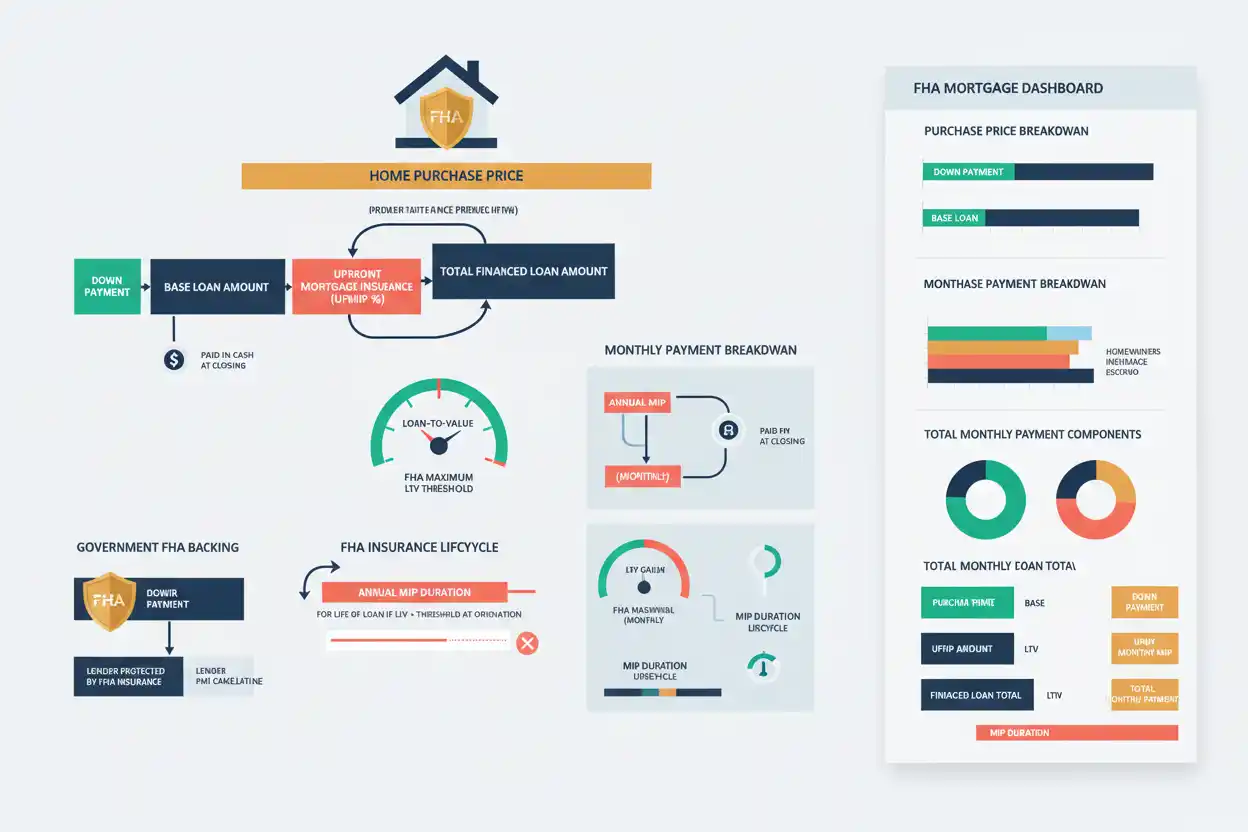

FHA loans are mortgages originated by private lenders and insured by the Federal Housing Administration.
FHA does not ordinarily lend the purchase money directly to the homebuyer. Instead, FHA mortgage insurance protects the lender against qualifying losses, which allows the program to support borrowers who may not fit conventional mortgage pricing or underwriting as easily.
FHA loans can allow down payments as low as 3.5%, and mortgage insurance is required for FHA loans.
The critical cost distinction is that FHA mortgage insurance can include both:
Upfront Mortgage Insurance Premium (UFMIP)
and:
Annual Mortgage Insurance Premium (Annual MIP)
Those insurance costs must be added to the interest rate and principal when comparing FHA with conventional financing.
What Is an FHA Loan?
An FHA loan is a mortgage insured by the Federal Housing Administration and funded by an FHA-approved private lender.
The FHA insurance relationship is designed to protect the mortgage lender, not to insure the borrower against losing the home.
CFPB describes FHA loans as private-lender mortgages insured by FHA and notes that they allow lower down payments and, generally, more flexible credit access than many conventional products.
FHA Down Payment
HUD states that FHA purchase financing can allow:
Minimum Down Payment = 3.5%
for qualifying borrowers and transactions.
Suppose:
Home price = $400,000
Then:
Down Payment = $400,000 × 3.5%
Down Payment = $14,000
Base mortgage before financed UFMIP:
Base Loan = $400,000 − $14,000
Base Loan = $386,000
This is a 96.5% base financing relationship.
FHA Upfront Mortgage Insurance Premium
HUD’s current FHA materials state that upfront MIP is required for most FHA Single Family mortgage-insurance programs. The standard forward-mortgage premium structure uses 1.75% of the base loan amount for typical transactions, with specified program exceptions.
The formula is:
UFMIP = Base Loan Amount × 1.75%
Using the $386,000 base loan:
UFMIP = $386,000 × 1.75%
UFMIP = $6,755
If financed into the mortgage:
Total Starting Mortgage = $386,000 + $6,755
Total Starting Mortgage = $392,755
The borrower did not receive another $6,755 for purchasing the home.
That amount represents financed mortgage-insurance cost.
Paying UFMIP in Cash vs Financing It
If UFMIP is paid in cash, the mortgage principal can remain at the base loan amount.
If financed:
Higher Mortgage Principal → Higher Principal-and-Interest Payment
Financing the premium also means interest is generated on that financed premium.
That is why FHA cost comparisons should distinguish:
base loan amount from total financed mortgage amount.
FHA Principal-and-Interest Example
Assume:
Financed mortgage = $392,755
Interest rate = 6.5%
Term = 30 years
The standard fixed-payment formula is:
Payment = P × [r(1 + r)^n] ÷ [(1 + r)^n − 1]
Principal-and-interest payment:
≈ $2,482.48 per Month
That figure does not yet include annual FHA mortgage insurance, property taxes, homeowners insurance, or other housing costs.
FHA Annual MIP
Annual mortgage insurance premium is generally calculated from the applicable FHA premium rate and mortgage balance methodology, then collected through monthly installments.
HUD’s current premium framework includes a 0.55% annual MIP for many typical FHA purchase mortgages with terms above 15 years and LTV above 95%, while other LTV, term, loan-size, and program combinations can use different rates.
Therefore:
Do Not Assume Every FHA Loan Has the Same Annual MIP Rate
The applicable FHA premium table should be checked for the actual transaction.
Simplified First-Year MIP Estimate
For the $386,000 base loan, using 0.55% as a simplified first-year approximation:
Approximate Annual MIP = $386,000 × 0.55%
Approximate Annual MIP = $2,123
Monthly approximation:
Approximate Monthly MIP = $2,123 ÷ 12
Approximate Monthly MIP ≈ $176.92
HUD’s actual periodic MIP methodology uses the applicable outstanding-balance calculation rather than simply charging the original balance multiplied by the rate forever.
Therefore, $176.92 should be treated as an easy planning estimate rather than the exact servicer calculation.
Approximate FHA Monthly Cost
Principal and interest:
$2,482.48
Simplified monthly MIP estimate:
$176.92
Combined:
$2,659.40
That still excludes:
property taxes, homeowners insurance, homeowners association fees, and other ownership costs.
The complete mortgage payment can therefore be materially higher.
FHA Mortgage Insurance Duration
FHA annual MIP does not automatically disappear simply because the mortgage reaches 80% LTV.
Under the current FHA premium framework, duration varies according to factors such as original LTV, mortgage term, and applicable premium category. For many FHA mortgages with an original LTV above 90%, annual MIP can continue for the mortgage term; certain loans with original LTV at or below 90% use an 11-year duration.
That is materially different from conventional PMI rules.
FHA Mortgage Insurance vs PMI
The dedicated mortgage insurance page owns the broad concept, while private mortgage insurance focuses on conventional PMI.
The distinction is:
FHA loan: government mortgage insurance under FHA rules.
Conventional loan: private mortgage insurance can apply when required.
Do not assume FHA annual MIP follows conventional PMI cancellation rules.
FHA Loans and Down Payments
The down payments decision is central to FHA comparison.
Suppose a buyer can afford either:
3.5% down FHA or 10% down conventional.
The answer cannot be determined from down payment alone.
Compare:
interest rate, mortgage insurance, points, closing costs, APR, and how long each insurance charge is expected to remain.
CFPB specifically advises borrowers to compare total FHA and conventional costs because either can be more attractive depending on borrower and market circumstances.
2026 FHA Loan Limits
FHA mortgage limits vary by county.
For calendar year 2026, HUD lists the one-unit nationwide FHA forward-mortgage floor at:
$541,287
and the one-unit high-cost ceiling at:
$1,249,125.
The applicable local limit must be checked for the property.
The high-cost ceiling should not be treated as the limit in every county.
FHA vs Conforming Loan
A conforming loan is conventional financing that fits Fannie Mae or Freddie Mac requirements.
FHA is government-insured financing.
Interestingly, the 2026 one-unit high-cost FHA ceiling and conforming high-cost ceiling are both $1,249,125, but that does not make the two programs equivalent.
They have different insurance, underwriting, and program structures.
FHA and Fixed-Rate Mortgages
A fixed-rate mortgage can be FHA-insured.
FHA describes the insurance program.
Fixed-rate describes the interest-rate structure.
A borrower can therefore have an FHA-insured fixed-rate mortgage.
FHA Adjustable Mortgages
FHA also permits eligible adjustable-rate mortgage products under its program rules.
The broader adjustable-rate mechanics belong to the adjustable-rate mortgage page.
A borrower should separately evaluate:
FHA insurance cost and future interest-rate adjustment risk.
FHA and Discount Points
Discount points can lower the interest rate in exchange for higher upfront mortgage cost.
Suppose:
Base mortgage = $386,000
One point = 1%
Point Cost = $3,860
That $3,860 is in addition to the FHA mortgage-insurance economics.
A lower rate can still be unattractive if the borrower will sell or refinance before the point cost reaches break-even.
FHA and Construction Loans
FHA has specialized financing programs that can support certain rehabilitation or construction-related transactions, but an ordinary construction loan should not automatically be assumed FHA-eligible.
HUD program requirements determine whether the specific project and structure qualify.
FHA and HELOC
A HELOC is a separate home-equity credit product.
It should not be confused with FHA first-mortgage insurance.
Adding a HELOC later creates additional property-secured debt and can change combined leverage.
FHA and LTV
The loan-to-value ratio matters because the 3.5% minimum down-payment example corresponds to approximately:
Base LTV = 96.5%
before considering the treatment of financed UFMIP under FHA’s applicable LTV rules.
HUD’s 203(b) materials describe approximately 96.5% financing for eligible borrowers.
FHA and Mortgage APR
The mortgage APR can help incorporate certain financing costs into an annualized comparison.
When comparing FHA and conventional offers, do not compare:
FHA note rate against conventional APR.
Use the same type of metric across both offers.
FHA and Closing Costs
Mortgage closing costs still apply to FHA transactions.
A low down payment does not mean the buyer needs only 3.5% of the purchase price in cash.
Closing costs, prepaids, reserves, and other transaction amounts can create additional cash requirements.
FHA and Mortgage Preapproval
A mortgage preapproval can help determine whether a borrower meets the lender’s FHA qualifications.
FHA insurance does not mean every applicant is automatically approved.
The lender still evaluates the mortgage under applicable FHA and lender requirements.
FHA and Mortgage Principal
The mortgage principal distinction is particularly important when UFMIP is financed.
Example:
Base loan = $386,000
Financed UFMIP = $6,755
Starting financed mortgage:
$392,755
Borrowers comparing balances should understand why the mortgage can begin above the base purchase-money amount.
FHA and Mortgage Affordability
Mortgage affordability should include annual MIP in the monthly housing cost.
A borrower who calculates affordability only from principal and interest can materially understate the required monthly payment.
Taxes and homeowners insurance must also be included separately.
FHA vs Conventional Example
Suppose FHA permits a 3.5% down payment while a conventional option requires or is being considered with a larger down payment.
FHA preserves more cash upfront.
The conventional option can potentially avoid FHA’s upfront and annual mortgage-insurance structure.
Neither outcome is universally cheaper.
The useful comparison is:
Total Cash at Closing + Monthly Cost + Expected Insurance Cost + Total Interest Over Expected Holding Period
Refinancing Out of FHA Insurance
A homeowner sometimes considers refinancing an FHA mortgage into conventional financing later.
That can potentially remove FHA annual MIP if the borrower qualifies for a suitable replacement mortgage.
However, refinancing introduces:
a new interest rate, new closing costs, a new amortization schedule, and possibly a longer term.
The refinancing decision should be based on total savings rather than mortgage insurance alone.
Common FHA Loan Mistakes
One mistake is assuming FHA lends the money directly.
Another is focusing on 3.5% down while ignoring mortgage insurance.
Borrowers also confuse UFMIP with annual MIP.
A fourth mistake is assuming FHA mortgage insurance automatically disappears at 80% LTV.
Finally, FHA and conventional financing should be compared using complete costs rather than interest rates alone.
Frequently Asked Questions
What is an FHA loan?
It is a mortgage from a private lender that is insured by the Federal Housing Administration.
What is the minimum FHA down payment?
Eligible transactions can permit:
3.5% Down.
What is FHA UFMIP?
It is the upfront mortgage insurance premium required for most FHA Single Family insured mortgages.
What is the standard upfront MIP rate for a typical forward FHA mortgage?
1.75% of the Base Loan Amount, subject to specified program exceptions.
Can UFMIP be financed?
HUD’s basic FHA program materials state that borrowers can finance the upfront mortgage insurance premium into the mortgage.
What is annual FHA MIP?
It is the recurring mortgage insurance premium calculated according to the applicable FHA premium category and balance methodology.
Is annual MIP always 0.55%?
No. While 0.55% applies to many common FHA purchase mortgages, rates vary with term, LTV, loan amount, and program.
Does FHA mortgage insurance disappear at 80% LTV?
Not automatically. FHA MIP duration follows FHA program rules rather than conventional PMI cancellation rules.
What is the 2026 FHA one-unit floor?
$541,287.
What is the 2026 FHA one-unit high-cost ceiling?
$1,249,125.
Is FHA always cheaper than conventional financing?
No. CFPB recommends comparing actual offers and total costs because the better option depends on borrower and market circumstances.
Can an FHA mortgage have a fixed interest rate?
Yes. FHA insurance and fixed-rate structure are separate mortgage characteristics.
Final Takeaway
FHA loans combine a relatively low down-payment option with mandatory mortgage insurance.
For a $400,000 home with 3.5% down:
Down payment:
$14,000
Base mortgage:
$386,000
Typical 1.75% UFMIP:
$6,755
If financed:
Starting Mortgage = $392,755
At an illustrative 6.5% fixed rate for 30 years, principal and interest are approximately:
$2,482.48 per Month
A simplified 0.55% first-year MIP estimate adds roughly:
$176.92 per Month
before taxes and homeowners insurance.
The headline 3.5% down payment therefore tells only part of the FHA story. A complete comparison must include UFMIP, annual MIP, interest rate, APR, loan limit, down payment, monthly payment, closing costs, and how long mortgage insurance is expected to remain.