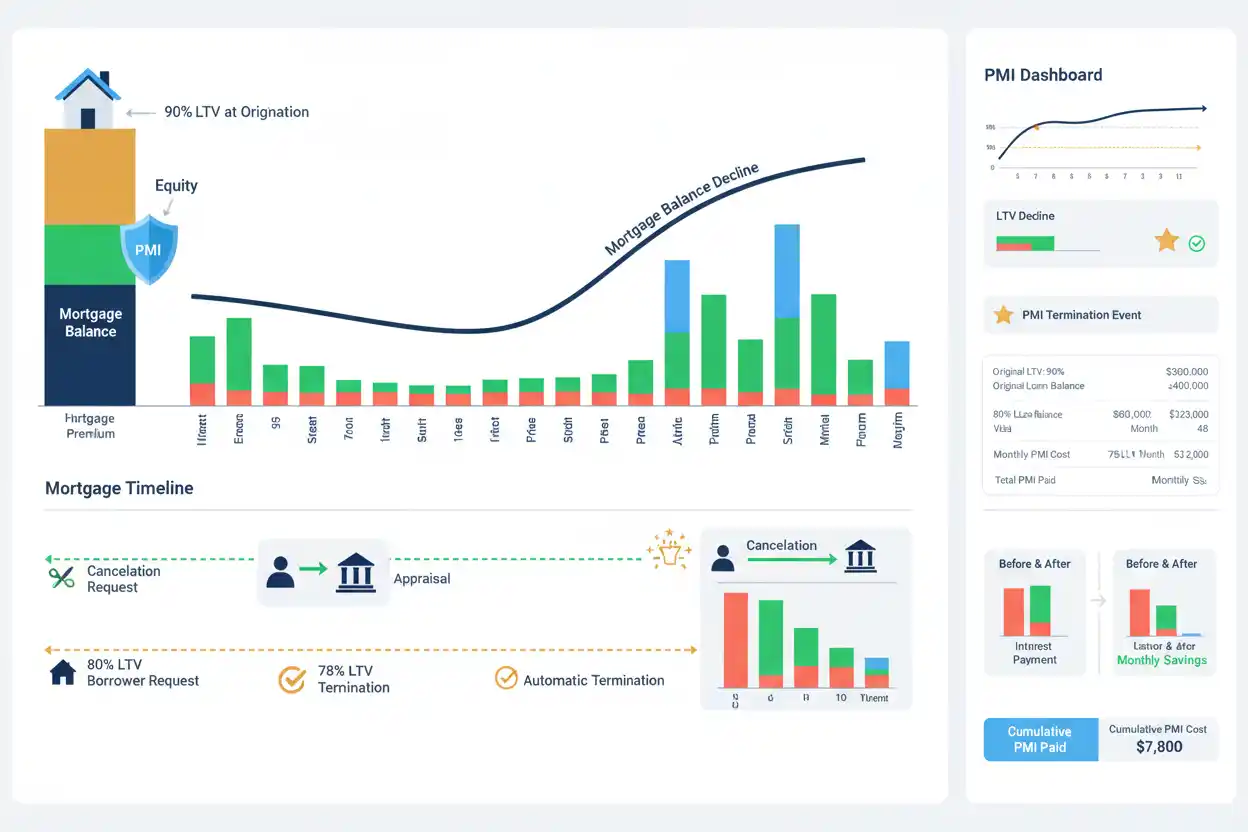

Private mortgage insurance, or PMI, is mortgage insurance commonly associated with conventional mortgages when the borrower’s equity at origination is relatively low.
PMI primarily protects the lender—not the homeowner—against specified losses if the borrower defaults.
CFPB’s current guidance states that borrowers with conventional loans and down payments below 20% will often be required to carry PMI, while cancellation and termination rights depend on federal law and the mortgage’s specific circumstances.
A useful planning formula is:
Estimated Annual PMI = Applicable Mortgage Balance × Annual PMI Rate
Then:
Estimated Monthly PMI = Annual PMI ÷ 12
Actual PMI pricing is lender-, insurer-, borrower-, and mortgage-specific.
PMI Cost Example
Suppose:
Home value = $500,000
Down payment = 10%
Mortgage principal = $450,000
Initial LTV:
LTV = $450,000 ÷ $500,000 × 100
LTV = 90%
Now assume an illustrative PMI rate of:
0.60% per Year
Annual PMI:
$450,000 × 0.60%
$2,700
Monthly estimate:
$2,700 ÷ 12
$225 per Month
This 0.60% rate is an educational assumption, not a universal PMI price.
PMI and the Mortgage Payment
Suppose:
Mortgage = $450,000
Rate = 6.5%
Term = 30 years
Principal-and-interest payment:
≈ $2,844.31
Add illustrative PMI:
$225
Combined before taxes and homeowners insurance:
≈ $3,069.31 per Month
The PMI payment does not reduce mortgage principal.
It is a separate insurance cost.
PMI vs Mortgage Insurance
Mortgage insurance is the broader category.
Private mortgage insurance is specifically associated with applicable conventional mortgages.
FHA mortgage insurance follows separate FHA rules.
Therefore:
PMI ≠ FHA MIP
This page owns conventional private mortgage insurance rather than government mortgage-insurance structures.
Borrower-Requested PMI Cancellation at 80%
For many mortgages covered by the Homeowners Protection Act, borrowers can request PMI cancellation once principal is scheduled to reach 80% of the home’s original value, or actually reaches that threshold earlier through additional principal payments, subject to statutory conditions. CFPB lists requirements including a written request, current/good payment history, no disqualifying junior liens, and evidence that property value has not fallen where required.
For a $500,000 original property value:
80% Threshold = $500,000 × 80%
$400,000
Starting mortgage:
$450,000
Principal reduction needed:
$450,000 − $400,000
$50,000
Automatic PMI Termination at 78%
For many covered mortgages, PMI generally must automatically terminate when the mortgage is scheduled to reach 78% of the home’s original value, provided the borrower is current.
For $500,000:
78% Threshold = $500,000 × 78%
$390,000
That is $10,000 below the borrower-requested 80% balance threshold.
80% vs 78%
The distinction is important.
80%
Potential Borrower-Requested Cancellation
subject to applicable conditions.
78%
Automatic Termination Based on the Scheduled Amortization Threshold
when applicable and the borrower is current.
Do not assume the lender must automatically terminate PMI the moment an extra payment causes the actual balance to hit 78%; the statutory automatic termination test focuses on the scheduled termination date.
Midpoint Termination
CFPB also states that PMI generally must end after the midpoint of the original amortization schedule if it has not already terminated, provided the borrower is current. For a 30-year mortgage, that midpoint occurs after 15 years.
This rule can become especially relevant for loans whose balances decline unusually slowly.
PMI Cancellation Example
Using:
Mortgage = $450,000
Rate = 6.5%
Term = 30 years
The scheduled balance falls below:
$400,000
around payment:
95
or approximately:
7 Years and 11 Months
The scheduled balance falls below:
$390,000
around payment:
109
or approximately:
9 Years and 1 Month
These are amortization estimates.
Actual PMI rights depend on the applicable legal and servicing requirements.
Extra Principal and PMI
Suppose after several years:
Current balance = $410,000
Original property value = $500,000
Additional principal required to reach 80%:
$410,000 − $400,000
$10,000
If the borrower pays $10,000 directly toward principal:
New Balance = $400,000
That can create eligibility to request PMI cancellation earlier if the other applicable conditions are satisfied.
PMI and Mortgage Recast
A mortgage recast can follow a substantial principal reduction.
The lump sum can simultaneously:
reduce the mortgage balance, lower LTV, and potentially move the borrower into PMI-cancellation territory.
However, PMI cancellation and recasting remain separate servicing decisions.
Do not assume one automatically triggers the other.
PMI and Mortgage Term
The mapped mortgage term affects how quickly principal declines.
A shorter term generally amortizes principal faster.
That can allow the mortgage to reach 80% or 78% of original property value sooner.
PMI and Rate-and-Term Refinance
A rate-and-term refinance produces a new mortgage with a new LTV calculation.
Suppose:
Home value = $500,000
Current mortgage = $375,000
New refinance LTV:
$375,000 ÷ $500,000 × 100
75%
Depending on the new conventional mortgage and underwriting, refinancing can eliminate the need for PMI.
But closing costs and the new interest rate must still be evaluated.
PMI and Refinancing
Refinancing solely to eliminate $150 or $200 of monthly PMI can be a bad deal if:
the new interest rate is worse, closing costs are high, or the mortgage term is extended significantly.
Always calculate the mortgage break-even point.
PMI and Mortgage Rate Lock
The mortgage rate lock can affect the mortgage’s final interest-rate pricing before closing.
PMI is a separate pricing component.
A borrower comparing offers should therefore evaluate:
note rate, APR, points, PMI, and total monthly payment.
A low locked rate does not make PMI disappear.
PMI and Down Payment
The down payments amount directly affects initial LTV.
On a $500,000 property:
5% down:
$475,000 Mortgage = 95% LTV
10% down:
$450,000 Mortgage = 90% LTV
20% down:
$400,000 Mortgage = 80% LTV
Larger down payments can therefore reduce or eliminate PMI exposure on applicable conventional mortgages.
PMI and Home Appreciation
Suppose:
Mortgage balance = $420,000
Original home value = $500,000
Current estimated value = $600,000
Current-value LTV would be:
$420,000 ÷ $600,000 × 100
70%
Certain investor or servicer guidelines can allow PMI termination based on current value under additional conditions, but those rules differ from the statutory original-value thresholds. Fannie Mae, for example, publishes separate current-value termination procedures.
Contact the servicer for the mortgage’s actual requirements.
PMI and Junior Liens
A home equity loan or HELOC can complicate borrower-requested cancellation.
CFPB specifically identifies certification that no junior liens exist as one of the requirements for the standard 80% borrower-request cancellation process it describes.
Therefore, a low first-mortgage balance alone may not be enough.
Does PMI Build Equity?
No.
Suppose:
Monthly PMI = $225
After one year:
$225 × 12 = $2,700
That $2,700 does not reduce mortgage principal.
It pays for mortgage-insurance coverage.
Common PMI Mistakes
One mistake is believing PMI protects the homeowner.
Another is assuming PMI automatically disappears at exactly 80%.
Borrowers also confuse the 80% borrower-request rule with the 78% automatic-termination rule.
A fourth mistake is applying conventional PMI rules to FHA MIP.
Finally, refinancing to eliminate PMI should not be evaluated without rate, fee, term, and break-even analysis.
Frequently Asked Questions
What is private mortgage insurance?
PMI is mortgage insurance that primarily protects the lender on applicable conventional mortgages.
When is PMI commonly required?
It commonly applies to conventional mortgages with less than 20% down, though actual requirements depend on the mortgage.
What is the basic PMI formula?
For planning:
Monthly PMI ≈ Mortgage Balance × Annual PMI Rate ÷ 12
Is 0.60% a standard PMI rate?
No. It is only an illustrative rate used in this example.
What is PMI on $450,000 at 0.60%?
$225 per Month
When can I request cancellation?
For many covered mortgages, at the 80% original-value threshold subject to applicable requirements.
When is PMI automatically terminated?
Generally at the scheduled 78% original-value threshold when the borrower is current on covered mortgages.
What is midpoint termination?
PMI generally must end after the midpoint of the original amortization schedule when applicable conditions are met.
Can extra principal remove PMI sooner?
It can help reach the 80% borrower-request threshold sooner, subject to the other requirements.
Can home appreciation help?
Some investor/servicer programs permit current-value cancellation under separate rules.
Is PMI the same as FHA mortgage insurance?
No.
Does PMI reduce my mortgage balance?
No.
Final Takeaway
Private mortgage insurance increases the cost of conventional financing when borrower equity is relatively low.
For a:
$500,000 Home
with:
10% Down
the mortgage is:
$450,000
and LTV is:
90%
At an illustrative 0.60% annual PMI rate:
PMI ≈ $225 per Month
For many covered mortgages:
80% of Original Value = Borrower-Request Threshold
while:
78% of Original Value = Scheduled Automatic-Termination Threshold
subject to the applicable statutory conditions.
The strongest PMI strategy is to track principal balance, original property value, payment history, junior liens, current servicer requirements, and the economics of extra principal versus refinancing.