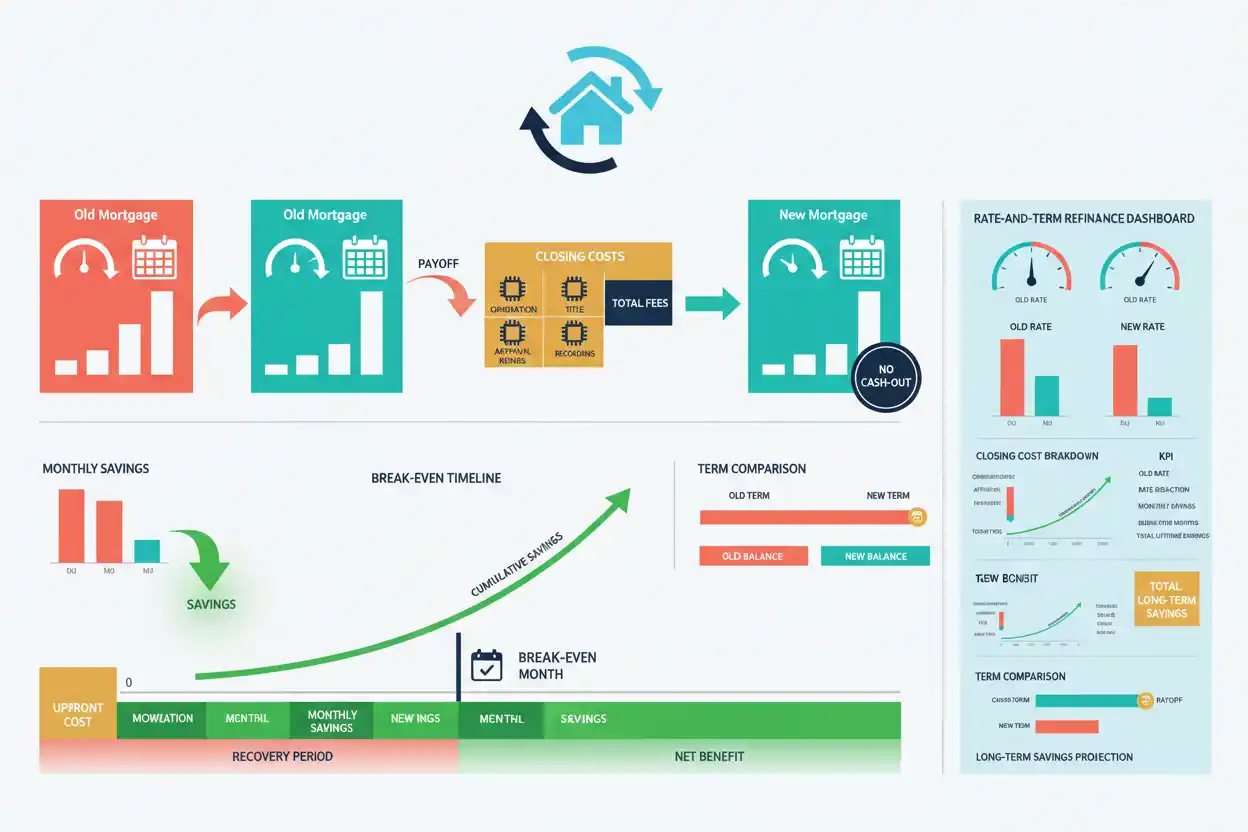

A rate-and-term refinance replaces an existing mortgage primarily to change its interest rate, repayment term, or both rather than to extract substantial home equity as cash.
The economic objective is usually one or more of the following:
lower the mortgage rate, reduce the required payment, shorten the repayment period, or move to a more stable mortgage structure.
Fannie Mae’s current limited-cash-out refinance rules, for example, explicitly permit modifying the interest rate and/or term and paying off the existing first mortgage, while allowing only limited incidental cash back under that specific program.
Because program terminology differs, “rate-and-term refinance” should be understood conceptually rather than assumed to have one universal cash-back rule across every lender and mortgage program.
Rate-and-Term Refinance Formula
The new payment is calculated using the replacement mortgage:
New Payment = P × [r(1 + r)ⁿ] ÷ [(1 + r)ⁿ − 1]
Then:
Monthly Savings = Old Payment − New Payment
A simple break-even formula is:
Break-Even Months = Refinance Costs ÷ Monthly Savings
This assumes the lower payment represents genuine comparable savings rather than merely extending the mortgage term.
Rate-and-Term Refinance Example
Suppose:
Current mortgage balance = $300,000
Current rate = 7.25%
Remaining term = 25 years
Current monthly principal-and-interest payment:
≈ $2,168.42
Now suppose the borrower refinances:
New principal = $300,000
New rate = 6.25%
New term = 25 years
Closing costs paid in cash = $7,000
New payment:
≈ $1,979.01
Monthly savings:
$2,168.42 − $1,979.01
≈ $189.41
Break-Even Point
Break-Even = $7,000 ÷ $189.41
≈ 37 Months
That is approximately:
3 Years and 1 Month
If the borrower expects to keep the new mortgage for substantially longer than 37 months, the refinance has time to recover its $7,000 costs through the modeled payment savings.
Remaining Interest Comparison
If the original 7.25% mortgage continues for its remaining 25 years:
Approximate remaining interest:
$350,526.18
If refinanced to 6.25% for the same 25-year remaining term:
Approximate interest on the new mortgage:
$293,702.44
Difference before closing costs:
≈ $56,823.74
Subtract $7,000 of refinance costs:
Simplified Long-Term Benefit ≈ $49,823.74
assuming the replacement mortgage remains outstanding for all 25 years and the modeled assumptions hold.
Why Matching the Remaining Term Matters
Suppose the existing mortgage has:
25 Years Remaining
Refinancing into another 25-year term gives a relatively clean comparison.
If the borrower instead refinances into a new 30-year mortgage, the payment can fall partly because the debt is being stretched over an additional five years.
CFPB specifically warns refinance borrowers to determine how much of a lower payment comes from a lower rate versus a longer mortgage term.
Shortening the Term
Suppose the same $300,000 balance is refinanced at 6.25% for 20 years.
Payment:
≈ $2,192.78
That is slightly higher than the existing $2,168.42 payment.
However, approximate total interest over 20 years is:
$226,268.31
Compared with continuing the old 25-year mortgage:
$350,526.18
Potential interest reduction before refinance costs:
≈ $124,257.87
The refinance can therefore improve long-term economics even without reducing the monthly payment.
Rate-and-Term Refinance vs General Refinancing
Refinancing is the broader category.
It can include:
rate-and-term refinance, cash-out refinance, or other program-specific refinance structures.
This page remains narrowly focused on changing rate and term without making equity extraction the primary purpose.
Rate-and-Term vs Cash-Out Refinance
A cash-out refinance intentionally increases or restructures mortgage debt to return significant equity proceeds to the borrower.
Rate-and-term refinancing instead centers on improving the financing of the existing mortgage balance.
That difference matters when comparing payments.
A cash-out refinance can show a higher payment simply because the borrower has taken on more debt.
Rate-and-Term Refinance and Mortgage Term
The mapped mortgage term is one of the two central variables.
A refinance can move:
30 years → 20 years
or:
ARM structure → 30-year fixed structure.
The correct comparison should show:
new payment and new total interest.
A lower payment alone is incomplete.
Rate-and-Term Refinance and Private Mortgage Insurance
Private mortgage insurance can change when a new conventional mortgage is originated.
Suppose:
Home value = $500,000
Refinance balance = $375,000
New LTV:
$375,000 ÷ $500,000 × 100
75%
The new mortgage may not need the same PMI structure as the old one, depending on underwriting and program requirements.
Eliminating PMI can add to monthly refinance savings.
Rate-and-Term Refinance and Mortgage Recast
A mortgage recast is an alternative when the borrower has a large lump sum and wants a lower payment without replacing the existing mortgage.
The distinction is:
Recast = Keep Existing Rate, Reduce Principal, Recalculate Payment
Refinance = Replace Existing Loan With New Terms
If the existing mortgage rate is already excellent, recasting can preserve valuable pricing.
Rate-and-Term Refinance and Renting vs Buying
The mapped renting vs buying relationship matters because refinancing changes the future ownership cost of the property.
A lower rate can improve the long-term cost case for keeping the home.
However, if the homeowner expects to sell soon, refinance closing costs can reduce or eliminate the benefit.
Expected holding period belongs in both analyses.
Rate-and-Term Refinance and Mortgage Break-Even
The mortgage break-even point is essential whenever upfront costs are exchanged for future savings.
If:
Costs = $7,000
Monthly savings = $189.41
then:
Break-Even ≈ 37 Months
Do not refinance for a $189 monthly saving if you are highly likely to sell 12 months later unless another benefit justifies the transaction.
Rate-and-Term Refinance and Mortgage APR
Compare the mortgage APR as well as the note rate.
A refinance advertised at 6.00% with substantial points can cost more upfront than a 6.25% offer with few fees.
The lowest advertised rate does not automatically create the fastest break-even.
Rate-and-Term Refinance and Mortgage Points
Mortgage points can create a second break-even calculation.
Suppose an additional $3,000 of points saves another:
$50 per Month
Point break-even:
$3,000 ÷ $50
60 Months
The borrower should plan to keep the loan long enough to recover both the base refinance costs and any optional point cost.
Rate-and-Term Refinance and Closing Costs
Mortgage closing costs can include lender charges, third-party services, and other settlement items.
When calculating refinance economics, separate genuine transaction costs from escrow funding or prepaid expenses that may represent timing rather than permanent economic loss.
Rate-and-Term Refinance and Rate Locks
Once the borrower selects a refinance offer, the mortgage rate lock can matter before closing.
A refinance that looks attractive at 6.25% may not remain equally attractive if the rate is left unlocked and rises materially.
Rate-and-Term Refinance and Principal
Use the actual mortgage payoff amount when determining how much the new mortgage needs to replace.
The principal balance shown online can differ from the exact amount needed to settle the old loan.
When Rate-and-Term Refinancing Makes Sense
It can be attractive when:
the new rate is materially lower, the mortgage will remain outstanding beyond break-even, the new term fits the borrower’s goals, closing costs are reasonable, or the refinance eliminates an undesirable loan feature.
It can also make sense when monthly payment stays similar but the mortgage is paid off substantially faster.
When It May Not Make Sense
A refinance can be unattractive when:
the borrower already has a much lower rate, expects to sell soon, has very high closing costs, restarts a long term unnecessarily, or gives up favorable mortgage features.
Frequently Asked Questions
What is a rate-and-term refinance?
It replaces an existing mortgage primarily to change the interest rate, repayment term, or both.
Does it provide cash to the borrower?
Substantial equity extraction is not the main purpose. Specific programs can allow limited incidental cash back under their own rules.
What is the payment in the example before refinancing?
≈ $2,168.42
What is the new payment?
≈ $1,979.01
What is the monthly saving?
≈ $189.41
What is the break-even with $7,000 of costs?
≈ 37 Months
Can a refinance shorten the mortgage term?
Yes.
Can a refinance increase the monthly payment but still save money?
Yes. A shorter term can raise the payment while materially reducing lifetime interest.
Is rate-and-term refinance the same as cash-out refinance?
No.
Can refinancing remove PMI?
A new conventional refinance can have a different PMI requirement based on its own LTV and underwriting.
Is recasting an alternative?
Potentially, especially when the existing rate is favorable and the borrower has cash to reduce principal.
Should I restart a new 30-year term?
Not automatically. Compare the remaining old term with the proposed new term and total interest.
Final Takeaway
A rate-and-term refinance should improve the financing structure, not merely make the monthly payment look smaller.
In the example:
Current mortgage = $300,000 at 7.25%, 25 years remaining
Current payment ≈ $2,168.42
New mortgage:
$300,000 at 6.25% for 25 Years
New payment:
≈ $1,979.01
Monthly savings:
≈ $189.41
With $7,000 of refinance costs:
Break-Even ≈ 37 Months
The strongest analysis keeps the old and new terms comparable and measures rate, monthly payment, closing costs, PMI, remaining principal, total interest, and realistic holding period rather than choosing a refinance solely from the advertised rate.