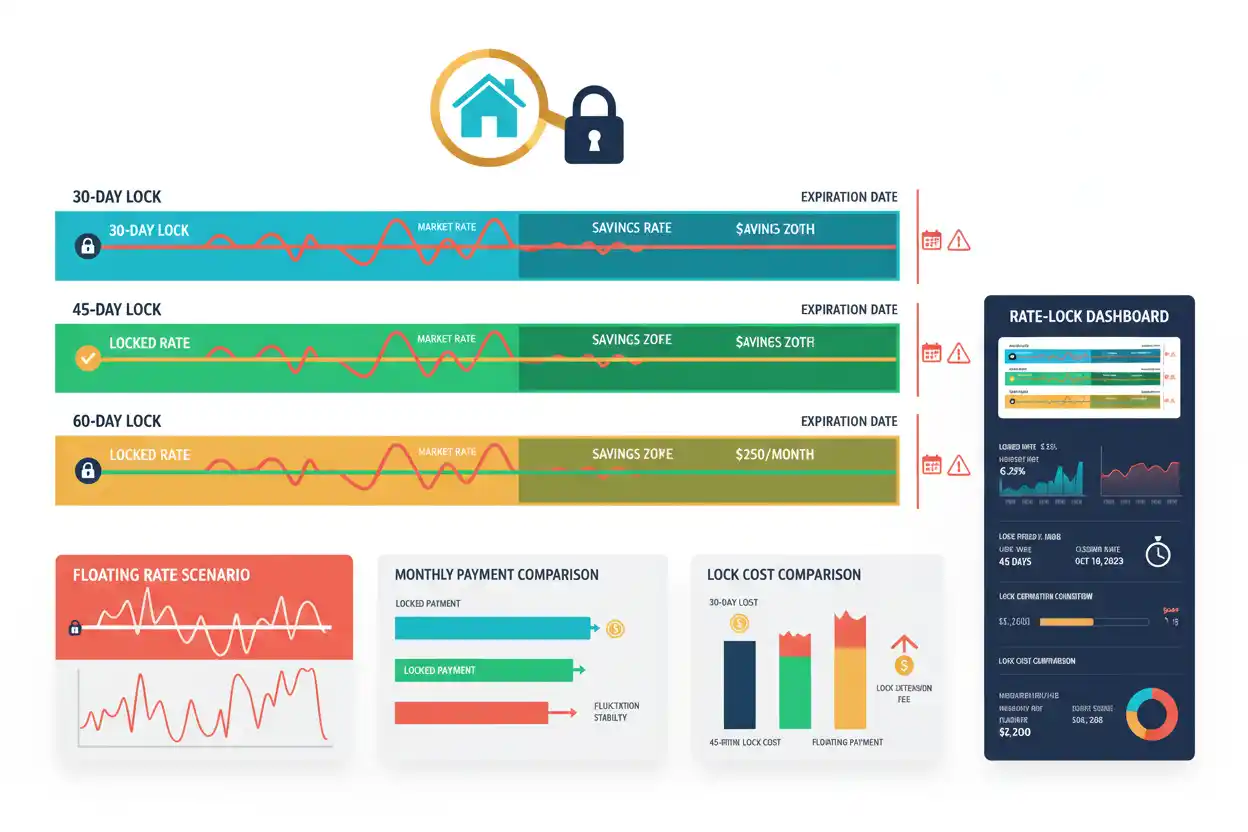

A mortgage rate lock is an agreement that protects specified mortgage interest-rate pricing for a defined period before closing, subject to the lock’s terms and there being no disqualifying changes to the application.
CFPB explains that a rate lock generally means the mortgage interest rate will not change between the lock and closing as long as the borrower closes within the specified time frame and the application does not materially change in a way that affects the lock.
A rate lock therefore protects against one specific risk:
Market Mortgage Rates Rising Before Closing
It can also create an opportunity cost if market rates fall and the lock does not include an applicable float-down or repricing feature.
Mortgage Rate Lock Example
Suppose a borrower plans to take a:
Mortgage principal = $400,000
Term = 30 years
The lender offers:
6.25% Locked Rate
Without a lock, suppose the market-compatible rate later rises to:
6.75%
Payment at 6.25%:
≈ $2,462.87
Payment at 6.75%:
≈ $2,594.39
Difference:
$2,594.39 − $2,462.87
≈ $131.52 per Month
The rate lock protects approximately $131.52 of monthly principal-and-interest cost in this hypothetical scenario.
Annual Payment Difference
$131.52 × 12
≈ $1,578.28 per Year
Over the first five years:
≈ $7,891
of gross scheduled payment difference.
This does not represent a universal “value” of the lock because principal amortization and any lock cost also matter.
It does show why even a half-percentage-point rate change can be financially meaningful on a large mortgage.
What Does a Rate Lock Protect?
The mortgage rate lock primarily protects the agreed mortgage pricing during the lock window.
CFPB notes that mortgage rates can change frequently and that an unlocked rate can change before closing.
Therefore:
Unlocked Mortgage = Exposed to Rate Changes Before Closing
while:
Locked Mortgage = Protected Under the Lock Terms
Common Lock Periods
CFPB states that rate locks are commonly available for periods such as 30, 45, or 60 days, with longer periods sometimes available.
The specific lender decides what lock periods and pricing it offers.
A longer lock can sometimes cost more or come with different rate pricing.
There is no universal extension or lock-fee formula.
Rate Lock and Closing Date
A lock must last long enough to cover the expected closing process.
Suppose:
Lock begins = September 1
Lock period = 30 days
Expected closing = October 10
A 30-day lock would expire before the expected closing.
The borrower should therefore evaluate:
a longer initial lock, later locking, or the lender’s extension terms.
The right timing depends on the transaction.
Rate Lock Expiration
If the mortgage does not close before the lock expires, the borrower can face:
an extension charge, repricing, a new lock, or another lender-specific outcome.
CFPB advises borrowers to understand how long the lock lasts and what happens if closing is delayed.
Do not assume an expired lock extends automatically.
Illustrative Lock Extension Cost
Suppose a lender—not as a universal market standard—quotes an extension fee of:
0.25% of the $400,000 Mortgage
Illustrative extension cost:
$400,000 × 0.25%
$1,000
If the extension protects a materially lower interest rate, that $1,000 could be worthwhile.
If the market rate has fallen, paying the extension can be less attractive depending on lender rules and alternatives.
The actual lender’s written extension terms control.
Rate Lock and Mortgage Principal
The mapped mortgage principal is the debt amount being financed.
The larger the principal, the larger the dollar effect of a rate movement.
Compare:
$200,000 mortgage versus $800,000 mortgage.
A 0.50 percentage-point rate change has a much larger monthly dollar effect on the $800,000 mortgage.
Rate risk therefore scales with principal.
Rate Lock and Mortgage Points
Mortgage points can be part of the locked mortgage pricing.
A quote might be:
6.25% with one point
rather than simply:
6.25%.
CFPB’s Loan Estimate guidance advises checking the top of page 1 to see whether the rate is locked and until when, while the mortgage-cost sections show associated points and charges.
Therefore, record the complete combination:
Rate + Points/Credits + Lock Period
Rate Lock and Preapproval
A mortgage preapproval does not automatically mean the mortgage rate is locked.
CFPB distinguishes the preapproval process from later mortgage-offer and rate-lock decisions.
A buyer can therefore have:
a preapproval letter but no locked rate.
If market rates move materially, affordability assumptions can change.
Rate Lock and Mortgage Term
The mortgage term is another part of the pricing package.
A rate quoted for:
30-year fixed
should not be compared casually with:
15-year fixed.
The lock applies to the specific mortgage terms being offered.
Changing the loan structure can require different pricing.
Rate Lock and Mortgage Recast
A mortgage recast generally occurs after closing on an existing eligible mortgage.
The original pre-closing rate lock is no longer the central issue.
A recast typically preserves the existing contractual mortgage rather than replacing it with current market pricing.
This makes recast distinct from refinancing.
Rate Lock and Fixed-Rate Mortgages
A pre-closing rate lock and a fixed-rate mortgage are related but different.
Rate lock: protects pricing before the loan closes.
Fixed-rate mortgage: determines rate behavior after closing.
Once the fixed-rate mortgage closes, its contractual rate governs according to the loan terms.
Rate Lock and Adjustable-Rate Mortgages
An adjustable-rate mortgage can also have initial pricing locked before closing.
The lock protects the initial transaction pricing.
It does not convert the future ARM into a permanently fixed-rate mortgage.
Later adjustments follow the ARM contract.
What If Rates Fall After You Lock?
A basic rate lock protects against rising rates.
It does not automatically guarantee the borrower a lower rate if market pricing falls.
Some lenders can offer:
float-down, renegotiation, or repricing options.
Those features are lender-specific.
The borrower should ask for the policy in writing rather than assume a lower market rate will automatically replace the lock.
Rate Lock and Loan Estimate
CFPB states that the Loan Estimate shows whether the rate is locked and the date through which the lock applies.
This makes the Loan Estimate one of the first places to verify:
locked or unlocked status.
Do not rely only on a verbal conversation.
Application Changes Can Affect a Lock
CFPB’s rate-lock guidance states that the rate generally remains protected provided the borrower closes within the specified period and there are no changes to the application that affect the lock.
Potential transaction changes should therefore be discussed with the lender before assuming the original pricing remains intact.
Mortgage Rate Lock Break-Even
Suppose a longer lock costs:
$1,000
and protects a payment that would otherwise be:
$131.52 Higher per Month
A rough recovery period is:
$1,000 ÷ $131.52
≈ 7.6 Months
If the protected lower rate remains on a 30-year mortgage, that extension cost could recover quickly in this hypothetical scenario.
However, the rate increase is not known in advance.
Rate locks manage uncertainty; they are not guaranteed profit opportunities.
Should You Lock Immediately?
There is no universal answer.
Locking earlier reduces exposure to rising rates.
Waiting preserves the possibility of benefiting from falling rates.
The relevant considerations include:
closing timeline, available lock periods, current pricing, lender extension policy, points, borrower risk tolerance, and how sensitive the payment is to rate changes.
Common Mortgage Rate Lock Mistakes
One mistake is assuming a preapproval automatically locks the rate.
Another is accepting a lock that expires before the realistic closing date.
Borrowers also compare rates without comparing points and lock periods.
A fourth mistake is assuming a lower market rate after locking automatically applies.
Finally, verbal rate discussions should be confirmed against written mortgage disclosures.
Frequently Asked Questions
What is a mortgage rate lock?
It is an agreement protecting specified mortgage rate pricing between locking and closing under the lock’s conditions.
How long does a mortgage rate lock last?
CFPB notes that 30-, 45-, and 60-day periods are common, with longer periods sometimes available.
What happens if the rate is not locked?
It can change before closing.
Does preapproval mean my rate is locked?
No.
Where can I check lock status?
The Loan Estimate identifies whether the interest rate is locked and the relevant expiration information.
Can my locked rate change if my application changes?
Certain changes can affect pricing or lock treatment under the lender’s terms.
What happens when a lock expires?
The lender’s extension and repricing rules determine the outcome.
Are rate-lock extension fees standardized?
No. Actual costs and terms vary by lender.
Does one mortgage rate lock cost the same as another?
No. Pricing can vary with duration, mortgage characteristics, lender, and market conditions.
What if rates fall after I lock?
Any float-down or repricing opportunity depends on the lender’s specific policy.
Does a rate lock continue after closing?
After closing, the mortgage contract governs. A fixed-rate mortgage then keeps its contractual rate according to its terms.
Why does rate lock matter on a large mortgage?
Because even small rate changes can create large dollar differences in payment and lifetime interest.
Final Takeaway
A mortgage rate lock protects the borrower from adverse mortgage-rate movement during a defined pre-closing period, subject to its terms.
For a $400,000, 30-year mortgage:
At 6.25%:
Payment ≈ $2,462.87
At 6.75%:
Payment ≈ $2,594.39
Difference:
≈ $131.52 per Month
That is approximately:
$1,578 per Year
of scheduled payment difference.
The strongest rate-lock decision therefore compares the locked rate, points or lender credits, lock duration, expected closing date, extension rules, and the financial effect of a rate movement on your specific mortgage principal.