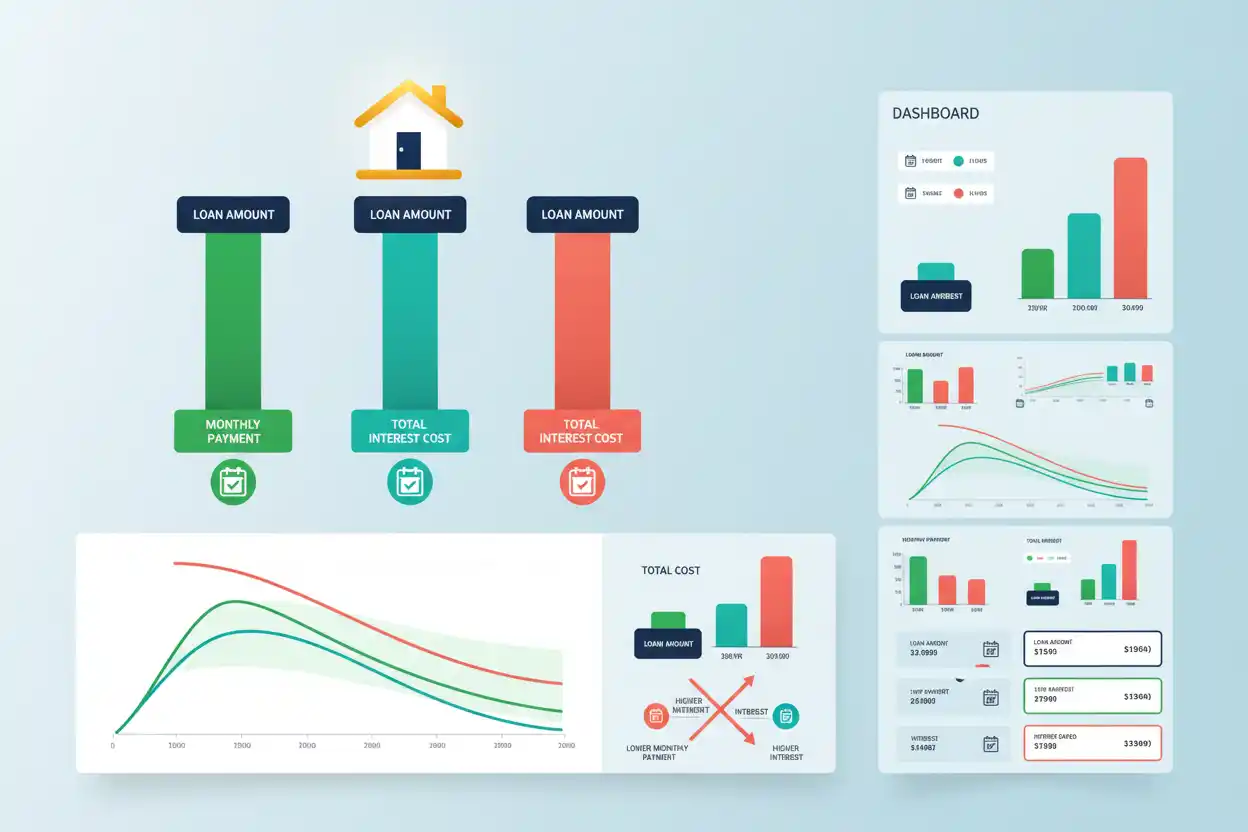

Mortgage term is the length of time scheduled for repayment of a mortgage.
CFPB’s mortgage terminology identifies 15-, 20-, and 30-year terms as common home-loan structures, while other terms can also be available.
Mortgage term directly affects two major numbers:
Monthly Payment
and:
Total Interest
For the same principal and rate:
Longer Term → Lower Required Monthly Payment, More Time for Interest
Shorter Term → Higher Required Monthly Payment, Less Time for Interest
Mortgage Term Formula
The payment formula is:
Monthly Payment = P × [r(1 + r)ⁿ] ÷ [(1 + r)ⁿ − 1]
The mortgage term controls n.
For monthly payments:
n = Mortgage Term in Years × 12
Therefore:
15-year mortgage:
n = 180
20-year mortgage:
n = 240
30-year mortgage:
n = 360
Mortgage Term Example
Suppose:
Mortgage principal = $400,000
Interest rate = 6.5%
For illustration, the same rate is used across every term so the effect of term length can be isolated.
Actual mortgage pricing can differ by term; CFPB notes that shorter-term mortgages are often offered at lower rates than longer-term mortgages.
30-Year Mortgage
Principal = $400,000
Rate = 6.5%
Payments = 360
Monthly payment:
≈ $2,528.27
Total payments:
≈ $910,177.95
Total interest:
≈ $510,177.95
20-Year Mortgage
Payments:
240
Monthly payment:
≈ $2,982.29
Total interest:
≈ $315,750.21
Compared with the 30-year mortgage:
Monthly payment increases by:
$2,982.29 − $2,528.27
≈ $454.02
Interest falls by approximately:
$510,177.95 − $315,750.21
≈ $194,427.74
15-Year Mortgage
Payments:
180
Monthly payment:
≈ $3,484.43
Total interest:
≈ $227,197.30
Compared with the 30-year version:
Monthly payment increases:
$3,484.43 − $2,528.27
≈ $956.16
Lifetime interest decreases:
$510,177.95 − $227,197.30
≈ $282,980.65
This is the central mortgage-term tradeoff.
Mortgage Term Comparison
| Term | Approx. Monthly P&I | Approx. Total Interest |
|---|---|---|
| 30 Years | $2,528.27 | $510,177.95 |
| 20 Years | $2,982.29 | $315,750.21 |
| 15 Years | $3,484.43 | $227,197.30 |
The rate is deliberately held at 6.5% in all three examples.
In real mortgage offers, the interest rate itself can change by term. CFPB’s current consumer guidance notes that shorter terms generally have higher monthly payments but lower total costs and are often offered with lower interest rates.
Mortgage Term and Principal Reduction
The mortgage principal declines much faster with the shorter mortgage.
Why?
A larger monthly payment leaves more money available to repay principal after interest is satisfied.
Therefore:
Shorter Term → Faster Amortization
The borrower builds equity from debt reduction faster.
Mortgage Term and Mortgage Interest
The mortgage interest cost falls dramatically with a shorter term because principal remains outstanding for fewer years.
The 15-year example saves almost:
$283,000
of interest compared with the 30-year version when the rate is held constant.
That difference is much larger than many borrowers expect.
Mortgage Term and Mortgage Amortization
Mortgage amortization explains how each payment is divided between interest and principal.
With a shorter term:
the scheduled payment is higher and principal must decline quickly enough to reach zero in fewer months.
With a longer term:
principal reduction can occur much more slowly, particularly during the early years.
Mortgage Term and Affordability
The advantage of a 30-year term is cash-flow flexibility.
A $956 monthly difference between the 15- and 30-year examples can be significant.
The mortgage affordability decision should therefore ask whether the household can sustain the higher payment without sacrificing:
emergency reserves, retirement saving, insurance, maintenance, or other important obligations.
Mortgage Term and Private Mortgage Insurance
The mapped private mortgage insurance relationship matters because faster principal repayment can reach PMI cancellation thresholds sooner.
For many covered conventional mortgages, borrower-requested cancellation can become available at the 80% original-value threshold subject to applicable conditions, while automatic termination generally applies when scheduled principal reaches 78% if the borrower is current.
A shorter mortgage can reach those principal thresholds much earlier.
Mortgage Term and Mortgage Recast
A mortgage recast generally keeps the remaining mortgage term while recalculating payment after a substantial principal reduction.
Suppose:
25 years remain before recast.
The new payment is normally calculated across those remaining 25 years rather than automatically starting a new 30-year term.
This preserves the original maturity structure.
Mortgage Term and Rate-and-Term Refinance
A rate-and-term refinance can intentionally change the mortgage term.
For example:
25 years remaining → new 20-year mortgage.
That can allow the borrower to obtain a lower rate while also accelerating payoff.
However, refinancing into a new 30-year loan when only 20 years remain can extend repayment significantly.
Mortgage Term and Refinancing
CFPB warns borrowers evaluating refinancing to determine whether a lower payment results from a lower interest rate or merely from extending the loan term.
Suppose:
Existing payment = $2,500 with 15 years remaining.
New refinance payment = $2,000 over 30 years.
The $500 reduction is not necessarily pure savings.
Part of it can come from doubling the remaining repayment horizon.
Mortgage Term and Mortgage Rate Lock
The mortgage rate lock applies to a specific financing structure.
A lender’s 15-year and 30-year mortgages can carry different rates and point requirements.
Therefore, compare:
same mortgage term, same rate-lock period, and similar point structure
when shopping lenders.
Mortgage Term and Fixed-Rate Mortgage
A fixed-rate mortgage can use any of several available terms.
The rate type tells you whether interest changes.
The mortgage term tells you how long repayment is scheduled to last.
These characteristics should never be treated as the same thing.
Mortgage Term and Adjustable-Rate Mortgage
An adjustable-rate mortgage can have a 30-year overall term while its interest rate resets periodically.
Therefore:
Mortgage Term ≠ Fixed-Rate Period
A 5/6 ARM can still have a 30-year mortgage term even though the initial rate is fixed for only five years.
Mortgage Term and Balloon Loans
A balloon mortgage illustrates another important distinction.
Its legal maturity can be shorter than the period used to calculate regular payments.
That creates a final balloon balance.
Therefore, borrowers must understand both:
actual maturity and amortization structure.
Mortgage Term and Total Cash Flow
Long-term borrowing makes today’s payment easier but increases the number of payments.
For the same $400,000 at 6.5%:
30 years:
360 Payments
15 years:
180 Payments
The 30-year borrower makes twice as many scheduled monthly payments.
Choosing a Term Based on Flexibility
Some borrowers choose a 30-year mortgage but voluntarily make extra principal payments.
That can create:
a lower contractual minimum payment plus optional accelerated repayment.
However, this strategy requires discipline.
A formal 15-year loan forces the faster schedule.
A 30-year loan does not.
Common Mortgage Term Mistakes
One mistake is choosing a term solely from the monthly payment.
Another is assuming the interest rate will be identical across terms.
Borrowers also refinance into a longer term without recognizing how much additional interest that can create.
A fourth mistake is confusing ARM adjustment periods with the mortgage term.
Finally, the shortest mortgage term is not automatically appropriate if the required payment leaves inadequate liquidity.
Frequently Asked Questions
What is a mortgage term?
It is the period scheduled for repayment of the mortgage.
What mortgage terms are common?
CFPB identifies 15-, 20-, and 30-year terms as common structures, while other terms can also exist.
Does a longer term lower the monthly payment?
For the same principal and rate, yes.
Does a longer term increase total interest?
Generally yes because the principal remains borrowed for longer.
What is the payment on $400,000 at 6.5% for 30 years?
≈ $2,528.27
What is the payment over 15 years?
≈ $3,484.43
using the same illustrative 6.5% rate.
How much interest does the 15-year example save?
Approximately:
$282,981
compared with the 30-year version at the same rate.
Does a shorter term always have the same interest rate?
No. Lenders can price terms differently, and shorter terms are often offered with lower rates.
Can refinancing change mortgage term?
Yes.
Does recasting change mortgage term?
A straightforward recast generally uses the remaining term rather than replacing the mortgage with a new term.
Is mortgage term the same as ARM fixed period?
No.
Which mortgage term is best?
The appropriate term depends on payment capacity, rate, total interest, liquidity, financial goals, and expected holding period.
Final Takeaway
Mortgage term controls how quickly principal must be repaid.
On $400,000 at 6.5%:
30 years:
$2,528.27 per Month
$510,177.95 Total Interest
20 years:
$2,982.29 per Month
$315,750.21 Total Interest
15 years:
$3,484.43 per Month
$227,197.30 Total Interest
A longer term buys lower required payments.
A shorter term buys faster equity growth and substantially lower lifetime interest.
The strongest choice balances monthly affordability against the total cost of keeping principal outstanding for many additional years.