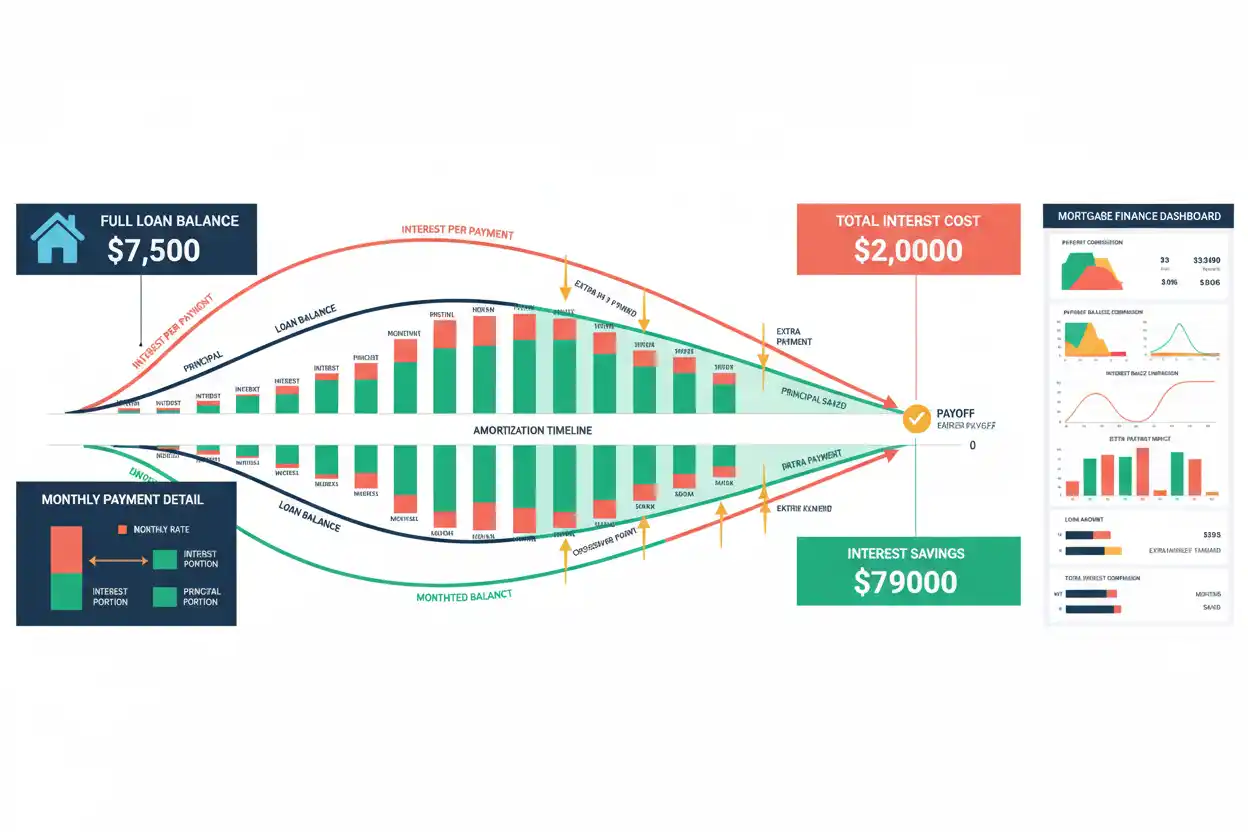

Mortgage interest is the cost a lender charges for allowing you to borrow money secured by real estate.
For a standard fixed-rate mortgage, interest is calculated from the outstanding principal balance. As that balance declines through scheduled principal payments, the dollar amount of interest charged each month generally declines as well.
The basic monthly relationship is:
Monthly Mortgage Interest = Outstanding Principal × Annual Interest Rate ÷ 12
Suppose:
Mortgage balance = $400,000
Annual interest rate = 6.5%
Then the first month’s interest is:
Mortgage Interest = $400,000 × 6.5% ÷ 12
Mortgage Interest = $2,166.67
If the scheduled principal-and-interest payment is approximately $2,528.27, the remainder reduces principal:
Principal Repaid = $2,528.27 − $2,166.67
Principal Repaid ≈ $361.61
CFPB explains the same underlying mortgage structure: part of a typical mortgage payment goes to principal and part to interest, while the principal portion reduces the amount owed.
What Is Mortgage Interest?
Mortgage interest is different from mortgage principal.
Principal is the amount borrowed and still owed.
Interest is the financing cost charged for borrowing that principal.
The Mortgages & Home Loans pillar connects these concepts across the broader mortgage lifecycle, while this page focuses specifically on calculating and interpreting mortgage interest.
A payment can be large without producing an equally large reduction in debt because interest must also be paid.
Mortgage Interest Formula
For a simplified monthly fixed-rate calculation:
Interestₜ = Beginning Mortgage Balanceₜ × Annual Rate ÷ 12
Suppose:
Beginning balance = $350,000
Rate = 6%
Then:
Monthly Interest = $350,000 × 6% ÷ 12
Monthly Interest = $1,750
If the scheduled payment is $2,098:
Principal Reduction = $2,098 − $1,750
Principal Reduction = $348
The next month’s interest is calculated from approximately:
$350,000 − $348 = $349,652
This creates the declining-interest pattern found in conventional mortgage amortization.
Complete Mortgage Interest Example
Assume:
Mortgage principal = $400,000
Fixed annual rate = 6.5%
Term = 30 years
Payments = monthly
The standard fixed mortgage payment formula is:
Payment = P × [r(1 + r)ⁿ] ÷ [(1 + r)ⁿ − 1]
The resulting monthly principal-and-interest payment is approximately:
$2,528.27
First Payment
Interest:
$400,000 × 6.5% ÷ 12 = $2,166.67
Principal:
$2,528.27 − $2,166.67 = $361.61
Ending balance:
$400,000 − $361.61 ≈ $399,638.39
Second Payment
Interest is now calculated from the smaller balance:
$399,638.39 × 6.5% ÷ 12
≈ $2,164.71
Principal:
$2,528.27 − $2,164.71
≈ $363.56
Interest falls slightly while principal repayment rises.
Mortgage Interest and Amortization
The reason mortgage interest changes is explained by mortgage amortization.
With a typical fixed-rate mortgage, the combined principal-and-interest payment remains level, but its internal composition changes over time. CFPB notes that early payments contain more interest because the loan balance is higher, while more of later payments goes to principal as the balance declines.
The relationship is:
Smaller Principal Balance × Same Rate = Smaller Interest Charge
That leaves more of the fixed payment available to reduce principal.
Mortgage Interest After One Year
Using the $400,000 example:
Remaining balance after 12 payments is approximately:
$395,529.10
Principal repaid during the first year:
$400,000 − $395,529.10
≈ $4,470.90
Total principal-and-interest payments:
$2,528.27 × 12
≈ $30,339.27
The difference between total payments and principal reduction is largely mortgage interest.
Mortgage Interest After Five Years
After 60 scheduled payments:
Remaining Principal ≈ $374,443.91
Principal reduction:
$400,000 − $374,443.91
≈ $25,556.09
Total payments:
$2,528.27 × 60
≈ $151,696.33
Approximate interest paid over that period:
$151,696.33 − $25,556.09
≈ $126,140.24
The example illustrates how heavily long-term mortgages are weighted toward interest during their early years.
Total Mortgage Interest Formula
For a conventional fixed-rate mortgage held for the entire term:
Total Interest = Total Scheduled Principal-and-Interest Payments − Original Principal
Using the $400,000 mortgage:
Total Scheduled Payments ≈ $2,528.27 × 360
≈ $910,177.95
Therefore:
Total Interest ≈ $910,177.95 − $400,000
Total Interest ≈ $510,177.95
This assumes every scheduled payment is made as modeled and the mortgage remains outstanding for the full 30 years.
Mortgage Interest and Loan Term
The mortgage term strongly affects lifetime interest.
A longer term generally reduces the monthly payment but keeps principal outstanding for more years.
A shorter term generally produces:
higher monthly payments, faster principal reduction, and less total interest.
The borrower should therefore compare both:
Monthly Affordability
and:
Lifetime Interest Cost
Mortgage Interest and Fixed-Rate Mortgages
A fixed-rate mortgage keeps the contractual interest rate stable.
That makes future interest easier to project.
The dollar interest charge still changes because the balance changes.
Therefore:
Fixed Interest Rate ≠ Fixed Dollar Interest Each Month
The percentage remains fixed; the principal base declines.
Mortgage Interest and Adjustable Rates
An adjustable-rate mortgage adds another variable.
Future interest can change because:
principal changes and the contractual interest rate can change.
If the rate rises while a large mortgage balance remains outstanding, both the monthly interest charge and required payment can rise.
Mortgage Interest vs Mortgage APR
The mortgage APR is not the same as mortgage interest rate.
The note rate is used to calculate contractual interest.
APR provides a broader annualized measure that can incorporate specified points, fees, and other finance charges.
A mortgage can therefore show:
Interest Rate = 6.5%
while:
APR = 6.72%
without charging 6.72% directly to the principal every month.
Mortgage Interest and Origination Fees
A mortgage origination fee is another borrowing cost.
It does not normally become mortgage interest simply because both costs are paid to obtain financing.
For example:
Mortgage interest = recurring financing cost based on principal and rate.
Origination fee = upfront lender charge associated with making the mortgage.
CFPB identifies origination charges as part of the cost of obtaining a mortgage and distinguishes them from the recurring interest component.
Mortgage Interest and Mortgage Insurance
Mortgage insurance is also separate.
Suppose the monthly payment contains:
Principal = $400
Interest = $2,100
Mortgage insurance = $180
Only the $2,100 is mortgage interest.
The insurance premium should not be added to mortgage interest when calculating the amount of contractual interest paid.
Mortgage Interest and Escrow
The same distinction applies to mortgage escrow.
Property taxes and homeowners insurance may be collected with the mortgage payment, but they are not mortgage interest.
CFPB notes that the total payment sent to a mortgage company is often higher than principal and interest because taxes and insurance can also be included.
Mortgage Interest and Debt-to-Income Ratio
The mortgage debt-to-income ratio focuses on qualifying monthly obligations.
It does not isolate mortgage interest.
A mortgage’s full qualifying housing payment can include:
principal, interest, property taxes, insurance, mortgage insurance, and other required amounts.
Therefore:
Mortgage Interest ≠ Mortgage DTI Payment
Extra Principal Reduces Future Interest
Suppose:
Current mortgage balance = $300,000
Rate = 6.5%
Extra principal payment = $20,000
New balance:
$300,000 − $20,000
$280,000
Approximate first-month interest before the extra payment:
$300,000 × 6.5% ÷ 12
$1,625
After:
$280,000 × 6.5% ÷ 12
≈ $1,516.67
Immediate monthly interest difference:
≈ $108.33
The actual lifetime savings depend on payment timing and the remaining schedule.
Mortgage Payoff and Accrued Interest
The mortgage payoff amount can exceed the displayed principal balance because interest continues to accrue through the intended payoff date.
CFPB explicitly notes that payoff amounts can include interest owed through the payoff date and may differ from the current mortgage balance.
This is why a final mortgage settlement should use an actual payoff statement.
Mortgage Interest Deduction
Some mortgage interest can qualify for a federal mortgage interest deduction.
However, paying $20,000 of mortgage interest does not automatically mean a taxpayer receives a $20,000 reduction in taxes.
Deductibility depends on current tax rules, whether the taxpayer itemizes, the type and amount of mortgage debt, and how the proceeds were used. Current IRS guidance should be checked for the tax year involved.
Interest-Only Mortgage Comparison
An interest-only mortgage demonstrates what happens when principal is not reduced.
For $400,000 at 6.5%:
Monthly Interest = $2,166.67
If the borrower pays only that amount:
Principal Reduction = $0
and the next month’s interest is still calculated from approximately $400,000.
Amortization saves future interest because it steadily shrinks that base.
Common Mortgage Interest Mistakes
One mistake is calculating monthly interest from the original mortgage forever.
Another is assuming the entire mortgage payment is interest.
Borrowers also confuse interest rate with APR.
A fourth mistake is treating taxes, insurance, or mortgage insurance as mortgage interest.
Finally, total scheduled interest should not be confused with the interest a borrower will actually pay if the mortgage is refinanced, sold, or paid off early.
Frequently Asked Questions
What is mortgage interest?
Mortgage interest is the financing cost charged for borrowing mortgage principal.
What is the monthly mortgage interest formula?
Monthly Interest = Outstanding Principal × Annual Rate ÷ 12
for a simplified monthly fixed-rate calculation.
What is first-month interest on $400,000 at 6.5%?
$2,166.67
Why does mortgage interest decline?
Because the outstanding principal generally decreases through amortization.
Is mortgage interest the same as the mortgage payment?
No. The payment can also include principal, taxes, insurance, and mortgage insurance.
Is mortgage interest the same as APR?
No. APR is a broader annualized borrowing-cost measure.
Does making extra principal payments reduce interest?
Generally yes, because future interest is calculated from a smaller outstanding balance.
Why is so much interest paid early in a mortgage?
The principal balance is highest early in the term.
How do I calculate total scheduled mortgage interest?
Total Interest = Total Scheduled P&I Payments − Original Principal
Is all mortgage interest tax deductible?
No. Federal deductibility depends on current tax rules and the taxpayer’s circumstances.
Does escrow count as mortgage interest?
No.
Does mortgage insurance count as mortgage interest?
It is a separate cost and should not be treated as ordinary contractual mortgage interest.
Final Takeaway
Mortgage interest is driven primarily by:
Outstanding Principal × Interest Rate × Time
On a $400,000 mortgage at 6.5%, the first month’s interest is:
$2,166.67
With a scheduled payment of approximately:
$2,528.27
only about:
$361.61
reduces principal initially.
Over time, principal falls, monthly interest declines, and more of the fixed payment attacks the balance.
If the mortgage remains outstanding for the full 30-year term, total scheduled interest is approximately:
$510,177.95
That is why mortgage cost cannot be understood from the advertised rate alone. Principal, rate, term, amortization, extra payments, fees, and the actual length of time the mortgage remains outstanding all affect the interest ultimately paid.