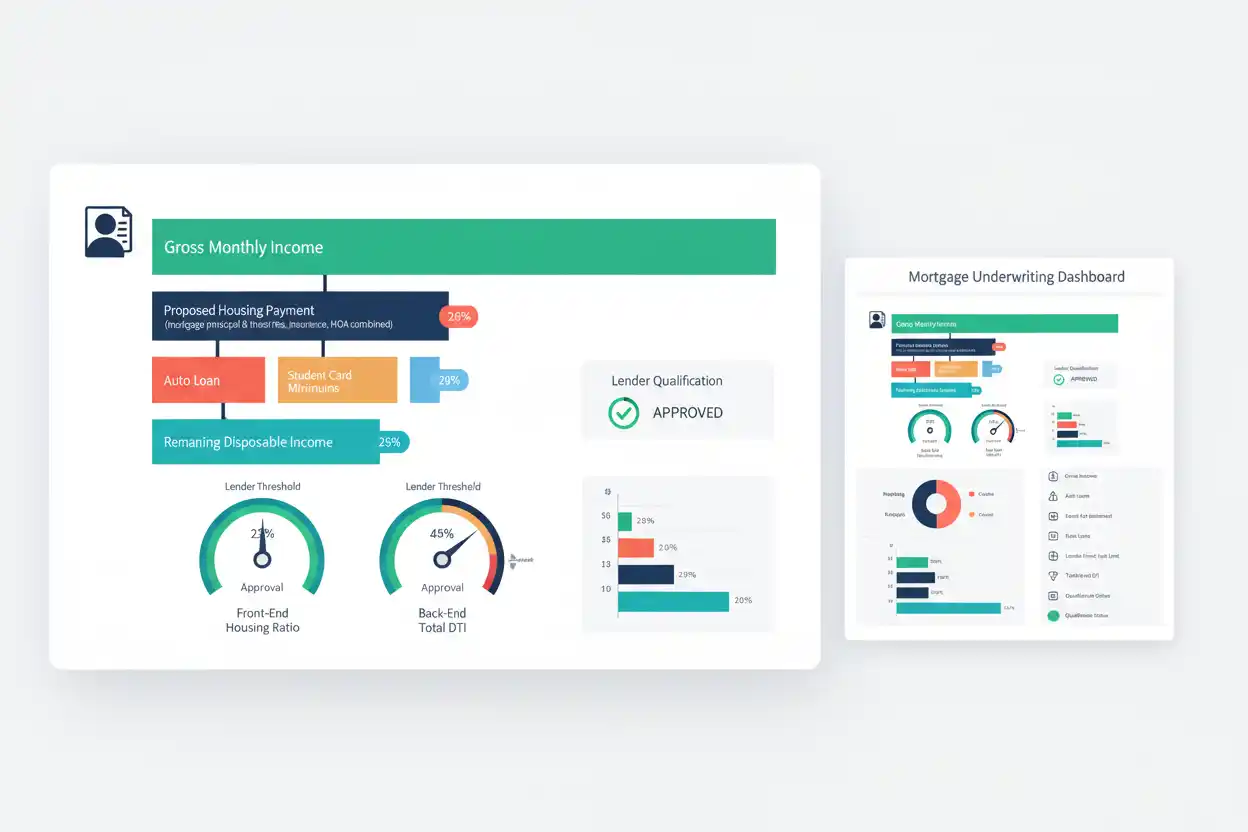

Mortgage debt-to-income ratio compares a borrower’s recurring monthly debt obligations—including the proposed qualifying housing payment—with gross monthly income.
The general formula is:
Mortgage DTI = Total Qualifying Monthly Debt Payments ÷ Gross Monthly Income × 100
Suppose:
Proposed monthly housing obligation = $2,600
Auto loan = $350
Student loan = $250
Credit-card minimum = $100
Gross monthly income = $10,000
Total qualifying monthly obligations:
$2,600 + $350 + $250 + $100
$3,300
Mortgage debt-to-income ratio:
DTI = $3,300 ÷ $10,000 × 100
DTI = 33%
CFPB defines DTI as monthly debt payments divided by gross monthly income and notes that different mortgage products and lenders can use different DTI limits.
That second point matters: there is no single percentage that should be presented as a universal mortgage-approval cutoff.
What Is Mortgage Debt-to-Income Ratio?
Mortgage DTI helps measure whether recurring debt obligations are large or small relative to pre-tax monthly income.
The numerator can include the proposed housing obligation plus other qualifying debts.
The denominator is:
Gross Monthly Income
This page owns the mortgage-specific DTI intent within Mortgages & Home Loans.
The broader debt-to-income ratio page covers DTI outside the mortgage-specific context, while mortgage affordability converts payment capacity into an estimated mortgage amount.
Mortgage DTI Formula
The basic formula is:
DTI = Total Monthly Debt Payments ÷ Gross Monthly Income × 100
For mortgage analysis:
Total Debt = Proposed Housing Obligation + Other Qualifying Monthly Debt
Suppose:
Housing = $2,800
Other debt = $700
Gross income = $10,000
Then:
DTI = ($2,800 + $700) ÷ $10,000 × 100
DTI = 35%
Housing-Only Ratio vs Total DTI
It can also be useful to calculate the housing expense alone:
Housing Ratio = Proposed Monthly Housing Expense ÷ Gross Monthly Income × 100
Using:
Housing = $2,600
Income = $10,000
Housing Ratio = 26%
Total DTI from the earlier example is:
33%
The seven-percentage-point difference comes from non-housing debt.
The two ratios should not be confused.
What Goes Into the Mortgage Housing Payment?
Depending on the mortgage program and underwriting method, the housing obligation can include more than principal and interest.
Common components can include:
principal, interest, property taxes, homeowners insurance, mortgage insurance, and applicable association or property-related obligations.
That is why using only the principal-and-interest payment can understate mortgage DTI.
The mortgage escrow account can collect some of these expenses even though escrow itself does not create the expense.
Mortgage Insurance and DTI
Suppose:
Principal and interest = $2,300
Taxes and homeowners insurance = $600
Mortgage insurance = $150
Qualifying housing expense:
$2,300 + $600 + $150
$3,050
Using only $2,300 would understate the housing burden by:
$750 per Month
Example With Existing Debts
Suppose:
Gross monthly income = $9,000
Housing = $2,700
Auto loan = $500
Student loan = $300
Credit-card minimum = $150
Total monthly debt:
$2,700 + $500 + $300 + $150
$3,650
DTI:
$3,650 ÷ $9,000 × 100
≈ 40.56%
The ratio itself does not determine whether the mortgage will be approved.
The lender applies the rules for the specific mortgage product and underwriting process.
CFPB explicitly states that DTI limits differ among lenders and loan products.
How Paying Off Debt Changes Mortgage DTI
Using the same example:
DTI before payoff:
40.56%
Suppose the $500 auto loan is completely eliminated.
New debt:
$3,650 − $500 = $3,150
New DTI:
$3,150 ÷ $9,000 × 100
35%
Removing one payment lowers DTI by approximately:
5.56 Percentage Points
That can materially change the mortgage underwriting profile.
Income Increase Example
Suppose monthly debts remain:
$3,650
Gross income increases from:
$9,000 to $10,000
New DTI:
$3,650 ÷ $10,000 × 100
36.5%
The numerator did not change.
The ratio fell because the income denominator increased.
New Car Loan Example
Now return to the original $10,000-income borrower with:
Current DTI debt = $3,300
The borrower takes a new vehicle loan requiring:
$600 per Month
New monthly debt:
$3,900
New DTI:
$3,900 ÷ $10,000 × 100
39%
The new debt increases mortgage DTI by six percentage points.
That is why taking on new financing during the mortgage process can materially change qualification.
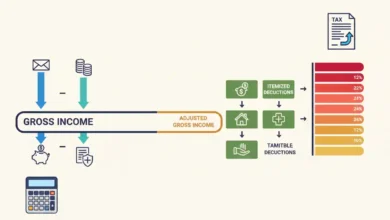
DTI Uses Gross Income
Gross income means income before ordinary payroll taxes and other deductions.
Suppose:
Gross monthly income = $10,000
Take-home income = $7,500
Using $7,500 in a formula intended to use gross income would produce a different ratio.
Mortgage underwriting definitions can also specify which income can be counted and how variable income is documented.
Use the lender’s qualifying-income calculation rather than assuming every dollar deposited into a bank account counts equally.
DTI Does Not Equal a Household Budget
A 35% mortgage DTI does not mean 65% of gross income is freely spendable.
Gross income still has to cover:
taxes, food, utilities, transportation, healthcare, childcare, savings, maintenance, and other expenses.
That is why home affordability should be evaluated separately from mortgage qualification.
Mortgage DTI and Closing Costs
The mapped mortgage closing costs generally affect cash needed at closing rather than becoming recurring monthly debt in the basic DTI formula.
This creates two different constraints:
DTI Constraint = Can Income Support the Monthly Debt?
Cash Constraint = Can the Borrower Fund the Transaction?
A borrower can pass one and fail the other.
Mortgage DTI and Mortgage APR
Mortgage APR measures annualized borrowing cost.
DTI measures payment burden relative to income.
A loan with a lower APR can improve DTI if it creates a lower monthly payment.
However:
APR ≠ DTI Input by Itself
The qualifying monthly payment is what matters.
Mortgage DTI and Mortgage Break-Even Point
A refinance can lower the payment and therefore improve mortgage DTI.
However, the mortgage break-even point might show that the refinance will not recover its costs before the borrower expects to move.
A lower DTI and a profitable refinance are therefore not identical outcomes.
Mortgage DTI and Mortgage Escrow
Mortgage escrow can make the complete mortgage payment easier to observe because taxes and insurance are collected with principal and interest.
If taxes increase:
escrow payment can increase.
If the qualifying housing obligation changes accordingly, the borrower’s real monthly housing burden also rises.
Mortgage DTI and Fixed-Rate Mortgages
With a fixed-rate mortgage, contractual principal and interest are predictable.
However, taxes, insurance, mortgage insurance, and HOA charges can change.
Therefore:
Fixed Mortgage Rate ≠ Permanently Fixed Housing Expense
Mortgage DTI and Adjustable-Rate Mortgages
An adjustable-rate mortgage introduces potential future payment changes.
Mortgage underwriting can require a qualifying payment methodology different from simply using the introductory payment.
A borrower should also test personal affordability at possible future rates even if the initial DTI looks comfortable.
Mortgage DTI and Interest-Only Mortgages
An interest-only mortgage can have a low introductory payment.
However, principal repayment can later increase the required payment substantially.
A borrower should not interpret introductory DTI as proof that the mortgage will remain equally affordable throughout its life.
Mortgage DTI and Mortgage Insurance
Mortgage insurance can materially affect DTI.
Suppose:
Mortgage insurance = $220 per month
Gross income = $8,000
Its direct ratio contribution is:
$220 ÷ $8,000 × 100
2.75 Percentage Points
Eliminating an insurance payment later can therefore improve monthly cash flow materially.
Mortgage DTI and Loan-to-Value
The loan-to-value ratio measures property leverage rather than income burden.
A borrower can have:
60% LTV and 45% DTI.
Another can have:
95% LTV and 25% DTI.
Neither ratio substitutes for the other.
Mortgage DTI and Preapproval
A mortgage preapproval can use the borrower’s income, debts, credit, intended mortgage structure, and other information.
Because DTI can change when debts or income change, large financial changes between preapproval and closing can affect the transaction.
What Is a Good Mortgage DTI?
There is no single correct DTI for every mortgage.
CFPB states directly that different lenders and loan products use different limits.
A financially comfortable household can also choose a lower personal ceiling than the maximum a lender would permit.
The appropriate ratio therefore depends on both:
underwriting and personal budget resilience.
Common Mortgage DTI Mistakes
One mistake is using net income instead of the required gross-income figure.
Another is including principal and interest but omitting taxes, insurance, or applicable mortgage insurance from the housing payment.
Borrowers also overlook small recurring debts.
A fourth mistake is assuming one DTI limit applies to every mortgage.
Finally, lender qualification should not be confused with household affordability.
Frequently Asked Questions
What is mortgage debt-to-income ratio?
It compares qualifying monthly debt payments with gross monthly income.
What is the formula?
DTI = Monthly Debt Payments ÷ Gross Monthly Income × 100
What is a 33% DTI?
It means qualifying monthly debts equal 33% of the gross monthly income used.
Is mortgage payment included in DTI?
The proposed qualifying housing obligation is generally included in mortgage DTI.
Are taxes and insurance included?
They can be part of the qualifying monthly housing expense under the applicable mortgage methodology.
Is DTI based on gross or net income?
The standard DTI formula uses gross monthly income.
Is there one universal maximum DTI?
No. CFPB notes that limits differ by lender and loan product.
Does paying off a car loan improve DTI?
Yes, if it removes a qualifying recurring payment while income remains unchanged.
Does a larger down payment reduce DTI?
It can, because a smaller mortgage can create a lower monthly housing payment.
Does mortgage insurance affect DTI?
It can because it increases the monthly housing obligation.
Is DTI the same as LTV?
No. DTI compares debt payments with income; LTV compares mortgage debt with property value.
Does a low DTI guarantee mortgage approval?
No. Mortgage underwriting considers additional eligibility and risk factors.
Final Takeaway
Mortgage debt-to-income ratio measures the relationship between recurring debt payments and gross income:
Mortgage DTI = Total Qualifying Monthly Debt ÷ Gross Monthly Income × 100
In the worked example:
Housing payment = $2,600
Other monthly debts = $700
Gross monthly income = $10,000
Therefore:
DTI = $3,300 ÷ $10,000 × 100
DTI = 33%
The formula is simple, but the inputs matter. Use the lender’s qualifying definitions for income, housing payment, student loans, revolving debt, installment loans, mortgage insurance, and other obligations, and remember that the maximum ratio a lender permits is not necessarily the payment level that best fits the household budget.