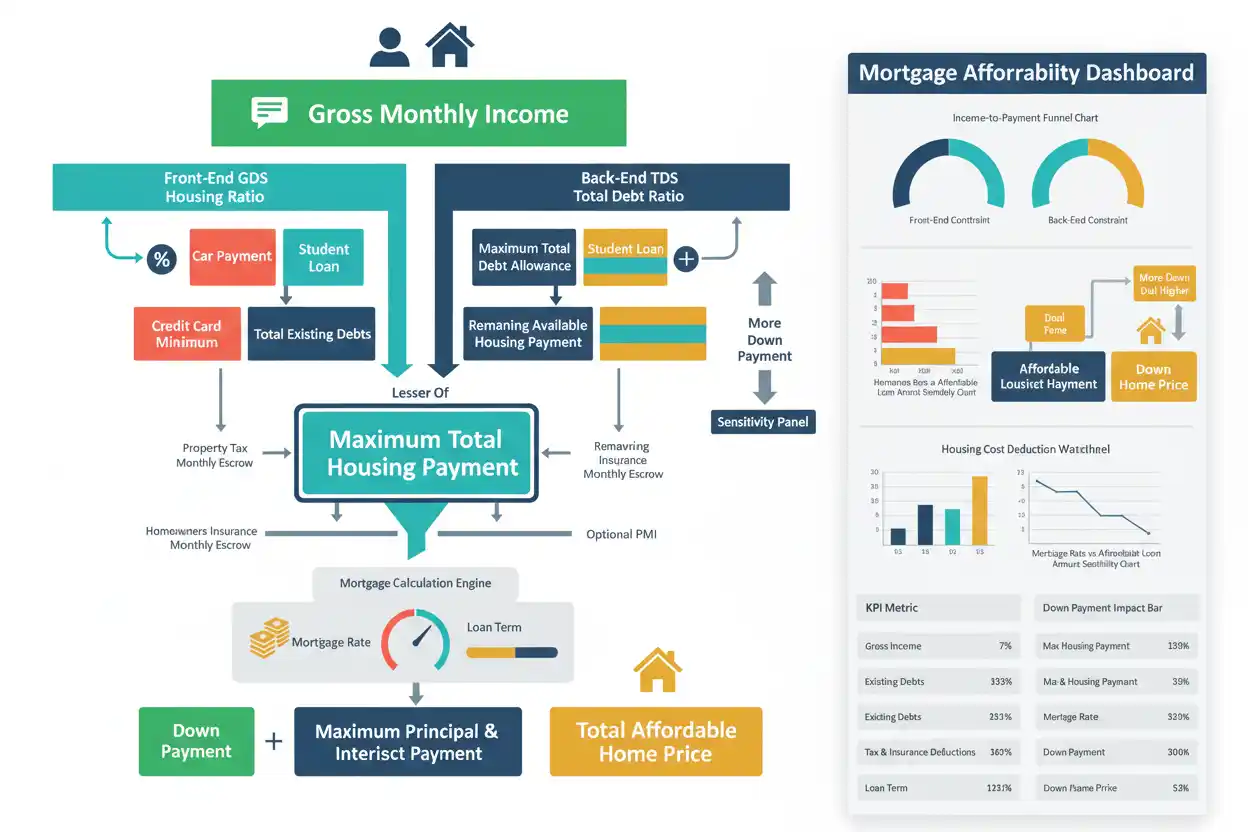

Mortgage affordability estimates how much mortgage principal a borrower can support based on income, debt obligations, housing expenses, interest rate, and loan term.
The strongest calculation works backward.
Instead of starting with a home price and asking whether the payment fits, first determine the monthly housing payment that can be supported.
Then subtract non-mortgage housing costs.
Finally, convert the remaining principal-and-interest budget into an estimated mortgage amount.
A useful framework is:
Maximum Housing Payment = Maximum Total Monthly Debt Budget − Existing Qualifying Debt Payments
Then:
Available P&I Payment = Maximum Housing Payment − Taxes − Insurance − HOA − Mortgage Insurance
Finally:
Affordable Mortgage Principal = Payment × [(1 + r)ⁿ − 1] ÷ [r(1 + r)ⁿ]
CFPB advises borrowers to include property taxes, homeowners insurance, mortgage insurance when applicable, and association costs when determining how much home financing they can comfortably support.
Mortgage Affordability vs Home Affordability
These concepts overlap but have different scopes.
Mortgage affordability focuses on the financing mechanics:
income, qualifying debts, housing expenses, rate, term, and mortgage principal.
Home affordability is broader and considers the complete household decision, including repairs, maintenance, savings, and personal spending priorities.
That distinction matters.
A borrower can qualify for a mortgage that does not fit comfortably within the household’s preferred budget.
CFPB specifically warns that the amount a lender is willing to approve can differ from the amount a household is comfortable spending.
Mortgage Affordability Formula
Suppose:
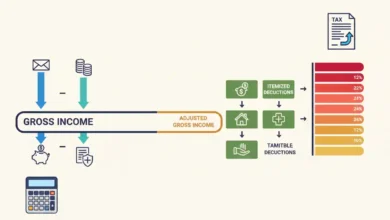
Gross monthly income = $12,000
Existing qualifying debts = $1,500
For teaching purposes, assume the borrower or modeled underwriting scenario allows total monthly debt payments equal to 40% of gross income.
This 40% figure is an illustrative assumption, not a universal mortgage approval rule.
Maximum total debt budget:
$12,000 × 40%
$4,800
Available for housing:
$4,800 − $1,500
$3,300
Subtract Property Expenses
Suppose expected monthly property costs are:
Property taxes = $600
Homeowners insurance = $180
HOA = $120
Mortgage insurance = $0
Total non-P&I housing cost:
$600 + $180 + $120
$900
Available principal-and-interest payment:
$3,300 − $900
$2,400
That $2,400 becomes the mortgage-payment input.
Convert $2,400 Payment to Mortgage Principal
Assume:
Mortgage rate = 6.5%
Term = 30 years
Monthly rate:
r = 6.5% ÷ 12
r ≈ 0.541667%
Number of payments:
n = 360
Inverse payment formula:
Mortgage Principal = A × [(1 + r)ⁿ − 1] ÷ [r(1 + r)ⁿ]
Using a $2,400 payment:
Affordable Mortgage ≈ $379,705.97
That is the estimated mortgage principal supported by the stated assumptions.
Convert Mortgage to Home Price
Suppose the borrower plans a 20% down payment.
The mortgage represents 80% of the home price:
Home Price = Mortgage ÷ 80%
Home Price ≈ $379,705.97 ÷ 0.80
Home Price ≈ $474,632.46
Required 20% down payment:
≈ $94,926.49
This is a financing estimate—not a lender approval and not a recommendation to spend exactly $474,632.
Mortgage Affordability Changes With Interest Rates
Keep the affordable P&I payment fixed at:
$2,400
At a lower rate, that payment supports more principal.
At a higher rate, it supports less.
This creates the fundamental affordability relationship:
Higher Mortgage Rate → Lower Affordable Principal
assuming payment budget and term remain unchanged.
That is why affordability should be recalculated when mortgage rates materially change.
Mortgage Affordability and Mortgage APR
The mortgage APR should not normally be substituted directly into a standard principal-and-interest payment formula unless the calculation specifically calls for it.
The contractual interest rate determines the scheduled principal-and-interest payment.
APR is a broader cost measure incorporating the rate plus applicable finance charges. CFPB explains that APR includes the mortgage interest rate plus points, fees, and other specified charges.
Therefore:
Interest Rate → Payment Calculation
while:
APR → Cost Comparison
Mortgage Affordability and Loan-to-Value Ratio
The loan-to-value ratio affects leverage and potentially mortgage pricing or insurance.
Suppose:
Affordable mortgage = $379,706
Home price = $474,632
LTV = $379,706 ÷ $474,632 × 100
80%
If the borrower has only 10% down and still borrows $379,706:
Home Price ≈ $379,706 ÷ 90%
≈ $421,896
The same affordable mortgage supports a lower purchase price when the buyer contributes less cash.
Mortgage Affordability and Mortgage Insurance
If a smaller down payment introduces mortgage insurance, the insurance payment reduces the monthly amount available for principal and interest.
Suppose:
Housing budget = $3,300
Taxes, insurance, HOA = $900
Mortgage insurance = $180
P&I budget becomes:
$3,300 − $900 − $180
$2,220
That lower payment supports a smaller mortgage at the same rate and term.
Mortgage Affordability and Mortgage Amortization
Mortgage amortization determines how the affordable payment is allocated between principal and interest.
A borrower can afford a $2,400 payment, but early in the loan much of that payment may cover interest.
Affordability tells you whether the payment fits.
Amortization tells you how quickly the debt is actually being reduced.
Mortgage Affordability and Interest-Only Mortgages
An interest-only mortgage can distort affordability when only the introductory payment is considered.
Suppose:
Interest-only payment = $2,400
but future fully amortizing payment = $3,200.
If the borrower can afford only $2,400:
the mortgage is not robustly affordable across its full payment schedule.
Affordability testing should use realistic future payments, not merely the lowest temporary payment.
Mortgage Affordability and Jumbo Mortgages
A jumbo mortgage can be affordable to a high-income household even though the loan amount exceeds conforming limits.
Conversely, a conforming mortgage can be unaffordable to another household.
Jumbo status measures loan size.
Affordability measures payment capacity.
They are completely different dimensions.
Mortgage Affordability and Down Payment
A larger down payment reduces mortgage principal.
Suppose the desired home costs:
$500,000
With 10% down:
Mortgage = $450,000
With 20% down:
Mortgage = $400,000
At 6.5% for 30 years:
$450,000 payment:
≈ $2,844.31
$400,000 payment:
≈ $2,528.27
Additional cash at closing can therefore reduce monthly financing requirements substantially.
Mortgage Affordability and Existing Debt
Suppose:
Gross income = $12,000
Total debt budget at illustrative 40% = $4,800
Borrower A has:
$500 of Existing Debt
Housing budget:
$4,300
Borrower B has:
$2,000 of Existing Debt
Housing budget:
$2,800
The $1,500 difference in existing debt reduces the available housing payment by exactly $1,500 in the simplified model.
Debt payoff can therefore materially change mortgage capacity.
Car Loan Example
Suppose a borrower has a $700 monthly vehicle loan that will remain outstanding.
Removing that payment before buying a home would increase available monthly mortgage capacity by:
$700
At a 6.5%, 30-year mortgage rate, $700 of additional principal-and-interest capacity corresponds to roughly:
$110,748 of Additional Mortgage Principal
under the simplified formula.
This shows why recurring debt payments can have a powerful effect on borrowing capacity.
Mortgage Affordability and Fixed-Rate Mortgages
A fixed-rate mortgage makes the principal-and-interest component easier to model because the contractual rate does not change.
However, property taxes and insurance can still change over time. CFPB notes that total monthly mortgage payments can therefore vary even on fixed-rate loans.
Mortgage Affordability and Adjustable Rates
An adjustable-rate mortgage requires stress testing.
A mortgage affordable at the introductory rate may become uncomfortable after an adjustment.
The analysis should therefore model:
initial payment, plausible adjusted payment, and contractual maximum exposure.
Mortgage Affordability and Closing Costs
Mortgage closing costs affect cash affordability rather than monthly mortgage capacity alone.
Suppose:
20% down payment ≈ $94,926
Closing costs and prepaids = $15,000
Cash required:
≈ $109,926
before credits or deposits.
A borrower can have enough monthly income for the mortgage but insufficient cash to complete the purchase safely.
Mortgage Affordability and Discount Points
Discount points can lower the interest rate and increase the mortgage principal supportable by a fixed monthly payment.
However, points require additional cash upfront.
The financing decision therefore has two affordability dimensions:
monthly affordability and closing-cash affordability.
Mortgage Affordability and Conforming Limits
A calculated affordable mortgage can exceed the conforming loan limit.
That does not mean the borrower cannot obtain financing.
It means the financing can fall into a different mortgage category, such as jumbo, depending on the property’s applicable limit.
Personal Budget vs Underwriting Limit
A borrower should calculate mortgage affordability at least twice:
once using the lender’s qualifying method, and once using the household’s own preferred budget.
If the lender allows:
$3,800 Housing Cost
but the household feels comfortable only at:
$3,000
then $3,000 is the more relevant lifestyle limit.
Approval is not an instruction to borrow the maximum.
Common Mortgage Affordability Mistakes
One mistake is using only the principal-and-interest payment.
Another is ignoring existing monthly debt.
Borrowers also use APR instead of the note rate in the scheduled payment formula.
A fourth mistake is assuming one debt-to-income threshold applies universally.
Finally, using an introductory ARM or interest-only payment can materially overstate long-term affordability.
Frequently Asked Questions
What is mortgage affordability?
It is an estimate of how much mortgage debt can be supported by income, debts, housing expenses, rate, and loan term.
What is the basic process?
First determine an affordable total housing payment, subtract taxes and other required housing costs, then convert the remaining P&I budget into mortgage principal.
Is there one universal DTI limit?
No. Requirements vary by lender and mortgage program.
Should property taxes be included?
Yes. CFPB advises including taxes in monthly home-cost estimates.
Should homeowners insurance be included?
Yes.
Does mortgage insurance reduce affordability?
Yes, because it consumes part of the total monthly housing budget.
Does a larger down payment increase mortgage affordability?
It reduces the mortgage needed for a given home price and therefore lowers the payment.
Does a lower interest rate increase mortgage capacity?
Yes, assuming the payment and term remain unchanged.
Is mortgage APR used to calculate the monthly P&I payment?
Generally, the contractual interest rate drives the scheduled payment; APR is a broader cost comparison measure.
How do existing debts affect mortgage affordability?
They reduce the monthly payment capacity available for housing under a total-debt framework.
Is lender approval the same as personal affordability?
No. CFPB recommends considering the household’s actual spending and savings priorities.
Should I test future ARM or interest-only payments?
Yes. Affordability should reflect realistic future contractual payments, not merely an introductory amount.
Final Takeaway
Mortgage affordability works best when calculated backward from a realistic monthly payment.
In the example:
Gross monthly income = $12,000
Illustrative total-debt budget = 40%
Existing debts = $1,500
Maximum housing budget:
$3,300
After $900 of taxes, insurance, and HOA:
P&I Budget = $2,400
At 6.5% for 30 years, that payment supports approximately:
$379,705.97 of Mortgage Principal
With 20% down, the corresponding purchase price is roughly:
$474,632.46
The calculation is useful only when its assumptions are realistic. A sound mortgage-affordability decision should account for income, existing debts, property expenses, mortgage insurance, rate, term, down payment, closing cash, and the possibility that future housing costs will rise.