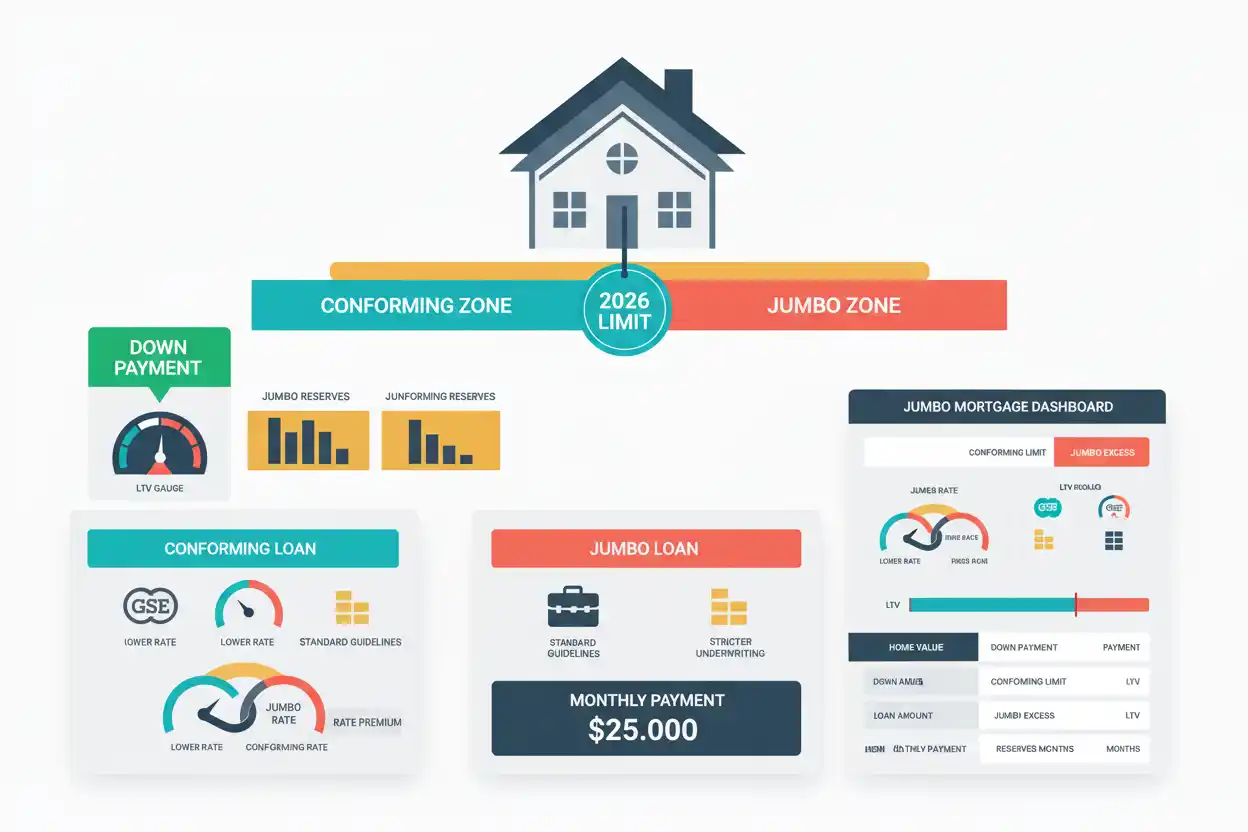

A jumbo mortgage is a home loan whose amount exceeds the applicable conforming loan limit for the property.
The important number is the mortgage amount, not simply the home’s purchase price.
For 2026, the baseline conforming loan limit for a one-unit property in most of the United States is $832,750. Qualifying high-cost areas can have higher limits, up to a one-unit ceiling of $1,249,125.
A basic classification test is:
Jumbo Mortgage = Mortgage Amount > Applicable Conforming Loan Limit
Suppose a buyer needs an $880,000 mortgage in a county where the applicable limit is $832,750.
Amount Above Limit = $880,000 − $832,750
Amount Above Limit = $47,250
The mortgage exceeds the baseline limit and therefore falls outside the standard baseline conforming size range.
However, that same $880,000 mortgage could remain within the conforming limit in a qualifying high-cost county.
That distinction is why the conforming loan limit for the property’s specific location must be checked before calling a mortgage jumbo.
What Is a Jumbo Mortgage?
A jumbo mortgage is generally conventional financing above the applicable conforming loan limit.
It is called “jumbo” because the principal is too large for purchase under the normal conforming loan-size framework.
The broader Mortgages & Home Loans pillar covers the overall mortgage market. This page specifically owns the jumbo mortgage intent: size classification, payment math, leverage, qualification considerations, and the financial consequences of financing a large balance.
A jumbo mortgage is not automatically:
an interest-only mortgage, an adjustable-rate mortgage, a luxury-home-only product, or a high-risk loan.
It simply starts with a mortgage amount above the applicable conforming ceiling.
Jumbo Mortgage Formula
There is no unique payment formula used only for jumbo loans.
A standard fully amortizing jumbo mortgage can use the same payment equation as any other fixed-rate mortgage:
Monthly Payment = P × [r(1 + r)ⁿ] ÷ [(1 + r)ⁿ − 1]
Where:
P = jumbo mortgage principal
r = monthly interest rate
n = number of monthly payments
The “jumbo” classification comes from loan size, not from different amortization mathematics.
Jumbo Mortgage Example
Suppose:
Home price = $1,100,000
Down payment = 20%
Mortgage rate = 6.75%
Mortgage term = 30 years
First calculate the down payment:
Down Payment = $1,100,000 × 20%
Down Payment = $220,000
Mortgage principal:
Mortgage = $1,100,000 − $220,000
Mortgage = $880,000
In a baseline-limit county:
$880,000 > $832,750
The mortgage exceeds the 2026 baseline conforming loan limit by:
$47,250
and therefore requires financing outside that baseline conforming size range.
Jumbo Mortgage Monthly Payment
At 6.75% for 30 years:
Monthly rate:
6.75% ÷ 12 = 0.5625%
Number of payments:
30 × 12 = 360
Using the mortgage payment formula:
Monthly Principal-and-Interest Payment ≈ $5,707.66
This figure includes only principal and interest.
The actual monthly housing payment can also include property taxes, homeowners insurance, association dues, and mortgage insurance when applicable. CFPB emphasizes that the total monthly mortgage payment is generally higher than principal and interest alone.
Total Interest Example
If the $880,000 mortgage remains outstanding for all 360 scheduled payments:
Total Payments ≈ $5,707.66 × 360
Using full precision:
Total Payments ≈ $2,054,758.77
Total interest:
Total Interest ≈ $2,054,758.77 − $880,000
Total Interest ≈ $1,174,758.77
Large mortgage balances make small changes in rate, term, and fees extremely important in dollar terms.
Jumbo Mortgage LTV
The loan-to-value ratio in the example is:
LTV = $880,000 ÷ $1,100,000 × 100
LTV = 80%
Jumbo status and LTV are separate concepts.
A mortgage can be:
jumbo with low LTV, or conforming with high LTV.
For example, a $900,000 mortgage on a $1.5 million property has:
LTV = $900,000 ÷ $1,500,000 × 100
LTV = 60%
Yet it can still be jumbo in a baseline county because the mortgage amount exceeds the applicable conforming limit.
Down Payment Needed to Avoid Jumbo Status
Suppose:
Home price = $1,100,000
Baseline conforming limit = $832,750
The minimum difference needed to reduce the mortgage to the baseline limit is:
Required Down Payment = $1,100,000 − $832,750
Required Down Payment = $267,250
As a percentage:
Down Payment % = $267,250 ÷ $1,100,000 × 100
≈ 24.30%
Therefore, a buyer in a baseline-limit county would need to contribute at least approximately $267,250 simply to reduce the mortgage to $832,750, before considering closing costs or other program requirements.
Jumbo Mortgage vs Conforming Loan
The core distinction is:
Conforming Loan ≤ Applicable Conforming Limit
Jumbo Mortgage > Applicable Conforming Limit
The conforming loan page owns the detailed conforming framework.
The applicable threshold changes by year and can vary by location. FHFA publishes the limits annually.
Jumbo Mortgage and Home Affordability
A large mortgage should not be treated as affordable merely because the borrower qualifies for it.
The home affordability page looks at the broader household budget, including ownership expenses and financial priorities.
Suppose:
Jumbo P&I payment = $5,707.66
Property taxes = $1,500
Insurance = $400
HOA = $300
Total estimated housing cost:
$5,707.66 + $1,500 + $400 + $300
$7,907.66 per Month
That is the number that matters more to household cash flow than principal and interest alone.
Jumbo Mortgage and Mortgage Affordability
The mortgage affordability calculation focuses more closely on how income, debts, rate, term, and qualifying housing expenses translate into a supportable mortgage principal.
The jumbo label does not create affordability.
It merely describes the mortgage’s size relative to conforming limits.
Jumbo Mortgage and Interest-Only Financing
Some large mortgages can use an interest-only mortgage structure.
Suppose:
Jumbo principal = $880,000
Rate = 6.75%
Interest-only payment:
$880,000 × 6.75% ÷ 12
$4,950 per Month
That is lower than the $5,707.66 fully amortizing payment.
However:
Principal Reduction = $0
during a pure interest-only payment period.
The lower payment therefore postpones principal repayment rather than making the debt smaller.
Jumbo Mortgage and Home Equity Loans
A home equity loan can be added behind a jumbo first mortgage if the borrower and property satisfy the relevant requirements.
That raises combined property debt.
Suppose:
Jumbo first mortgage = $880,000
Home equity loan = $100,000
Property value = $1,300,000
Combined debt:
$980,000
CLTV = $980,000 ÷ $1,300,000 × 100
≈ 75.38%
First-mortgage LTV and total property leverage should therefore be analyzed separately.
Jumbo Mortgage and HELOC
A HELOC can create similar combined-leverage concerns.
A borrower with a low first-mortgage LTV can still become highly leveraged after drawing heavily against a home-equity line.
That can affect later refinancing options and household payment risk.
Jumbo Mortgage and Mortgage APR
The mortgage APR becomes especially important on large balances because even modest percentages of fees represent significant dollar amounts.
CFPB explains that mortgage APR reflects the interest rate plus applicable points, fees, and other charges used in the disclosure calculation.
One point on an $880,000 mortgage costs:
$880,000 × 1%
$8,800
Two points cost:
$17,600
Upfront pricing therefore deserves careful break-even analysis.
Jumbo Mortgage and Discount Points
The discount points decision can materially change cash required at closing.
Suppose:
1.5 points on $880,000:
Point Cost = $880,000 × 1.5%
$13,200
If those points save $150 per month:
Break-Even Months = $13,200 ÷ $150
88 Months
That is approximately seven years and four months.
Jumbo Mortgage and Closing Costs
Mortgage closing costs can also scale upward with transaction size.
A borrower should separate:
down payment, lender fees, title and settlement costs, prepaid expenses, points, and cash reserves.
The fact that a buyer can make a large down payment does not mean using nearly all available liquidity at closing is prudent.
Jumbo Mortgage and Fixed Rates
A jumbo loan can use a fixed-rate mortgage structure.
It can also use an adjustable structure.
Again:
Jumbo describes loan size.
Fixed or adjustable describes rate behavior.
These terms should not be treated as substitutes.
Jumbo Mortgage and Mortgage Amortization
Mortgage amortization has a large dollar effect on jumbo balances.
On the $880,000 loan, early monthly interest is:
$880,000 × 6.75% ÷ 12
$4,950
First-month principal:
$5,707.66 − $4,950
≈ $757.66
Even with a payment above $5,700, less than $800 reduces principal in the first month.
Jumbo Mortgage and Refinancing
Refinancing a jumbo mortgage can generate large potential savings from a rate reduction, but closing costs can also be large.
Suppose refinancing lowers the payment by $500 per month but costs $15,000.
Break-Even = $15,000 ÷ $500
30 Months
The borrower should expect to keep the replacement mortgage longer than that break-even period before treating the transaction as clearly beneficial on a simple cash-flow basis.
Jumbo Mortgage and Mortgage Insurance
Mortgage insurance requirements depend on product structure rather than the jumbo label alone.
A borrower should not assume that a 20% down payment, jumbo status, or a particular LTV automatically determines every insurance requirement.
Actual lender and program terms control.
Common Jumbo Mortgage Mistakes
One mistake is deciding whether a loan is jumbo from the home price rather than the mortgage amount.
Another is using the baseline conforming limit in a high-cost county without checking the local limit.
Borrowers also focus on the monthly payment while ignoring the enormous lifetime interest created by a large principal.
A fourth mistake is assuming all jumbo loans require the same down payment or underwriting standards.
Finally, refinancing should not be treated as guaranteed simply because the borrower currently has substantial home equity.
Frequently Asked Questions
What is a jumbo mortgage?
It is a mortgage above the applicable conforming loan limit for the property.
What is the 2026 baseline conforming limit?
For a one-unit property in most U.S. areas:
$832,750.
What is the 2026 high-cost ceiling?
For a one-unit property:
$1,249,125.
Is an $880,000 mortgage jumbo everywhere?
No. It exceeds the baseline limit but can remain conforming in qualifying high-cost areas.
Is a $1 million house automatically jumbo?
No. A sufficiently large down payment can reduce the mortgage below the applicable conforming limit.
Do jumbo mortgages use a different payment formula?
Not necessarily. A standard fixed-rate jumbo loan uses the same amortization formula as other fixed mortgages.
What is the payment on $880,000 at 6.75% for 30 years?
Approximately:
$5,707.66 per Month
for principal and interest.
Can a jumbo mortgage be interest-only?
Some jumbo products can have interest-only structures, depending on lender terms.
Can jumbo loans have fixed rates?
Yes.
Does jumbo status determine LTV?
No. Mortgage size and LTV measure different things.
Are jumbo loan limits permanent?
No. Conforming limits are updated annually.
What should I compare when shopping for a jumbo mortgage?
Compare rate, APR, points, down payment, LTV, reserves, monthly housing cost, term, total interest, and lender-specific qualification requirements.
Final Takeaway
A jumbo mortgage is defined by its size relative to the applicable conforming loan limit.
For 2026:
Baseline One-Unit Limit = $832,750
in most U.S. areas.
On a $1.1 million home with 20% down, the mortgage is:
$880,000
That is $47,250 above the 2026 baseline limit.
At 6.75% for 30 years, principal and interest are approximately:
$5,707.66 per Month
and lifetime interest can exceed:
$1.17 Million
if the loan remains outstanding for all 360 payments.
The core jumbo decision is therefore much bigger than whether the loan exceeds a regulatory threshold. It requires careful analysis of down payment, LTV, APR, rate structure, monthly affordability, total interest, closing cash, and the financial resilience needed to carry a very large mortgage balance.