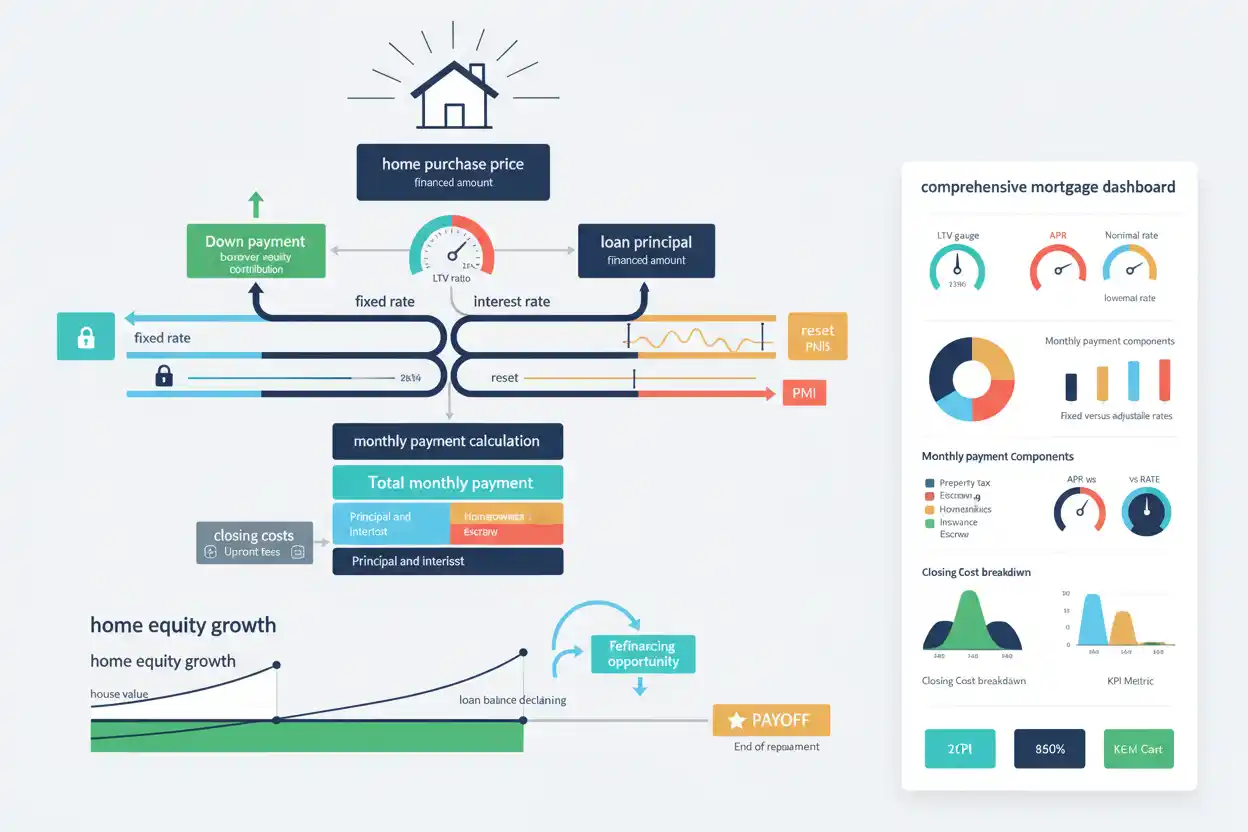

Mortgages and home loans turn a large property purchase into a long-term financing obligation.
The basic structure is simple:
a buyer contributes some cash, a lender finances part of the purchase price, and the borrower repays the mortgage principal plus interest over time.
The details are where the economics become significantly more complex.
A real mortgage decision can involve:
interest rate, APR, down payment, loan-to-value ratio, loan term, closing costs, mortgage insurance, escrow, discount points, rate locks, fixed or adjustable rates, refinancing, extra payments, and the eventual payoff amount.
This guide provides the framework connecting those concepts without replacing the specialist calculations assigned to each individual mortgage topic.
How a Mortgage Works
Suppose a home costs $400,000 and the buyer makes a $80,000 down payment.
The mortgage principal is:
Mortgage Principal = Home Price − Down Payment
Mortgage Principal = $400,000 − $80,000
Mortgage Principal = $320,000
The down payment percentage is:
Down Payment % = $80,000 ÷ $400,000 × 100
Down Payment = 20%
The initial loan-to-value ratio is:
LTV = $320,000 ÷ $400,000 × 100
LTV = 80%
The specialist down payments and loan-to-value ratio guides examine those variables in detail.
Mortgage Payment Formula
For a standard fixed-rate fully amortizing mortgage:
Monthly Principal-and-Interest Payment = P × [r(1 + r)^n] ÷ [(1 + r)^n − 1]
Where:
P = mortgage principal
r = monthly interest rate
n = number of monthly payments
Suppose:
Mortgage principal = $320,000
Interest rate = 6.5%
Term = 30 years
Monthly rate:
r = 6.5% ÷ 12
r ≈ 0.54167%
Number of payments:
n = 30 × 12
n = 360
The principal-and-interest payment is approximately:
Monthly Payment ≈ $2,022.62
The planned guide on how mortgage payments work owns the detailed payment allocation.
Mortgage Payment Is Not Total Housing Cost
The $2,022.62 example covers only principal and interest.
A homeowner may also pay:
property taxes, homeowners insurance, mortgage insurance, association charges, utilities, maintenance, and other ownership costs.
Some taxes and insurance can be collected through mortgage escrow.
Therefore:
Principal + Interest Payment ≠ Total Monthly Homeownership Cost
Total Mortgage Interest
If the $320,000 mortgage at 6.5% continued for all 360 scheduled payments:
Total Principal-and-Interest Payments ≈ $2,022.62 × 360
Using full precision:
Total Payments ≈ $728,142.36
Total interest is approximately:
Mortgage Interest ≈ $728,142.36 − $320,000
Mortgage Interest ≈ $408,142.36
That large lifetime figure illustrates why rate and term matter even when the monthly difference between two mortgage offers looks small.
The dedicated mortgage interest page owns the detailed interest calculation.
Fixed-Rate Mortgages
A fixed-rate mortgage keeps its contractual interest rate fixed according to the mortgage terms.
That provides greater principal-and-interest payment predictability.
If market rates rise, the existing fixed rate remains protected.
If market rates fall, the borrower generally needs to evaluate refinancing or another contractual option to obtain a lower rate.
Adjustable-Rate Mortgages
An adjustable-rate mortgage can change its interest rate after the initial period.
A common relationship is:
Fully Indexed Rate = Index + Margin
The mortgage can also include:
initial adjustment caps, later periodic caps, and lifetime caps.
An ARM can begin with a lower rate than a fixed alternative but creates future payment uncertainty.
Balloon Mortgages
A balloon mortgage does not necessarily repay the entire principal through ordinary scheduled installments before maturity.
A large remaining balance can become due at the balloon date.
A lower scheduled payment can therefore conceal a substantial refinancing or payoff requirement later.
Interest-Only Mortgages
An interest-only mortgage can require payments that do not initially reduce principal.
Suppose:
Mortgage balance = $300,000
Rate = 6%
Monthly interest-only payment:
Interest-Only Payment = $300,000 × 6% ÷ 12
Interest-Only Payment = $1,500
The principal remains $300,000 until amortizing payments or another repayment event begins.
Mortgage Term
The mortgage term determines how long the mortgage is scheduled to remain outstanding.
A shorter term generally creates:
higher monthly payments and lower total interest.
A longer term generally creates:
lower monthly payments and higher total interest.
The payment should therefore never be evaluated without the term.
Mortgage Amortization
Mortgage amortization describes the gradual reduction of principal.
Early payments on a standard fixed-rate mortgage generally contain more interest.
Later payments contain more principal.
The balance therefore does not decline in equal increments even when the monthly principal-and-interest payment remains unchanged.
Mortgage Principal
Mortgage principal is the actual outstanding loan amount.
Suppose:
Payment = $2,022.62
First-month interest ≈ $1,733.33
Principal reduction is:
Principal Reduction ≈ $2,022.62 − $1,733.33
Principal Reduction ≈ $289.29
The next month’s interest is then calculated from a slightly smaller balance.
Mortgage APR
A mortgage APR provides an annualized cost measure incorporating specified mortgage finance charges under the applicable disclosure rules.
A mortgage might show:
Interest rate = 6.25%
APR = 6.55%
That does not mean the monthly payment is simply calculated using 6.55%.
Rate and APR answer different questions.
Closing Costs
Mortgage closing costs can include multiple transaction and financing charges.
A buyer therefore needs more cash than the down payment alone in many transactions.
A simplified cash requirement is:
Cash Needed ≈ Down Payment + Closing Costs + Required Prepaids − Credits and Deposits Already Applied
The exact closing disclosure provides the transaction-specific amounts.
Mortgage Origination Fees
A mortgage origination fee can increase the cost of obtaining financing.
Fees should be compared together with:
interest rate, APR, loan term, and expected time in the home.
A low-rate mortgage with unusually high upfront costs can take years to become economically advantageous.
Mortgage Points and Discount Points
Discount points are commonly associated with paying an upfront amount in exchange for mortgage pricing.
The broader mortgage points page covers point calculations and distinctions.
A common fee-style calculation is:
Cost of One Point = Mortgage Amount × 1%
On a $320,000 mortgage:
One Point = $3,200
Whether buying points makes sense depends on the monthly savings and how long the borrower expects to keep the mortgage.
Mortgage Break-Even Point
The mortgage break-even point compares upfront costs with recurring savings.
A simplified formula is:
Break-Even Months = Upfront Cost ÷ Monthly Savings
Suppose:
Points and extra costs = $4,800
Monthly payment savings = $100
Break-Even = $4,800 ÷ $100
Break-Even = 48 Months
If the borrower expects to refinance or sell after two years, paying the extra upfront cost may not recover its value.
Mortgage Insurance
Mortgage insurance can protect the lender against certain borrower-default losses.
It should not be confused with homeowners insurance, which protects against specified property risks.
Mortgage insurance can materially increase the borrower’s monthly or upfront cost depending on the loan program.
Private Mortgage Insurance
Private mortgage insurance applies to specific conventional mortgage situations.
Its cost and cancellation rules depend on the mortgage structure and applicable requirements.
The down payment and LTV relationship is especially important when evaluating PMI.
FHA Loans
FHA loans use a government-insured mortgage framework with its own mortgage-insurance requirements and underwriting rules.
The program should be compared with conventional financing using total cash, payment, insurance, and long-term cost rather than down payment alone.
VA Mortgages
VA mortgages serve eligible borrowers under a different government-backed structure.
A funding fee can apply depending on the transaction and borrower circumstances.
Again, the correct comparison is complete financing cost, not merely interest rate.
Conforming Loans
A conforming loan meets applicable requirements for acquisition by the major housing-finance enterprises.
Conforming status is distinct from whether the mortgage has a fixed or adjustable rate.
The loan category can influence pricing, documentation, and size limits.
Jumbo Mortgages
A jumbo mortgage generally refers to financing above applicable conforming loan limits.
Because loan amounts are larger, even small differences in rates or fees can produce substantial dollar effects.
Mortgage Affordability
Mortgage affordability examines how much mortgage payment can be supported by income and existing obligations.
A lender’s qualification figure should not automatically become the household’s spending target.
Actual affordability also depends on:
after-tax income, maintenance, savings goals, childcare, transportation, and other household expenses.
Home Affordability
The broader home affordability question includes costs beyond the mortgage.
A household buying a property should budget for ownership as a system rather than treating the principal-and-interest payment as the entire housing expense.
Mortgage Debt-to-Income Ratio
The mortgage debt-to-income ratio focuses on the relationship between qualifying monthly obligations and gross income in mortgage underwriting.
It should remain distinct from property-level LTV.
DTI measures payment capacity.
LTV measures leverage against property value.
Combined Loan-to-Value Ratio
When multiple loans are secured by the same property, the combined loan-to-value ratio can provide a broader leverage measure.
Conceptually:
CLTV = Total Property-Secured Loan Balances ÷ Property Value × 100
That matters when a first mortgage exists alongside a HELOC or home equity loan.
HELOC
A HELOC is revolving borrowing secured by home equity.
Unlike a conventional fixed mortgage, the outstanding balance can change as the borrower draws and repays funds during the permitted period.
Variable-rate exposure is common in this type of financing.
Home Equity Loan
A home equity loan generally provides a defined lump-sum balance secured by home equity.
It should not be confused with a HELOC.
Both increase debt secured by the property.
Cash-Out Refinance
A cash-out refinance replaces existing mortgage debt with a larger new mortgage and returns some difference to the borrower as cash, subject to costs and eligibility.
The borrower should evaluate:
new rate, new term, closing costs, additional principal, and how long the mortgage is extended.
Rate-and-Term Refinance
A rate-and-term refinance is primarily designed to modify rate, term, or both rather than extracting substantial additional equity.
Its value is usually assessed through monthly savings, total interest, closing costs, and break-even period.
Refinancing
The broader refinancing decision can be summarized as:
Net Refinance Value = Financing Savings − Refinancing Costs
A lower rate alone does not prove refinancing is beneficial.
Resetting a nearly paid-off mortgage into another long term can increase total lifetime interest.
Mortgage Rate Locks
A mortgage rate lock can protect specified pricing for a defined period while the mortgage proceeds toward closing.
Its value depends on:
lock duration, fees, extension rules, and what happens if market rates move.
Mortgage Preapproval
Mortgage preapproval provides a preliminary lender assessment based on submitted borrower information and underwriting processes.
It should not be mistaken for a final guarantee of closing.
Property, documentation, income, debts, credit, and other conditions can still matter.
Bridge Loans
A bridge loan provides short-term financing between transactions or financing events.
Because the borrowing period is short, fees and annualized costs can be particularly important.
It is a specialist product rather than an ordinary replacement for long-term mortgage financing.
Construction Loans
A construction loan finances building activity rather than a completed-property purchase in the same way as a conventional mortgage.
Draw schedules, interest during construction, conversion terms, and project risk can make the structure more complex.
Biweekly Mortgage Payments
Biweekly mortgage payments can accelerate principal reduction when the payment schedule results in more money being paid toward the mortgage each year.
The benefit comes from actual additional or earlier principal—not from the label “biweekly” alone.
Mortgage Recast
A mortgage recast recalculates future payments after a substantial principal reduction on eligible mortgages without necessarily replacing the loan.
The rate generally remains attached to the existing mortgage.
This differs from refinancing, which creates a new loan.
Mortgage Payoff Strategies
Mortgage payoff strategies examine additional principal, lump-sum payments, biweekly structures, and other methods for shortening repayment.
The potential benefit is lower future interest.
The tradeoff is reduced liquidity.
Mortgage Payoff Amount
A mortgage payoff amount can differ from the principal balance because accrued interest and other applicable amounts can remain due through the settlement date.
A final payoff should therefore use the lender or servicer’s actual quote.
Renting vs Buying
Renting vs buying is not simply a comparison between rent and mortgage payment.
Ownership creates:
transaction costs, maintenance, taxes, insurance, opportunity cost, price risk, and equity accumulation.
The correct comparison depends heavily on the expected holding period.
Reverse Mortgages
A reverse mortgage reverses the ordinary cash-flow pattern of a conventional mortgage in important ways and serves a specific borrower population.
Its fees, eligibility, balance growth, property obligations, and repayment triggers require specialist treatment.
Frequently Asked Questions
What is a mortgage?
A mortgage is financing secured by real property under the applicable loan and security documents.
How is a standard mortgage payment calculated?
Payment = P × [r(1 + r)^n] ÷ [(1 + r)^n − 1]
for a conventional fixed-rate fully amortizing mortgage.
What is LTV?
LTV = Mortgage Balance ÷ Property Value × 100
Does a 20% down payment always mean no mortgage insurance?
Not universally. Loan program, lender, property, and insurance requirements determine the actual result.
Is mortgage APR the same as the interest rate?
No. APR is an annualized credit-cost measure that can incorporate specified finance charges.
What is the difference between fixed and adjustable mortgages?
A fixed mortgage maintains its contractual rate during the fixed term, while an ARM can reset according to its index, margin, and caps.
What are closing costs?
They are transaction and financing charges associated with completing the home purchase and mortgage.
Does a longer mortgage term lower the payment?
Generally yes, but it usually increases total interest.
What is mortgage escrow?
It is an arrangement in which specified property-related amounts such as taxes or insurance can be collected with the mortgage payment and paid by the servicer when due.
Does paying extra principal save interest?
Generally yes on an outstanding-balance mortgage when the additional amount is properly applied to principal.
Is refinancing always beneficial when rates fall?
No. Closing costs, remaining term, new term, rate difference, and expected holding period determine the result.
Is a mortgage payment the full cost of owning a home?
No. Taxes, insurance, maintenance, utilities, transaction costs, and other ownership expenses also matter.
Final Takeaway
Mortgages and home loans are built from a small number of variables that interact over a very long period:
home price, down payment, mortgage principal, interest rate, term, fees, and repayment structure.
For a $400,000 home with a $80,000 down payment, the mortgage is:
$320,000
and initial LTV is:
80%
At 6.5% for 30 years, principal and interest are approximately:
$2,022.62 per Month
But that number is only the beginning.
A sound mortgage decision also evaluates APR, closing costs, insurance, affordability, fixed vs adjustable rates, property value, refinancing, equity, and the time you expect to keep both the home and the loan.