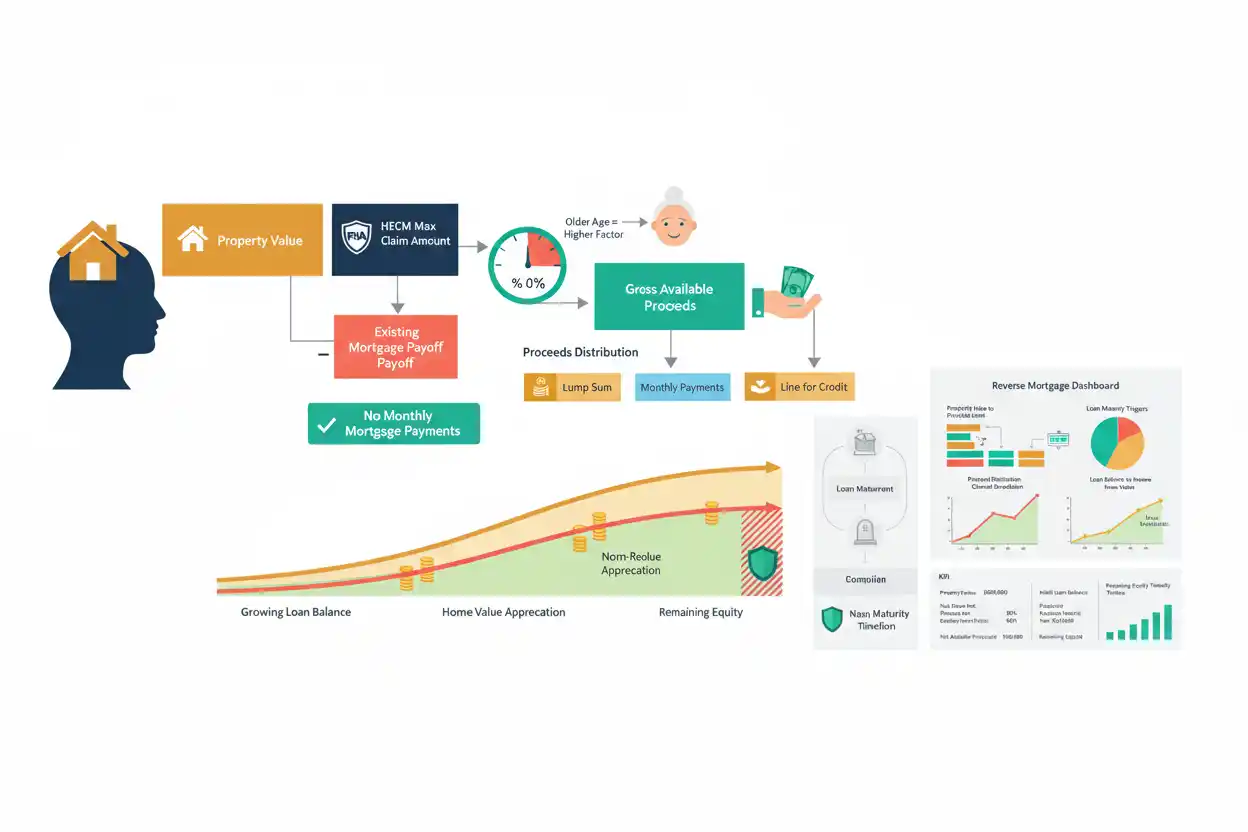

A reverse mortgage allows an eligible homeowner to borrow against home equity without making the same type of scheduled principal-and-interest payments required by a traditional forward mortgage.
For the FHA-insured Home Equity Conversion Mortgage, or HECM, the amount initially available is not simply the home’s equity.
A central formula is:
Initial Principal Limit = Maximum Claim Amount × Principal Limit Factor
HUD defines the HECM initial principal limit using the maximum claim amount and the principal limit factor associated with the relevant borrower age and expected interest rate.
The principal limit factor is not one fixed percentage for every borrower.
2026 HECM Maximum Claim Amount
For FHA case numbers assigned in calendar year 2026, HUD set the nationwide HECM maximum claim amount at:
$1,249,125
The limit applies nationwide for 2026.
For a standard HECM, the maximum claim amount generally uses the applicable lesser value under HUD’s rules rather than allowing an unlimited home valuation to drive proceeds. HUD’s HECM calculator guidance identifies the appraised value and national mortgage limit among the inputs used in determining maximum claim amount.
Reverse Mortgage Example
Suppose:
Home appraised value = $600,000
Existing mortgage = $80,000
Because $600,000 is below the 2026 HECM maximum claim amount:
Illustrative Maximum Claim Amount = $600,000
Now assume a hypothetical principal limit factor of 0.40 solely to demonstrate the mathematics.
Actual PLFs depend on HUD tables, borrower age and expected rate; 0.40 is not a quote or eligibility determination.
Initial Principal Limit = $600,000 × 0.40
Initial Principal Limit = $240,000
What Determines the Principal Limit Factor?
HUD states that the amount available through a HECM depends on factors including the age of the youngest borrower or eligible non-borrowing spouse, the interest rate, and the applicable property-value/HECM-limit input.
Conceptually:
older age tends to support a different PLF than younger eligibility ages, while interest-rate assumptions also affect the factor.
Because the factor comes from the HECM program’s applicable tables, it should not be guessed for a real transaction.
Subtract Existing Mortgage Debt
An existing mortgage generally must be addressed as part of the HECM transaction.
In the example:
Initial principal limit:
$240,000
Existing mortgage:
$80,000
Remaining before other obligations and costs:
$240,000 − $80,000
$160,000
The homeowner does not receive the full $240,000 as spendable cash.
HECM Mortgage Insurance
HUD’s 2026 HECM counseling handbook states that HECMs carry upfront and ongoing FHA mortgage-insurance premiums and identifies the current HECM initial premium as 2% of the maximum claim amount and the annual premium as 0.5% of the loan balance.
Using the $600,000 maximum claim amount:
Upfront MIP = $600,000 × 2%
Upfront MIP = $12,000
If financed, that cost reduces the amount of equity economically available to the borrower and contributes to the reverse-mortgage balance.
HECM Origination Fee Example
HUD’s current counseling handbook describes the HECM origination-fee cap as the greater of $2,500 or 2% of the first $200,000 of the maximum claim amount plus 1% of the amount above $200,000, subject to a $6,000 maximum.
On a $600,000 maximum claim amount:
First $200,000:
$200,000 × 2% = $4,000
Remaining $400,000:
$400,000 × 1% = $4,000
Calculated amount:
$8,000
But the stated maximum applies:
Illustrative Maximum Origination Fee = $6,000
Estimated Net Principal Limit
Suppose:
Initial principal limit = $240,000
Existing mortgage payoff = $80,000
Upfront MIP = $12,000
Origination fee = $6,000
Other illustrative closing costs = $4,000
Then:
Estimated Remaining Principal Limit = $240,000 − $80,000 − $12,000 − $6,000 − $4,000
≈ $138,000
This does not mean the homeowner necessarily receives $138,000 immediately.
HECM disbursement limits, set-asides, mandatory obligations, chosen payment plan, and actual lender figures can affect the amount and timing of funds available.
Reverse Mortgage Balance Grows
A traditional mortgage amortization schedule normally reduces principal over time.
A reverse mortgage generally works in the opposite direction.
When advances, interest, insurance premiums, and applicable charges are added:
New Reverse Mortgage Balance = Prior Balance + Advances + Accrued Interest + Applicable Charges − Repayments
Therefore, the mortgage balance can grow rather than decline.
HUD describes reverse mortgages as rising-debt, falling-equity loans because the loan balance can increase as equity is converted into borrowed funds.
Interest Example
Suppose the outstanding reverse-mortgage balance is:
$150,000
and, for illustration, the effective annual borrowing rate used for a simple estimate is 7%.
Approximate one-year interest before additional charges:
$150,000 × 7%
$10,500
If no repayment is made and the interest is added to the balance:
New Balance ≈ $160,500
before subsequent advances, MIP, or other applicable amounts.
The actual HECM accrual follows the mortgage’s contractual rate and servicing terms.
No Ordinary Monthly Principal-and-Interest Payment
The defining feature is that the borrower generally does not make the normal monthly principal-and-interest payment associated with a forward mortgage while the HECM remains in good standing under its terms.
That does not mean homeownership becomes cost-free.
HUD requires borrowers to continue meeting important property obligations, including property taxes and homeowners insurance.
Age Requirement
HUD’s HECM program is designed for homeowners age:
62 or Older
subject to the program’s detailed borrower and eligible non-borrowing-spouse rules.
The exact age used in the principal-limit calculation can depend on the youngest relevant person under HECM rules.
HECM Counseling
HUD requires HECM counseling through an approved housing counseling process before the transaction.
The purpose is to help prospective borrowers understand:
costs, alternatives, borrower obligations, payment options, and consequences.
HUD identifies counseling as an integral HECM requirement.
Reverse Mortgage and Home Equity
A reverse mortgage converts part of home equity into debt-backed proceeds.
Suppose:
Home value = $600,000
Reverse mortgage balance = $150,000
Simplified gross remaining equity:
$600,000 − $150,000
$450,000
If the balance rises to $250,000 while property value remains unchanged:
Gross Equity = $350,000
The homeowner remains the property owner, but more of the property value is encumbered by mortgage debt.
Reverse Mortgage vs HELOC
A HELOC is a revolving home-equity credit line that generally requires repayment according to its contractual schedule.
A HECM reverse mortgage follows a fundamentally different repayment structure designed for eligible older homeowners.
Both can access home equity, but they should not be treated as interchangeable.
Reverse Mortgage vs Home Equity Loan
A home equity loan generally provides a lump sum with required installment payments.
A reverse mortgage can provide proceeds through several permitted structures while postponing ordinary repayment until a maturity event under the mortgage terms.
The appropriate product depends on eligibility, cash flow, costs, and goals.
Reverse Mortgage vs Refinancing
Traditional refinancing replaces one forward mortgage with another.
A reverse mortgage changes the repayment structure much more fundamentally.
A homeowner considering both should compare:
monthly cash flow, closing costs, equity consumption, interest accumulation, and long-term estate implications.
Rate-and-Term Refinance Alternative
An older homeowner who can still comfortably make mortgage payments might consider a rate-and-term refinance if the primary objective is simply to lower the rate or payment.
A reverse mortgage is more relevant when the objective involves accessing equity and changing the payment structure.
Reverse Mortgage and Private Mortgage Insurance
The mapped private mortgage insurance applies to applicable conventional forward mortgages.
HECM uses FHA mortgage insurance instead.
Therefore:
HECM MIP ≠ Conventional PMI
The pricing and purposes should be analyzed under their respective programs.
Reverse Mortgage and VA Mortgages
A VA mortgage is another fundamentally different mortgage structure.
An eligible Veteran may have access to VA-backed forward financing without monthly mortgage insurance.
That does not make a VA purchase mortgage a substitute for the cash-flow structure of a reverse mortgage.
Reverse Mortgage and Renting vs Buying
The mapped renting vs buying decision usually arises before or during the initial homeownership decision.
A reverse mortgage usually becomes relevant later, once an eligible homeowner has accumulated meaningful equity.
These pages therefore occupy different points in the housing-finance lifecycle.
When Does a Reverse Mortgage Become Due?
HECM repayment can be triggered by events defined under the mortgage and HUD program rules, such as when the home is no longer the applicable principal residence or following other maturity events.
Borrower and eligible non-borrowing-spouse protections can be technically complex.
The actual HECM documents and HUD counseling guidance should control the transaction.
Non-Recourse Protection
FHA insurance is a major HECM feature.
HUD explains that HECM insurance protects against crossover risk when the loan balance exceeds the property’s value.
That does not mean the homeowner or heirs automatically keep the property without addressing the mortgage.
It means the FHA insurance structure addresses specified losses under program rules.
Frequently Asked Questions
What is a reverse mortgage?
It is home-equity financing that allows eligible homeowners to access equity through a mortgage whose balance can grow rather than amortize through ordinary monthly principal-and-interest payments.
What is a HECM?
HECM means Home Equity Conversion Mortgage, FHA’s federally insured reverse-mortgage program.
How old do you need to be for an FHA HECM?
The program is designed for homeowners age 62 or older, subject to detailed borrower and spouse rules.
What is the 2026 HECM maximum claim amount?
$1,249,125.
What is the principal-limit formula?
Initial Principal Limit = Maximum Claim Amount × Principal Limit Factor
Is the principal limit factor fixed?
No. It depends on HECM program inputs including age and expected interest rate.
Does the homeowner receive the full principal limit?
Not necessarily. Existing liens, mortgage insurance, closing costs, set-asides, mandatory obligations, and disbursement rules can reduce or delay available proceeds.
Do reverse mortgages charge interest?
Yes. Interest accrues on the outstanding mortgage balance.
Do borrowers still pay property taxes?
Yes. HECM borrowers retain important property-charge obligations.
Is reverse-mortgage counseling required?
HECM borrowers must complete the applicable HUD-approved counseling process.
Is a reverse mortgage the same as a HELOC?
No.
Does a reverse mortgage reduce home equity?
The mortgage converts equity into debt, and the balance can grow over time.
Final Takeaway
A reverse mortgage is not calculated simply as:
Home Value − Existing Mortgage
For an FHA HECM, a central starting relationship is:
Initial Principal Limit = Maximum Claim Amount × Principal Limit Factor
For 2026, the nationwide HECM maximum claim amount is:
$1,249,125.
In the illustrative $600,000-home example with a hypothetical 0.40 PLF:
Initial Principal Limit = $240,000
After an $80,000 existing mortgage and illustrative insurance and closing charges, approximately:
$138,000
remains before other HECM restrictions, set-asides, and disbursement rules.
The crucial tradeoff is that cash flow can improve today while mortgage debt grows and home equity is consumed over time.