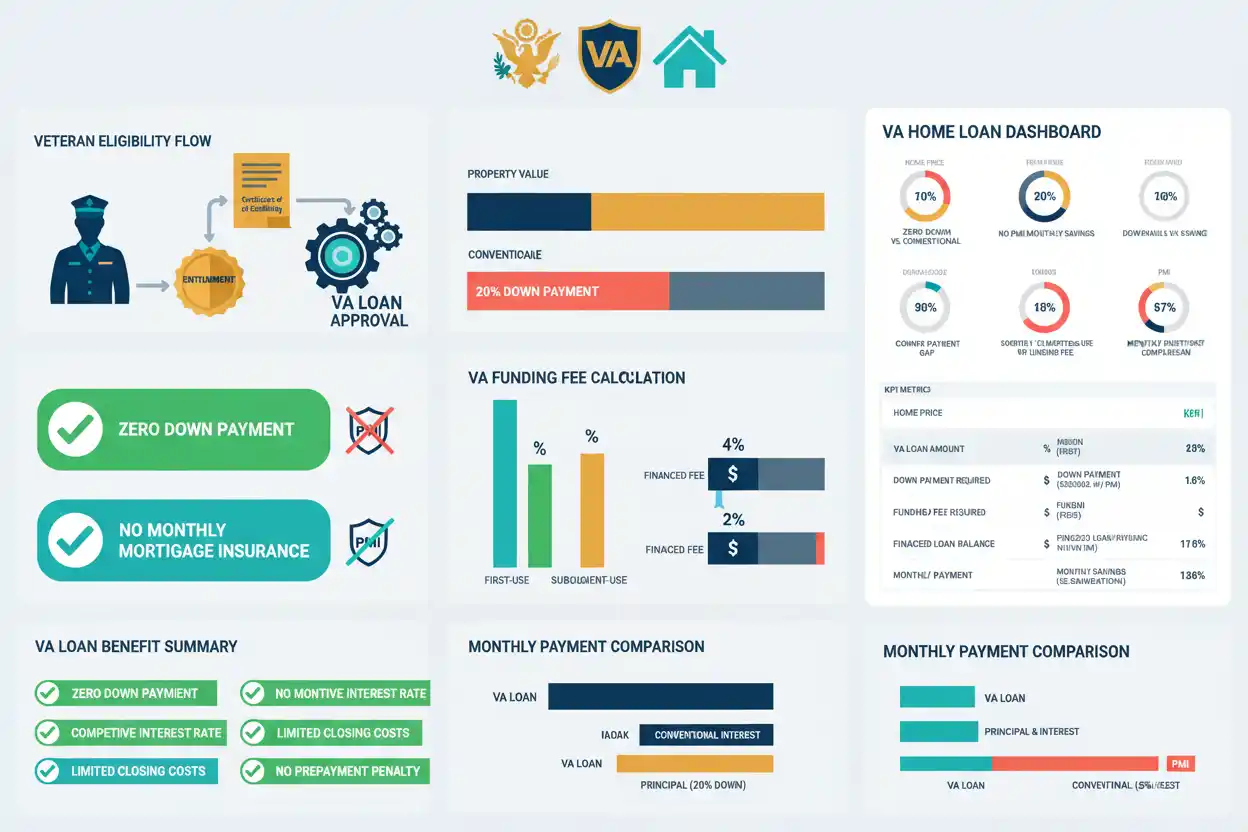

VA mortgages are home loans made by private lenders or, in certain programs, directly by the Department of Veterans Affairs and supported by the VA home-loan benefit for eligible borrowers.
One of their defining cost features is the VA funding fee.
VA describes the funding fee as a one-time charge that helps support the home-loan program, which can provide benefits including no required down payment in eligible purchase transactions and no monthly mortgage insurance.
The basic funding-fee formula is:
VA Funding Fee = Applicable Loan Amount × Funding Fee Rate
The percentage depends on factors including:
loan type, first or subsequent use, and down-payment amount for applicable purchase loans.
2026 VA Purchase Funding Fee Rates
VA’s current published funding-fee chart, last updated January 2026, lists the following purchase/construction rates for Veterans, active-duty service members, and National Guard and Reserve members.
| Down Payment | First Use | After First Use |
|---|---|---|
| Less than 5% | 2.15% | 3.30% |
| 5% or more | 1.50% | 1.50% |
| 10% or more | 1.25% | 1.25% |
These percentages apply to the loan amount rather than simply the home’s purchase price.
First-Use VA Mortgage Example
Suppose an eligible first-time VA home-loan user purchases a:
$400,000 Home
with:
$0 Down
Base loan amount:
$400,000
Applicable first-use funding fee at less than 5% down:
2.15%
Funding fee:
$400,000 × 2.15%
$8,600
If paid in cash, the mortgage remains:
$400,000
If the borrower finances the funding fee:
Financed Mortgage = $400,000 + $8,600
$408,600
VA permits the funding fee itself to be financed into an eligible purchase loan.
Payment Effect of Financing the Funding Fee
Assume an illustrative:
Rate = 6.5%
Term = 30 years
Payment on $400,000:
≈ $2,528.27
Payment on $408,600:
≈ $2,582.63
Difference:
≈ $54.36 per Month
Financing the fee preserves $8,600 of closing cash but creates a larger mortgage and additional interest.
5% Down Example
Suppose:
Home price = $400,000
Down payment = 5%
Down payment:
$400,000 × 5% = $20,000
Base VA loan:
$380,000
First-use funding-fee rate:
1.50%
Funding fee:
$380,000 × 1.50%
$5,700
If financed:
Total Mortgage = $385,700
At the illustrative 6.5%, 30-year rate:
P&I ≈ $2,437.89
The down payment lowers both:
the amount borrowed and the applicable first-use funding-fee percentage.
10% Down Example
Home price:
$400,000
Down payment:
$40,000
Base loan:
$360,000
Funding-fee rate:
1.25%
Fee:
$360,000 × 1.25%
$4,500
If financed:
Total Mortgage = $364,500
Illustrative payment at 6.5% for 30 years:
≈ $2,303.89
First Use vs Subsequent Use
The largest purchase-fee difference occurs when the down payment is less than 5%.
First use:
2.15%
Subsequent use:
3.30%
For a $400,000 base loan:
First-use fee:
$8,600
Subsequent-use fee:
$13,200
Difference:
$4,600
Once the down payment reaches at least 5%, VA’s current purchase fee table shows the same percentage for first and subsequent use.
Funding-Fee Exemptions
Not every eligible VA borrower pays the funding fee.
VA lists exemption categories including certain borrowers receiving or eligible for VA compensation for a service-connected disability, certain surviving spouses receiving Dependency and Indemnity Compensation, certain pre-discharge-rated service members, and qualifying active-duty Purple Heart recipients.
The borrower’s Certificate of Eligibility and VA/lender process should determine actual funding-fee status.
Funding Fee Refunds
VA also states that some borrowers can qualify for a funding-fee refund when they later receive a qualifying service-connected disability compensation award with an effective date retroactive to before the loan closing.
This is a program-specific determination rather than something to assume from the mortgage balance alone.
VA Mortgages and PMI
One major distinction from conventional high-LTV financing is that VA-backed mortgages do not use monthly private mortgage insurance in the ordinary conventional PMI structure.
VA specifically states that its home-loan program does not require monthly mortgage insurance.
That can make a zero-down VA mortgage economically different from a low-down-payment conventional mortgage.
VA Mortgage vs Conventional 5% Down
Suppose a conventional mortgage would require monthly PMI while the eligible VA mortgage does not.
A fair comparison should include:
VA funding fee, conventional PMI, rate, APR, lender fees, down payment, and expected holding period.
Do not compare only the note rates.
VA Mortgage and Renting vs Buying
For an eligible borrower, the financing assumptions on the renting vs buying page can change substantially.
A VA purchase can allow the borrower to preserve down-payment cash.
However, preserving cash also means financing more of the home’s value.
That can increase monthly principal and interest.
VA Mortgage and Refinancing
VA-backed borrowers also have refinance options.
The current VA funding-fee table lists cash-out refinance funding fees of:
First use:
2.15%
After first use:
3.30%
and an Interest Rate Reduction Refinance Loan, or IRRRL, funding fee of:
0.50%.
These are distinct from ordinary refinancing rules for conventional mortgages.
VA IRRRL
A VA Interest Rate Reduction Refinance Loan is designed specifically for eligible existing VA-backed financing.
Funding fee:
0.50%
under VA’s current chart.
Suppose:
IRRRL loan amount = $350,000
Funding fee:
$350,000 × 0.50%
$1,750
The complete refinance economics should still include lender costs and the mortgage break-even point.
VA Mortgage and Rate-and-Term Refinance
A rate-and-term refinance is a general refinancing concept.
VA refinancing follows VA-specific programs and rules.
Therefore, an eligible Veteran should compare the VA refinance option with any conventional alternative actually available rather than assuming the same fee and underwriting framework applies.
VA Mortgage and Reverse Mortgage
A reverse mortgage has a fundamentally different repayment model.
VA mortgages are ordinary forward home financing.
VA does not turn the mortgage into a reverse mortgage simply because the borrower is an eligible Veteran.
The products serve different objectives.
VA Loan and Mortgage Principal
If the funding fee is financed, it increases mortgage principal.
Example:
Base mortgage:
$400,000
Financed fee:
$8,600
Starting principal:
$408,600
Interest is then calculated from the higher balance.
VA Loan and LTV
The loan-to-value ratio can be high when a VA purchase uses no down payment.
However, VA eligibility and guaranty rules are not simply conventional PMI rules with a different name.
The lack of monthly mortgage insurance is one reason VA financing needs its own comparison.
VA Closing Costs
VA borrowers can still face ordinary mortgage transaction costs.
VA notes that lenders determine the interest rate, discount points, and many other closing costs.
Therefore:
No Down Payment ≠ No Cash Needed at Closing
Some borrowers can still need cash for other transaction charges unless seller credits, lender arrangements, or other permitted structures cover them.
Can All Closing Costs Be Financed?
For VA purchase and construction/permanent loans, VA states that the funding fee can be financed but other closing costs generally cannot simply be rolled into the VA loan amount in the same way.
This distinction matters when calculating cash needed to close.
Mortgage APR
The mortgage APR should be reviewed when comparing VA lenders.
Two lenders can offer:
the same VA funding fee
but different:
interest rates, discount points, and lender charges.
The funding fee is established by the applicable VA rules, while lender pricing can vary.
Mortgage Term
The mortgage term affects monthly payment and lifetime interest exactly as it does with other amortizing mortgages.
Financing a VA funding fee over 30 years lowers the immediate cash burden but can cause the borrower to pay interest on that fee for years.
Funding Fee vs Mortgage Insurance
The funding fee is:
A One-Time VA Program Charge
Monthly conventional PMI is:
A Recurring Insurance Premium
These cash-flow patterns differ significantly.
A borrower expecting to keep the mortgage for many years can therefore experience very different total costs.
Frequently Asked Questions
What is a VA mortgage?
It is eligible home financing backed or provided under the Department of Veterans Affairs home-loan program.
Do VA mortgages require a down payment?
VA-backed purchase financing can offer no-down-payment borrowing for eligible borrowers, subject to the transaction and lender requirements.
Do VA mortgages have monthly PMI?
VA states that its program does not require monthly mortgage insurance.
What is the VA funding fee?
It is a one-time program fee that applies to many VA home loans unless the borrower qualifies for an exemption.
What is the first-use purchase fee with less than 5% down?
2.15%.
What is the subsequent-use fee with less than 5% down?
3.30%.
What is the fee with at least 5% down?
1.50%
for first and subsequent purchase use under the current table.
What is the fee with at least 10% down?
1.25%.
Can the funding fee be financed?
Yes. VA allows the funding fee to be included in the loan amount.
Can other purchase closing costs be financed the same way?
VA states that on purchase/construction-permanent loans, only the funding fee can be financed into the loan amount under this rule.
What is the IRRRL funding fee?
0.50% under the current VA chart.
Is everyone required to pay the funding fee?
No. VA provides several exemption categories.
Final Takeaway
The defining VA funding-fee formula is:
VA Funding Fee = Loan Amount × Applicable Funding Fee Rate
For a $400,000 first-use VA purchase with less than 5% down:
Funding Fee = $400,000 × 2.15%
$8,600
If financed:
Starting Mortgage = $408,600
At an illustrative 6.5% for 30 years:
Payment rises from approximately:
$2,528.27
to:
$2,582.63
VA financing can eliminate the ordinary down-payment requirement and monthly mortgage insurance for eligible borrowers, but the correct comparison still includes the funding fee, exemption status, lender rate, closing costs, mortgage term, and whether financing the fee is worth the additional long-term interest.