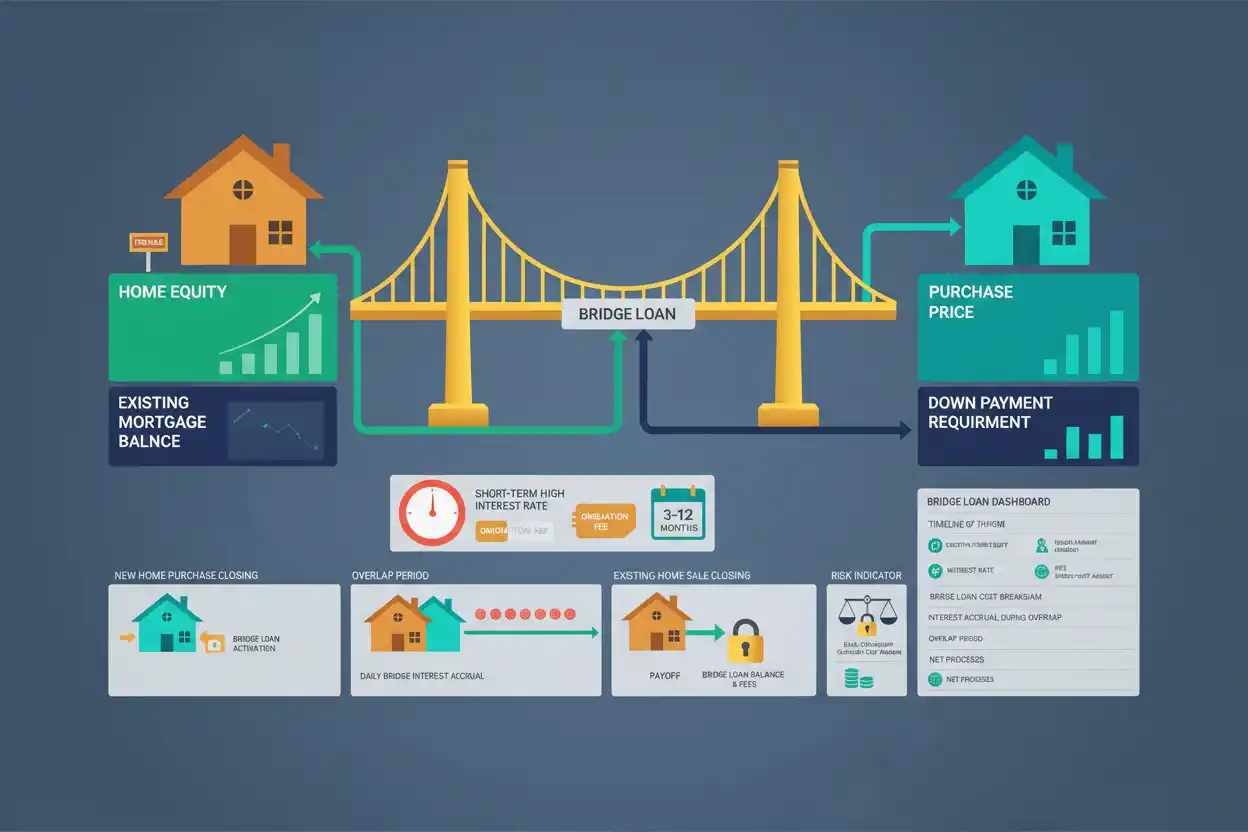

A bridge loan is short-term financing designed to cover a temporary funding gap until another expected source of money becomes available.
In residential real estate, a common use is helping a homeowner purchase a new property before the existing home has been sold.
The borrower expects the sale proceeds from the old property to repay or substantially reduce the bridge loan.
CFPB mortgage rules use temporary bridge financing as an example of credit that can finance the purchase of a new dwelling while the borrower plans to sell the current dwelling. Certain regulatory provisions specifically reference temporary bridge loans with terms of 12 months or less, although actual products and contractual terms can vary.
A bridge loan therefore should not be judged like an ordinary 30-year mortgage.
The key questions are:
How much temporary cash is needed?
How much will the bridge cost during the expected holding period?
What happens if the planned sale is delayed or produces less money than expected?
What Is a Bridge Loan?
A bridge loan temporarily connects two financial events.
For example:
Event 1: purchase a new home.
Event 2: sell the existing home.
The borrower has substantial equity in the existing property but does not yet have the sale proceeds in cash.
The bridge loan provides temporary liquidity.
Once the property sells, the borrower uses the proceeds to repay the short-term financing.
Within the Mortgages & Home Loans cluster, bridge loans belong to transitional financing rather than ordinary long-term amortization.
Basic Bridge Loan Cost Formula
For a simple-interest bridge loan:
Bridge Interest = Principal × Annual Interest Rate × Time
If time is measured in months:
Bridge Interest = Principal × Annual Rate × Months ÷ 12
If time is measured in days:
Bridge Interest = Principal × Annual Rate × Days ÷ Day-Count Basis
Total simplified financing cost:
Bridge Financing Cost = Interest + Origination Fees + Other Financing Charges
The final payoff generally also includes repayment of principal.
Bridge Loan Example
Suppose:
Bridge loan principal = $100,000
Interest rate = 10%
Expected term = 6 months
Origination fee = 2%
Interest is paid monthly
Principal is repaid when the old property sells
Step 1: Calculate Monthly Interest
Monthly Interest = $100,000 × 10% ÷ 12
Monthly Interest ≈ $833.33
Step 2: Calculate Six Months of Interest
Interest = $833.33 × 6
Interest ≈ $5,000
Step 3: Calculate Origination Fee
Origination Fee = $100,000 × 2%
Origination Fee = $2,000
Step 4: Calculate Total Financing Cost
Financing Cost = $5,000 + $2,000
Financing Cost = $7,000
The borrower pays approximately $7,000 for access to $100,000 of bridge financing for six months, before other possible charges.
Bridge Loan Payoff
If the borrower has been paying interest monthly, the principal payoff at sale can be approximately:
Bridge Principal Payoff = $100,000
If interest was deferred rather than paid monthly, the payoff could instead include both principal and accrued interest:
Payoff ≈ $100,000 + $5,000
Payoff ≈ $105,000
before fees or other adjustments.
The actual payment structure comes from the loan agreement.
Home Equity Available for Bridge Financing
Suppose:
Current home estimated value = $500,000
Existing mortgage payoff = $250,000
Expected selling costs = $30,000
Estimated net sale equity:
Net Sale Equity = Home Sale Price − Existing Mortgage Payoff − Selling Costs
Net Sale Equity = $500,000 − $250,000 − $30,000
Net Sale Equity = $220,000
A $100,000 bridge loan would consume a significant portion of that expected equity.
The borrower should therefore evaluate the bridge against net sale proceeds, not simply gross home value.
Bridge Loan and Combined Loan-to-Value Ratio
The combined loan-to-value ratio can matter when multiple debts are secured by the same property.
Suppose:
Existing first mortgage = $250,000
New bridge financing secured by current property = $100,000
Current property value = $500,000
Combined secured debt:
$250,000 + $100,000 = $350,000
Simplified CLTV:
CLTV = $350,000 ÷ $500,000 × 100
CLTV = 70%
Program-specific underwriting definitions can vary, but the example shows how bridge debt can increase property leverage.
Bridge Loan and Cash-Out Refinance
A cash-out refinance replaces an existing mortgage with a larger new mortgage and returns part of the difference to the borrower.
A bridge loan is different.
Cash-out refinance:
restructures long-term mortgage debt.
Bridge loan:
provides temporary financing around a transition.
The right choice depends heavily on how long the money is needed.
Bridge Loan vs HELOC
A HELOC can also provide access to home equity.
Unlike a typical bridge loan, a HELOC is revolving credit.
If a homeowner already has an available HELOC at favorable terms, it may provide an alternative source of short-term liquidity.
However, HELOC rates, draw terms, repayment structure, and lien position differ from bridge financing.
Bridge Loan vs Home Equity Loan
A home equity loan generally provides a lump-sum second mortgage with a defined repayment schedule.
A bridge loan is more explicitly connected to a short-term transition.
Using long-term home equity debt for a short-term property transition can sometimes create unnecessary interest or repayment complexity.
Bridge Loan and Balloon Mortgage
A balloon mortgage also creates a large final repayment obligation.
A bridge loan can similarly require principal repayment at the end of a short term.
However, the purposes differ.
Balloon mortgage:
structured mortgage with a large maturity balance.
Bridge loan:
temporary financing intended to be repaid from a foreseeable future event.
Bridge Loan and Adjustable-Rate Mortgage
An adjustable-rate mortgage creates longer-term rate-adjustment exposure.
Bridge loans are usually focused on short holding periods.
Nevertheless, a variable bridge rate can still create risk if the sale is delayed.
The borrower should determine whether the interest rate is fixed for the bridge period or can change.
Bridge Loan and Biweekly Mortgage Payments
Biweekly mortgage payments are a long-term principal-acceleration strategy.
They are generally not the central repayment mechanism for a temporary bridge.
Bridge financing should instead be evaluated around:
holding period, interest accrual, fees, exit event, and final payoff.
Bridge Loan and Construction Loan
A construction loan finances building activity and can disburse funds through staged draws.
Bridge financing can occasionally be used around a construction transition, but the purposes remain distinct.
A borrower should not assume that a short construction loan and a bridge loan have the same funding mechanics.
Bridge Loan and Down Payment
A bridge loan can help provide cash needed for a down payment on the next property before proceeds from the old home’s sale arrive.
Suppose:
New home = $600,000
Desired down payment = $120,000
Cash savings available = $40,000
Funding gap:
Bridge Need = $120,000 − $40,000
Bridge Need = $80,000
That $80,000 could be the temporary liquidity requirement before transaction costs.
Bridge Loan and Mortgage Preapproval
A mortgage preapproval for the new home may need to account for the current mortgage, bridge debt, expected sale, and other obligations under the lender’s underwriting rules.
Borrowers should not assume the future sale automatically removes the existing payment from qualification calculations before the lender has documented and accepted the structure.
Bridge Loan and Mortgage DTI
The mortgage debt-to-income ratio can become complicated during a bridge period because the borrower may temporarily have:
an old mortgage, new mortgage, and bridge obligation.
This is sometimes called carrying overlapping housing obligations.
The household budget should be stress-tested for that overlap even if the lender’s underwriting permits the transaction.
Double-Housing-Cost Example
Suppose during the transition:
Old mortgage payment = $1,800
New mortgage payment = $2,600
Bridge interest payment = $833
Temporary monthly financing outflow:
Total = $1,800 + $2,600 + $833
Total = $5,233
Even if this lasts only a few months, it can create significant cash-flow pressure.
Bridge Loan and Closing Costs
The borrower can encounter transaction costs on:
the bridge loan, new mortgage, new-home purchase, and old-home sale.
The mortgage closing costs associated with the permanent mortgage should therefore be budgeted separately from bridge financing fees.
Bridge Loan Origination Fee
If the bridge loan carries a 2% fee:
$50,000 bridge:
Fee = $1,000
$150,000 bridge:
Fee = $3,000
A percentage fee becomes especially significant on short-term financing because it is incurred for only a few months of borrowing.
Effective Cost of a Short Bridge Loan
Using the $100,000 example:
Interest = $5,000
Fee = $2,000
Holding period = six months
Total cost:
$7,000
The simple cost relative to principal over six months is:
$7,000 ÷ $100,000 × 100 = 7%
Annualizing a short-term cost requires careful cash-flow treatment, but this calculation illustrates why upfront fees are especially important on short financing periods.
What If the Home Takes Longer to Sell?
Suppose the expected six-month sale instead takes nine months.
Additional interest:
Extra 3 Months = $100,000 × 10% × 3 ÷ 12
Extra Interest = $2,500
Total interest rises from $5,000 to:
$7,500
Total cost including the $2,000 fee becomes:
$9,500
Bridge financing therefore becomes progressively more expensive when the transition lasts longer than expected.
What If the Home Sells for Less?
Suppose expected net sale equity was $220,000.
The property sells for $40,000 less than expected.
Ignoring related changes in selling costs, net equity could fall toward:
$180,000
If bridge principal is $100,000, substantially less cash remains for the next home’s financing or reserves.
The borrower should therefore model conservative sale-price scenarios.
Bridge Loan and Mortgage Rate Lock
A mortgage rate lock on the permanent financing can expire if the property transaction takes longer than expected.
A delayed sale can therefore create both:
higher bridge interest and possible permanent-mortgage lock-extension costs.
Timing risk can affect more than one loan simultaneously.
Bridge Loan and Mortgage Payoff Amount
The old home’s mortgage payoff amount should be used when estimating sale proceeds.
The principal balance shown on a statement may not equal the exact amount required to release the old mortgage.
Using an understated payoff can overstate available bridge equity.
Bridge Loan Exit Strategies
A bridge loan should have a clearly defined exit.
Common possibilities include:
sale of the current home, permanent mortgage financing, another asset sale, or another contractually supported source.
A vague assumption such as “I’ll figure it out later” is not a strong bridge-financing plan.
Common Bridge Loan Mistakes
One mistake is estimating available equity from home value without subtracting the existing mortgage and selling costs.
Another is ignoring origination fees.
Borrowers also assume the home will sell at the expected price and date.
A fourth mistake is overlooking the temporary burden of carrying multiple property payments.
Finally, a bridge loan should not be treated as inexpensive merely because it will exist for only a few months.
Frequently Asked Questions
What is a bridge loan?
It is temporary financing designed to cover a funding gap until an expected future transaction or source of cash occurs.
How is bridge-loan interest calculated?
A simple structure can use:
Interest = Principal × Annual Rate × Time
What does a $100,000 bridge loan at 10% cost for six months?
Approximately:
$5,000 of Interest
before fees.
What does a 2% origination fee add?
$100,000 × 2% = $2,000
Can a bridge loan help with a down payment?
Yes, some borrowers use bridge financing to access expected equity before selling their current home.
Are bridge loans always 12 months or less?
No universal rule defines every bridge product that way. Certain federal mortgage rules specifically reference temporary bridge loans of 12 months or less for particular regulatory treatment.
Is a bridge loan the same as a HELOC?
No. A HELOC is revolving home-equity credit, while a bridge loan is temporary financing around a transition.
Is a bridge loan the same as a balloon mortgage?
No. Both can have large final obligations, but their purposes and structures differ.
What happens if my home does not sell on time?
The bridge remains outstanding longer, potentially increasing interest and refinancing or liquidity pressure.
What if the property sells for less than expected?
Available sale proceeds can be insufficient to cover all planned uses, including the bridge payoff and new-home financing.
Does bridge debt affect mortgage qualification?
It can, depending on the lender’s underwriting treatment of existing and temporary obligations.
What should I calculate before using a bridge loan?
Estimate net home-sale equity, bridge principal, interest, fees, monthly carrying costs, conservative sale timing, and the final payoff source.
Final Takeaway
A bridge loan solves a timing problem, not an affordability problem.
For a $100,000 bridge loan at 10% for six months:
Interest = $5,000
A 2% origination fee adds:
$2,000
Total simplified financing cost becomes:
$7,000
If the planned sale takes three additional months, another:
$2,500
of interest can accumulate.
That is why bridge financing should be built around a realistic and conservative exit plan. The critical variables are available home equity, sale timing, interest rate, fees, overlapping mortgage payments, and the amount of cash that will actually remain after the old property is sold.