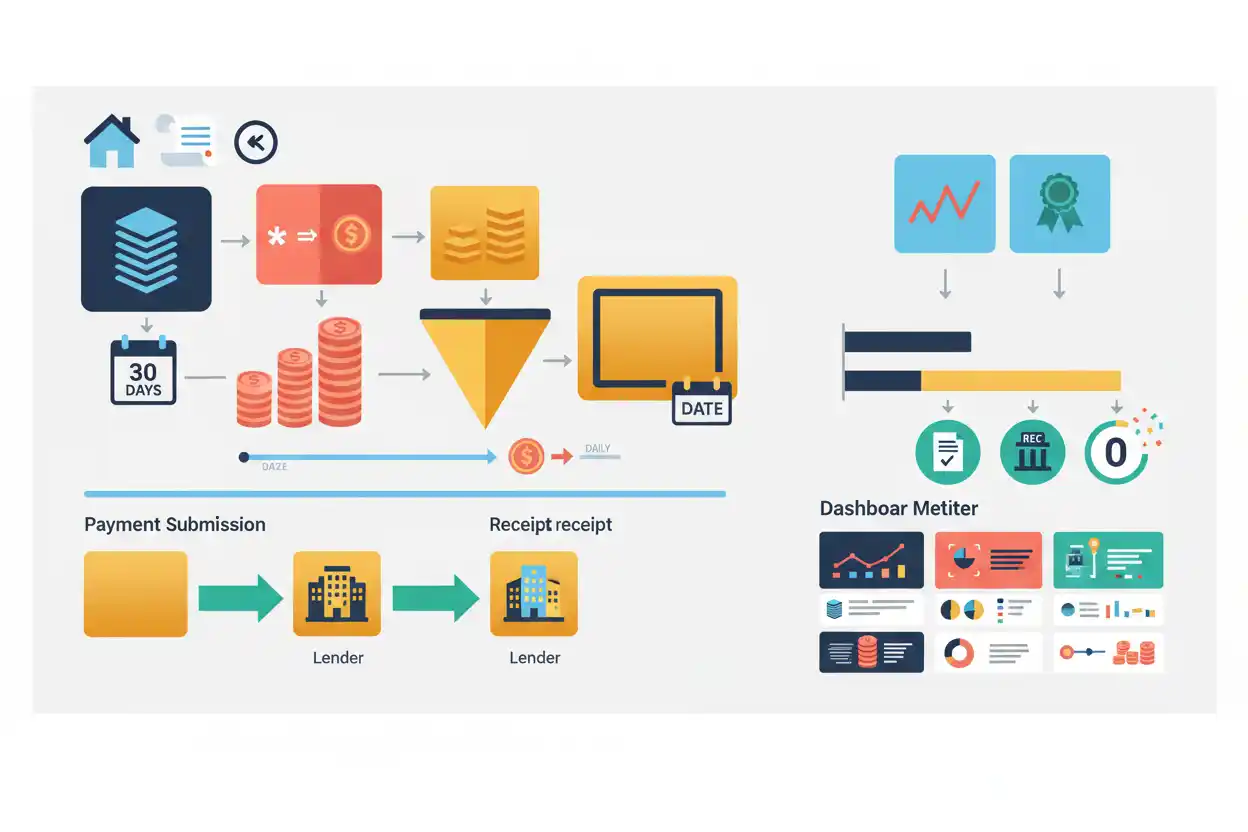

A mortgage payoff amount is the total amount required to completely satisfy a mortgage as of a specified payoff date.
It is usually not identical to the principal balance displayed on the latest mortgage statement.
A useful simplified formula is:
Mortgage Payoff Amount = Principal Balance + Accrued Interest Through Payoff Date + Applicable Fees or Charges − Credits
CFPB defines the payoff amount as the amount required to completely satisfy the mortgage and notes that it can differ from the current balance because interest continues through the payoff date and unpaid fees or applicable prepayment charges can also be involved.
Suppose:
Principal balance = $361,664.98
Accrued interest through payoff date = $966.09
Applicable unpaid charge = $50
Then:
Payoff Amount ≈ $361,664.98 + $966.09 + $50
Payoff Amount ≈ $362,681.07
That is the approximate amount needed to bring the debt to zero on the specified date under the example.
Mortgage Payoff Amount vs Principal Balance
The mortgage principal is the unpaid borrowed amount.
The payoff amount includes everything needed to settle the obligation through a particular date.
Therefore:
Mortgage Principal ≠ Automatically Mortgage Payoff
For example:
Principal = $250,000
Accrued interest = $900
Payoff before any additional charges is approximately:
$250,900
Why Mortgage Payoff Changes Every Day
Mortgage interest accrues over time.
Suppose:
Principal balance = $300,000
Annual rate = 6.5%
Using a simple 365-day estimate:
Daily Interest = $300,000 × 6.5% ÷ 365
Daily Interest ≈ $53.42
A payoff completed 10 days later can therefore require approximately:
$53.42 × 10
$534.25
of additional interest, assuming the principal and rate remain unchanged.
This is why payoff statements specify a date.
Mortgage Payoff Example
Assume a mortgage originally had:
Principal = $400,000
Rate = 6.5%
Term = 30 years
After 84 scheduled payments, the remaining principal is approximately:
$361,664.98
Suppose the intended payoff date is 15 days after the last regular payment.
Simplified daily interest:
Daily Interest = $361,664.98 × 6.5% ÷ 365
≈ $64.41
Interest for 15 days:
$64.41 × 15
≈ $966.09
Add an illustrative $50 unpaid charge:
Payoff ≈ $361,664.98 + $966.09 + $50
≈ $362,681.07
The exact servicer payoff statement controls the actual amount.
Payoff Amount vs Current Balance
CFPB specifically distinguishes the current mortgage balance from the payoff amount.
The current balance may not include all interest through the intended payoff date or other unpaid amounts necessary to satisfy the mortgage fully.
That means a borrower selling a home should not simply transfer the balance shown on an online dashboard and assume the lien will be released.
How to Get the Exact Mortgage Payoff
Request a payoff statement from the lender or mortgage servicer.
CFPB states that for a dwelling-secured loan, once the borrower requests a payoff amount, the servicer must provide an accurate statement of the total amount required to fully pay the loan as of a specified date.
Use that statement for:
home sales, refinances, large final payoff transactions, and other settlements.
Payoff Good-Through Date
A payoff quote commonly incorporates interest through a specified date.
Suppose:
Quote is good through August 20.
If payment arrives after that date:
additional interest or an updated payoff calculation can be necessary.
Therefore, closing agents and borrowers should coordinate the actual settlement date with the payoff statement rather than relying on an old figure.
Mortgage Payoff and How Payments Work
The mapped how mortgage payments work page explains why the current balance changes after every payment.
Each scheduled payment contains:
interest and principal.
Only the principal portion reduces the mortgage balance.
The payoff amount then starts from the remaining balance and adds amounts needed through the final settlement date.
Mortgage Interest in the Payoff Amount
The mortgage interest portion can be particularly important when the payoff occurs between scheduled payment dates.
Suppose:
Daily interest = $50
Payoff 5 days after the last payment:
Accrued Interest ≈ $250
Payoff 25 days after:
Accrued Interest ≈ $1,250
The timing alone can change the required payoff by about $1,000.
Mortgage Origination Fee vs Payoff Charge
A mortgage origination fee belongs to creating a mortgage.
A payoff amount belongs to ending one.
When refinancing:
the old loan generates a payoff amount, while the new loan can generate origination charges.
Those two sets of costs should not be combined conceptually.
Mortgage Interest Deduction at Payoff
The mapped mortgage interest deduction can become relevant because some interest paid as part of the payoff can potentially be included in qualifying mortgage interest under the applicable federal tax rules.
IRS Publication 936 states that qualifying mortgage interest paid up to the relevant sale/payoff period can be subject to the normal deduction requirements and limits.
Tax treatment should be determined separately from the payoff calculation.
Mortgage Payoff Strategies
The mortgage payoff strategies page focuses on ways to reach zero balance faster.
This article focuses on the actual amount required when that final day arrives.
The difference is:
Payoff Strategy = How You Get There
Payoff Amount = What You Owe on the Settlement Date
Extra Payments Reduce the Future Payoff
Suppose:
Current principal = $300,000
Extra principal payment = $25,000
New principal:
$275,000
Future payoff is now based on approximately $275,000 rather than $300,000, plus future accrued amounts.
CFPB advises borrowers who make extra principal payments to verify that the servicer applies those amounts to principal as intended.
Mortgage Points and Payoff
Mortgage points are generally upfront mortgage-pricing costs.
They are usually sunk costs by the time the borrower later pays off the mortgage.
A homeowner who paid substantial points and then refinances after one year may therefore have failed to recover their upfront cost.
That belongs in the economic payoff decision even though the original points are not usually added again to the payoff quote.
Prepayment Penalty
Some mortgages can contain a prepayment penalty.
The Loan Estimate identifies whether the loan has such a feature. CFPB describes a prepayment penalty as a charge that can apply when the mortgage is paid off early.
If applicable:
Payoff Amount = Principal + Accrued Interest + Prepayment Penalty + Other Applicable Charges
A borrower should verify the contract rather than assume every mortgage has—or does not have—such a charge.
Prepayment Penalty Example
Suppose:
Principal = $250,000
Accrued interest = $750
Applicable early-payoff penalty = $3,000
Payoff:
$250,000 + $750 + $3,000
$253,750
The penalty increases the cost of exiting the mortgage.
Mortgage Payoff and Escrow
A mortgage escrow balance is distinct from mortgage principal.
When the mortgage is paid off, the servicer handles remaining escrow funds under applicable servicing rules.
Therefore:
Escrow Balance ≠ Automatic Reduction in Principal Balance
Do not simply subtract an online escrow balance from the principal and call the result the payoff.
Home Sale Example
Suppose:
Home sale price = $500,000
Mortgage payoff = $300,000
Selling/closing costs = $35,000
Estimated seller proceeds:
$500,000 − $300,000 − $35,000
$165,000
Using an outdated principal balance of $298,500 instead of the actual $300,000 payoff would overstate expected proceeds by:
$1,500
Accurate payoff information is therefore central to home-sale settlement.
Refinance Example
Suppose:
Old mortgage payoff = $300,000
New refinance principal = $305,000
The difference is:
$5,000
That does not necessarily mean the borrower receives $5,000 cash.
The new mortgage can also need to fund closing costs, prepaid items, or other settlement amounts.
A refinance should therefore reconcile:
old payoff, new loan amount, transaction costs, and cash to or from the borrower.
Payoff Amount and Mortgage Amortization
A scheduled mortgage amortization table can estimate the principal after a specific number of payments.
However, it normally does not reproduce the exact final payoff because the payoff can include:
interest between payment dates and additional transaction-specific amounts.
Use the amortization schedule for planning.
Use the servicer payoff statement for settlement.
Payoff Amount and Recast
A mortgage recast is not a payoff.
A recast reduces future scheduled payments after a substantial principal reduction on an eligible mortgage.
The mortgage remains open.
A payoff eliminates the remaining debt entirely.
Mortgage Payoff vs Statement Balance
Suppose a monthly statement shows:
Principal = $250,000
and:
Next payment due = $2,000
Neither number necessarily equals the payoff.
The borrower might owe:
principal + interest accrued after the statement period + other applicable amounts.
CFPB’s payoff guidance explicitly warns against assuming the current balance is sufficient to satisfy the mortgage.
Payoff Amount and Negative Equity
Suppose:
Mortgage payoff = $420,000
Home value = $400,000
Difference:
$420,000 − $400,000
$20,000
The mortgage payoff exceeds property value by $20,000 before selling costs.
That can make an ordinary sale or refinance more difficult.
Should You Pay Off a Mortgage Early?
Mathematically, early principal repayment can reduce future mortgage interest.
Financially, the decision also depends on:
mortgage rate, cash reserves, other debt, investment opportunities, taxes, and liquidity.
The existence of a payoff quote does not mean using all available cash to satisfy it is automatically the best financial choice.
Common Mortgage Payoff Amount Mistakes
One mistake is using current principal balance as the payoff.
Another is ignoring daily accrued interest.
Borrowers also forget potential fees or prepayment provisions.
A fourth mistake is subtracting escrow from principal without following the servicer’s actual treatment.
Finally, payoff estimates should not replace an official payoff statement for a real closing.
Frequently Asked Questions
What is a mortgage payoff amount?
It is the amount required to completely satisfy the mortgage as of a specified date.
Is mortgage payoff the same as principal balance?
No.
What is the basic formula?
Payoff = Principal + Accrued Interest + Applicable Charges − Credits
Why is my payoff higher than my balance?
Interest can continue accruing through the payoff date, and other unpaid charges can apply.
Does payoff change every day?
It can because interest accrues with time.
How much daily interest does $300,000 at 6.5% generate?
Using a 365-day estimate:
Approximately $53.42 per Day
How do I get the exact payoff amount?
Request a payoff statement from the lender or servicer.
Can a prepayment penalty increase payoff?
Yes, when the mortgage contains an applicable early-payoff charge.
Does escrow reduce the payoff?
Escrow is handled separately under the mortgage servicing process; do not assume it directly offsets principal.
Do extra principal payments lower future payoff?
Yes, when properly applied to principal.
Is the payoff shown on an amortization calculator exact?
Usually not. Calculators estimate principal; the actual payoff can include accrued amounts through a specific date.
What happens after the mortgage is paid off?
The remaining servicing and lien-release process is completed according to applicable law, mortgage documents, and local recording procedures.
Final Takeaway
A mortgage payoff amount is more than the balance shown on your latest statement.
The simplified formula is:
Mortgage Payoff = Principal + Interest Through Payoff Date + Applicable Charges − Credits
In the worked example:
Principal after seven years ≈ $361,664.98
15 days of estimated interest ≈ $966.09
Illustrative unpaid charge = $50
Estimated payoff:
$362,681.07
The exact figure should come from the lender or servicer’s payoff statement.
Use a calculator to plan, but use the official payoff quote when selling, refinancing, or making the final mortgage payment, because even a few days of accrued interest can make the current principal balance insufficient to close the loan completely.