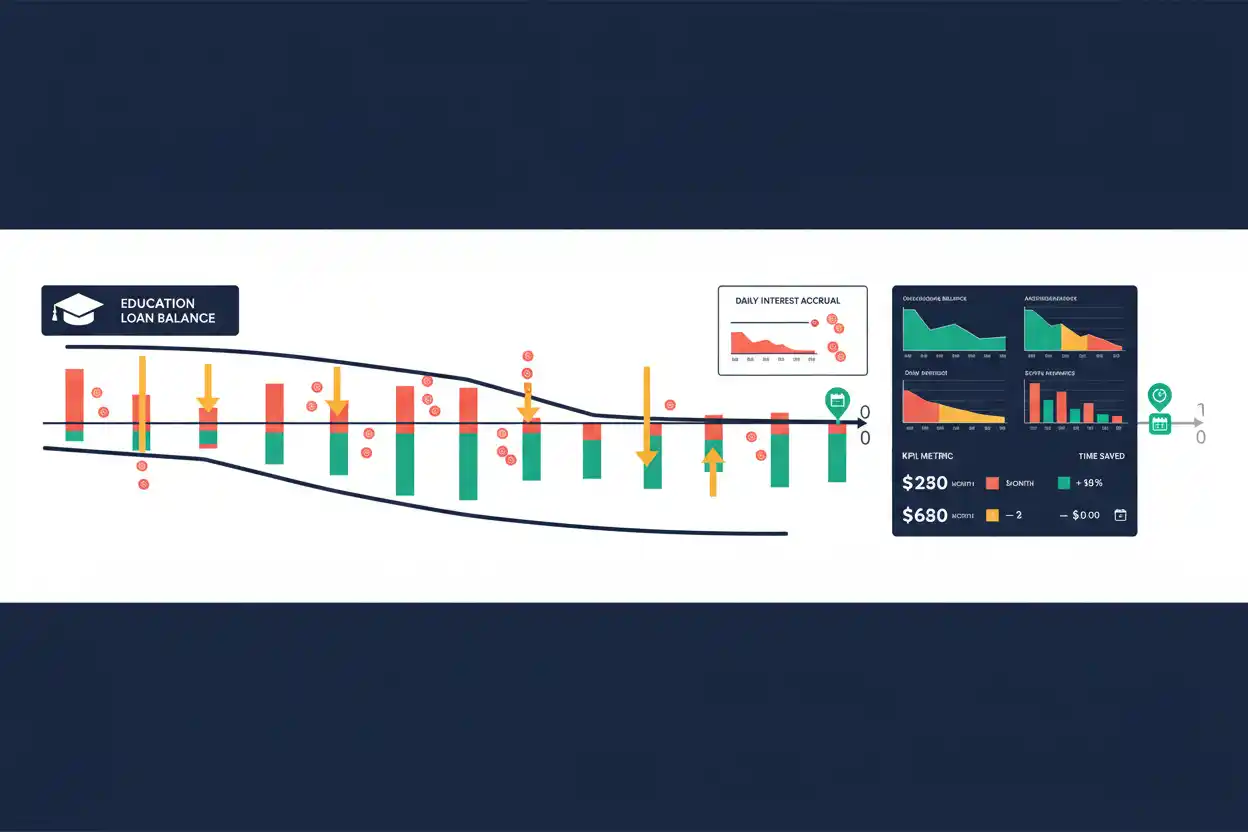

Student loan payments determine how quickly education debt moves from its current principal balance to zero.
The mechanics depend on the loan and repayment plan. A conventional level-payment loan can use a fixed monthly payment calculated from principal, interest rate, and repayment term. Other repayment structures can calculate required payments differently.
Regardless of the plan, three variables remain central:
principal, interest, and time.
A payment generally must first account for amounts due under the loan’s payment-allocation rules. The portion ultimately applied to principal reduces the balance that can generate future interest.
For a conventional fixed-payment amortizing loan, the payment formula is:
Monthly Payment = P × [r(1 + r)^n] ÷ [(1 + r)^n − 1]
Where:
P = principal balance
r = monthly interest rate
n = number of monthly payments
This formula is useful for understanding the mathematics behind many student loan payments, although an actual repayment plan can use different rules.
How Student Loan Payments Work
A student loan payment can contain:
interest that has accrued, principal repayment, and potentially other amounts required under the loan terms.
The basic relationship is:
Principal Reduction = Payment − Amount Applied to Interest and Other Required Charges
Suppose:
Payment = $400
Accrued interest satisfied = $150
Then:
Principal Reduction = $400 − $150
Principal Reduction = $250
If the starting principal balance is $30,000:
New Principal Balance = $30,000 − $250
New Principal Balance = $29,750
Future interest is then calculated from the applicable balance under the loan’s terms.
The detailed student loan interest calculation explains how daily interest can accumulate between payments.
Student Loan Payment Formula
For a standard fixed-payment illustration:
Payment = P × [r(1 + r)^n] ÷ [(1 + r)^n − 1]
Suppose:
Principal = $30,000
Annual interest rate = 6.5%
Repayment term = 10 years
Payments = monthly
Monthly rate:
Monthly Rate = 6.5% ÷ 12
Monthly Rate ≈ 0.54167%
As a decimal:
r ≈ 0.0054167
Number of payments:
n = 10 × 12
n = 120
The estimated fixed monthly payment is:
Monthly Payment ≈ $340.64
Again, this is a conventional amortization illustration. An actual student-loan repayment plan can produce a different required payment.
Total Repayment Example
Using the $30,000 balance, 6.5% rate, and 120-payment example:
Total Scheduled Payments ≈ $340.64 × 120
Using full precision:
Total Scheduled Payments ≈ $40,877.27
Estimated total interest:
Total Interest ≈ $40,877.27 − $30,000
Total Interest ≈ $10,877.27
The borrower repays roughly $10,877 above the original principal under the simplified fixed-payment model.
This demonstrates why the repayment timeline matters almost as much as the rate.
Student Loan Interest Accrues With Time
Many student loans use simple interest loan mechanics in which interest is calculated from outstanding principal.
For a daily calculation:
Daily Interest = Principal × Annual Interest Rate ÷ Day-Count Basis
Using a $30,000 balance at 6.5% and a 365.25-day basis:
Daily Interest ≈ $30,000 × 6.5% ÷ 365.25
Daily Interest ≈ $5.34 per Day
Across 30 days:
Interest ≈ $5.34 × 30
Interest ≈ $160.16
The exact figure can vary with balance changes and the servicer’s applicable calculation conventions.
Payment Timing Matters
If interest accrues daily, the number of days between payments affects the dollar interest that accumulates.
Suppose:
Daily interest = $5.34
A 28-day period produces approximately:
Interest ≈ $5.34 × 28 = $149.52
A 31-day period produces approximately:
Interest ≈ $5.34 × 31 = $165.54
That does not mean the annual rate changed.
The longer period simply contained more interest-accrual days.
First-Year Balance Example
Using the hypothetical $30,000 loan at 6.5% with approximately $340.64 monthly payments, the remaining balance after 12 scheduled payments is about:
Principal Balance After 12 Payments ≈ $27,797.42
So the borrower has paid approximately:
$30,000 − $27,797.42 = $2,202.58
of principal during the first year.
Yet total payments were approximately:
$340.64 × 12 ≈ $4,087.73
The difference largely represents interest.
This illustrates why a borrower’s bank account can show substantial payments while the principal balance declines more slowly.
Student Loan Payments and Principal Balance
The principal balance determines how much debt remains.
A payment does not reduce principal dollar-for-dollar when accrued interest must also be satisfied.
Suppose:
Principal = $20,000
Payment = $300
Accrued interest = $110
Then:
Principal Reduction = $190
New principal:
$20,000 − $190 = $19,810
Tracking principal separately gives a clearer picture of actual debt reduction.
Student Loan Payments and Repayment Schedules
A repayment schedule shows how each projected payment affects:
beginning balance, interest, principal, and ending balance.
For a conventional fixed-payment schedule:
Interest = Beginning Balance × Periodic Rate
Principal = Payment − Interest
Ending Balance = Beginning Balance − Principal
The next payment begins from the previous ending balance.
Fixed Payment vs Income-Based Payment Structures
Not every student loan repayment arrangement fixes the required payment using only principal, rate, and term.
Some repayment structures can determine payments partly from borrower income or other eligibility variables.
In that case, the scheduled payment may not correspond to a conventional fixed amortization formula.
This can change:
monthly affordability, principal reduction, total interest, and the time required before the debt is resolved.
A borrower should distinguish between:
how the required payment is determined
and:
how interest continues to accrue.
Lower Payments Can Extend the Timeline
Suppose one repayment strategy requires $350 per month while another requires $200.
The $200 payment provides greater current cash-flow relief.
However, if both plans ultimately require full repayment and the smaller payment reduces principal more slowly, the debt can remain outstanding longer.
That can increase total interest.
Therefore:
Lower Monthly Payment ≠ Automatically Lower Total Cost
Student Loan Payments and Total Debt Service Ratio
Student loan obligations can contribute to the total debt service ratio when a lender’s methodology includes them.
Suppose:
Gross monthly income = $7,000
Housing and other qualifying obligations = $2,200
Student loan payment = $400
Total obligations become:
$2,200 + $400 = $2,600
The student loan therefore affects broader borrowing capacity even though it is not housing debt.
Student Loan Payments and Debt-to-Income Ratio
The debt-to-income ratio directly compares qualifying monthly debt payments with gross monthly income.
Suppose:
Gross monthly income = $6,000
Other qualifying debt = $1,500
Student loan payment = $400
Then:
DTI = ($1,500 + $400) ÷ $6,000 × 100
DTI ≈ 31.7%
A repayment-plan change can therefore affect the monthly debt ratio even when the principal balance has not changed.
Student Loans Are Generally Unsecured
Student loans generally function differently from an ordinary secured loan backed by a house, car, or similar pledged asset.
That makes them closer in collateral structure to an unsecured loan, although student loans have their own contractual, statutory, and program-specific rules.
“Unsecured” does not mean the debt has no repayment consequences.
It means a conventional pledged asset does not define the obligation in the same way as a mortgage or vehicle loan.
Extra Student Loan Payments
Paying more than the required amount can reduce principal faster when the additional payment is applied appropriately.
Suppose:
Required payment = $340.64
Extra monthly amount = $100
Total payment:
$440.64
If the additional $100 ultimately reduces principal, future interest has less balance on which to accrue.
Repeated monthly principal reductions can shorten the repayment timeline materially.
Extra Payment Interest Effect
Suppose an extra $2,000 reduces principal immediately.
At 6.5%, the approximate daily interest no longer generated by that $2,000 is:
Daily Interest Reduction = $2,000 × 6.5% ÷ 365.25
Daily Reduction ≈ $0.36
Across one year, the simple interest difference is approximately:
$2,000 × 6.5% = $130
The actual savings depend on later payments and timing, but the principle is clear.
Targeting Multiple Student Loans
Borrowers can have several separate loans.
Suppose:
Loan A = $8,000 at 4.5%
Loan B = $12,000 at 6.5%
Loan C = $10,000 at 7.5%
Required payments should remain current according to the applicable terms.
If additional principal can be directed strategically, focusing extra cash on the highest-rate balance can reduce interest more efficiently under a debt avalanche approach.
A borrower prioritizing smaller balances instead would be following a debt snowball strategy.
Student Loan Payments and Credit
Repayment behavior can contribute to the broader credit score factors associated with reported credit accounts.
Interest itself is not a credit score.
The key distinction is:
interest determines cost, while payment behavior contributes to credit history.
Student Loan Payments and Loan-to-Income Ratio
The loan-to-income ratio compares principal with annual income.
Suppose:
Student loan principal = $30,000
Gross annual income = $60,000
Loan-to-Income = $30,000 ÷ $60,000 × 100
Loan-to-Income = 50%
This says nothing directly about the monthly payment.
A long repayment term can produce a low payment even when the principal is large relative to income.
Paying Off Student Loans Early
When early repayment is allowed without an applicable prepayment penalty, paying principal earlier can reduce future interest.
However, the borrower should still consider:
cash reserves, higher-cost debt, employer or program benefits, and other financial priorities.
The mathematically fastest repayment method is not automatically the best overall financial choice for every household.
Student Loan Payoff vs Current Balance
A final payoff amount can differ from the displayed principal because interest may have accrued since the last account update.
The same logic described in a loan payoff quote applies:
Payoff ≈ Principal + Accrued Interest + Other Applicable Amounts
Always obtain the servicer’s current payoff information before making a final settlement payment.
Common Student Loan Payment Mistakes
One mistake is assuming every student loan uses a standard 10-year fixed-payment formula.
Another is thinking the entire payment reduces principal.
Borrowers also confuse lower monthly payments with lower total cost.
A fourth mistake is ignoring daily interest between payment dates.
Finally, borrowers with multiple loans can overlook differences in interest rates and balances when deciding where extra money should go.
Frequently Asked Questions
How are student loan payments calculated?
It depends on the repayment plan. A conventional fixed-payment loan can use principal, interest rate, and term, while other plans can calculate required payments differently.
What is the standard fixed-payment formula?
Payment = P × [r(1 + r)^n] ÷ [(1 + r)^n − 1]
What is the payment on $30,000 at 6.5% for 10 years?
Approximately $340.64 per month under a standard fixed-amortization calculation.
How much total interest does that example generate?
Approximately $10,877.27 over 120 payments.
Why doesn’t my entire payment reduce principal?
Accrued interest and other applicable amounts can be satisfied before the remaining payment reduces principal.
Does student loan interest accrue daily?
Many student loans use daily interest calculations.
Does paying extra reduce future interest?
Generally yes when extra money reduces principal earlier.
Can my required payment change?
Yes. Certain repayment structures and loan terms can result in payment changes.
Are student loans secured by collateral?
They generally are not structured like ordinary mortgages or vehicle loans backed by a pledged asset.
Do student loans affect DTI?
Qualifying student-loan payments can be included in lender debt-payment calculations.
Should I pay the highest-rate student loan first?
Directing extra principal to the highest-rate debt generally minimizes interest when other assumptions remain equal.
How do I know my exact payoff amount?
Obtain current payoff information from the loan servicer because accrued interest can make it different from principal.
Final Takeaway
Student loan payments determine how quickly principal is reduced and how long interest has time to accumulate.
For a conventional fixed-payment example:
Payment = P × [r(1 + r)^n] ÷ [(1 + r)^n − 1]
A $30,000 loan at 6.5% over 10 years produces an estimated payment of:
$340.64 per Month
and total interest of approximately:
$10,877.27
However, not every student-loan repayment structure uses a conventional fixed payment.
The most useful way to understand any plan is to track required payment, daily interest, principal reduction, repayment timeline, and total expected cost separately.